
Essay Compliance Technology
AI in Compliance Monitoring and Surveillance
Real-time AI is replacing quarterly compliance checks across financial services and beyond.
Compliance monitoring used to run on a calendar. Someone scheduled a review, pulled a sample, checked boxes, filed a report, then waited for the next cycle. That model is breaking, and AI is why. The whole discipline is shifting from periodic, backward-looking checks to something that watches all the time and never really clocks out.
How large and fast-moving this market actually is
Ask three analysts how big the "AI compliance" market is and you'll get three different numbers. None of them are wrong, exactly. They're measuring different slices of the same animal. AI compliance monitoring, defined narrowly, was worth $1.8 billion in 2024, headed for $5.2 billion by 2030, a 19.4% compound annual growth rate. Widen the lens to cover compliance automation broadly and you get $6.8 billion in 2025, climbing to $28.4 billion by 2034 at 17.2% CAGR. Widen it once more to fold in physical and video surveillance, and the number becomes $6.26 billion in 2025 heading to $26.90 billion by 2034 at 18.2% CAGR.
Pick whichever number you like. They all point the same direction, and they're all speeding up.
Banking, insurance, and financial services hold the largest slice, 32% in 2025, which tells you where the money and the regulatory heat landed first. Cloud deployment makes up close to 64% of the market, and there's a simple reason for that: real-time, high-volume monitoring doesn't bolt onto on-premise systems built for quarterly batch jobs. It just doesn't fit the hardware. North America accounts for 32.6% of incremental growth, mostly because its rules are further along and its companies have the budget to move first.
So what does that mean for whoever's signing the purchase order? Money is pouring in, vendors are consolidating around whatever use cases already work, and anyone who waits is buying into a more crowded, more regulated market than the one early movers walked into a few years back. Moving at a leisurely pace stopped being realistic a while back; most budget cycles haven't caught up to that fact yet.
The three functional layers AI actually operates on in compliance monitoring
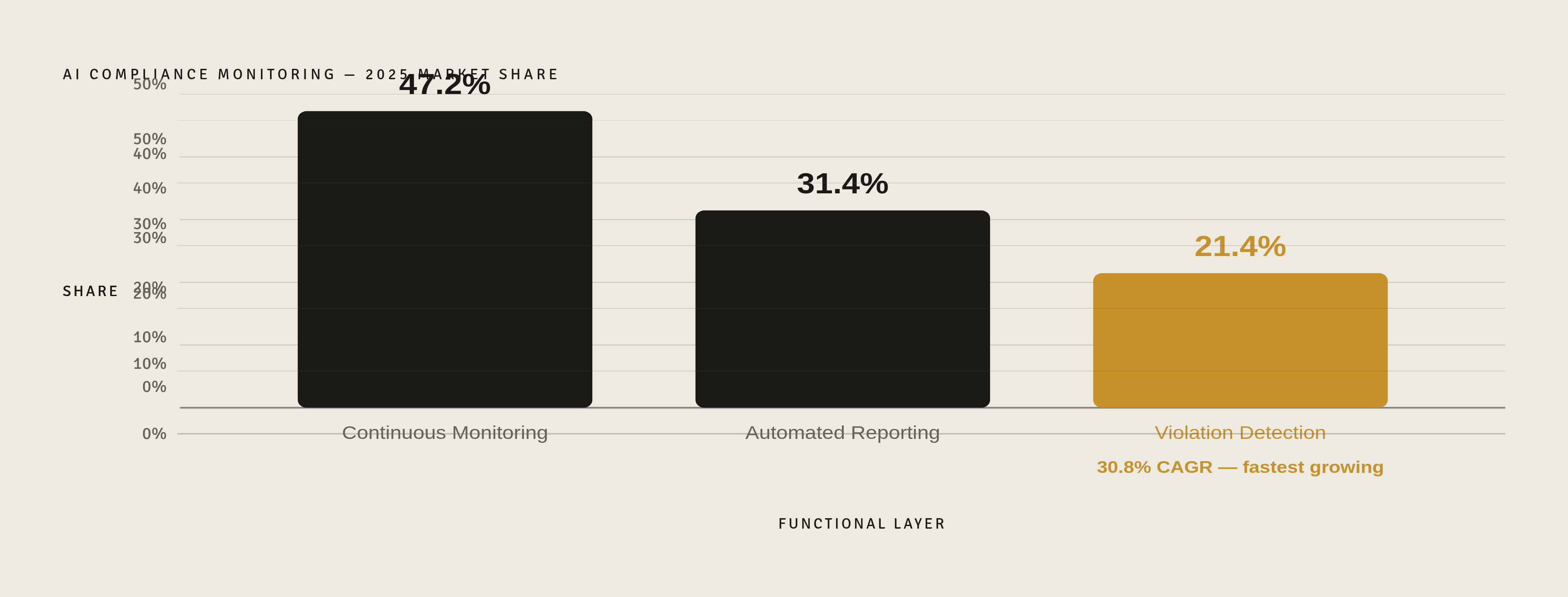
Cut through the sales decks and AI compliance tools really only do three jobs, even when a vendor bundles all three and calls it a platform.
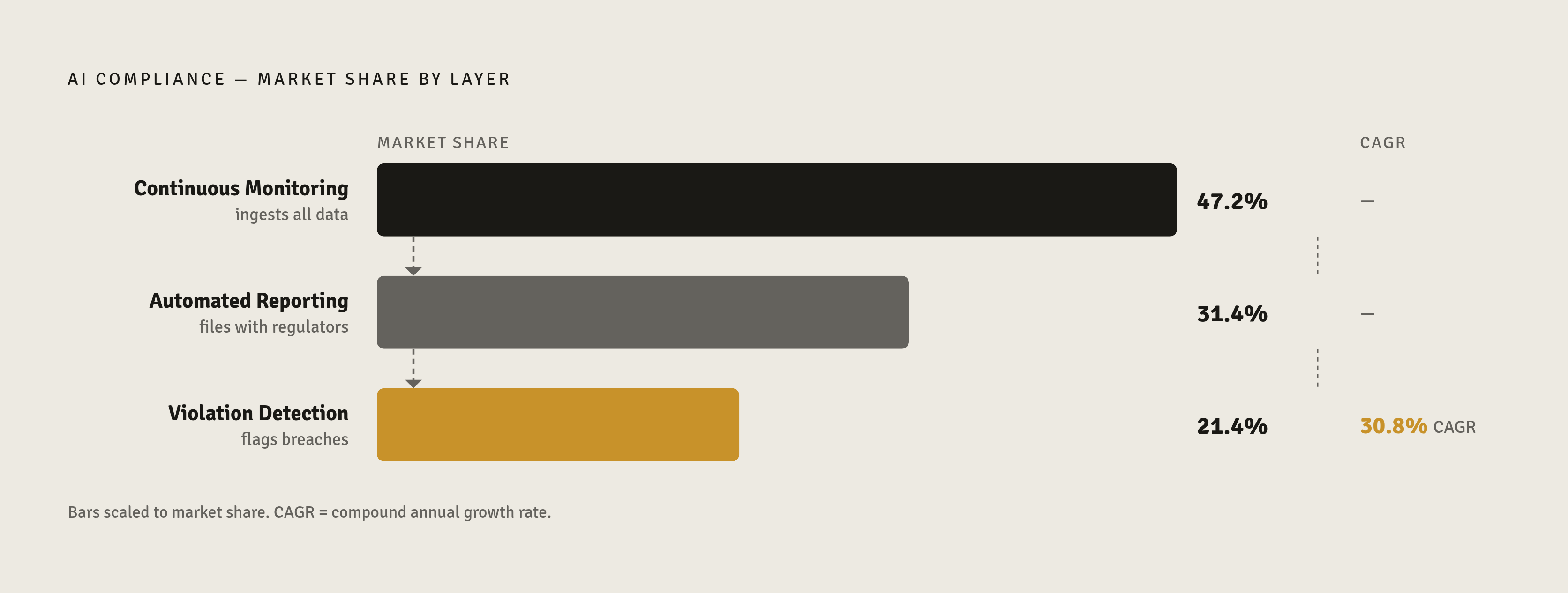
Continuous monitoring is the biggest segment by share, 47.2% in 2025. It's the always-on layer, the one taking in transactions, communications, documents, and access logs as they happen instead of after the fact. Automated reporting comes next at 31.4%, the layer that formats and files compliance data for regulators or internal review boards, so nobody's building a spreadsheet by hand at 11pm the night before a deadline. Violation detection sits at just 21.4% of the market, the smallest piece, but it's growing fastest, at roughly 30.8% CAGR. That's the pattern-recognition layer, the one that flags "this looks wrong."
These aren't three separate products sitting side by side on a shelf. Detection needs monitoring to hand it data; reporting needs detection to know what's worth writing up. Wire them together and the value compounds instead of just adding up. A compliance leader who buys "AI compliance software" without asking which of these three layers they're actually getting is buying a black box, and vendors have every incentive to keep it that way through the sales call.
What continuous monitoring looks like in financial services, where deployment is furthest along
Financial crime costs the global economy up to $2 trillion a year, according to the UN Office on Drugs and Crime. That number alone explains why this industry moved first and moved hardest while everyone else was still running quarterly reviews.
The old system drowned in its own alerts. Rule-based transaction monitoring throws false positives at a rate between 90% and 95%, meaning investigators spend most of the day chasing shadows instead of catching anything real. Alert fatigue isn't a minor headache in anti-money-laundering work; it's the main bottleneck, the thing that lets actual bad actors slip through, because the person reviewing the ninety-ninth false alert of the day has stopped paying close attention to any of them.
AI shifts that math, though the reported gains vary enough to make you want to check the fine print. Vendor studies claim detecting 70% to 90% more suspicious activity while cutting false positives by up to 90%. More conservative, independently cited figures land closer to a 40% drop in false positives from predictive scoring models. One case worth naming exactly because it's specific: a multinational bank ran daily alerts at a 98% false positive rate before deploying AI risk scoring. Afterward, false positives dropped 45% and investigative time fell 60%.
Perpetual KYC, or pKYC, sits underneath most of this. Customer risk used to get checked once, at onboarding, then filed away like an ID photo that never expires. pKYC treats risk as something alive, updated all the time, flagging the moment something material shifts: a sudden spike in cross-border transfers, a change in beneficial ownership, the kind of thing an annual review would catch eight months too late to matter. Trade surveillance runs on similar logic, scanning millions of daily transactions for manipulation, insider trading, and spoofing at a scale no team of human reviewers could match on their own.
Adoption backs this up. A 2023 PwC survey found 62% of financial institutions already used AI or machine learning for AML work, with that number expected to hit 90% by 2025. Financial services became the proving ground because the false-positive problem got bad enough that doing nothing stopped being an option.
They all point the same direction, and they're all speeding up.
How healthcare compliance uses AI differently — risk is document-level, not transaction-level
Healthcare's core problem is paperwork, and that changes what the AI actually watches.
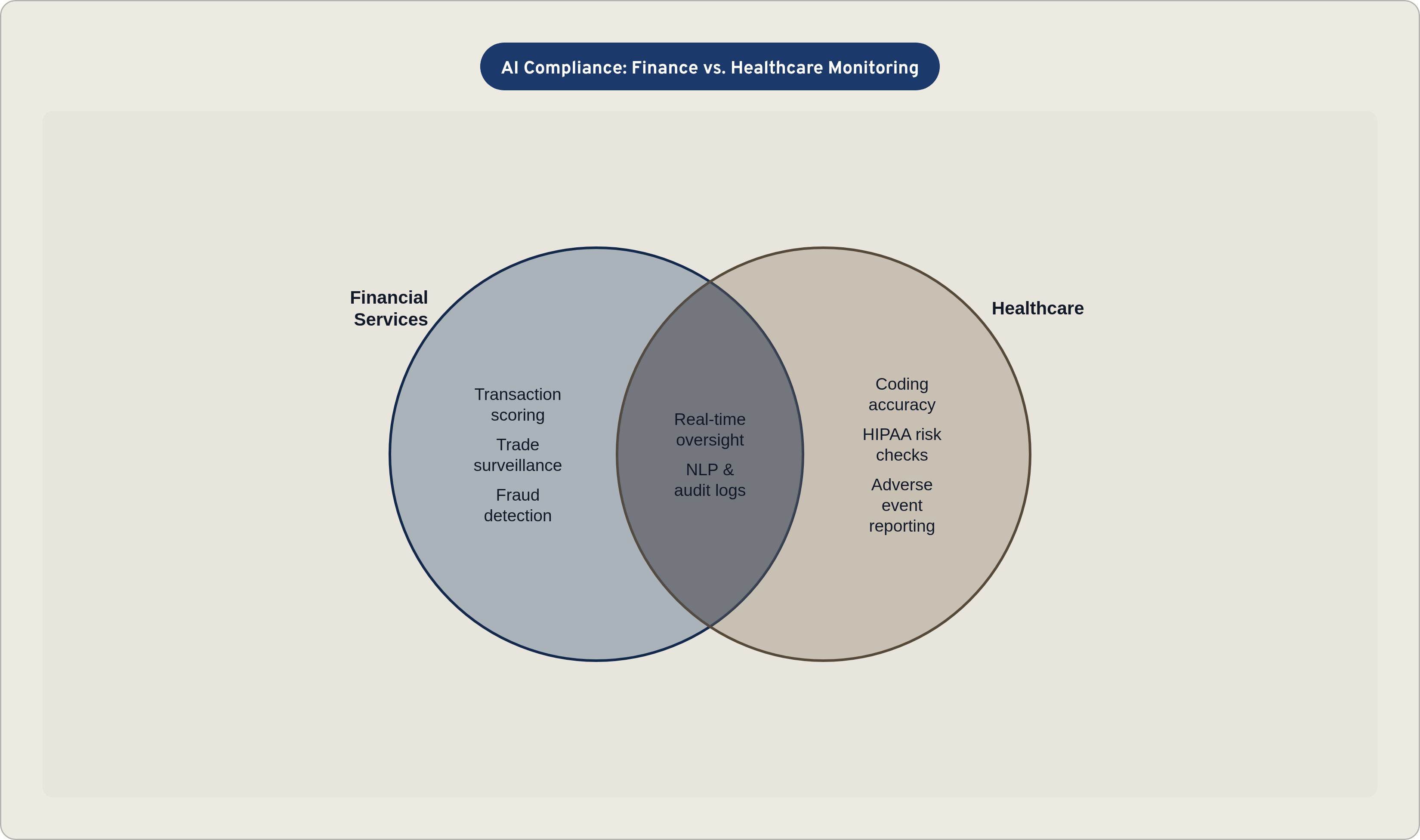
Where finance tracks money moving, healthcare compliance AI tracks documents getting written and data getting accessed. The core uses: real-time monitoring of clinical documentation for coding accuracy, automated HIPAA risk assessments that trigger the moment a new vendor or system enters the environment, and AI-driven adverse event surveillance feeding pharmacovigilance reports to the FDA.
The math here is blunt. HIPAA violation settlements averaged $2.1 million per incident in 2024. At that price, automated PHI monitoring and breach detection stop looking like a nice-to-have IT upgrade and start looking like insurance you'd be foolish to skip. Tools emerging in this space that check patient data against privacy rules in real time are a decent snapshot of where this category is headed: constant checking that the paperwork matches the rulebook, a different animal from fraud detection in the financial sense.
Hold that against the finance section above and the contrast makes the point for you. The AI here reads documents and audits access logs rather than scoring numeric transaction patterns. Natural language processing does the heavy lifting in healthcare the way anomaly detection does in banking. Same basic idea, continuous machine oversight replacing periodic human review, aimed at a completely different kind of risk.
The technology stack underneath: NLP, anomaly detection, predictive scoring, and where multi-agent systems fit
Set the marketing language aside and three technologies do most of the actual work, based on what enterprise buyers say they value most in 2025 surveys.
Natural language processing reads regulatory text, flags policy changes, and pulls specific obligations out of dense filings. It's increasingly turned loose on voice calls, emails, and chat logs for communications surveillance too. Anomaly detection is the statistical workhorse: model what normal looks like, flag whatever strays from it, and you've got the engine behind most transaction monitoring and access log review. Predictive risk scoring goes further, assigning dynamic risk levels to customers, counterparties, or employees based on behavior that shifts over time, instead of a static rulebook written five years ago and never revisited since.
What's newer is the shift toward multi-agent systems. One AI model, no matter how well-trained, struggles with the layered reasoning compliance work demands: is this transaction unusual for this customer, in this jurisdiction, given a regulatory change that took effect last month? Multi-agent setups split that reasoning across specialized models coordinating with each other, rather than asking one model to hold everything in its head at once. Industry observers increasingly flag this as one of the more promising architectural directions for compliance work specifically.
Generative AI adds something genuinely new: automated summaries of surveillance footage, search across archives, narrative report drafts instead of someone typing from scratch. Yet it drags along a governance headache classical machine learning didn't carry nearly as badly. A bounded model that spits out a risk score between zero and a hundred is fairly easy to check. A large language model produces open-ended text that's much harder to audit for bias, accuracy, or whether it's quietly breaking some rule nobody thought to test for. The more realistic pattern emerging across the industry is generative AI bolted onto infrastructure that already exists, not ripped out and rebuilt from scratch.
What the regulatory frameworks require from AI compliance systems themselves
Here's a wrinkle a lot of compliance teams miss: the AI tool itself is now a regulated object, not just a helper sitting quietly behind the compliance program.
The EU AI Act rolls out in stages. The regulation rolls out in stages, with different provisions taking effect on a phased schedule across 2025 and beyond. That's its own lesson about planning around regulation that isn't finished being written yet.
Financial regulators agree on the broad shape of this while disagreeing on the details. The EU's MAR and MiFID II require AI and human oversight together, each supporting rather than replacing the other. In the US, the SEC, FINRA, and CFTC focus heavily on spoofing and layering detection, and on whether the surveillance tech is actually up to the job; the SEC has made clear through its own organizational moves that it is watching AI surveillance capabilities closely. Across APAC, regulators including MAS, ASIC, and Hong Kong's SFC push AI adoption but demand model validation and governance logs as the price of entry.
One number says a lot about what buyers actually care about: the governance, risk, and compliance segment held 45% of the AI-for-security-compliance market in 2025, the largest share of any segment. Audit trails and paper trails drive that purchase decision more than raw detection accuracy does. Buyers want something they can hand a regulator, not a tool that happens to catch more bad actors on the side.
Regulators aren't just writing rules anymore; they're running AI of their own. Supervisory technology, or SupTech, means regulators increasingly read submissions and flag misconduct algorithmically, close to real time. A model probably reads the filing before, or instead of, a person ever does. Then there's the EU's Digital Operational Resilience Act, where Under DORA, major cloud and technology vendors serving European financial institutions are subject to direct regulatory oversight as critical ICT third-party providers. Any compliance program built on top of those vendors now has a direct regulatory relationship to manage, whether it asked for one or not.
Where human judgment still belongs in an AI-monitored compliance program
If AI handles the volume and the pattern-matching, what's left for the people? Quite a bit, actually.
AI is fast and never gets tired of spotting statistical outliers across millions of records. What it struggles with, at least for now, is weighing context the way a seasoned investigator does. Is this pattern unusual because of fraud, or because the client just closed a business sale and the money is moving for a dull, entirely legal reason? That judgment call, the decision to escalate, the phone call with a regulator, still belongs to a person sitting at a desk somewhere, coffee going cold, reading the same transaction three times before signing off.
Run the math from the financial services section again. A 45% cut in false positives sounds like a win, and it is one, but an institution generating that much alert volume in the first place still ends up with plenty left over even after the cut. How those remaining alerts get triaged, routed, and reviewed matters just as much as the model that flagged them in the first place.
Explainability isn't a line item on a spec sheet. It's what an investigator needs to act on an alert at all, and to defend that action later when a regulator asks why. That's also, not by coincidence, why multi-agent systems are gaining ground: a single model without the range to reason the way compliance work demands has the same blind spot human reviewers exist to patch.
None of this is a one-time install, either. AI compliance models need ongoing checking, watching for drift as behavior patterns change, and retraining as regulations and criminal methods evolve alongside each other. Treating deployment as a finished project instead of a recurring cost is probably the single most common mistake compliance leaders make here.
A few plain questions are worth asking before the next budget cycle locks in. Which layer, monitoring, reporting, or detection, carries the heaviest manual load right now? Which vendors produce outputs you can actually check line by line, and whose governance model satisfies the regulator watching your jurisdiction? Are the human review workflows built around what the AI actually produces, or just running alongside it, quietly canceling out the speed you paid for in the first place?
There's one more worth sitting with, longer than the rest: is your team ready for the AI itself to get audited, not just the compliance program it's supposed to be watching?
Notes
- https://virtuemarketresearch.com/report/global-ai-compliance-monitoring-market
Provided the 2024 market value, 2030 forecast, and 19.4% CAGR figure for AI compliance monitoring defined narrowly.
- https://www.precedenceresearch.com/ai-for-security-compliance-market
Provided the 32% financial services sector share, 64% cloud deployment share, and the 45% false positive reduction figure from the multinational bank case study.
- https://www.technavio.com/report/ai-for-security-compliance-market-industry-analysis
Provided the 32.6% North America incremental growth share figure.
- https://www.fortunebusinessinsights.com/ai-in-surveillance-market-109303
Provided the AI-in-surveillance market figures of $6.26 billion in 2025 growing to $26.90 billion by 2034 at 18.2% CAGR.
- https://marketintelo.com/report/ai-native-regulatory-compliance-automation-software-market
Provided the three-layer market share breakdown: continuous monitoring at 47.2%, automated reporting at 31.4%, and violation detection at 21.4% with 30.8% CAGR.
- https://dataintelo.com/report/compliance-automation-ai-market
Provided the compliance automation market figures of $6.8 billion in 2025 climbing to $28.4 billion by 2034 at 17.2% CAGR, and the $2.1 million average HIPAA violation settlement figure.