Long read Compliance Technology
Cybersecurity Compliance Tools for NIST and ISO 27001
A single tool bridges NIST and ISO 27001 compliance mapping.
This piece is about a single, boring, expensive problem: NIST CSF 2.0 and ISO 27001:2022 overlap in places, diverge in others, and most organizations are trying to satisfy both at once without a clean way to reconcile them. The right compliance tooling closes that gap by mapping controls across frameworks, automating evidence collection, and turning what used to be a spreadsheet nightmare into something closer to a live dashboard. That's the whole argument, and everything below is just showing the work.
Start with the math, because the math is what makes this worth reading past paragraph one. IBM's 2025 Cost of a Data Breach report put the average U.S. breach at $10.22 million, with the global average landing at $4.44 million. Compliance programs, by contrast, tend to run in the tens of thousands to low hundreds of thousands per year depending on scope and headcount. That gap is the whole ROI case in one sentence: you're either paying a little now or a lot later, and the "later" bill comes with lawyers attached.
Third-party risk is making the "later" scenario more likely, too. Verizon's 2025 Data Breach Investigations Report tied roughly 30% of breaches to third parties, which is double the prior year's share. Supply chain coverage carries real weight in a compliance program now, and the regulatory pressure comes from multiple directions at once. Federal contractors have to align with NIST under a stack of executive orders (13800, 14028, and 14144), while ISO 27001 has quietly become table stakes for enterprise buyers, insurers, and overseas partners who won't sign a contract without it. Most mid-size companies feel both pulls simultaneously, which is exactly why doing this manually stops making sense somewhere around your second framework.
What NIST CSF 2.0 actually requires and who it applies to
NIST published CSF 2.0 in 2024, and the headline change is who it's for. The original framework was built with critical infrastructure in mind; the 2.0 revision drops that boundary and explicitly addresses organizations of any size, in any sector. If you run a 12-person SaaS company, NIST is now talking to you too, whether you asked it to or not.
The framework organizes around six core functions: Govern, Identify, Protect, Detect, Respond, Recover. Govern is the new one, and it's not a footnote. It carries 37 subcategories covering risk strategy, roles and responsibilities, policy, oversight, and supply chain risk management, and it sits at the center of the model rather than at the edges. It's the function that gives the other five their marching orders. Underneath Govern, the full framework breaks down into 22 categories and 106 subcategories total, and that level of granularity is exactly why nobody sane tries to track this in a spreadsheet anymore.
Who actually has to comply depends on which side of the public-private line you're on. Federal agencies are required to follow it under EO 13800, extended further by EO 14028 and EO 14144. Private companies aren't legally bound, but adoption has become the norm rather than the exception; a 2025 report from Cyber Security Tribe found 68% of cybersecurity practitioners named CSF 2.0 the most valuable framework to their organization. Financial services has moved fastest, with roughly 81% of U.S. institutions reporting partial or full NIST CSF adoption in 2024. Small business adoption jumped from 29% in 2023 to 42% by 2025, which tells you this isn't just a large-enterprise phenomenon anymore.
One more wrinkle worth flagging: NIST released a draft Cyber AI Profile in December 2025, layered on top of CSF 2.0 to deal with AI-specific risk. The target keeps moving, and any tool you pick needs to be built by a vendor that's actually going to keep up with that, rather than one that shipped a CSF 2.0 mapping in 2024 and called it done.
What ISO 27001:2022 requires and how it differs in structure from NIST CSF
Here's where the two frameworks stop rhyming. NIST CSF is advisory: you align to it, you get audited internally if you want to, but nobody hands you a certificate. ISO 27001 is certification-based. You build an Information Security Management System (ISMS), an independent auditor comes in and checks it, and you either pass or you don't. That's a fundamentally different relationship to compliance, and it changes what "done" looks like.
The 2022 revision reshuffled the furniture pretty significantly. Controls dropped from 114 to 93 through consolidation, with 11 new controls added to address things like threat intelligence and data masking. Those controls now sit under four Annex A themes: organizational, people, physical, and technological. And if you're wondering whether you're on the old version or the new one, the transition deadline closed on October 31, 2025 under IAF MD 26. Any valid ISO 27001 certificate in circulation today is against the 2022 revision, full stop.
Adoption numbers back up how mainstream this has become. The ISO Survey 2024 recorded 96,709 valid certificates across 179,877 sites, up from 48,671 certificates in the 2023 survey. Worth a caveat: part of that near-doubling reflects the first use of the IAF CertSearch database rather than a pure surge in new certifications, so treat the growth rate with a little skepticism even as the overall scale stays impressive.
The deeper structural point is this: ISO 27001 asks for continuous upkeep. It demands documented policies, risk treatment plans, internal audits, management reviews, and corrective actions on an ongoing basis. NIST CSF gives you outcomes to aim for. ISO 27001 gives you a management system you have to keep running on an ongoing basis, with no fixed end date.
Where NIST CSF 2.0 and ISO 27001 overlap and where they diverge
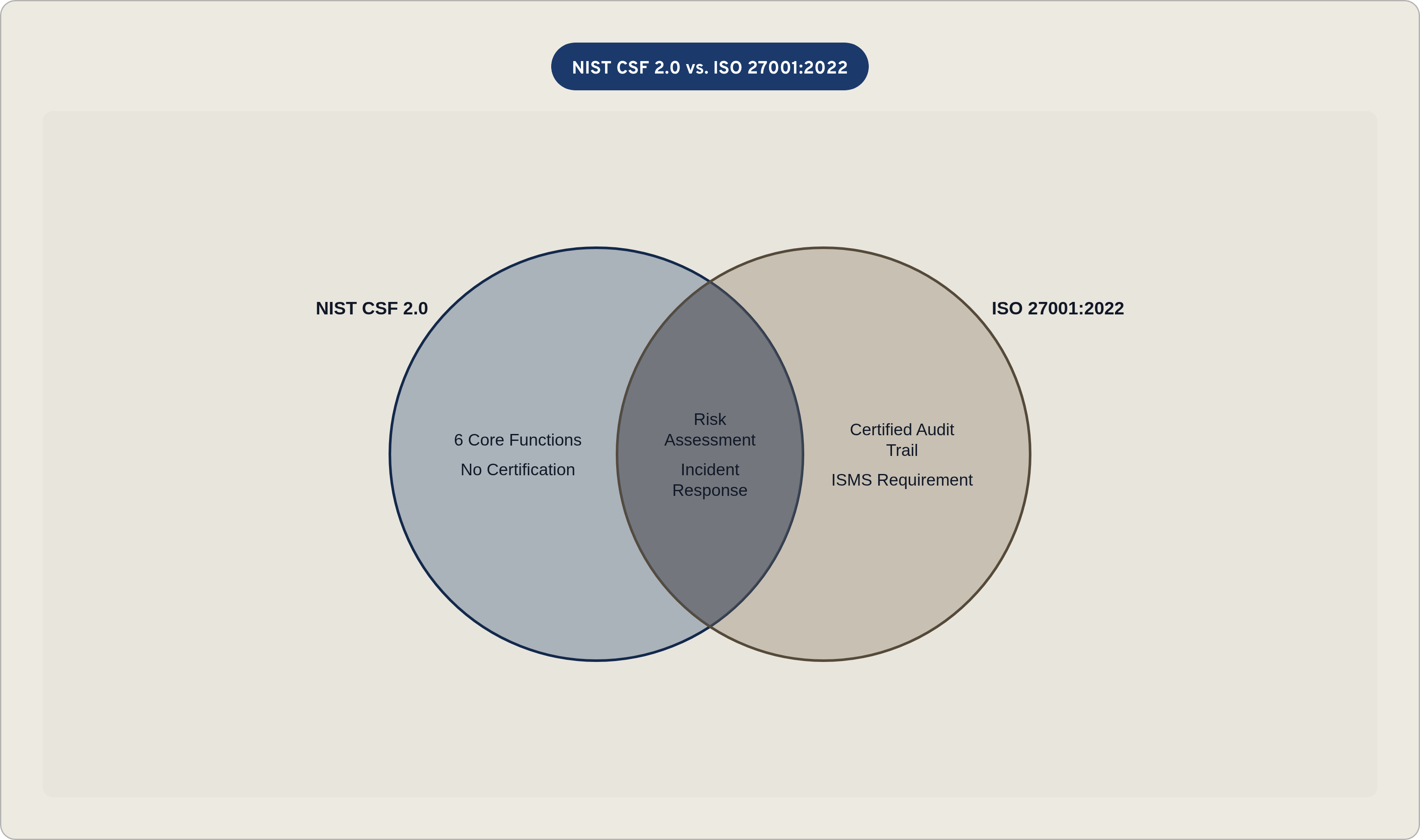
The good news first: there's real overlap. Both frameworks touch risk assessment, access control, incident response, supplier relationships, and business continuity. Where the overlap is clean, a single well-documented control can satisfy both frameworks at once, and that's the entire efficiency argument for buying a tool that maps across them instead of running two separate programs side by side.
Where they diverge, the divergence is structural, not cosmetic. NIST uses implementation tiers and profiles to describe maturity and prioritize what to fix first. ISO 27001 uses a Statement of Applicability and a formal risk treatment process to document which controls you're applying and why. Those are two different languages for talking about roughly the same problem. ISO also demands a certified audit trail; NIST doesn't require external certification at all. And on supply chain risk specifically, NIST's Govern function gets granular with explicit subcategories, while ISO 27001 covers supplier relationships in Annex A with less specificity.
What happens when organizations ignore this and run both programs manually? They end up building two of everything: two evidence collections, two risk registers, two policy libraries, often maintained by two different people who don't talk to each other as often as they should. That's an organizational-design problem, and it's exactly the kind of duplicated effort good tooling is supposed to eliminate.
No platform on the market resolves every one of these divergences natively; anyone who tells you otherwise is selling something. The next few sections look at how close different categories of tools actually get.
The core capabilities compliance tools must deliver to handle both frameworks
Four things matter here, and if a vendor's pitch deck doesn't cover all four, keep asking questions.
Control mapping across frameworks comes first. A tool needs to show, for every control, exactly which NIST subcategories and which ISO 27001 Annex A controls it satisfies. Without that mapping, you're collecting the same evidence twice under two different names, which is busywork dressed up as diligence. Pre-built crosswalks between CSF 2.0 and ISO 27001:2022 have become close to standard in the leading platforms, so this isn't an exotic ask anymore.
Automated evidence collection is the second piece, and it's the one that separates a modern compliance program from the old audit-week fire drill. The shift from scrambling to pull screenshots before an auditor shows up to knowing your control status in real time is probably the single biggest gap in the market right now. API integrations with your cloud infrastructure, identity provider, code repos, and ticketing system mean controls get checked against what's actually running in production, rather than against what someone typed into a form three months ago.
Continuous Control Monitoring builds on that by catching control failures and configuration drift before they show up as audit findings. This turns ISO 27001 from a once-a-year fire drill into something closer to an actual ongoing security program, which, in fairness, was the point all along.
Then there's the risk register and treatment workflow. ISO 27001 wants documented risk treatment decisions; NIST frames the same underlying risk through implementation tiers. A tool needs to hold one dataset and let you view it both ways, because your risk data shouldn't have to live in two systems just because two frameworks describe it differently. Round it out with audit readiness: automated evidence packages, policy libraries, and gap reports that an external auditor can actually use. PwC's Global Compliance Survey 2025 found 64% of executives saying compliance technology improves risk visibility, and these four capabilities are basically how that improvement shows up in practice.
Verizon's 2025 Data Breach Investigations Report tied roughly 30% of breaches to third parties, which is double the prior year's share.
Compliance automation platforms built for cloud-first and SMB environments
This tier is for companies chasing a specific outcome on a specific timeline: get ISO 27001 certified, or get aligned to NIST CSF, usually because a sales deal or an insurance renewal is holding it hostage. Infrastructure is cloud-native, the security team is small, and speed matters more than governance depth.
Vanta is probably the name you've heard most. It ships over 400 integrations and support for 35-plus frameworks, NIST CSF and ISO 27001 included, and its Vanta AI Agent handles policy management, evidence review, and security questionnaire responses without a human clicking through each one. IDC named it a MarketScape Leader in 2025, and the market perception matches: broad, fast, well-integrated. Where it thins out is governance depth. Policy lifecycle management, risk quantification, and third-party risk workflows are lighter here than what you'd get from an enterprise GRC platform.
Drata's pitch is Continuous Control Monitoring, and it backs that up with volume: more than 1,200 automated hourly tests running across frameworks, pulling evidence from upward of 170 integrations that include AWS, GitHub, Okta, Jira, and Google Workspace. When a control fails, you find out immediately, not at the next quarterly review. That immediacy makes it a natural fit for engineering-heavy teams that already live inside a toolchain and want compliance sitting inside it too, rather than bolted on as a separate chore.
Sprinto takes an AI-native approach built specifically for cloud-first teams, validating controls and surfacing drift and gaps in real time. It's positioned less as a one-time certification sprint and more as ongoing maintenance with ISO 27001 certification as the first milestone, not the finish line.
The shared limitation across this whole tier: audit trail depth, policy lifecycle management, and third-party risk workflows don't run as deep as what enterprise platforms offer. If your vendor ecosystem is small and your governance needs are straightforward, that's fine. If you're managing dozens of vendor risk assessments or need board-level risk quantification, you'll outgrow this tier, and probably faster than you'd expect.
Enterprise GRC platforms that handle governance depth alongside compliance
This tier serves a different problem: large enterprises, regulated industries, and organizations juggling multiple frameworks at once where certification is just one piece of a much bigger governance puzzle.
ServiceNow GRC folds compliance into the broader ServiceNow ecosystem, which is a real advantage if IT, security, and risk are already running on ServiceNow workflows; you're extending a system you already trust. It bundles risk quantification, policy management, audit workflow orchestration, and regulatory change tracking into one place. OneTrust goes wider still, covering privacy and third-party risk and ethics alongside cybersecurity compliance, which makes it a natural fit for multinationals juggling GDPR, NIST, and ISO all at the same time.
AuditBoard leans into audit management and cross-functional risk workflows, built for internal audit teams that need tight coordination with security and compliance rather than a separate silo. LogicGate takes a more configurable approach: it's a flexible risk management platform where you build your own control framework and map it to NIST and ISO 27001 on your own terms, instead of being boxed into a vendor's predefined structure. And Hyperproof is built specifically for compliance operations teams running multiple frameworks simultaneously, with particular strength in evidence management and control-to-requirement mapping across both CSF 2.0 and ISO 27001:2022.
None of this comes cheap or comes fast. Implementation complexity is higher, time-to-value stretches out longer, and licensing costs climb accordingly. But for organizations where governance and risk quantification and third-party oversight matter as much as the certificate on the wall, that tradeoff is the right one. It's worth noting the BFSI sector dominated GRC spend in 2025 at roughly 34% of revenue, which tracks: financial services is exactly where governance depth stops being optional.
How to match your organization's profile to the right tool tier
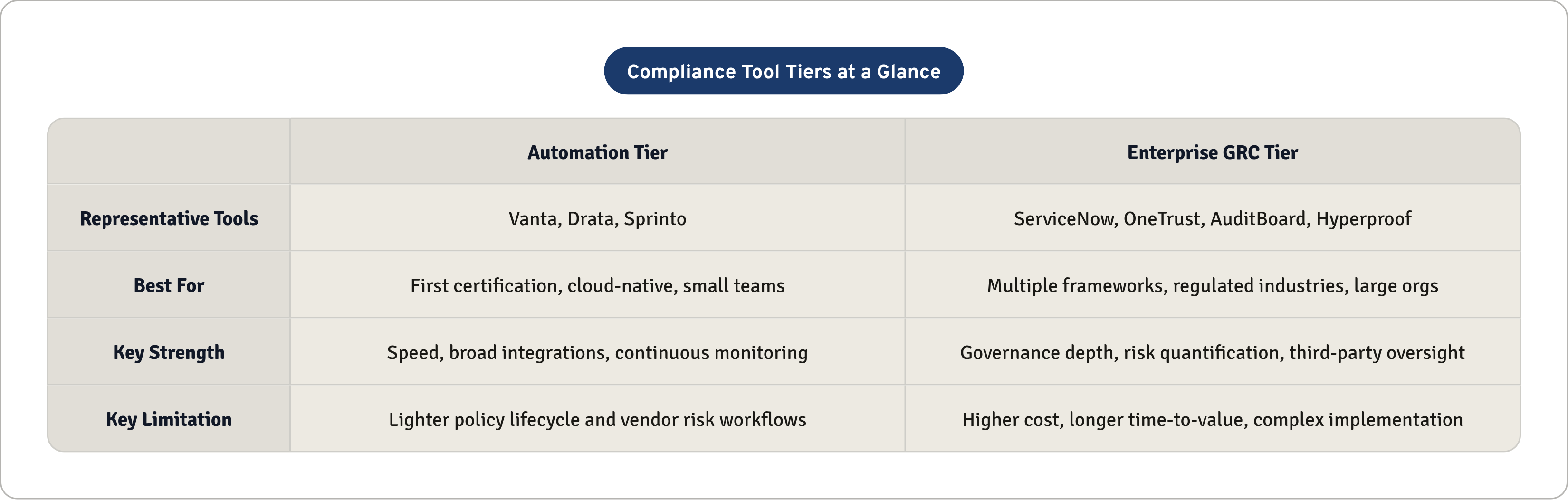
Choosing by feature checklist or analyst quadrant, without first being honest about your own size and maturity, is how companies end up paying enterprise prices for problems they don't have yet.
A few signals point toward the automation tier (Vanta, Drata, Sprinto). Is this your first ISO 27001 certification or your first real NIST alignment effort? Is your infrastructure mostly cloud-native, sitting in SaaS tools with APIs already exposed? Is your security or compliance team small, where manual evidence collection would eat a disproportionate share of someone's week? Does a sales contract or insurance underwriting deadline mean speed matters more than exhaustive governance? If most of those are yes, start there.
The enterprise GRC signals look different. Are you managing multiple concurrent frameworks beyond just NIST and ISO, things like SOC 2, FedRAMP, HIPAA, or GDPR? Does third-party risk management operate at real scale, with vendor assessments and supplier risk registers and fourth-party exposure to track? Does your internal audit function need to coordinate closely with security and compliance rather than work around them? Is risk quantification something your board actually asks for, not just something that would be nice to show them? That's the enterprise-tier profile.
Deployment mode is a smaller but still useful filter. Cloud deployment captured 62.90% of the GRC software market in 2025 and is the default choice for most buyers; on-premise survives mostly in regulated industries with data residency requirements that leave no other option. And on the size question, large enterprises controlled 69.60% of 2025 GRC revenue, but SMEs are growing faster, with a forecast CAGR of 13.02% through 2031. The SMB-focused tools exist because that growth is real, not because vendors invented a market that wasn't there.
Before you sign anything, ask the vendor a few pointed questions. Does the platform ship a pre-built CSF 2.0 to ISO 27001:2022 crosswalk, or will your team be building that mapping by hand? How is evidence actually collected: continuous via API, agent-based, or manual upload dressed up with a nicer interface? What does the final audit package look like, and has your target certification body actually accepted it before? And what's the integration footprint against your existing SIEM, ticketing, and identity stack? Vague answers to any of these are a tell.
What implementation actually looks like and where compliance programs break down
Here's the part vendors don't put on the homepage: the tool is not the program. Buying Drata doesn't make you compliant. It's an amplifier that makes good things louder and bad things louder too.
Programs break down in a few predictable places. The first is ownership. Someone has to actually own control implementation, rather than just monitor a dashboard that flags when things drift. Automated evidence collection tells you a control failed; it doesn't fix the IAM policy that let it fail in the first place. The second is scope creep disguised as thoroughness: teams try to map every NIST subcategory to every ISO Annex A control on day one, instead of starting with the overlap (access control, incident response, risk assessment) where a single mapped control actually saves work, and building out from there.
The third failure mode is treating certification as the finish line. ISO 27001 explicitly requires ongoing management reviews and corrective actions; NIST's Govern function assumes continuous oversight, not a one-time gap assessment. Organizations that pass their first audit and then let the tool run on autopilot usually find drift creeping back in within a couple quarters, and drift is exactly what surveillance audits are designed to catch.
None of this is a knock on the tools themselves, which genuinely do collapse hundreds of hours of manual evidence gathering into something a small team can manage. The tool maps the terrain, but somebody still has to walk the path: fix the misconfigured S3 bucket, retrain the team that keeps clicking phishing links, and show up for the management review nobody wants to schedule. Software gets you visibility, but the rest is still, stubbornly, a people problem.
Notes
- https://optro.ai/blog/iso-27001-software-tools
Provided the statistic that 64% of executives say compliance technology improves risk visibility, cited from PwC's Global Compliance Survey 2025.
- https://www.isms.online/nist/
Provided the count of 37 subcategories within the Govern function of NIST CSF 2.0.
- https://www.mordorintelligence.com/industry-reports/governance-risk-and-compliance-software-market
Provided GRC market share figures including cloud deployment at 62.90%, large enterprise revenue share at 69.60%, and SME CAGR of 13.02% through 2031.