Internal Audit Report Structure and Components

The IIA's 2024 Global Internal Audit Standards, the GIAS, replaced the 2017 framework, and organizations were expected to implement by January 9, 2025. The architecture reorganized into five domains, fifteen principles, and detailed implementation standards. Cleaner than what came before, but the real shift is in what the standards now demand explicitly.
Standard 2420 on Quality of Communications requires that audit communications be accurate, objective, clear, concise, constructive, complete, and timely. Content and detail level are determined by audience need, not habit. Standard 2440 requires the CAE to communicate findings to parties with direct responsibility and the authority to act. Sending a report to everyone as a hedge is not compliance with that standard; it is a workaround that dilutes accountability.
Standard 14.3 requires a formal mechanism for assigning significance and prioritizing findings. Standard 14.5 requires engagement conclusions tied directly to organizational goals. These are implementation requirements, not aspirational language, and the distinction matters in practice when findings get disputed.
Follow-up is where most audit functions quietly fail the standards. Standard 15.2 requires auditors to confirm that recommendations have been implemented, track progress at appropriate intervals, and update a tracking system using a risk-based approach. That standard is mandatory and the one most commonly treated as optional, which is exactly why so many findings recur.
Two other things from the 2024 standards are worth flagging. The first: topical requirements for cybersecurity, third-party risk, and AI must be reflected in audit programs covering those domains, with the Cybersecurity Topical Requirement taking effect February 2026. The second: the standards now use "conclusion" rather than "opinion." That is not cosmetic. It is a deliberate move away from subjective connotation, and it carries weight when management pushes back on findings.
How the report's opening sections establish credibility before a finding is read
Before a reader hits the first finding, the report has already either earned their trust or started spending it. The opening sections answer one question: why should what follows be believed?
The title page establishes the formality the rest of the document has to sustain. The distribution list signals who owns the findings and who carries authority to act on them. The CAE should set distribution guidelines in coordination with the board and senior management, because executives and operational managers need different things from the same report. Executives want to know what matters and what action is required. Process owners need the evidentiary detail behind findings and recommendations. Getting the distribution wrong, or sending a single version to everyone, is a failure of audience judgment before the content even lands.
The background section provides context about the audited entity: its size, complexity, and key operational features. If a reader has to stop and ask what this department actually does before interpreting a finding, the report has already lost the thread. That context is not optional preamble; it is the frame that makes everything downstream readable.
Scope and objectives confirm what was examined and, crucially, what was not. Boundaries are established in the engagement letter before fieldwork begins, and a discrete section on both is required under GIAS Standards 14 and 15. The methodology section follows, brief but essential, explaining how evidence was gathered and referencing the specific criteria findings are measured against. Without it, readers have no basis for assessing the evidentiary foundation of what comes next.
These sections function as a credibility preamble. Abbreviate them carelessly, let them drift into boilerplate, and every finding that follows starts at a deficit.
The executive summary as the report's most consequential page
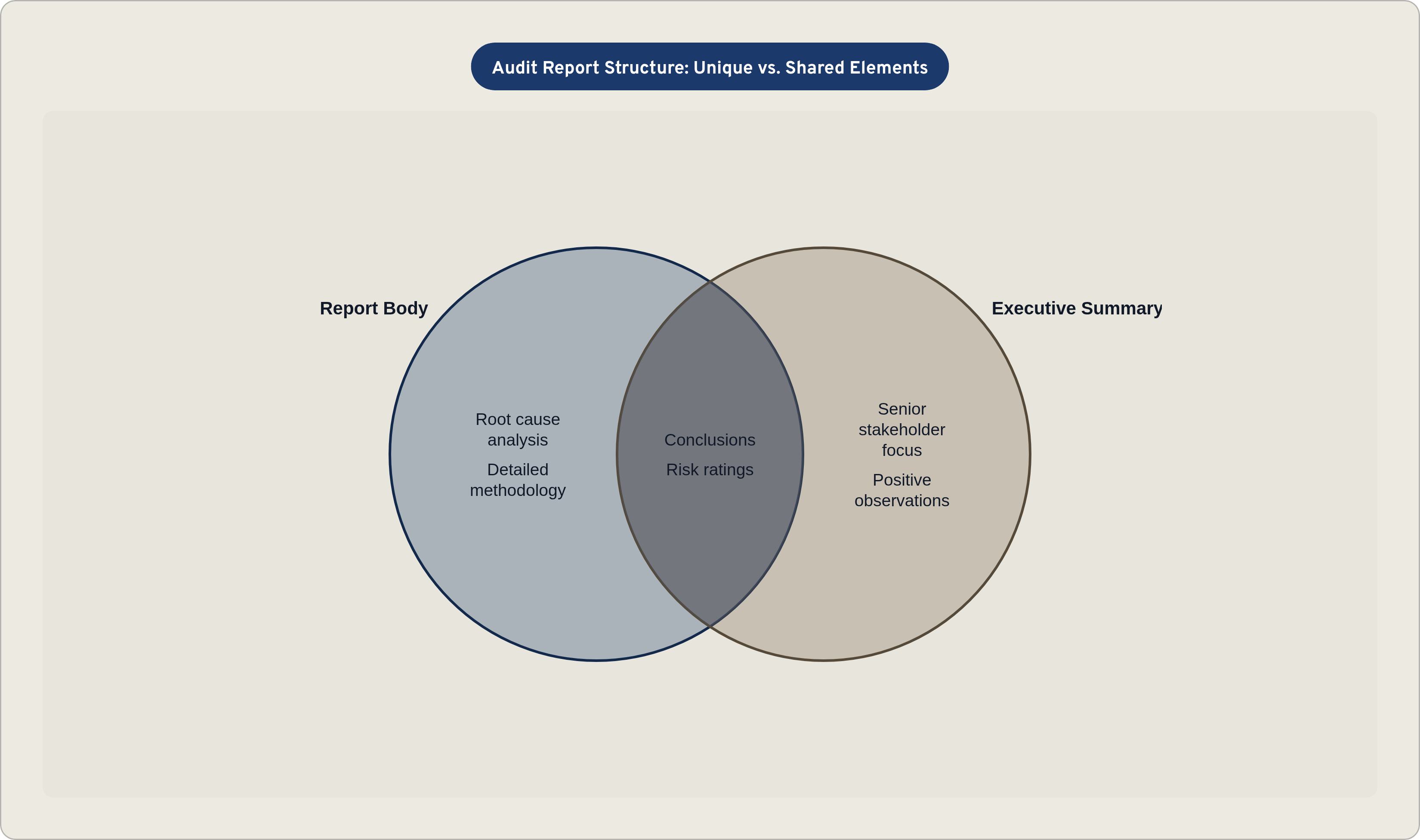
The executive summary is the most read section of the report. For most senior stakeholders, it is the only section they read, which makes it the most consequential page in the document and, reliably, the one written with the least care.
It must cover the audit's introduction, objectives, and scope; the engagement results; conclusions for the audited activity; and a summary of significant observations. Detailed methodology and technical jargon belong in the body. The summary is written for people with competing priorities and limited time, and it needs to deliver a complete picture without demanding expertise or patience.
What gets omitted from executive summaries is precisely what deserves the most prominent placement: conflicts with management over corrective actions or deadlines, and situations where the CAE has concluded that management has accepted residual risk the CAE considers unacceptable to the organization. If that judgment is buried in the body of the report or absent from the summary entirely, it will not reach the board. A former IIA CEO has spoken about the practical value of clear communication in executive roles, specifically the ability to determine at a glance which audit reports require immediate attention. The executive summary is where that determination gets made or missed.
Positive observations belong here too. Good practices observed during the engagement and meaningful improvements management has already implemented should be documented, not to soften criticism but because an accurate picture is complete. A summary that only surfaces problems is as incomplete as one that ignores them.
Length is not the measure of quality. The right level of detail is whatever allows the reader to determine whether the audit objective was met and what requires action.
How the five-attribute model structures every finding worth reading
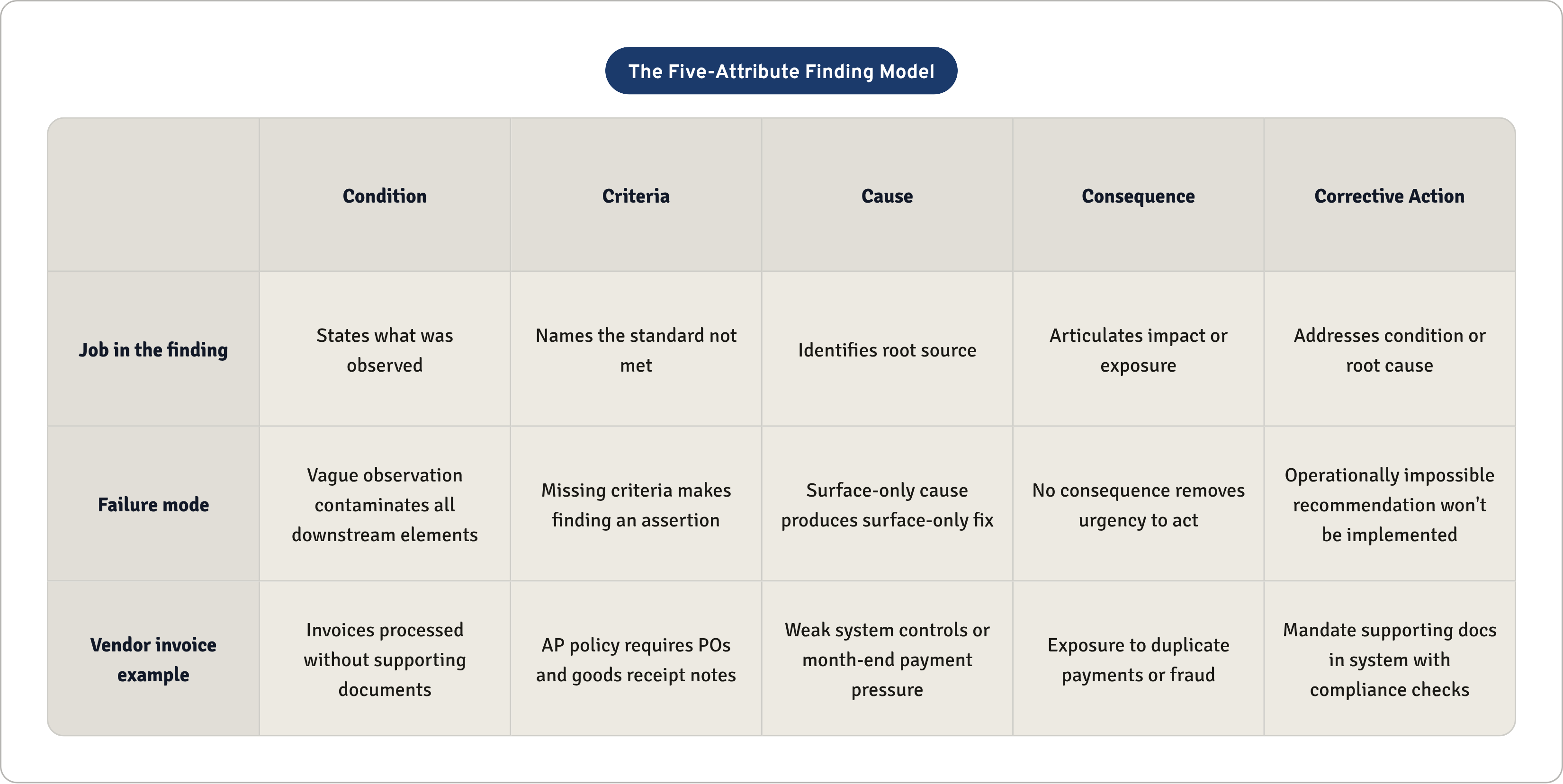
Every finding worth reading is built from five attributes: Condition, Criteria, Cause, Consequence, and Corrective Action. Each has a specific job. When any one of them is weak or missing, the finding loses its capacity to drive change.
The condition is what was actually observed, stated as a specific, objective fact grounded in evidence from fieldwork. Ambiguity here contaminates everything downstream. If the condition is vague, the criteria cannot be clearly applied, the cause cannot be accurately identified, and the recommendation cannot be targeted.
The criteria is the standard, policy, law, or expectation that was not met. The gap between condition and criteria is the finding. Without clearly stated criteria, the finding is an assertion rather than a conclusion, and management will dispute it on exactly those grounds.
The cause is where audit reports most frequently underperform. Without credible root cause analysis, a recommendation can only address the surface of a problem, not its source. Causes are often systemic: inadequate controls, process pressure, missing accountability structures, resource constraints that have been quietly normalized. Identifying the surface condition is straightforward; correctly attributing cause takes judgment and rigor.
The consequence articulates the actual or potential impact: financial exposure, fraud risk, compliance breach, operational disruption. This is what moves a reader to act. A finding without a clearly stated consequence gives management no urgency to respond.
The corrective action addresses either the condition directly or its root cause. Condition-based recommendations fix the immediate issue; cause-based recommendations prevent recurrence. The strongest recommendations do both and balance feasibility with effectiveness. A recommendation that is technically correct but operationally impossible will not be implemented, regardless of how precisely it identifies the problem.
A concrete example makes the model tangible. Vendor invoices processed without proper supporting documentation: the condition is that gap as observed and evidenced. The criteria is the accounts payable policy requiring purchase orders and goods receipt notes. The cause is inadequate system controls or month-end payment pressure that bypasses the normal approval sequence. The consequence is exposure to duplicate payments or fraud. The recommendation is making supporting documents mandatory in the payment system, with periodic compliance checks to confirm adherence.
Findings should open with a statement of specific, objective, evidence-based fact, not a generalization. Organize them by significance or theme, and let data, tables, charts, metrics, reinforce the narrative where applicable. Data does not replace argument; it substantiates it.
Risk ratings: why they help, where they create friction, and how to use them well
Standard 14.3 requires a formal mechanism for assigning significance and prioritizing findings. Risk ratings are the most common way audit functions fulfill that requirement, typically running Critical, High, Medium, and Low based on impact and likelihood.
The case for ratings is real. They tell executives which findings demand immediate attention and which can be addressed in the normal course of operations. A former IIA CEO has noted that ratings emerged as a direct response to the time pressures of senior leadership: when a board member has twenty minutes with a report, a rating tells them where to start.
But I have watched the ratings system backfire in ways that are entirely predictable and still regularly ignored. In practice, management frequently spends more time negotiating a rating than engaging with the finding itself. The rating becomes the argument. The issue becomes secondary. At that point, the mechanism designed to accelerate urgency is actively impeding it.
There is a middle path the standards accommodate. If a finding is included in the report at all, it has already been deemed important enough to document. An overall engagement conclusion is still required, but it does not have to take the form of an explicit rating scale applied to every individual finding. Some audit functions find that a single overall conclusion rating, Satisfactory, Needs Improvement, or Unsatisfactory, paired with qualitative priority language within findings, achieves the prioritization goal without triggering the negotiation dynamic. That approach is worth considering, particularly in environments where rating disputes have become a recurring pattern.
When individual ratings are used, the criteria for each level must be defined clearly and applied consistently across all assurance reports. Inconsistent rating application erodes credibility incrementally, as stakeholders begin to sense that the same issue would be rated differently depending on who conducted the engagement. The connection between individual finding ratings and the overall engagement conclusion must also be explicit and defensible. A report with three High findings concluding Satisfactory will generate questions. Those questions will be justified.
The overall engagement conclusion and what it must do beyond summarizing
The overall engagement conclusion is not a summary of findings. It is a judgment, grounded in evidence, on the adequacy of governance, risk management, and controls in the audited area relative to the organization's goals. Standard 14.5 of the GIAS requires that distinction, and it is a meaningful one in practice.
The shift from "opinion" to "conclusion" in the 2024 standards carries practical weight beyond terminology. An opinion invites disagreement as a matter of perspective. A conclusion signals a position reached through systematic analysis of objective evidence. When management pushes back on findings, that framing changes the nature of the conversation.
The conclusion must be defensible and the connection between findings and conclusion must be visible to the reader. A disconnect between what the findings document and what the conclusion states is a credibility problem that does not stay contained to the report. It reaches the board, it reaches senior leadership, and it reflects on the audit function's judgment in ways that accumulate.
A weak conclusion restates what the findings section already said. An effective conclusion translates evidence into judgment about the organization's risk posture in the audited area, which is a categorically different task.
The conclusion is also the required location for flagging situations where management has accepted residual risk the CAE considers unacceptable. This is not a stylistic choice. It is a disclosure obligation, and it belongs where board members and senior executives will encounter it without having to search.
Management response and action plan as the bridge between findings and change
A management response is a structured document in which management acknowledges findings, agrees or disagrees with explanation, outlines specific remediation actions, assigns responsibility, and sets target completion dates. A management action plan is more granular: each observation mapped to a named individual and a specific date, converting a commitment into an accountable task.
Disagreement is legitimate and should be documented. A response that explains, on factual or interpretive grounds, why a finding is disputed is more valuable than a pro forma acceptance that masks non-compliance or conceals a genuine difference in risk judgment. The difference between a well-reasoned disagreement and a reflexive objection is usually apparent, and both deserve engagement on substance rather than dismissal.
When risk ratings appear in the report, they carry into the management response. Management uses them to prioritize which actions to resource first; auditors use the same ratings to prioritize follow-up. That consistency is what makes the rating logic functional across the full cycle.
A weak management response, vague commitments, no named owner, no target date, is itself a signal worth noting. Audit committees should treat it as an indicator of accountability culture, because that is precisely what it reflects. The management response is where the report's backward-looking analysis becomes a forward-looking agreement. Without that transformation, the report documents a problem without creating any mechanism for resolving it.
Appendices and what supporting documentation actually earns its place
Appendices exist to preserve necessary detail without burdening the sections leadership actually reads. Detailed data tables, methodology notes, technical specifications, and raw supporting evidence referenced in the findings all belong here rather than in the main report.
The test for inclusion is not complicated: if the detail helps a specific audience verify a finding or understand a recommendation, it earns its place. If it is present to demonstrate thoroughness rather than to serve the reader, it should not be in the report. Padding costs the reader their time and signals that the author did not make the editorial decisions the audience needed them to make.
Appendices also serve the audit trail. They allow the executive-facing sections to stay concise while preserving the evidentiary record for operational managers, legal counsel, and future auditors reviewing the same area. Accessibility at one level, defensibility at another; that dual function is what appendices are designed to provide.
Referencing discipline matters as much as content selection. Every appendix item should be explicitly connected to a specific finding or recommendation in the body of the report. An appendix that floats without connection to anything signals a report that was assembled from parts rather than written as a coherent argument.
Timeliness and the follow-up process that determines whether findings actually close
A widely accepted professional benchmark: draft reports to management within roughly two weeks of fieldwork completion, management responses returned within one to two weeks of receiving the draft, final report issued within a week of receiving responses. The overall target is a finalized report with management responses within thirty days of the last day of fieldwork.
A delayed report does not simply arrive late. It arrives into a different environment than the one that produced it. Conditions change, responsible parties move on, and management's sense of urgency fades in ways that are difficult to reverse once they set in. Timeliness is a quality standard, and the GIAS framework treats it accordingly.
Standard 15.2 mandates follow-up: confirming that recommendations have been implemented, inquiring about progress at appropriate intervals, performing follow-up assessments on a risk-based basis, and updating the tracking system as corrective actions close. This is a required element of the audit cycle, and the audit functions that treat it as optional are the ones with the highest rates of finding recurrence.
Best practice involves a dedicated tracking system or structured mechanism that captures the observation, the action plan, the responsible person, the target date, and current status. Higher-rated findings receive more frequent and more rigorous monitoring. The follow-up process should mirror the prioritization logic used in the report, because the risk that justified a high rating during fieldwork does not diminish simply because a report was issued.
The follow-up loop is where the audit function's value gets confirmed or quietly forfeited. A finding documented but never verified as resolved is, from a governance standpoint, an open risk. The report created the obligation; follow-up is what fulfills it.
Formatting and tailoring the report to its audience without sacrificing substance
Format varies across organizations. Some align with internal communication templates; some reflect organizational culture; some incorporate preferences expressed by the board or senior management. The GIAS framework does not prescribe format. It prescribes content and quality, which means format is a vehicle, not a destination.
Audience tailoring is built into Standard 2420, which specifies that content and detail level should be determined by audience need. Format should follow from that determination. An audit report format adopted because it looks professional rather than because it serves the reader is working in the wrong direction.
Length is not a proxy for quality. A brief, tightly constructed report that covers all foundational components serves the audience better than a lengthy one that buries findings in detail belonging in an appendix. One-page formats are legitimate for lower-complexity engagements or advisory work. The right level of detail is whatever allows the audience to understand context, confirm the audit objective was met, and act on recommendations.
Consistency across reports matters as much as quality within any single one. When rating criteria, finding structures, and conclusion language differ between engagements, the audit function's credibility erodes incrementally. Structural discipline applied consistently is what separates an audit function that is trusted from one that is merely tolerated, and the gap between those two outcomes is larger than most audit leaders appreciate until they are sitting on the wrong side of it.