Audit Trail Requirements for Cloud-Based Systems
Each framework takes the same underlying standard and encodes it differently, shaped by its regulated context. Learning to read each translation on its own terms is more useful than treating compliance as one undifferentiated requirement.
HIPAA
HIPAA addresses audit trails through two provisions that most teams conflate. Section 45 CFR § 164.312(b) requires that covered entities implement hardware, software, and procedural mechanisms to record and examine activity in information systems containing electronic protected health information: who accessed what, when, and what action was taken. Section 45 CFR § 164.308(a)(1)(ii)(D) requires periodic or triggered log reviews, not merely retention. Having logs that nobody reviews is still a compliance gap, and auditors have seen that gap enough times that they check for it early.
Minimum retention is 6 years, though state law can and does extend this. Arkansas mandates 10 years; several states extend further for records involving minors. In 2024, 734 breaches exposed 276 million health records. The average breach cost reached $4.88 million, and 62 percent of healthcare organizations self-identified as "at risk," a full ten percentage points above the global average.
SOX
The Sarbanes-Oxley Act approaches audit trails through the lens of financial integrity and criminal accountability. Section 802 established criminal penalties for destroying records relevant to federal investigations. SEC rule 17 CFR 210.2-06 requires that audit workpapers and records relevant to financial reporting be retained for 7 years, and that scope includes system access logs, change management records, and documentation supporting the internal controls required under Sections 302 and 404. SOX gets underestimated as a technical requirement because it reads like an accounting statute. Its evidence demands reach deep into IT operations, and finance teams who assumed this was someone else's problem have found out otherwise.
PCI DSS v4.0
PCI DSS v4.0 requires 12 months of log retention, with 3 months immediately accessible. The mandatory compliance deadline passed March 31, 2025. The standard represents a genuine shift from checklist-based to risk-based, continuous security management: universal multi-factor authentication for all access to the cardholder data environment, continuous monitoring, stronger encryption standards. Non-compliance fines from payment brands range from $5,000 to $100,000 per month, and a card-data breach compounds that exposure substantially.
GDPR
GDPR takes a structurally different approach, and it trips up organizations that are accustomed to fixed retention schedules. There is no mandated log retention period. Logs should be retained only as long as necessary for the stated purpose, which in practice means one to three years depending on organizational context. Organizations must document their retention rationale in their Record of Processing Activities under Article 30, and a Data Protection Authority can request that documentation without warning. Fines reach €20 million or 4 percent of total worldwide annual turnover, whichever is higher.
DORA and NIS2
The Digital Operational Resilience Act has applied across the EU financial sector since January 2025 and adds explicit requirements for ICT-related incident logs and audit evidence. NIS2 extends analogous obligations to a broader set of critical infrastructure sectors. Both frameworks treat log availability and integrity as operational resilience issues rather than security hygiene, which is a meaningful distinction in how regulators weigh deficiencies when something goes wrong.
EU AI Act
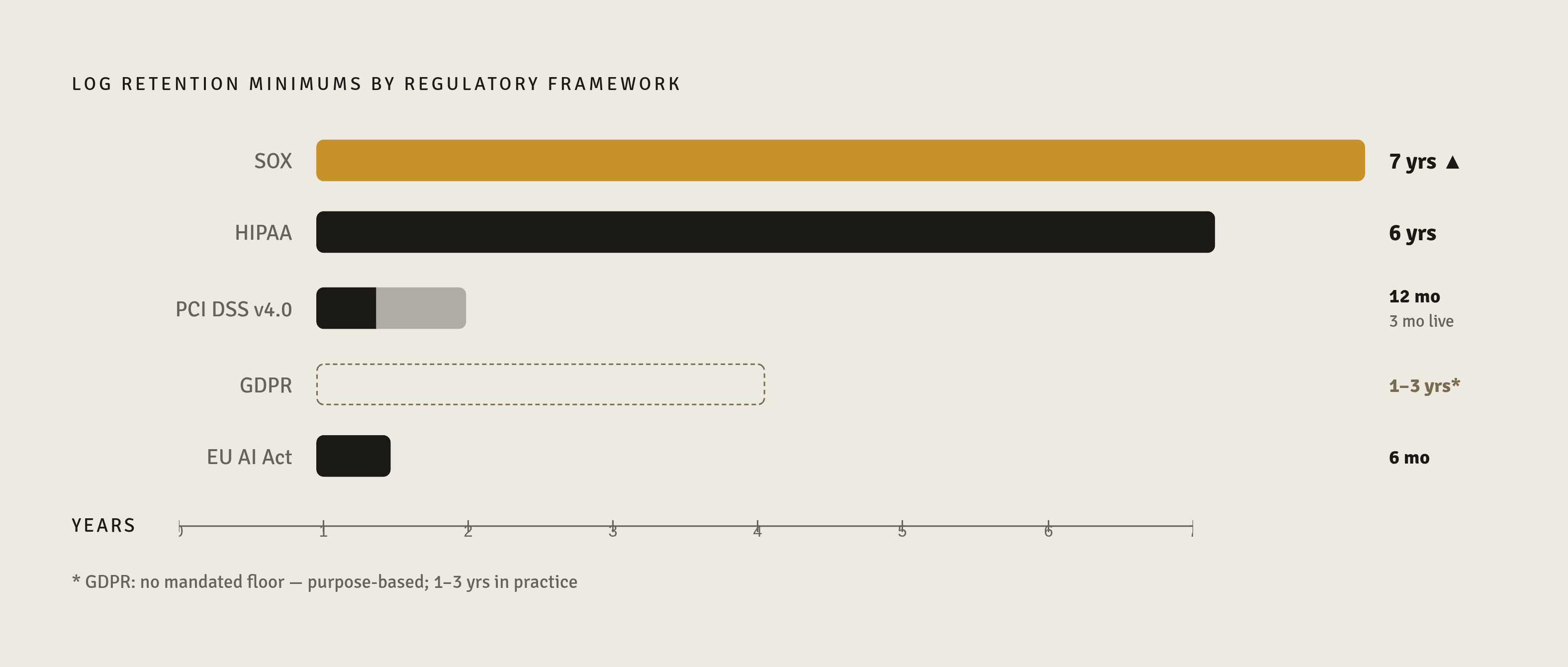
Article 12 of the EU AI Act requires that logs for high-risk AI systems be retained for at least 6 months. Most existing compliance frameworks were not designed to capture AI-generated data flows, which often cross cloud regions and involve personal data in training datasets. The AI Act begins addressing this gap, but the mapping work falls entirely on the organization.
Set retention to the longest applicable minimum across every framework the organization is subject to, then extend further for litigation hold and operational need. In most enterprise contexts, that ceiling is SOX at 7 years, though specific state laws or contractual obligations can push it further.
What NIST and ISO Frameworks Add Beyond Regulatory Minimums
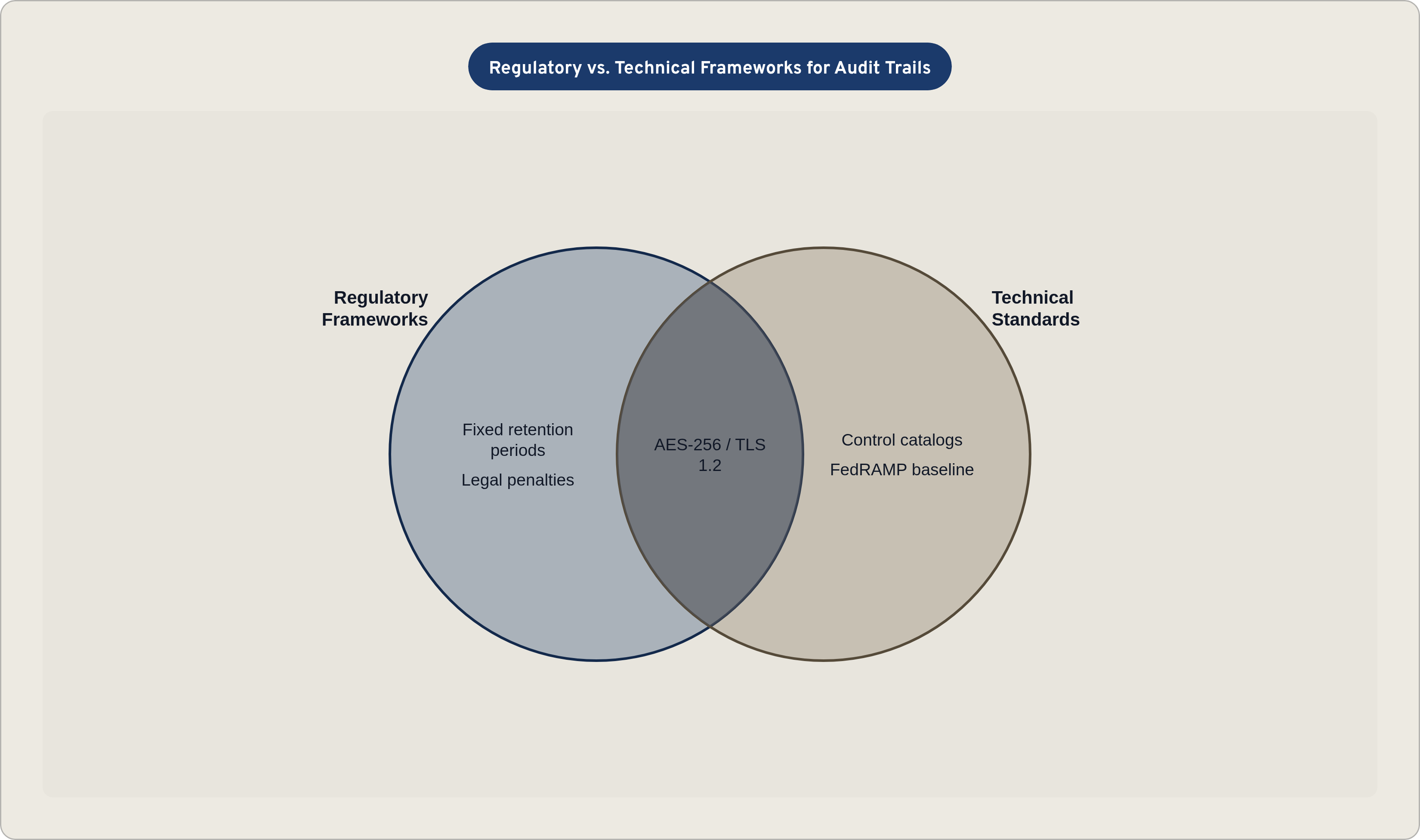
NIST and ISO frameworks are not law in most jurisdictions. What they are is the technical reference that auditors use to determine whether an audit trail is genuinely reliable, as opposed to merely present. An organization can satisfy the letter of HIPAA's logging requirement while failing the technical bar that a sophisticated auditor applies using NIST SP 800-53 as a reference.
NIST CSF 2.0, released in February 2024, organizes security outcomes across six functions: Govern, Identify, Protect, Detect, Respond, and Recover. NIST SP 800-53 is where the technical substance lives. It is the master control catalog behind most U.S. federal security programs, and its Audit and Accountability control family directly governs log content, protection, review, and retention. If your organization works with any federal agency or is pursuing FedRAMP authorization, 800-53 is not optional background reading.
The convergence point across frameworks is tamper-evidence. NIST CSF 2.0 and PCI DSS v4.0 both explicitly require it now, and the technical mechanisms are consistent: cryptographic hashing of log entries, write-once or append-only storage, digital signatures, hash chaining where each log entry incorporates the hash of the previous one. SOC 2 CC7.2, PCI DSS 10.5, and ISO/IEC 27001 A.12.4.2 all require audit record protection. This is a cross-framework baseline, and auditors treat it that way.
ISO/IEC 27001 specifies requirements for an information security management system and is the certification standard. ISO/IEC 27002 provides implementation guidance for specific controls, including access management, cryptography, and supplier relationships. ISO 27001 A.12.4.2 explicitly requires protection of log information. Certification under 27001 involves accredited auditors reviewing evidence of operating effectiveness, not policy documents. What satisfies it is a demonstrated, consistent record of the controls actually running.
Encryption expectations across these frameworks are consistent: AES-256 for data at rest, TLS 1.2 or higher for transmission. These are the baseline a competent auditor assumes before reviewing anything else.
Where Cloud Platform Defaults Fall Short of What These Requirements Actually Demand
The gap between cloud platform defaults and regulatory requirements is not theoretical. Organizations discover it during a breach investigation or a live audit, when the evidence they assumed existed simply does not.
Consider the healthcare organization that discovers mid-breach investigation that the cloud platform retained only 90 days of event history by default. The attack began four months earlier. HIPAA required 6 years of Security Rule documentation. The forensic trail is gone, and the investigation stalls.
The platform defaults are worth naming. AWS CloudTrail's event history is time-limited unless a trail is explicitly created and configured for long-term storage; the default does not persist indefinitely. Azure Activity Logs retain only 90 days by default and require explicit export for long-term retention. Google Cloud Logging uses default buckets with defined retention periods that do not align with most regulatory minimums. None of this is a provider failure under the shared responsibility model. It is a customer assumption, and that assumption is where audits go sideways.
Multi-cloud environments make this considerably worse. Identity services, policy engines, and log formats differ across providers. Retention defaults are not uniform. Reconciling audit evidence across AWS, Azure, and Google Cloud is a manual, error-prone process unless the architecture was deliberately designed to support it from the beginning.
The storage architecture that actually holds up is consistent across organizations that pass audits cleanly: a dedicated logging account or project isolated from workload accounts, so that compromising a production environment does not simultaneously compromise the audit trail; WORM policies applied to log storage so records cannot be modified or deleted before the retention period expires; access restricted to a small number of break-glass administrators operating under the WORM policy rather than around it; SIEM integration for continuous monitoring and tamper detection; AES-256 at rest and TLS 1.2 or higher in transit applied to log data with the same rigor as the underlying regulated data.
Why the Shared Responsibility Model Is the Root Cause of Most Audit Failures
The shared responsibility model is well understood in the abstract and consistently misapplied in practice. Cloud providers secure the infrastructure. Customers are responsible for configuration, access policy, and data handling. Audit gaps almost always live on the customer's side, and the numbers are uncomfortable for anyone running a cloud compliance program.
Roughly half of all compliance audit failures involve configuration-related findings tied to customer responsibilities under the shared responsibility model. More than half of organizations have been out of compliance with at least one regulatory framework specifically because of cloud-related issues. The Cloud Security Alliance ranked misconfiguration and inadequate change control as the top cloud threat in 2024, above zero-day attacks. These are the modal failure pattern, and they keep recurring because the root cause is structural, not technical.
Organizations underestimate their side of the boundary for reasons that compound each other. Each cloud platform runs a different identity management model, a different logging format, and a different interpretation of where its own responsibility ends. Regulatory frameworks do not translate uniformly across those differences. Requirements must be addressed separately per platform, and evidence must be reconciled from separate audit trails. No single cloud environment provides complete coverage by default, and no framework provides a ready-made mapping between its requirements and a specific platform's configuration model. That mapping is customer work.
What customer-side ownership actually requires in audit terms is concrete: documented configuration baselines and change records; access control records demonstrating role-based permissions and authentication logs; incident response documentation covering detection, resolution, and post-incident analysis; and security configurations including encryption settings and firewall rules. If any of those four categories is missing or incomplete when an auditor sits down with the evidence package, the conversation gets difficult fast.
How AI Workloads Create an Audit Attribution Gap That Existing Frameworks Already Cover
The compliance obligations governing employee access to sensitive data apply identically when an AI system accesses that same data. Regulators have not created AI-specific exemptions. Gaps in AI-related audit trails will be treated as failures under existing frameworks, not as a novel category awaiting new guidance.
The most common gap is straightforward to describe and harder to catch before an audit surfaces it. An AI system accesses regulated data under a service account or API key, and no log entry records which individual directed the access. The event is captured. The attribution is not. That single distinction creates violations across multiple frameworks simultaneously, and retroactive remediation is genuinely expensive.
HIPAA's unique user identification requirement cannot be satisfied by service account logging alone. The framework requires that each person accessing ePHI be uniquely identified in the record; a shared service account does not meet that standard. GDPR's accountability principle requires that individual attribution be traceable in the processing record; an API key is not an individual. SOX audit trail requirements demand individual-level access attribution for financial data; a service account shared across AI functions obscures that attribution entirely.
AI data flows introduce additional complications specific to cloud environments. Training datasets frequently include personal data. Model inference often crosses cloud regions, creating jurisdictional complexity under GDPR and the EU AI Act simultaneously. Article 12 of the EU AI Act sets a 6-month minimum log retention for high-risk AI systems, but most existing compliance programs were not designed to capture AI-generated events as a distinct category. Organizations deploying AI tools without mapping those flows against applicable frameworks create exposure that is genuinely difficult to audit retroactively, because the data is often already gone by the time someone thinks to look for it.
AI system actions must be logged with the same individual attribution, event type, timestamp, and data-scope detail required for human user actions. If an AI system acts autonomously, the log record must capture which human account or workflow initiated that autonomous action.
Building an Audit Trail Program That Holds Up Across Frameworks, Platforms, and an Audit
A program that holds up across frameworks, platforms, and a live audit is layered. Each layer addresses a distinct category of requirement. A checklist collapses under scrutiny; a layered program produces evidence at every level an auditor examines.
Layer 1: Content Coverage
Start by confirming that every required event type is captured: authentication attempts both successful and unsuccessful, privileged user actions and connections, object creation and modification and deletion across files, directories, and user accounts, configuration changes with any potential to affect security policy, and access to regulated data of any category.
Use unique user IDs and resource identifiers in log records, not sensitive data values. Capturing the ID of the record accessed satisfies the attribution requirement without reproducing PHI or PII in the log itself. Timestamps should be in UTC. Time zone discrepancies across cloud regions become genuinely disorienting during forensic reconstruction of a multi-region incident.
Layer 2: Retention Architecture
Set retention to the longest applicable regulatory minimum across all frameworks the organization is subject to, then extend beyond that for litigation hold and operational need. In most enterprise contexts, SOX at 7 years is the ceiling, though specific state laws or contractual obligations can push further.
The storage architecture follows a consistent pattern: dedicated logging account isolated from workload accounts, WORM policies applied to log storage, access restricted to break-glass administrators who cannot delete objects under the WORM retention policy. For every cloud platform in use, explicitly configure log export and long-term storage. Do not rely on default retention. Verify the configuration, document that the verification happened, and record when.
Layer 3: Integrity and Tamper-Evidence
Apply cryptographic hashing, hash chaining, or digital signatures to log entries. This is how you demonstrate to an auditor that records have not been modified after the fact. Without it, the logs are evidence. With it, they are authenticated evidence, which is a materially different category of document in a compliance proceeding.
AES-256 at rest and TLS 1.2 or higher in transit apply to log data exactly as they apply to the regulated data the logs describe. SIEM integration provides continuous monitoring and tamper detection, and it shortens the detection window for both security incidents and log integrity failures, which are sometimes the same event.
Layer 4: Shared Responsibility Documentation
Map which controls belong to the provider and which belong to the customer for each cloud platform in use. That mapping should be a living document, updated when platform configurations change or new services are adopted. Maintain documented configuration baselines and change records, because that is what auditors actually test.
For multi-cloud environments, reconciling audit evidence across platforms requires deliberate architecture from the start. The organizations that pass multi-cloud audits cleanly designed their logging infrastructure to produce comparable, reconcilable evidence before they needed it.