How Long to Keep Tax Returns and Supporting Documents
Keep tax records until the legal window closes, not until a round number feels safe.

The period of limitations is the legal window within which two things can happen: you can amend a return to claim a credit or refund, and the IRS can assess additional tax against you. Both clocks run simultaneously, governed by the same statutory provisions. Think of it as a legal timer counting down on a ticking bomb — defuse it with the right records, or let it detonate without them.
The length of that window gets all the attention. The start date gets almost none. That's the mistake.
If you file before the due date, the clock starts on the due date itself, not the day you actually filed. A return for tax year 2023, filed on March 28, 2024, begins its limitations period on April 15, 2024. File on extension and submit before the deadline, the clock starts on your actual filing date. File late, and it starts on receipt. A 2023 return filed April 15, 2024 carries audit exposure through April 15, 2027. That's a fixed, calculable date. Your records need to survive until it passes.
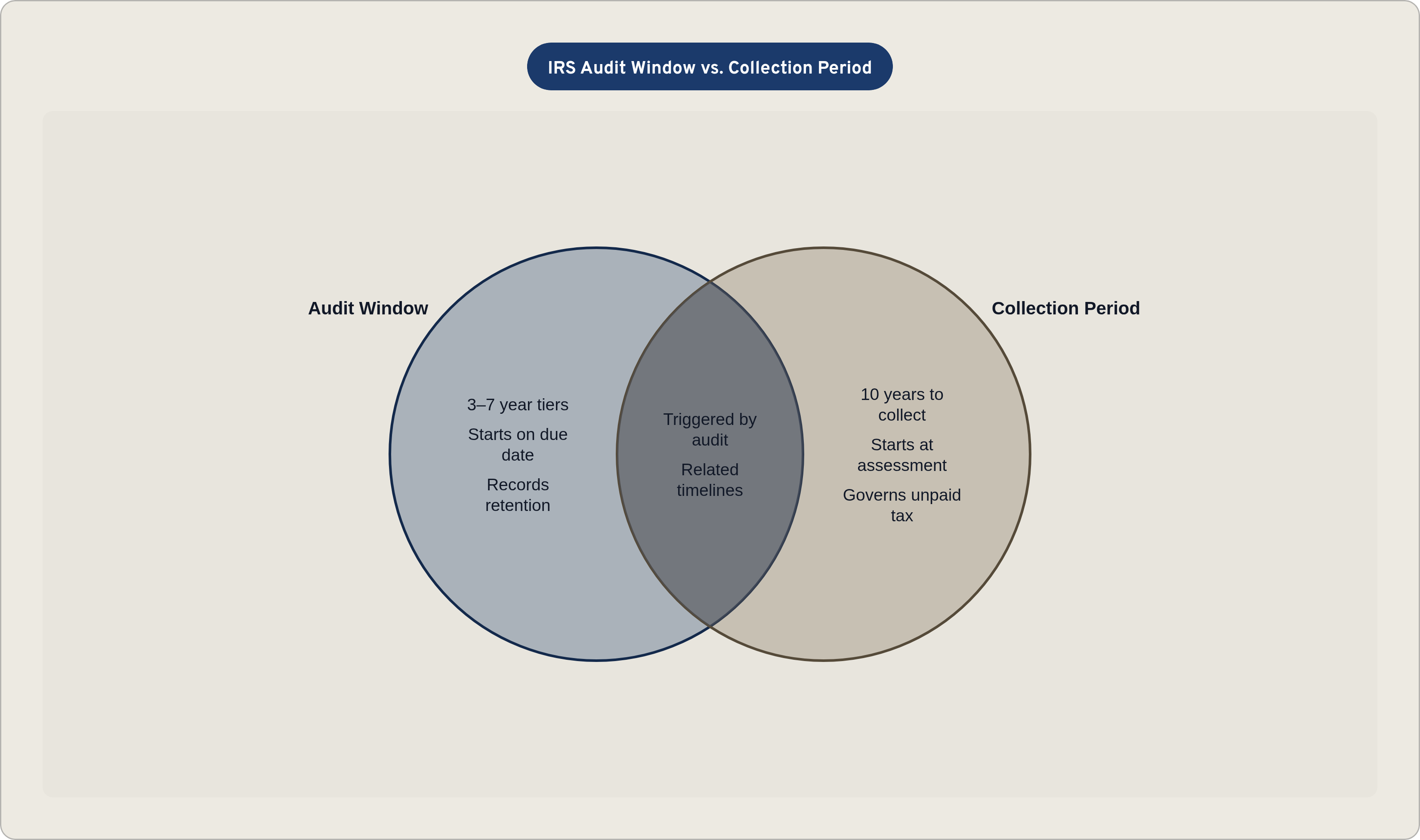
One other clock deserves mention because it gets conflated with the audit window constantly. The IRS has ten years from the date of assessment to collect unpaid taxes. That's a separate timeline governing collections, not examination. If an audit results in additional tax owed, the collection period starts from that assessment date. The two clocks are related but distinct, and confusing them leads to premature disposal of records tied to an open balance.
Per IRS guidance, records must be retained until the applicable limitations period expires. Not until a round number feels comfortable. Until the legal window actually closes.
The Five Retention Tiers and What Triggers Each One
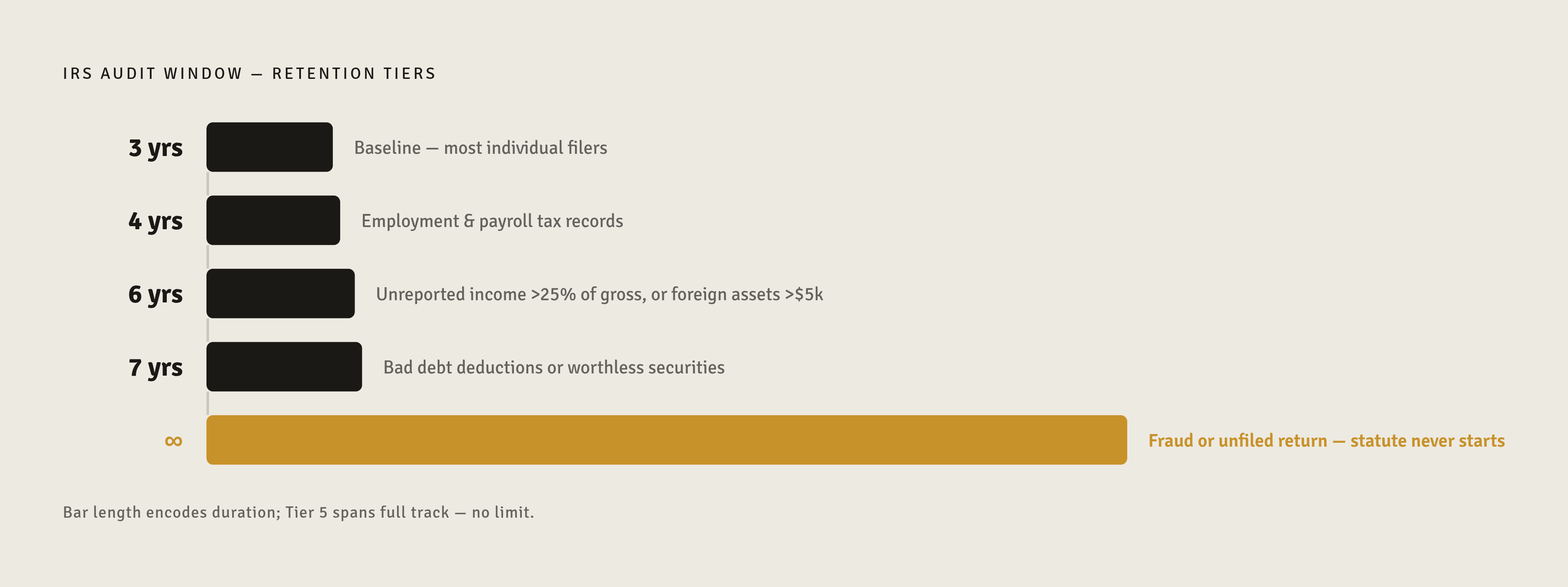
The IRS doesn't publish a single retention period because the law doesn't establish one. It establishes several, each tied to a specific circumstance. What follows isn't a summary of conventional wisdom. It's the actual structure.
Tier 1: Three Years
Three years is the baseline for most individual filers. It applies when none of the extended circumstances below are present, and it governs amended returns filed to claim refunds or credits: the window is three years from the original filing date or two years from the date the tax was paid, whichever is later.
The IRS typically initiates audits twelve to eighteen months after filing. Its internal goal is to open and close examinations well within the three-year window. That operational reality does not change the legal window. The statute runs the full three years.
Tier 2: Four Years
Employment tax records follow a longer rule. Businesses must retain them for at least four years after the tax is due or paid, whichever is later. This covers W-2s issued to employees, payroll tax deposit records, and Form 941 filings. If you have payroll, four years is your floor, not three.
Tier 3: Six Years
The six-year window is triggered when unreported income exceeds twenty-five percent of the gross income shown on the return. That threshold is codified in federal tax law. It's also triggered when unreported income from foreign financial assets exceeds $5,000.
Self-employed filers and small business owners managing multiple 1099s are disproportionately exposed here, and the risk is often invisible. Income aggregation across sources can push someone across that twenty-five percent threshold without a single deliberate omission. I've seen it happen with freelancers who lost track of a handful of small contracts in a busy year — a tax problem that's less a crime and more a paperwork avalanche. The IRS doesn't care that it was inadvertent. For those filers, keeping 1099s, contract income records, and business expense documentation for at least six years isn't excessive caution. It's the correct read of the law.
There's also an informal dimension: the IRS generally avoids going back more than six years even when it has broader legal authority. That makes six years a practical upper bound for most non-fraudulent situations.
Tier 4: Seven Years
Here is where that ubiquitous "seven-year rule" actually lives, and it lives in a much narrower space than its reputation implies. The seven-year period applies specifically to claims for credit or refund arising from a bad debt deduction or a loss from a security that became worthless or was abandoned. The clock runs seven years from the date the return was due.
If you've never claimed a bad debt deduction or reported a worthless security, this tier doesn't apply to you. The rule is real. It is just far more circumscribed than most people realize.
Tier 5: Indefinitely
No statute of limitations exists for fraudulent returns or years in which no return was filed at all. The IRS retains the right to assess tax for any such year indefinitely. For unfiled returns, the clock never starts, which means the exposure never closes.
This tier isn't a records retention strategy. It's a reminder that certain situations carry no safe harbor, and the only resolution is compliance.
Documents That Follow a Different Clock Than the Return They Supported
Some records don't take their timing from the year they were created. They follow the year in which the underlying asset or event is ultimately resolved. This is one of the most commonly misunderstood pieces of the entire retention question, and it's where well-intentioned people create real problems for themselves.
Property Records
Keep records supporting a property's purchase, improvements, and acquisition costs until the limitations period expires for the year you dispose of the property, not the year you bought it. These records establish basis, calculate depreciation where applicable, and determine gain or loss on sale.
Nontaxable exchanges complicate this further. When you exchange one property for another without recognizing gain, the basis of the old property carries forward to the new one. Records from the original acquisition must survive through the disposal of the replacement property and then through the subsequent limitations period.
Home improvement receipts deserve specific attention. Every dollar added to a property's adjusted basis reduces taxable gain on sale. That's a direct, calculable benefit that can surface decades after the work was done, and the only way to substantiate it is documentation. Keep those receipts for the entire ownership period plus at least three years after you sell.
Investment and Brokerage Records
Keep purchase confirmations, reinvestment records, and cost basis documentation until the asset is sold and reported on a return, then retain those records for at least three more years. Brokers now report cost basis to the IRS for most transactions, but that coverage has meaningful gaps: older positions, assets transferred between institutions, and securities acquired before reporting requirements were modernized. Original purchase records remain indispensable in those situations. The broker's statement is corroborating evidence. Your documentation is the primary record.
Retirement Account Records
Retain contribution records, rollover documentation, and distribution statements until at least three years after the account is fully distributed. Rollover and custodian transfer records should be kept through the life of the account; they establish the provenance of funds and can resolve disputes about whether distributions were handled correctly.
Pre-1987 contributions to a 403(b) plan are a specific exception. Those records should be kept indefinitely because they affect the required beginning date for minimum distributions, a calculation that can surface decades after the contribution was made. This is the kind of detail that appears abstract until someone's required minimum distribution calculation gets challenged and they no longer have the records to defend it.
W-2 Forms and Social Security Earnings
IRS retention rules don't require W-2s beyond four years. Social Security earnings records, however, can and do contain errors, and the only way to dispute a discrepancy in your earnings history is to produce the documentation. Keeping W-2s until you begin receiving Social Security benefits gives you the evidentiary basis to correct any errors the Social Security Administration has on file. The IRS rule and the practical need point in different directions here. Follow the practical need.
Tax Returns Themselves, and Why They Deserve Permanent Storage
A filed tax return is both a legal document and a longitudinal record of your financial life. Its utility extends well beyond any audit window, and the case for permanent storage doesn't rest on audit risk alone.
Mortgage lenders routinely require two to three years of returns. Income-based federal assistance programs use returns to establish eligibility. If the IRS ever disputes whether a return was received, a copy of the filed return is your primary evidence. Amended returns carry the same weight and belong alongside the originals.
The consistent recommendation across CPA firms and financial institutions is to keep federal tax returns permanently. Digital storage makes this easy and cheap. The IRS accepts digital records that accurately reproduce the original documents, so the cost of permanent retention is effectively zero. There is no reasonable argument for discarding them.
State returns belong in the same permanent file. The logic is identical: their usefulness doesn't expire with the audit window, and the cost of keeping them is negligible.
How State Tax Agencies Add Another Layer to the Retention Calculation
Federal tiers establish a floor. State law can raise it, and frequently does. State limitations periods are set independently of federal rules and are not synchronized with the IRS's windows.
Most states operate within a four to five year audit window. Several extend that period for substantial underreporting or fraud, mirroring the federal structure but on different timelines. California maintains a four-year statute of limitations for state tax assessments, one year beyond the standard federal window. That difference is consequential, and it means a filer who discards records at the three-year federal mark is exposed for the full additional year in California.
Where federal and state windows diverge, retain records long enough to satisfy whichever period is longer. For filers with income in multiple states, remote work arrangements that implicate more than one jurisdiction, or significant business income, the applicable state limitations period for each filing jurisdiction needs to be verified independently. This is the scenario where a blanket federal rule fails most visibly. The people most likely to get this wrong are exactly the ones whose situations are most complex.
A Working Retention Schedule You Can Use Right Now
Here is the framework, without the hedging.
W-2s, 1099s, 1098s, and receipts supporting deductions and credits: three years from the filing date. Six years if there's any meaningful possibility that unreported income crosses the twenty-five percent threshold.
Employment tax records, including payroll documentation and Form 941 filings: four years from the date the tax was due or paid, whichever is later.
Records supporting income or deductions where substantial underreporting is a plausible risk: six years.
Documentation for worthless securities or bad debt deductions: seven years from the return's original due date.
Property purchase and improvement records: duration of ownership, plus at least three years after disposal.
Brokerage and investment statements: retain until the asset is sold and reported, then three additional years.
Retirement account records: three years after the account is fully distributed. Pre-1987 403(b) contribution records: indefinitely.
Tax returns, federal and state: permanently.
Any year involving fraud or non-filing: no safe disposal date exists.
The decision rule is consistent across all of it. Identify what the document supports. Find the limitations period for that specific situation. Add a buffer for state rules that extend beyond the federal window. Set a retention date and write it down.
For digital organization, a folder structure indexed by tax year handles most of it. Within each year, a separate subfolder for property and investment records that don't expire with the filing year makes locating documents faster when a dispute surfaces years later. When a document's category is genuinely ambiguous, default to the next tier up. The cost of retaining something you didn't need is trivial. The cost of discarding something the IRS later requires is not.