Regulatory Compliance Differences Between SMBs and Enterprises
Small businesses spend 3x more per employee on compliance than large firms, squeezing growth.

SMBs allocate an estimated 3% to 6% of annual revenue to compliance activities. The average U.S. firm spends between 1.3% and 3.3% of its total wage bill on regulatory compliance, and SMBs consistently land at the high end of that range, frequently blowing past it. Average SMB compliance spend has climbed roughly 62% since 2020, per Thomson Reuters Cost of Compliance data. That's not a blip. That's a sustained structural shift in a cost category most small businesses were never built to carry — like asking a rowboat to haul freight that belongs on a cargo ship.
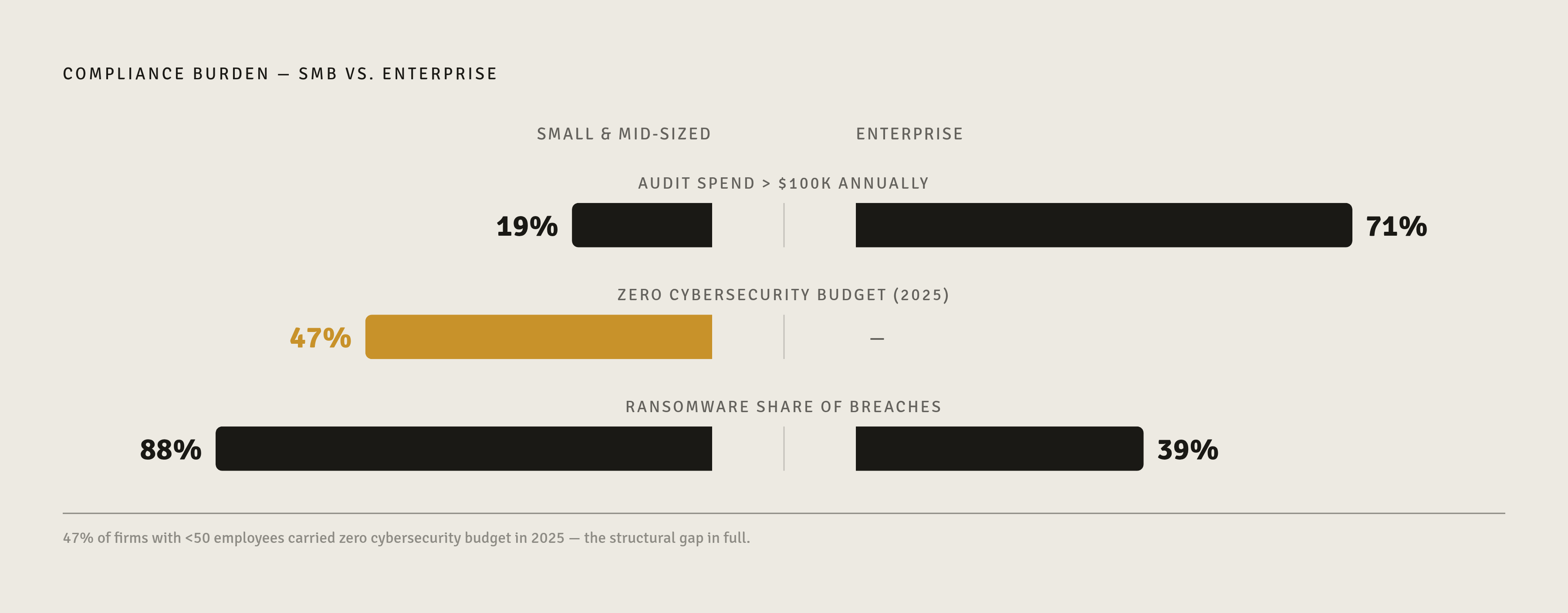
Audit spend makes the divergence concrete. Seventy-one percent of enterprise companies spend over $100,000 on audits annually, per A-LIGN's 2025 Compliance Benchmark Report. Nineteen percent of small companies cross that same threshold. But the dollar gap isn't the whole story. The deeper issue is whether you have internal infrastructure to prepare for an audit, manage the findings, and actually operationalize the results afterward. Enterprises have that infrastructure. Most SMBs are improvising with whatever's available.
The Conference of State Bank Supervisors' 2024 analysis of ten years of bank data found that the smallest institutions devoted roughly 11% to 15.5% of payroll to compliance, against 6% to 10% at the largest. Accounting and auditing costs ran 5 to 17 percentage points higher at smaller firms. The SBA's Office of Advocacy has documented that federal regulatory costs for firms with fewer than 20 employees historically exceed those of larger firms on a per-employee basis. Globally, organizations spent an estimated $304 billion on regulatory compliance in 2025, per Thomson Reuters. That per-employee cost skews heaviest at the very bottom of the size distribution, where the businesses can least absorb it.
How SMBs Actually Experience Regulatory Pressure Day to Day
The lived reality of compliance for a small business owner looks nothing like a GRC dashboard or a quarterly compliance review. It's a Tuesday afternoon spent trying to determine whether a new state privacy rule applies to you, with no one to ask and no playbook to reference. It's a part-time office manager assembling documentation for a customer audit using whatever she can find in the shared drive, hoping it holds up. The thing most compliance frameworks never account for is that small businesses don't have a compliance function. They have a person, or part of a person, or sometimes just whoever answers the email.
Fifty-one percent of small businesses say navigating regulatory compliance is negatively affecting their growth. Forty-seven percent say they spend too much time on it. Sixty-nine percent say they spend more per employee than larger competitors do, per the MetLife and U.S. Chamber of Commerce Small Business Index from Q4 2024. These aren't complaints. They're structural observations about where the cost lands.
Forty-four percent of small businesses outsource compliance tasks, and not because outsourcing is necessarily cheaper. It's because there's no internal capacity to handle it otherwise. The cost still appears on the P&L, just in a different line. And every hour that goes toward interpreting a new regulation or responding to a vendor security questionnaire is an hour that didn't go toward revenue, product, or operations. That's the part that doesn't show up in the aggregate statistics — compliance has a funny way of taxing the time you were saving by skipping the compliance team hire in the first place.
The Structural Gap in Compliance Capacity Between SMBs and Enterprises
Enterprise compliance is a program with organizational ownership: dedicated compliance officers, in-house legal teams, cross-functional GRC functions, and integrated technology stacks built for continuous monitoring rather than scrambling before an audit. Eighty-one percent of organizations reported current or planned ISO 27001 certification in 2025, up from 67% in 2024, per A-LIGN. Pursuing and maintaining that certification isn't just a decision. It's an organizational capability that requires staffing, tooling, and process maturity to sustain year over year.
SMB compliance looks like the owner handling it between other responsibilities, or that same office manager doing her best with whatever she can find online, or a contractor brought in to patch a gap before a specific audit and never heard from again. Most compliance tools on the market were designed for enterprise deployments, with licensing structures and implementation requirements that make no sense below a certain headcount. At the far end of that scale, 47% of businesses with fewer than 50 employees carried zero cybersecurity budget as of 2025, per StrongDM data. Zero. Not a small budget. None.
What makes this structural rather than incidental is that regulators and auditors apply the same documentation and control validation standards to a 30-person firm as to a 3,000-person one. The standard doesn't scale with headcount. Fifty-eight percent of organizations conducted four or more audits in 2025; 35% of enterprises conducted more than six, per A-LIGN. SMBs face equivalent audit demands from customers and regulators without the infrastructure enterprises built specifically to absorb them.
GRC tooling closes some of that gap. SMBs using it report meaningful reductions in compliance management time and lower operational costs compared to manual methods, though the most precise figures in circulation come from vendor-proximate research and warrant appropriate skepticism. The more fundamental obstacle is that closing the gap requires first acknowledging it exists, and a meaningful portion of the SMB market hasn't gotten there yet.
Where Company Size Actually Changes Which Rules Apply
Company size doesn't just change how difficult compliance is. In several regulatory domains, it determines which rules apply at all. Knowing where those thresholds fall is the starting point for any compliance strategy worth building.
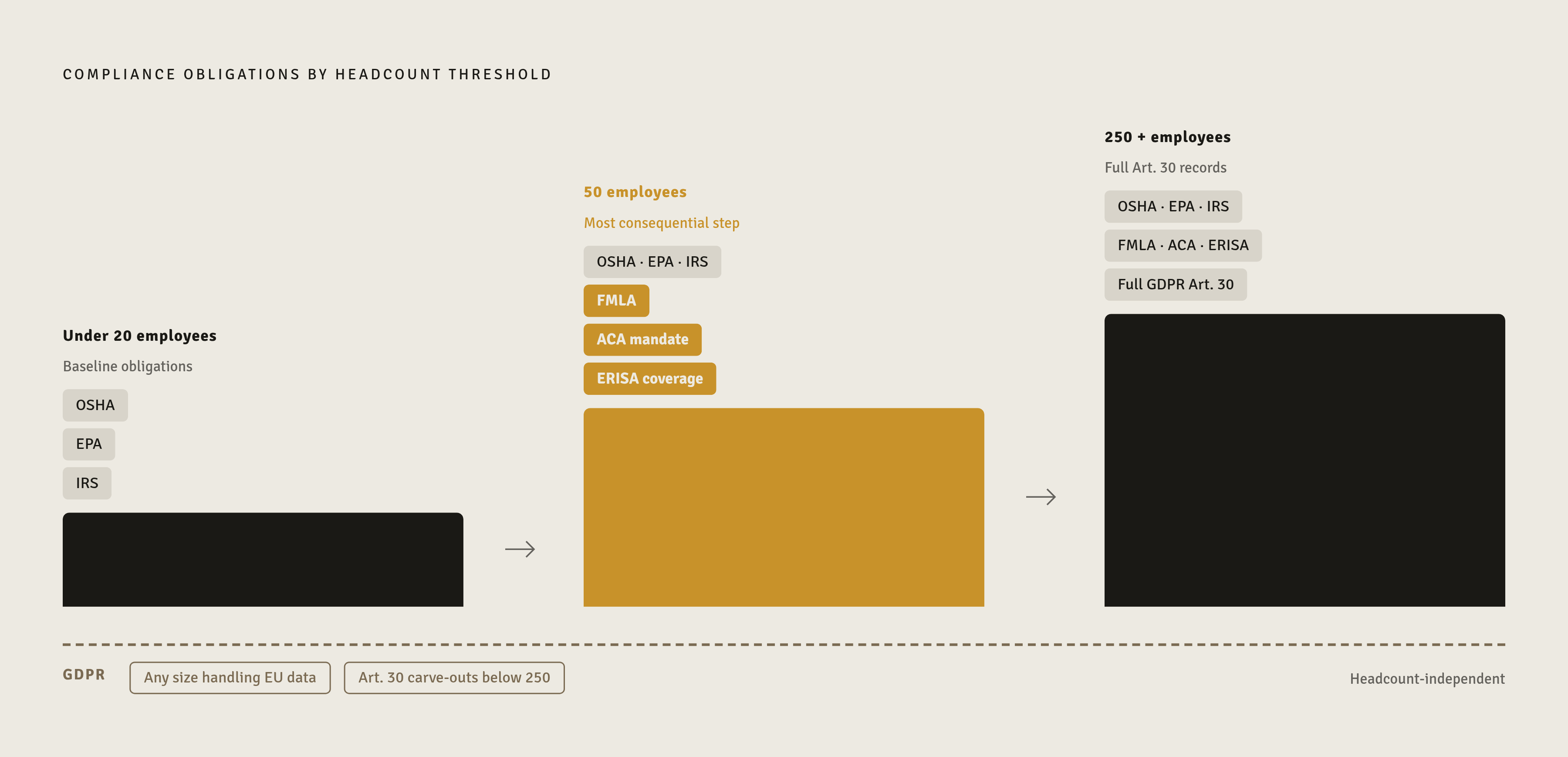
Employment law is the most legible example. A 12-person firm has OSHA, EPA, and IRS obligations. At 50 employees, FMLA and the ACA employer mandate kick in, and ERISA coverage for benefit plans follows. Headcount functions as a compliance staircase, with each step adding obligations that simply don't exist below it.
Data privacy frameworks illustrate two different philosophies operating simultaneously. GDPR applies to any entity processing EU resident data, regardless of size or revenue. There's no general SMB exemption, though Article 30 record-keeping requirements include limited carve-outs for organizations with fewer than 250 employees. The nearly 2,248 GDPR fines totaling close to €6.6 billion since 2018 are concentrated among large enterprises, but small organizations carry real enforcement exposure. CCPA works differently: it applies only to businesses exceeding $25 million in annual revenue or handling data on 100,000 or more California residents, an explicit size threshold that exempts the smallest businesses entirely.
ESG disclosure obligations are tiered by filer category. The SEC's climate disclosure rules, stayed pending litigation as of mid-2025, require greenhouse gas emissions disclosures from large accelerated filers but exempt smaller reporting companies from Scope 1 and 2 emissions reporting. Non-accelerated filers face climate-related risk disclosure requirements beginning in 2028 at the earliest. The EU's Non-Financial Reporting Directive similarly targets large, publicly listed companies.
The Corporate Transparency Act is worth examining for how quickly it changed shape. Its beneficial ownership reporting requirements originally covered an estimated 32 million entities, most of them SMBs, since large companies meeting certain employee, revenue, and physical presence thresholds were exempt from the outset. As of FinCEN's interim final rule published March 26, 2025, all U.S. domestic entities are now exempt.
CMMC offers no equivalent relief. Its Final Rule became enforceable November 10, 2025. SMBs in the defense supply chain must meet the required CMMC level at contract award, regardless of headcount or resource constraints. Full stop.
Why Cybersecurity and Data Compliance Hit SMBs Disproportionately Hard
SMBs experienced approximately four times more confirmed breaches than large organizations in 2024, per Verizon's 2025 Data Breach Investigations Report. Attackers go where defenses are thinnest, and the compliance posture gap is precisely what creates the opening. A small business without a cybersecurity policy isn't just unlocked — it's a door left open with a welcome mat outside.
Thirty-four percent of small businesses have a formal cybersecurity policy. Eighteen percent conduct annual risk assessments. Thirteen percent conduct proactive cybersecurity audits. Under CMMC, the HIPAA Security Rule, and a growing number of state-level cybersecurity mandates, these aren't optional practices. They're required. The distance between what's mandated and what's actually in place in most SMB environments is substantial, and enforcement doesn't wait for that gap to close on its own schedule.
Eighty-eight percent of SMB breaches in 2025 included a ransomware component, compared to 39% at large organizations, per Verizon's DBIR. Organizations with 50 to 100 employees face recovery costs per employee nearly eight times higher than those of larger enterprises following cyber incidents, per StrongDM data. Compliance fines averaged $8,900 per violation for noncompliant SMBs, and the FTC Safeguards Rule caused compliance expenses to spike 19% in some sectors in 2024. Over 55% of HIPAA penalty actions target practices and businesses with fewer than 50 employees. The enforcement pattern is consistent: regulators do not discount penalties because you're small, and they've never pretended otherwise.
How Enterprises Use Compliance as a Business Development Tool
At enterprise scale, compliance certifications function as market-access credentials. SaaS vendors don't get into enterprise procurement cycles without SOC 2 attestation. Global supply chain partners need ISO/IEC 27001 certification to qualify. Insurance underwriters are increasingly pricing policies against proof of framework adherence. At this level, compliance isn't purely a legal obligation. It's a mechanism for winning business, and sophisticated enterprises treat it accordingly.
Per A-LIGN's 2025 Compliance Benchmark Report, "increasing revenue and winning new clients" was cited as the primary driver of compliance programs by 35% of enterprise respondents with over $1 billion in revenue. That reframe, from cost center to growth strategy, is only available to organizations that have already built the infrastructure to make certification achievable and defensible on an ongoing basis.
Eighty-five percent of executives report that compliance requirements have grown more complex over the last three years, per PwC's 2025 Global Compliance Study. At enterprise scale, that complexity gets absorbed by dedicated personnel and integrated systems. The burden exists. It just has a proper home.
Enterprise compliance is built top-down, staffed deliberately, and reviewed on a regular cycle. SMB compliance is almost always reactive: triggered by a contract requirement, an audit notice, or an incident that already happened. Sixty-nine percent of organizations, including those with full compliance programs, report finding the regulatory landscape too complex or struggling to verify third-party supplier compliance, per A-LIGN 2025. Even enterprises find this hard. They just have teams assigned to that specific difficulty, which changes the nature of the problem considerably.
How Businesses at Each Tier Should Think About Resourcing Compliance
For SMBs, the operative question is triage, not comprehensiveness. No small business can or should attempt to map every framework that exists. The rational approach is identifying which regulations apply given headcount, revenue, industry, geography, and customer base, then prioritizing those carrying the most severe enforcement consequences. Employment law thresholds, HIPAA for healthcare organizations, CMMC for defense contractors: those are the non-negotiable starting points. Everything else is secondary until the foundational exposure is addressed.
Fifty-eight percent of SMBs are now investing in compliance management software, per McKinsey 2024 data, and the time and cost reductions from adoption are real enough to take seriously. Outsourcing compliance tasks is rational for many businesses, but it relocates the cost from the owner's calendar to a different line on the income statement. It doesn't eliminate it.
For enterprises, coverage isn't the primary challenge. Integration and third-party risk management are. Sixty-nine percent of organizations struggle to verify whether third-party suppliers actually meet their compliance requirements, per A-LIGN 2025, and that problem compounds as supply chains grow more complex. Because compliance signals market credibility at the enterprise level, underinvesting in certifications like ISO 27001 or SOC 2 carries direct revenue consequences alongside the regulatory exposure.
What changes as a business grows isn't the burden; it's the shape of it. New headcount thresholds activate new obligations. New geographies introduce new frameworks. New customer relationships bring their own audit expectations, often non-negotiable. The organizations that build appropriate infrastructure before the next threshold forces the issue are the ones that avoid purely reactive compliance, and reactive compliance consistently costs more than the kind you actually planned for.