Industry-Specific Regulations Examples Across Sectors
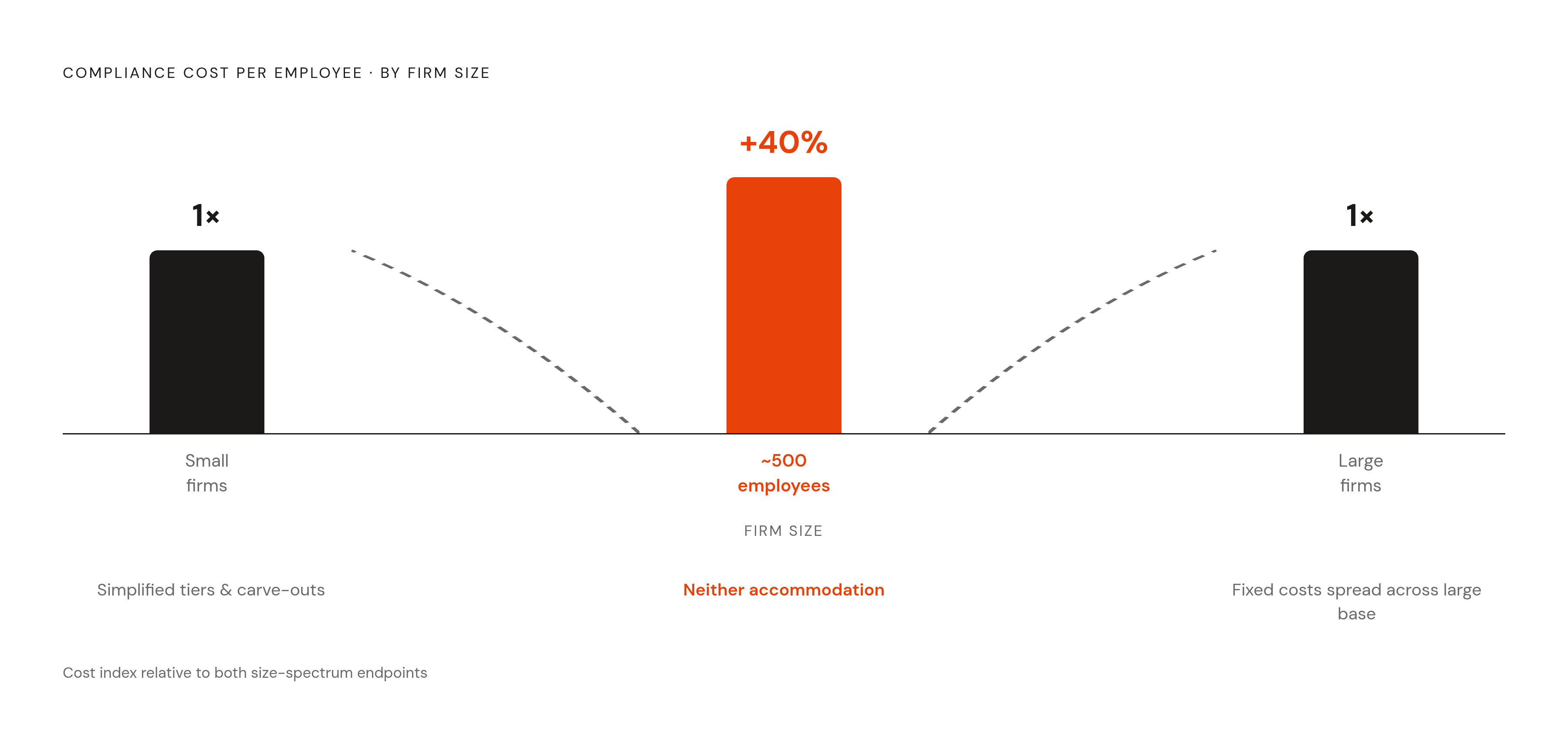
Mid-size companies face compliance costs 40% higher per employee than larger or smaller rivals.

Here's something that surprises most people when they first encounter the data: mid-size companies carry a heavier compliance burden than either small firms or large ones. Not slightly heavier. Meaningfully heavier.
Per a Cato Institute analysis, firms around 500 employees face compliance costs nearly 40% higher per employee than their counterparts at either end of the size spectrum. Large firms absorb compliance as overhead, spreading fixed costs across substantial revenue bases and staffing dedicated legal and compliance functions that make the per-unit cost manageable. Small firms feel the weight acutely, but regulators know it, which is why simplified tiers and carve-outs exist specifically for them. The 500-person company gets neither of those accommodations. Too big for exemptions, too lean for enterprise infrastructure.
A Q4 2024 U.S. Chamber of Commerce survey of 750 small businesses found that 69% spend more per employee on compliance than their larger competitors, and 44% outsource compliance entirely because building the internal capacity isn't viable. The average compliance cost per U.S. employee sits around $10,000 annually, and that number doesn't distribute evenly. It lands hardest in the middle.
The same regulation hitting a 600-person manufacturer and a 6,000-person manufacturer produces two very different operational realities, not because the rule reads differently, but because the cost structure underneath it does. Before you've said a word about sector, that size-based asymmetry is already shaping what compliance realistically looks like for your organization.
Financial services: the layered architecture of rules governing money, data, and risk
Financial services regulation isn't a single law. It's a stack, and every layer was added in direct response to a specific failure.
The foundation includes (i) Dodd-Frank, enacted after the 2008 financial crisis, which required higher capital reserves, stricter risk management, and a body (the Financial Stability Oversight Council) dedicated to monitoring systemic risk; (ii) Sarbanes-Oxley, governing financial transparency and investor protection for public companies; (iii) Gramm-Leach-Bliley, covering customer data privacy; (iv) PCI-DSS, governing payment card security; and (v) the Bank Secrecy Act and anti-money laundering rules, which form the baseline for any institution that touches transaction flows.
Dodd-Frank exists because insufficient capital reserves and unchecked systemic risk nearly collapsed the global economy in 2008. SOX exists because Enron and WorldCom demonstrated that accounting fraud at scale doesn't self-correct. Each regulatory layer in this sector reflects a documented failure from a prior period.
Cybersecurity has been embedded directly into financial regulation rather than treated as a separate IT concern, which is a meaningful shift in how the sector operates. New York's Department of Financial Services amended its cybersecurity regulation, 23 NYCRR Part 500, with full compliance under the Second Amendment taking effect in 2026 and active enforcement already underway. The SEC's cybersecurity disclosure rules require public companies to file a Form 8-K within four business days of a material incident. If you have not tested your incident response timeline against that requirement, treat it as an open gap.
The enforcement figures make the stakes concrete. The SEC ordered $8.2 billion in financial remedies in fiscal year 2024, including $600 million in penalties specifically for recordkeeping failures. In April 2025, Block paid $40 million to New York State for AML, BSA, and KYC deficiencies, on top of $255 million in earlier federal and state settlements. Recordkeeping failures in this sector can carry nine-figure consequences. That risk belongs at the center of your compliance program, not in the footnotes.
Emerging 2025 priorities include AI model risk governance, which has moved from theoretical guidance into active enforcement territory, and the first federal stablecoin framework, requiring 100% reserve backing and AML compliance. A Dun & Bradstreet survey from August 2024 found that over 75% of European compliance leaders reported a 35% rise in compliance workload over the prior year. Forty-eight percent of financial firms planned to increase compliance technology budgets in 2025, per PwC.
Each stratum of the regulatory stack in financial services has its own enforcement body, its own documentation requirements, and its own failure history that motivated it. That's not complexity for its own sake. It's the accumulated record of what happens when the prior version wasn't strict enough.
Healthcare: where privacy law, cybersecurity enforcement, and AI governance are converging
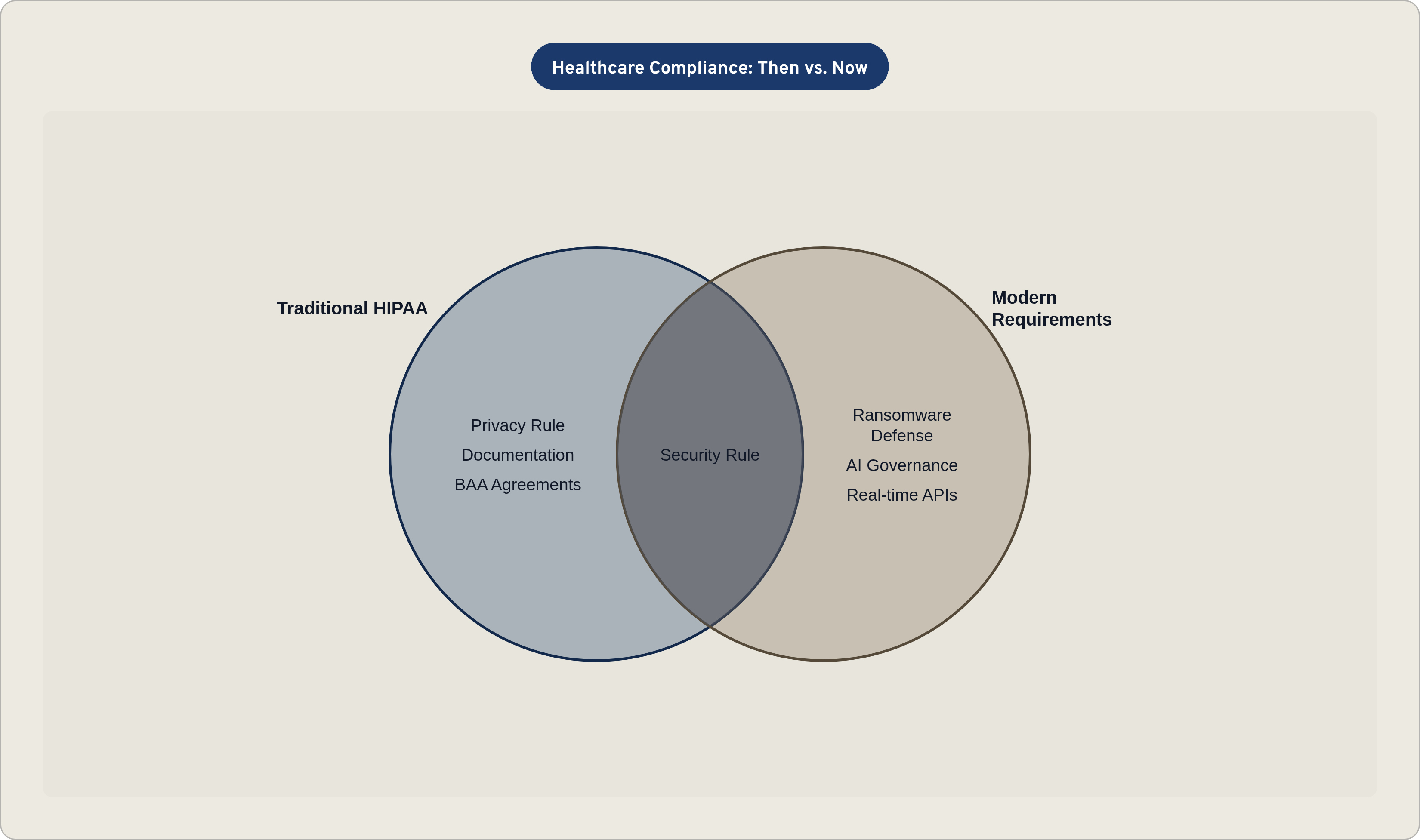
Healthcare compliance started as a paperwork discipline. HIPAA, enacted in 1996, established the governance structure for Protected Health Information through its Privacy Rule, Security Rule, and Breach Notification Rule. For most of the two decades that followed, compliance in this space meant policies, training, signed business associate agreements, and periodic audits. A documentation-heavy but relatively stable operating environment.
Ransomware broke that stability. The Office for Civil Rights documented a 264% increase in large ransomware breaches in the healthcare sector since 2018 and a 13% month-over-month increase in healthcare data breaches as recently as August 2025. Healthcare has ranked as the most expensive sector for data breaches for 14 consecutive years, with the average cost per incident at $7.42 million according to IBM's 2025 Cost of a Data Breach Report. Those figures point to a sector whose technical safeguards failed to keep pace with the threat environment, and that is the conclusion HHS reached in initiating updates to the HIPAA Security Rule.
HHS responded by publishing a Notice of Proposed Rulemaking on January 6, 2025, initiating the most significant update to the HIPAA Security Rule in over a decade. Compliance with remaining Notice of Privacy Practices modifications is required by February 16, 2026. By January 2027, APIs enabling real-time data exchange between patients, providers, and payers become enforceable, adding a distinct technical infrastructure compliance layer on top of existing security and privacy requirements. Most organizations are underestimating the lift that transition involves.
AI governance is arriving faster than the industry anticipated, and the speed matters. Forty-six percent of U.S. healthcare organizations are currently implementing generative AI. In September 2025, the Joint Commission partnered with the Coalition for Health AI to release the first comprehensive responsible AI guidance for U.S. health systems, affecting the accrediting body for over 23,000 organizations. That guidance asks you to answer hard questions: (i) what data do your AI systems consume, (ii) how are clinical decisions being shaped by that data, and (iii) where does liability sit when an AI-assisted decision goes wrong. Those aren't abstract governance questions. They're questions regulators are now formally asking.
Healthcare compliance is no longer primarily a privacy and documentation problem. It's increasingly a cybersecurity and technology governance problem that operates under HIPAA's statutory authority, and if your program was built for the prior version of this environment, it may already be behind.
Manufacturing and chemicals: where workplace safety, environmental law, and supply chain accountability overlap
Manufacturing sits at the intersection of more regulatory regimes than almost any other sector. Organizations in this space manage OSHA and EPA requirements simultaneously, along with everything layered on top, and the places where those regimes interact are where compliance programs fracture.
The baseline includes OSHA's safety suite covering hazard communication and lockout/tagout procedures, alongside EPA's core environmental statutes: the Clean Air Act, the Clean Water Act, and the Resource Conservation and Recovery Act, which governs hazardous waste from generation through disposal. Pharmaceutical and medical device manufacturers add FDA's current Good Manufacturing Practice regulations, codified in 21 CFR Parts 210, 211, and 820, covering facility design, equipment validation, process controls, and documentation requirements that rank among the most rigorous in any regulated industry.
Two developments from 2024 and 2025 are reshaping the environmental compliance landscape for manufacturers with global supply chains. The EPA established stringent PFAS thresholds in water and waste streams. Simultaneously, the European Union adopted REACH restrictions mandating phased elimination of PFAS in textiles, food packaging, electronics, and industrial products. Organizations operating in both jurisdictions must track two parallel regimes with different timelines and different technical thresholds. TSCA PBT deadlines also sharpened in 2024, with final restrictions on decaBDE and PIP 3:1 hitting electronics, automotive, and consumer goods sectors. That's not a documentation change. It requires supply chain reformulation.
The Uyghur Forced Labor Prevention Act establishes a rebuttable presumption that goods manufactured in China's Xinjiang region are produced with forced labor. To import those goods, an organization must provide clear and convincing evidence to U.S. Customs and Border Protection. Canada's Bill S-211 creates parallel reporting obligations. Compliance no longer stops at your facility's fence line. It extends into your suppliers' operations, and the documentation burden to demonstrate that is substantial.
GHG rules add a layer of genuine uncertainty that is itself a compliance cost. As of June 2025, the EPA proposed repealing 2024 power sector GHG rules, but the rules had not been stayed. For manufacturers with long capital planning cycles, maintaining compliance posture against a regulatory timeline that may shift is a real operational cost. Organizations cannot simply wait to see how it resolves.
ISO 45001 is worth naming here as the framework many leading manufacturers use to organize their occupational health and safety obligations into a manageable structure. It doesn't replace statutory requirements, but it gives compliance teams a coherent architecture to work within rather than an undifferentiated list of obligations with no organizing principle.
Energy: the sector where federal mandates, state authority, and market structure all shape what compliance means
Energy is unusual because compliance obligations don't arrive from one direction. They arrive simultaneously from federal regulators, state authorities, and the structure of the markets in which utilities and generators operate. A single infrastructure decision can trigger requirements across all three, often on different timelines, with different documentation standards and different enforcement bodies.
FERC governs wholesale electricity markets and interstate transmission. State public utility commissions govern retail rates and distribution. The EPA governs emissions. Those three oversight bodies don't always move in the same direction, which creates planning complexity other sectors rarely encounter at the same scale. Organizations can find themselves caught between state commission timelines and federal permitting requirements on projects where neither authority defers to the other's schedule.
Cybersecurity is treated as a national security issue in this sector, not merely a business risk, and the regulatory apparatus reflects that. NERC CIP standards, which cover bulk electric system operators, address access controls, incident reporting, supply chain risk management, and recovery planning. Fines for non-compliance can reach $1 million per violation per day. That figure reflects actual stakes: a compromised grid affects the physical infrastructure that millions of people depend on, and regulators set the penalty accordingly.
The EPA's June 2025 proposed repeal of 2024 power sector GHG rules has not resolved; utilities must maintain compliance posture while rule status remains unsettled. If you're making capital commitments that play out over 20 or 30 years, that ambiguity can carry a real dollar cost that shows up in planning decisions, not just operational budgets. There's no clean way to model a project's compliance cost when the regulatory baseline is under active litigation.
Renewable energy adds its own distinct compliance layer. Interconnection rules, permitting timelines, and land-use regulations vary significantly by state, creating jurisdictional complexity that fossil fuel developers, working from decades of established precedent, face to a lesser degree. Regulatory frameworks governing renewable infrastructure are still developing, and that development imposes its own costs on project planning.
In energy, compliance functions less like an annual audit exercise and more like a variable in every capital and infrastructure decision that compounds over decades. The sectors where you can treat compliance as a back-office function are not this one.
Data privacy: the cross-sector regulatory layer that now touches every industry
Every sector examined in this piece has a data privacy dimension, and that dimension has crossed from governance aspiration to enforceable compliance requirement. Total EU GDPR fines reached approximately €5.65 billion by March 2025. Fines in the range of €250 million to €345 million were issued in 2024 to companies including Uber and Meta. GDPR enforcement is a functioning penalty mechanism operating at a scale that affects earnings statements.
In the United States, there is still no single federal privacy law, and the gap is filled by sector-specific statutes: HIPAA for health data, GLBA for financial data, FERPA for education records, COPPA for children's data. An organization operating across sectors faces a patchwork where every layer has different thresholds, different opt-out mechanics, and different enforcement timelines. That's not a temporary condition pending federal preemption. It's the operating environment, and it has grown more complex every legislative session for the past several years.
State law is moving faster than federal. California's CPRA, Virginia's CDPA, and a growing matrix of state-level privacy laws mean that a multi-state business must track requirements that differ in material ways depending on where customers and employees are located. If your compliance program is built around federal baselines, it may already be underbuilt for this reality, and the gap between that program and your actual state-law exposure is likely widening.
The SEC's cybersecurity disclosure rule, effective December 2023 and actively enforced through 2025 and 2026, requires public companies to disclose material cybersecurity incidents on Form 8-K within four business days. A data breach is now also a disclosure event, with all the investor relations and legal exposure that implies. If you have not stress-tested your incident response processes against that four-day window, you are operating with an assumption that remains unvalidated.
AI data governance is where the privacy layer becomes the most consequential emerging compliance frontier. Healthcare's CHAI guidance and financial services' AI model risk requirements both turn on the same underlying questions: (i) what data do your AI systems consume, (ii) how are decisions made from that data, and (iii) who is accountable when the output causes harm. The privacy framework is where AI compliance will be adjudicated across sectors, because it's already the legal infrastructure governing data. Whatever sector you're in, data governance is now a compliance requirement. The only variable is which statute names it.
What the pattern across sectors tells us about navigating your own regulatory environment
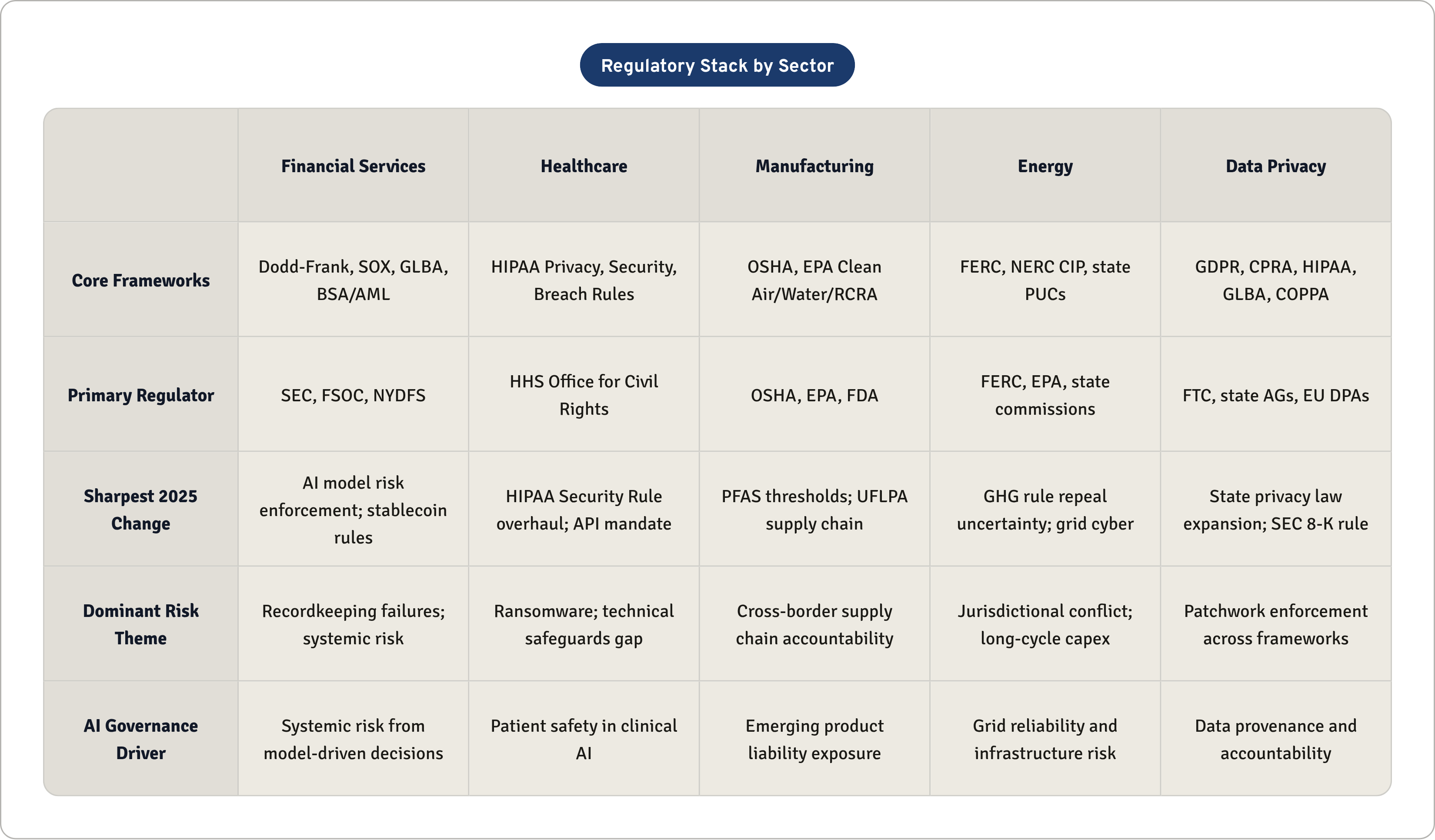
Every sector's regulatory regime exists because a specific category of harm was judged too serious to leave to market discipline alone. Patients can't audit hospital cybersecurity. Depositors can't assess a bank's capital adequacy. Workers can't independently evaluate their industrial chemical exposure. The regulation exists precisely because the party bearing the risk cannot protect themselves through market choices alone.
That logic is also predictive. When ransomware breaches in healthcare rise 264%, the HIPAA Security Rule update follows. When the 2008 crisis exposes systemic risk, Dodd-Frank follows. When supply chain opacity enables forced labor, the Uyghur Forced Labor Prevention Act follows. If you can identify where the next significant failure in your sector is most likely to occur, you have a working read on where the next regulatory requirement is most likely to land. Most compliance teams think about current obligations. Fewer think about where the regulatory frontier is moving and why.
Most organizations also sit at the intersection of multiple frameworks simultaneously, and that intersection is where programs break down. A hospital accepting card payments must comply with PCI-DSS. That same hospital holds employee data subject to state privacy law and is now deploying AI diagnostics that fall under emerging FDA and CHAI guidance. Treating these as a single unified checklist fails. They have different authorities, different timelines, different documentation requirements, and different enforcement consequences. The problem isn't usually ignorance of the rules. It's treating separate regimes as though they share a common logic when they don't.
The $10,000-per-employee average compliance cost and the $7.42 million average cost of a healthcare data breach are both consequences of under-investing in compliance relative to actual sector risk exposure. The breach cost isn't an anomaly. It's what happens when the compliance investment doesn't match the exposure, and when organizations find out, they find out at the worst possible moment.
AI governance is the next shared frontier across all sectors, and it will not arrive as a single cross-industry standard. It's arriving sector by sector, shaped by the same logic that produced every other rule here. Financial services is developing model risk requirements because AI-driven trading and credit decisions carry systemic risk. Healthcare is developing responsible AI guidance because AI-assisted clinical decisions carry patient safety risk. The SEC is shaping disclosure requirements for AI-related incidents because investors can't assess that risk on their own. The principles overlap. The authority structures and enforcement mechanisms don't. Treat AI compliance as sector-specific work from the beginning, not as a universal framework you'll adapt later.
Knowing which rules govern your space, and understanding why they exist, is the precondition for building a compliance program that's proportionate: neither under-engineered against real risk, nor wastefully over-engineered against risks your organization doesn't actually carry.