Penalties and Enforcement Trends in Sector-Specific Regulation

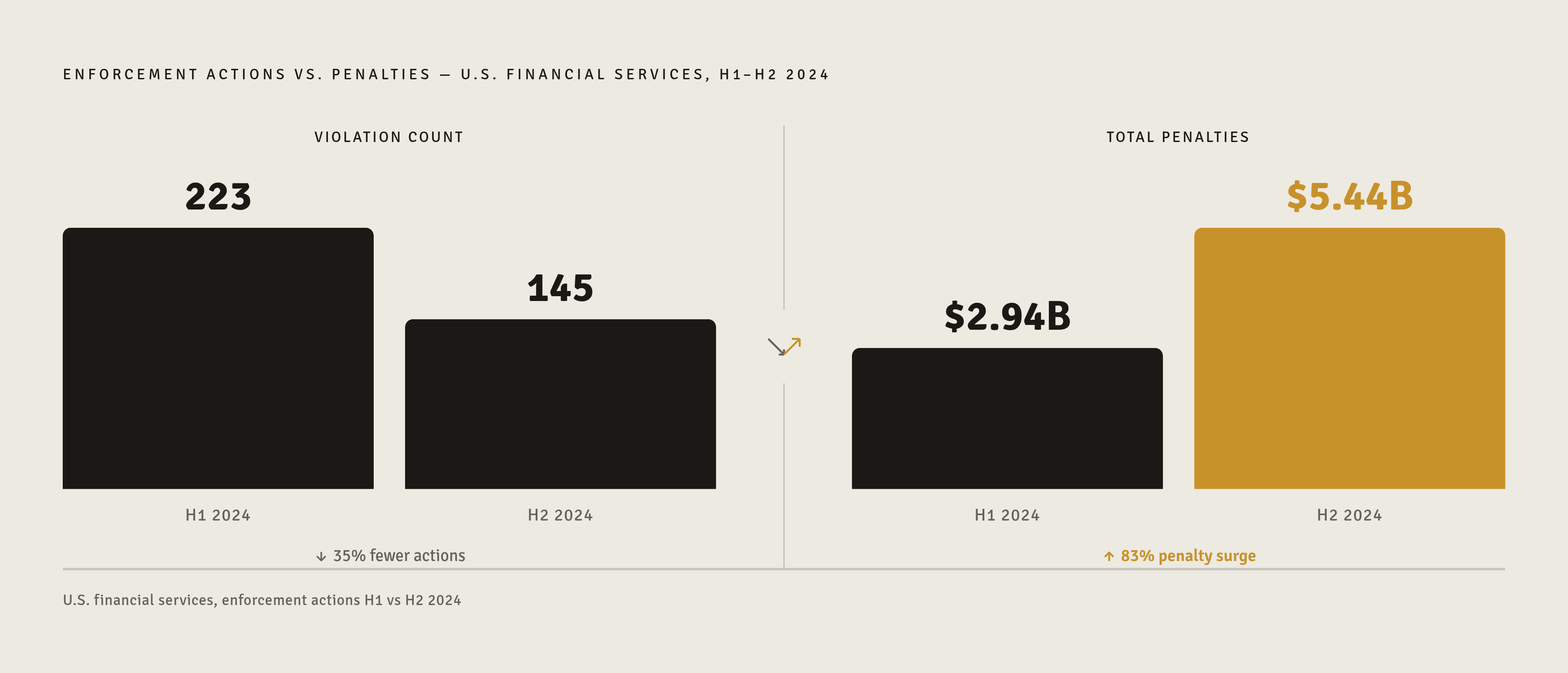
Start with the cleanest single data point available. Per Wolters Kluwer's Regulatory Violations Intelligence Index, U.S. financial services regulators issued 145 violations in the second half of 2024, down 35% from the first half of that year. Total penalties over the same period jumped 83%, from $2.94 billion to $5.44 billion. Fewer actions, dramatically more money. This isn't coincidental timing; it's the signature of a deliberate reallocation of enforcement effort. Regulators have stopped casting a wide net and started fishing with a spear.
The logic behind it isn't complicated once you've spent time inside these systems. Deterrence theory has always held that a single landmark penalty does more behavioral work across an industry than dozens of smaller ones. One $3 billion fine on a major bank sends a message that ten $300 million fines simply cannot replicate, because the $3 billion case becomes the case. It gets written about, litigated in the trade press, discussed in board risk committees, cited in regulatory guidance for years. The smaller cases disappear into the compliance calendar.
Resource constraint reinforces this. Enforcement agencies face real staffing pressures and finite legal bandwidth. Concentrating resources on the most egregious or highest-profile violators is a rational allocation under those conditions, and it produces more durable precedent. Cases selected for their jurisprudential value — the ones that expand legal interpretation or establish new standards — give regulators leverage over future enforcement that volume-based approaches simply can't generate.
What this changes for compliance leaders is the shape of the risk, not just the size of it. Traditional "likelihood times magnitude" models were calibrated for an environment where enforcement was broad, relatively predictable, and distributed across many firms. When the distribution narrows and penalties concentrate at the top, the probability of being targeted falls for most organizations. But the consequence if you are targeted has increased dramatically. Any model that discounts tail risk because the tail looks thin is now the wrong model — like ignoring a tornado because the sky looks clear most of the time.
How AML enforcement became the clearest expression of the strategy
No case illustrates the "fewer but bigger" posture more precisely than TD Bank. The bank's cumulative U.S. penalties reached $3 billion: a $1.7 billion criminal fine from the DOJ and $1.3 billion from FinCEN. Those numbers alone would make the case notable. But the detail that elevates it beyond a fine story is the Federal Reserve's asset cap on TD's U.S. growth. A deficient transaction monitoring program became a multi-year operational constraint, not a one-time settlement. The bank's ability to grow its American business is now contingent on satisfying regulatory conditions about the quality of its compliance infrastructure. TD Bank didn't just pay a fine; it paid with its future.
Transaction monitoring violations exceeded $3.3 billion in penalties in 2024, a 100% year-over-year increase per Fenergo. The subcategory where concentration is most extreme is also the one with the most operationally definable failure mode: you either have a functioning transaction monitoring system or you don't. Regulators are not struggling to prove the violation. Rather, they are choosing to price it at a level that makes non-compliance existentially expensive.
The Starling Bank case applies the same logic to a different institutional profile. The FCA's £28.96 million fine was explicitly tied to the finding that growth had outpaced customer due diligence infrastructure. Starling opened more than 54,000 accounts for high-risk customers during a period when the FCA had explicitly restricted it from doing so. The regulatory message is direct: scaling fast without scaling compliance is no longer a forgivable startup trade-off. The fintech challenger model, built on the premise that regulatory friction is something you negotiate down as you prove market fit, has run into an enforcement environment that disagrees.
Crypto's presence in the large-penalty category is disproportionate and not accidental. FTX was ordered to pay $12.7 billion, the largest recovery in CFTC history, and digital asset firms accounted for nearly a quarter of the top ten highest-value fines in 2025. That concentration reflects both deliberate enforcement priority and the scale of the underlying violations. The sector's extended period of regulatory ambiguity is closing.
The SEC's record-dollar, low-volume year and what changed under new leadership
Fiscal year 2024 produced 583 SEC enforcement actions, down 26% from 784 the prior year, alongside $8.2 billion in financial remedies, the largest total in the agency's history. More than half of that figure flows from a single $4.5 billion judgment against Terraform Labs and Do Kwon. The Terraform Labs case is simultaneously evidence of the strategy and a warning about reading headline numbers uncritically. Strip that one case, and the dollar total looks very different. The concentration that defines the "fewer but bigger" pattern is sometimes so extreme that a single outcome can determine whether a given year looks like a record or a retreat.
Fiscal year 2025 sharpened the leadership-driven dimension. The action count fell to 456, the lowest in at least two decades. Headline monetary relief reached $17.9 billion, but after excluding "deemed satisfied" amounts and continuing Stanford Ponzi litigation, actual new relief combining disgorgement and civil penalties came to roughly $2.7 billion. The Gensler-era Division filed more than half of the year's actions between October 2024 and inauguration day, a pace the Division itself described as unprecedented, which means comparing fiscal year 2025 cleanly to prior years requires accounting for that front-loading.
What disappeared under the Atkins-led Commission is analytically significant. Enforcement actions involving off-channel communications, whistleblower rule violations, non-fraud crypto offerings, and cyber matters were effectively suspended as categories. These weren't edge cases. Off-channel communications alone had generated substantial penalty volume across multiple fiscal years, touching firms from global banks to boutique advisors. Their absence reflects a deliberate reprioritization, not a finding that the underlying conduct stopped.
Compliance leaders who treat the SEC's current posture as a permanent baseline are making a structurally unsound assumption. The institutional capacity for aggressive enforcement was built deliberately, staffed over years, and can be rebuilt. Priority has changed. Power has not. The enforcement architecture is intact.
GDPR enforcement's concentration problem and the sectors now in its sights
Since GDPR's inception in 2018, European regulators have issued more than 3,000 enforcement actions and assessed total fines exceeding €6.31 billion. The distribution, though, is strikingly skewed. A handful of large tech cases account for a disproportionate share of that cumulative total, and the year-over-year volatility in aggregate fine totals reflects the timing of individual cases more than any genuine shift in enforcement posture.
The 2024 dip illustrates the concentration dynamic in reverse. GDPR fines that year came in at approximately €1.2 billion, roughly 33% below the prior year, almost entirely because the €1.2 billion Meta fine had fallen in 2023. The enforcement intensity didn't change; the timing of a single large case did. What 2024's fines actually looked like: a €290 million Dutch DPA fine on Uber for improper EU-to-U.S. data transfers, a €310 million Irish DPC fine on LinkedIn for behavioral advertising data misuse, a €251 million Irish DPC fine on Meta for the 2018 Facebook breach. Then, in April 2025, the Irish DPC assessed €530 million against TikTok for transferring European user data to China. By any reasonable historical standard, these are substantial penalties. They only read as a "slowdown" against the anomalous scale of the largest Big Tech cases.
The forward-looking signal is the expansion beyond Big Tech. European regulators are increasingly targeting finance, healthcare, and energy. Sectors that spent five years watching GDPR enforcement from a comfortable sideline now find themselves explicitly named in supervisory priorities. The legal frameworks that exposed large technology platforms have always applied equally to a regional bank, a hospital network, or an energy utility. Regulators are simply getting to them now.
Personal liability is the next structural escalation. The Dutch DPA's announced investigation into whether directors of Clearview AI can be held personally liable for the company's violations shifts enforcement pressure from the entity to individuals. That changes the internal incentives for boards and executives in ways that entity-level fines alone cannot. Explaining to a board that the company faces a material fine is one conversation. Explaining that board members face direct personal consequences is a different conversation entirely.
The UK divergence is a genuine outlier worth noting plainly. ICO Commissioner John Edwards has publicly rejected fines as his primary enforcement tool, preferring outcomes-focused supervisory engagement. That posture is coherent and not irrational, but it means the "bigger" half of "fewer but bigger" is not universal even within privacy enforcement. Compliance programs with UK-specific exposure are operating in a meaningfully different environment than those facing Irish DPC jurisdiction.
The EU's new digital and AI penalty frameworks before any fines have landed
The Digital Markets Act is no longer theoretical. Apple received a €500 million fine for anti-steering violations; Meta received €200 million for failing to offer a less data-intensive service option. Activist pressure for structural remedies beyond monetary penalties intensified following the €2.95 billion Google DMA fine, and the enforcement logic tracks precisely: large technology platforms with the ability to absorb enormous fines will only change behavior when structural constraints are attached.
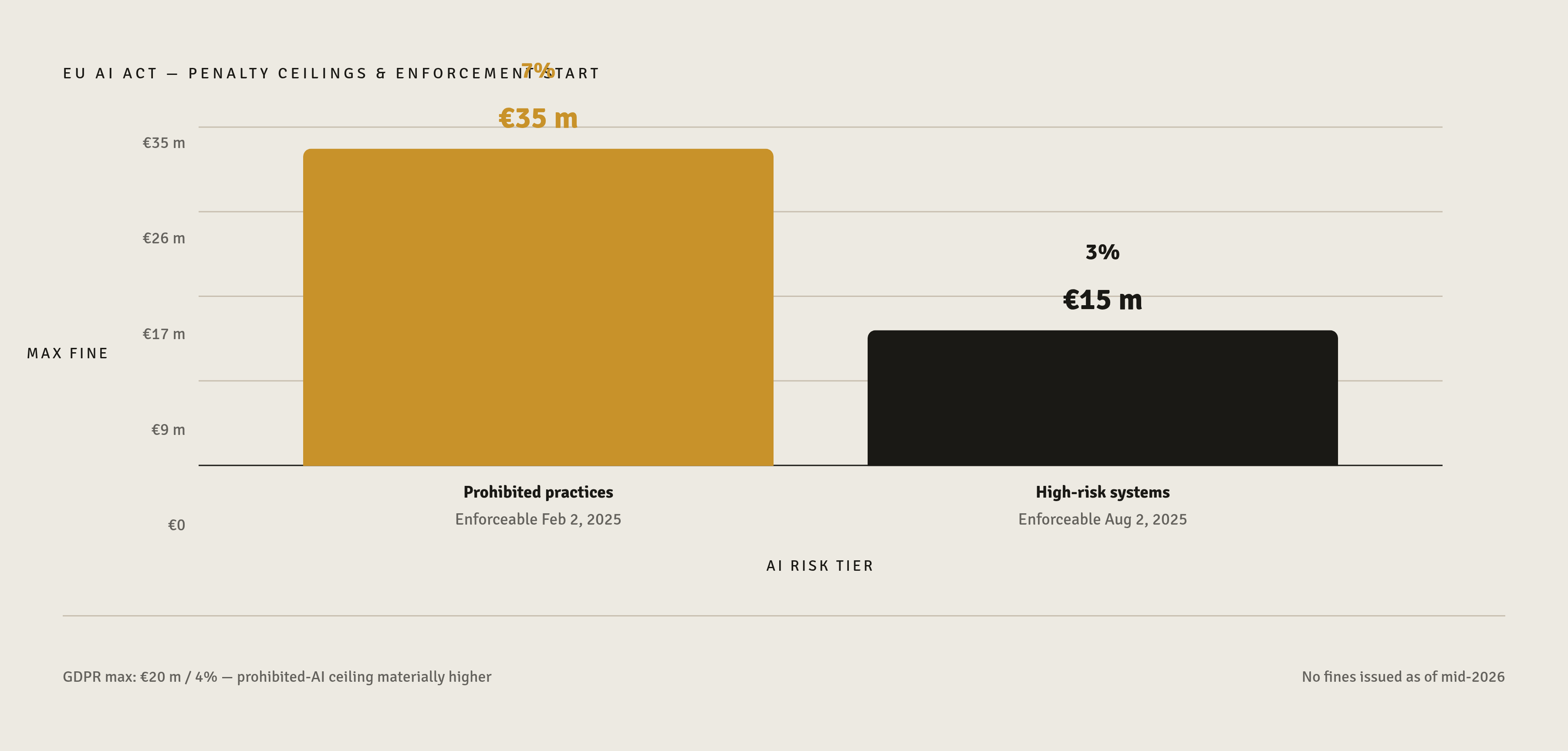
The EU AI Act introduces a penalty architecture that materially exceeds GDPR's maximum percentages for the most serious violations. Prohibited AI practices carry penalties of up to €35 million or 7% of global annual turnover. High-risk AI system non-compliance sits at up to €15 million or 3% of global turnover. Prohibited practices became enforceable as of February 2, 2025; the full penalty framework under Article 99 became applicable from August 2, 2025. As of mid-2026, no public AI Act fines have been issued, though the European Commission launched its first formal investigations into potential prohibited AI practices in early 2026.
The absence of fines in the initial period is itself a compliance planning problem, and it's one I don't think enough organizations are taking seriously. When there is no enforcement history, there is no pricing signal. Firms cannot benchmark against precedent that doesn't yet exist, which means they cannot make calibrated judgments about acceptable risk. The first AI Act fine, when it comes, will almost certainly be calibrated to signal rather than merely to punish — a shot across the bow loud enough to be heard in every boardroom in Europe. The Commission has already demonstrated this approach in GDPR and DMA enforcement; it is the established institutional playbook. Organizations that have failed to invest in AI compliance infrastructure before that first case are behind the curve, waiting to be made an example.
Trade compliance and sanctions: where penalty volume fell but severity intensified
OFAC issued 12 public enforcement actions in 2024, down from 17 in 2023, assessing roughly $48.8 million in civil monetary penalties. That figure is a fraction of 2023's $1.5 billion record, though largely consistent with 2022 levels. The 2023 figure was the outlier, driven by a concentration of large cases that skewed the annual total in the same way single large cases distort GDPR and SEC annual statistics. Reading 2024 as a retreat from sanctions enforcement misunderstands what happened.
The real signal in OFAC enforcement is not the dollar total but the targeting logic. OFAC consistently and explicitly imposes harsher penalties on parties that knowingly violated sanctions and attempted to conceal their conduct. This concealment premium is not implicit; it is stated in enforcement guidance and visible in penalty calculations. The distinction between a firm that violated sanctions through a control failure and a firm that violated them knowingly and then structured its communications to obscure the violation is the difference between a moderate civil penalty and a landmark case. Documentation posture and disclosure behavior are not soft compliance considerations in this domain. They are primary determinants of outcome severity.
DOJ enforcement in FCPA and export controls moved in a different direction during 2024, with roughly one-third more penalties than the prior year. An aerospace and defense company received a $364 million fine combining FCPA and export control violations. Advanced technology, including semiconductors and AI components, emerged as the focal category for export control enforcement, with dedicated investigative resources targeting circumvention routes that exploit indirect suppliers or intermediary jurisdictions. This is a structural priority, not a temporary spike. It reflects the broader geopolitical logic that national security concerns will continue to drive enforcement intensity in this domain regardless of broader deregulatory trends elsewhere.
The U.S. deregulatory countercurrent and why it doesn't neutralize the risk
Enforcement actions against U.S. financial firms fell 37% and monetary penalties dropped roughly 32% in early 2025, per Wolters Kluwer. That is a real and measurable pullback. It is not an illusion, and dismissing it as noise would be inaccurate.
The CFPB's effective suspension beginning February 14, 2025, is the most dramatic institutional change. Acting Director Vought instructed staff to cease supervision, investigations, enforcement, rulemaking, and stakeholder engagement. Bureau staff fell from roughly 1,700 to under 200. Nearly 70 interpretive rules, policy statements, and circulars were rescinded. Whatever one's view of the CFPB's prior aggressiveness, the operational reality is that a major consumer financial protection apparatus was substantially dismantled in a matter of weeks. The FTC's institutional stability was similarly tested when the President removed two sitting Democratic Commissioners, leading to the April 2025 stay of the FTC's September 2024 administrative action against major pharmacy benefit managers.
But the deregulatory environment is jurisdiction-specific, and that specificity is where compliance leaders need to be precise. EU enforcement under GDPR, the DMA, and the AI Act continues on its own trajectory, entirely indifferent to U.S. political conditions. State-level regulators in the U.S. are not bound by federal pullback; state attorneys general and financial regulators have historically expanded their enforcement activity when federal agencies contract. DOJ national security, sanctions, and export control enforcement has not retrenched.
There's also a concentration effect worth keeping in mind. In domains where federal enforcement continues, fewer selected targets means each pursued case carries more signal value for regulators. The expected penalty for a firm that does get targeted is larger, not smaller, in a low-volume enforcement environment. Compliance functions that read a deregulatory environment as permission to reduce investment are correctly identifying which risks have diminished while misidentifying which risks remain fully intact, and in some respects have intensified.
What the concentration pattern means for how compliance leaders allocate attention
The traditional compliance risk model was built for a world of broad enforcement: distribute resources reasonably across regulatory obligations, maintain defensible programs everywhere, and accept that some violations will occur at the margins. That calibration made sense when regulators pursued volume. It is now misaligned with the environment that actually exists.
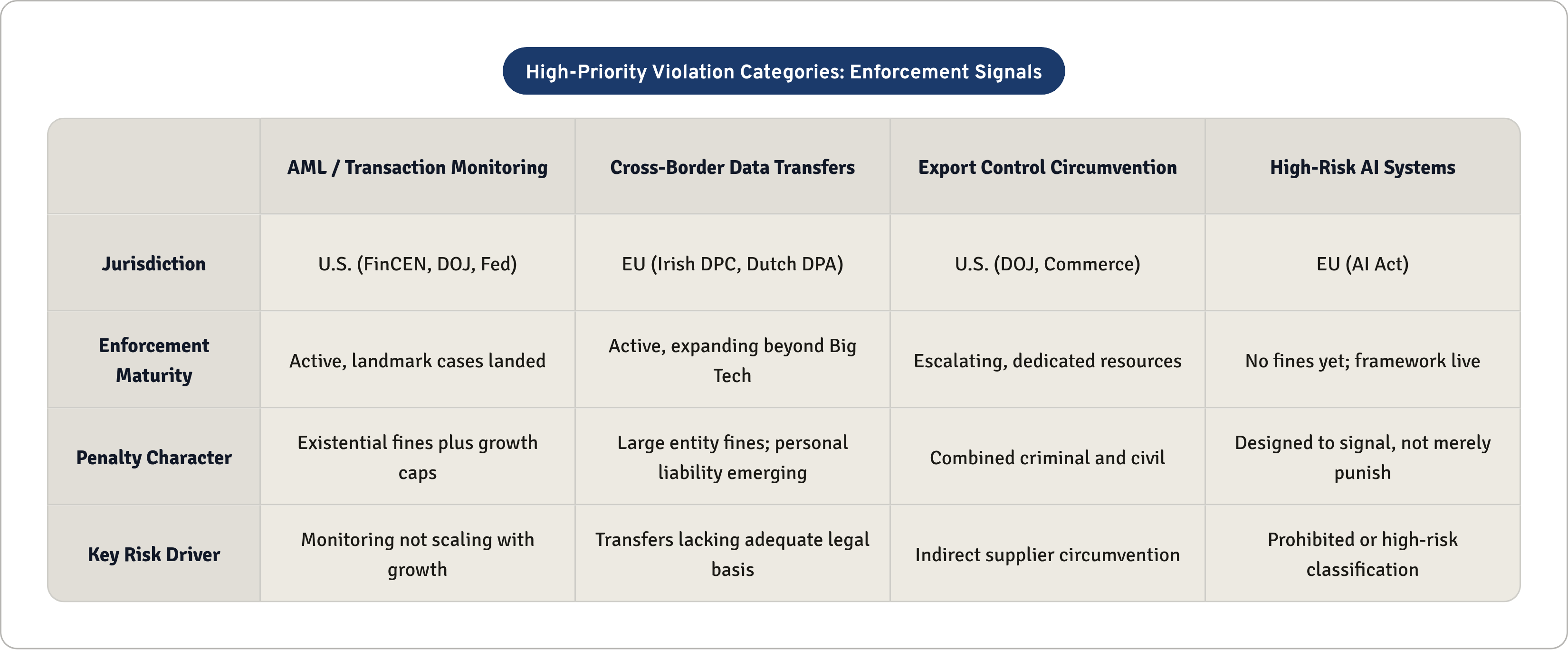
The violation types drawing concentrated enforcement attention are identifiable and consistent across jurisdictions. Transaction monitoring and AML infrastructure failures, especially where monitoring programs did not scale with business growth, have produced the most extreme penalty concentration in the financial sector. Cross-border data transfers without adequate legal basis remain the most reliably enforced GDPR category, with recent cases demonstrating that no company is too large or too small for a major enforcement action. Export control circumvention in advanced technology supply chains, particularly through indirect channels, has become a dedicated investigative priority. AI systems classified as high-risk or potentially prohibited under the EU AI Act represent a forward category with no enforcement history yet but a penalty architecture designed to produce landmark cases. Off-channel communications, where recordkeeping obligations clearly apply, drove years of SEC enforcement under prior leadership and retain legal standing regardless of current enforcement priorities.
Remediation posture is itself an enforcement variable. TD Bank and Starling Bank both faced penalties in part for failures that were known to regulators before the penalty was assessed. How a firm responds to identified weaknesses, whether it moves decisively to remediate or treats regulatory observations as items to manage on a rolling basis, is visible to supervisors and factors into how aggressively they pursue formal enforcement. Treating a regulatory finding as a documentation exercise rather than an operational priority is how firms create the conditions for the next large-penalty case.
The personal liability trajectory in GDPR enforcement and the structural remedies sought under DMA enforcement suggest the next phase will not be limited to entity-level consequences. The Clearview AI director investigation is an early data point, but it reflects a logical progression: when entity-level fines fail to change behavior because the entities are large enough to absorb them, regulators escalate to structural remedies and individual accountability. Boards and executives in regulated industries have genuine personal exposure, and internal compliance investment should reflect that reality.
The geopolitical fragmentation of enforcement is a real planning variable. A compliance posture built around a reduced U.S. federal enforcement environment is simultaneously under-resourced for GDPR, AI Act, or DMA exposure in the same organization. Global compliance programs require a multi-jurisdiction view that cannot be flattened into a single regulatory environment assessment. The risk hasn't disappeared. It has migrated, concentrated, and in some places grown. The firms that recognize that distinction early are the ones that won't be explaining tail risk after the fact.