Long read Compliance Automation
Continuous Controls Monitoring in Financial Services
Automated monitoring closes the compliance gaps that quarterly audits by design cannot catch.
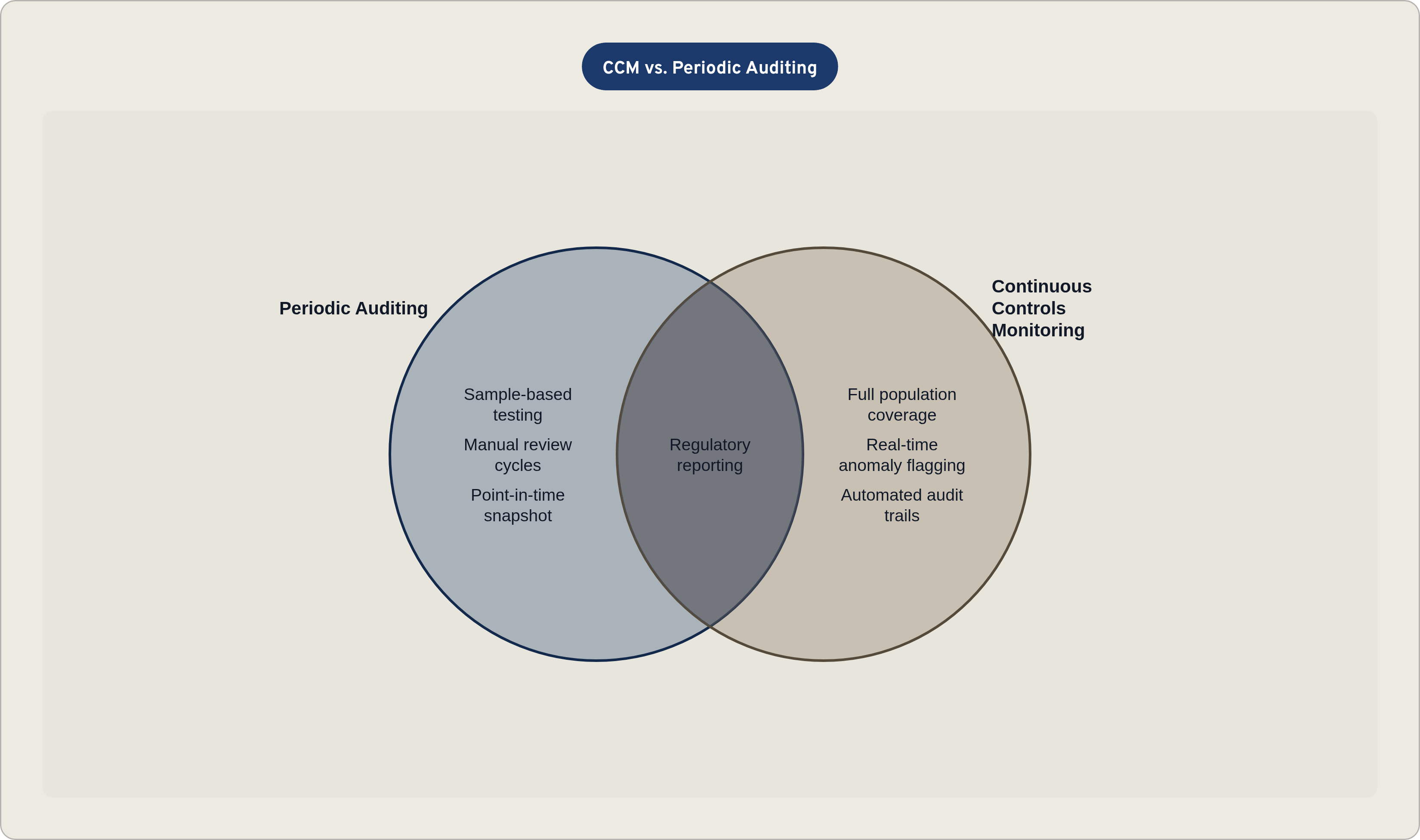
Periodic auditing was never designed to catch problems in real time. It was designed to provide reasonable assurance, at a point in time, that a sample of transactions or controls behaved as expected. The operative word is "sample." A quarterly access review checks who had what permissions on the day someone ran the report. It says nothing about what happened in the ninety days before, or the ninety days after.
How did this become the standard? Largely because it was the only thing operationally feasible. Manual testing has hard capacity limits. Compliance staff can review a thousand records in a cycle, not ten million. So the profession built frameworks around what was achievable, and regulators accepted those frameworks as adequate for decades. Nobody was being dishonest about this. The ceiling was structural, and the profession worked within it.
But what if the gap between "periodic and sampled" and "continuous and complete" is not a minor efficiency improvement? What if it is a structural flaw in how institutions understand their own risk posture? McKinsey's 2025 RegTech analysis puts a number to that intuition: a U.S.-based bank running legacy manual compliance met only 75% of its regulatory requirements before automated tooling pushed that figure above 95%. A 20-point gap in control coverage, invisible to the institution because the testing methodology itself had a ceiling, is not a performance problem. It is an architectural one.
The resource misallocation compounds it. Compliance staff spend enormous proportions of their cycles on rote execution: pulling reports, comparing lists, documenting results. That is not analysis. It is data management, performed by expensive people who were hired to think. I have sat in enough quarterly review meetings to recognize the particular exhaustion of smart people doing work a script could handle. It is like watching a chess grandmaster spend their day sorting paperclips — the capacity is there, but the work does not reach it.
Continuous controls monitoring addresses both problems simultaneously. CCM, defined precisely, is the automated, ongoing verification that internal controls are operating as designed across the full population of relevant transactions, access events, or process steps. Not a sample. Not on a schedule someone set in a spreadsheet three years ago. It covers three broad categories: financial controls (transaction integrity, reconciliation, authorization), technological controls (access, security configuration, system integrity), and internal controls (policy adherence, process compliance, separation of duties). Exceptions get flagged as they occur. Audit trails generate automatically.
One distinction worth preserving before moving forward: CCM and continuous auditing are related but not identical, despite what vendor literature often implies. CCM monitors whether controls are working. Continuous auditing evaluates the financial data outputs those controls are meant to protect. Conflating them leads institutions to buy one when they need the other, or to assume they have covered both when they have addressed only one. It is a small confusion with outsized implementation consequences.
Speed is no longer a preference; it is a material control variable
The financial services sector absorbed 744 data compromises in 2023, making it the second-most targeted industry for cyber incidents. In the first half of 2024 alone, that figure reached 407, a 67% increase over the same period the prior year. Sixty-five percent of financial organizations reported ransomware attacks in 2024.
Why exactly does this matter for controls monitoring specifically? Because the detection gap is where damage accumulates. A control failure caught in eight minutes is a categorically different event from one caught in three months. In the interval between failure and detection, fraud transactions clear, unauthorized access persists, regulatory violations compound. IBM's 2024 Cost of a Data Breach Report puts the global average breach cost at USD $4.88 million, a 10% rise year-over-year. The average in financial services exceeds $6 million per incident. The IMF has documented more than 20,000 cyberattacks against the financial sector over two decades, cumulative losses exceeding $12 billion. This is not episodic bad luck. It is a structural exposure that periodic testing cannot address by design.
One might argue that incident response teams, not compliance monitoring, are the appropriate countermeasure to cyberattacks. That argument has merit in isolation. But financial controls and cybersecurity controls are not separate domains anymore. Unauthorized access to a payment system is simultaneously a technology security event, an internal control failure, and a potential regulatory violation. CCM operates across all three. When a user account acquires permissions it should not have, CCM flags the anomaly before the system is touched, before the transaction clears, before the auditor schedules the meeting.
The cost of non-compliance adds another layer that surprises people when they see it written down. When fines, legal exposure, operational downtime, and reputational damage are aggregated, the global average cost of non-compliance reaches $14.82 million. That figure exceeds breach costs by a meaningful margin. Getting hacked is expensive; failing to demonstrate you were monitoring is often more expensive. That asymmetry should inform how institutions prioritize investment, and frequently does not.
Regulators have stopped asking nicely
Regulatory frameworks are converging on continuous monitoring requirements with a specificity that leaves less interpretive room than institutions prefer.
In the United States, the OCC's heightened standards under 12 CFR Part 30 Appendix D have long codified the expectation that risk management is ongoing and enterprise-wide. That language was aspirational for years. It is increasingly operational. In April 2026, the Federal Reserve, OCC, and FDIC replaced SR 11-7 with SR 26-2 for model risk governance, retaining core requirements for continuous monitoring and independent validation while adopting a more risk-based calibration. The direction is clear: ongoing monitoring is not a best practice. It is a documented expectation subject to examination.
The SEC's 2024 enforcement record adds texture. The agency issued more than $600 million in fines for messaging violations in that year alone. Not fraud. Not material misrepresentation. Failures to maintain adequate monitoring of communications channels. That enforcement posture tells you something uncomfortable: gaps in control coverage, independent of intent or outcome, are now fine-worthy events. "We test quarterly" draws follow-up scrutiny in examination conversations that it simply did not draw five years ago.
That raises an important question about the EU trajectory, because it suggests U.S. regulators are not moving in isolation. DORA entered application in January 2025, applying to approximately 22,000 EU-regulated financial entities. It mandates ICT risk management frameworks, incident reporting, resilience testing, and third-party oversight at a level of specificity that essentially requires continuous monitoring infrastructure to satisfy. As of the 2026 enforcement cycle, only an estimated 50% of institutions are fully compliant. Penalty exposure reaches 2% of annual worldwide turnover. For any institution that assumed DORA was primarily a European problem, that is a consequential miscalculation.
The EU AI Act overlay, effective from August 2026, extends the logic further. Article 12 mandates automatic logging over the lifetime of high-risk AI systems. Article 72 requires active, systematic data collection on system performance. If a financial institution uses AI-driven processes for credit decisions, fraud detection, or customer risk scoring, those articles effectively require CCM logic to be built into the AI infrastructure. The regulation is not calling it CCM. But the operational requirement is functionally identical.
Two regulatory jurisdictions, operating independently, arriving at the same requirement: ongoing, documented, automated control verification. That is not coincidence. It is regulators responding to the same threat environment the industry is navigating, and doing so with more precision than many institutions anticipated.
What if it is a structural flaw in how institutions understand their own risk posture?
The use cases are not abstract; they are specific and demanding
CCM is not a single capability deployed uniformly. Each application domain requires a different data source, a different control definition, and different threshold logic. Understanding what each use case actually demands is where implementation decisions get made or made badly.
Transaction monitoring and fraud detection. CCM automatically scans full transaction populations, identifies behavioral patterns, and flags anomalies for investigation rather than waiting for batch review cycles. The shift is from after-the-fact sampling to real-time pattern recognition. The operational requirement is integration with transaction processing systems at sufficient depth to capture the signal before the transaction clears or the window for intervention closes.
AML compliance. AML controls need to track effectiveness as customer risk profiles evolve, transaction behavior shifts, and regulatory thresholds change. The monitoring cannot be static; it has to adapt to a moving target. The Coinbase Europe enforcement action in November 2025 is the canonical case study. The Central Bank of Ireland fined the firm tens of millions of euros after a configuration fault allowed tens of millions of transactions totaling hundreds of billions of euros to go unmonitored for twelve months. The fine is large. The reputational and regulatory relationship damage is harder to quantify. The root cause was not fraud or intent; it was a configuration gap that no one caught because the monitoring was not continuous. That distinction matters enormously when explaining the failure to a board.
Identity and access management. The traditional model runs quarterly or monthly access reviews, with compliance staff manually comparing employee roles to permission lists. CCM continuously compares user access states, flagging excessive or misaligned permissions as they appear rather than ninety days later. The operational requirement is integration with IAM systems and clear logic for what constitutes an exception, because the volume of access events in a large institution is too high for human review without algorithmic triage.
Separation of duties. In complex financial systems, SoD violations accumulate between periodic reviews without anyone's knowledge. A single user acquires conflicting authorization rights across two systems that were never designed to communicate, and the violation persists until the next review cycle catches it, if it does. CCM surfaces those conflicts immediately. The operational requirement is mapping SoD rules across system boundaries, which is harder than it sounds in institutions with heterogeneous technology stacks.
Cybersecurity controls. Continuously testing security configurations, verifying that controls remain active and correctly configured, identifying unauthorized access attempts. The integration requirement spans security tooling, network infrastructure, and endpoint management. The alert logic needs to distinguish genuine anomalies from noise, because false positives at scale create their own compliance workload. A system drowning its reviewers in alerts is not monitoring; it is noise generation with better documentation.
The common operating logic across all of these: automated test execution against defined control criteria, exception flagging, audit trail generation. What varies is the data source and the control definition. That variance is where implementations succeed or fail.
The three-lines model doesn't go away; it changes jobs
The three-lines-of-defense model is not obsolete under CCM. But every line's function shifts enough that institutions routinely underestimate the organizational change required.
Under periodic testing, each line maintained its own testing cadence. The first line conducted its own control checks. The second line ran its own periodic oversight reviews. The third line executed annual point-in-time audits. The result was duplicated effort, gaps between cycles, and a structural inability for any line to know what was happening in real time. That is not a design flaw in the three-lines model; it is a consequence of manual testing capacity limits. The model was rational given its constraints.
Under CCM, the first line owns and operates controls in real time. It becomes accountable for daily control performance, not just for responding to audit findings after the fact. Business units that previously experienced compliance as something that happened to them during review cycles now have continuous visibility into their own control performance. Some organizations find that energizing. Others find it deeply inconvenient, and their response to that inconvenience is a leading indicator of whether CCM actually works at that institution.
The second line shifts from running periodic oversight tests to reviewing exceptions and analyzing trends. Monitoring dashboards replace scheduled sampling runs. The skill requirement changes: second-line staff need to interpret exception patterns and investigate root causes, not execute checklists. Those are different cognitive tasks, and not everyone makes that transition comfortably.
Third-line internal audit shifts furthest. Rather than executing control tests, audit's job becomes evaluating the CCM system itself: validating that the monitoring logic is correctly designed, that alert thresholds are appropriately calibrated, that exceptions are being acted on within defined timelines. Under SR 26-2, that validation function is a documented requirement. Audit becomes the quality assurance function for the monitoring infrastructure, which is a substantively different role than most audit teams were built to perform.
The redundancy reduction is real. When the first line continuously monitors and the second line has real-time visibility, much of the overlapping verification work that each line previously performed separately can be consolidated. But that consolidation requires deliberate redesign. It does not happen automatically because a platform was purchased, and that assumption is where a surprising number of implementations stall.
The market is not debating whether this shift is real
CCM sits within the broader governance, risk, and compliance platform market, where financial services is the dominant end-user segment. The BFSI sector held approximately 34% of the GRC market in 2025, the largest single segment.
Market sizing estimates diverge substantially depending on scope definition and methodology. IMARC Group puts the global GRC platform market at USD $54.7 billion in 2025, projecting USD $135.6 billion by 2034. Spherical Insights estimates USD $65.08 billion in 2025, with growth to USD $277.4 billion by 2035. Technavio projects incremental growth of USD $46.975 billion between 2026 and 2030. The numbers do not agree with each other precisely, and treating any single figure as authoritative would be a mistake. But the direction is unambiguous: growth at that scale, across multiple independent analyses, reflects broad institutional commitment to automating compliance infrastructure. This is not early-adopter experimentation anymore.
More than 75% of large enterprises have implemented at least one integrated GRC platform. Around 68% report using automated compliance monitoring tools. The industry has moved past the "whether" question. It is now in the "how well" phase, which is where implementation quality and vendor selection actually matter.
Implementation is where good intentions go to die
The single most common mistake in CCM implementations is treating the platform purchase as the project. It is not. The platform is the mechanism. The project is defining which controls to monitor, writing the test logic, establishing exception-handling workflows, assigning accountability for acting on alerts, and then verifying that all of it actually works.
That last step is where SR 26-2 becomes operationally relevant. Independent validation of the monitoring logic is a requirement. If alert thresholds are miscalibrated, the CCM system produces either a flood of false positives that overwhelm the review function or a trickle of alerts that miss real exceptions. Both failures are invisible to the institution unless someone validates the logic independently. The Coinbase Europe case is instructive again: the violation was a configuration fault, not a policy failure. A gap in the monitoring logic that no one caught for twelve months. The controls existed on paper. The monitoring did not.
What should financial institutions evaluate when selecting tooling?
Coverage is the baseline question: can the platform monitor the full range of financial, technological, and internal controls the institution needs to test? Many platforms are strong in one domain and thin in others. An institution that buys a strong transaction monitoring tool and assumes it addresses access management will have a gap it does not know about, which is precisely the situation CCM is supposed to prevent.
Integration depth matters more than coverage claims. A platform requiring heavy customization to connect to core banking systems, ERP, IAM, and transaction platforms will consume implementation resources at a rate that delays value realization significantly. Ask specifically about integration methodology, not just integration capability. Those are different questions, and vendors who conflate them are telling you something.
Alert logic and tuning are where platforms differentiate meaningfully over time. How are thresholds set initially? How does the platform reduce false-positive volume as it learns the institution's environment? A system generating thousands of alerts per day that no one can review is operationally equivalent to a system with no monitoring at all. It is just more expensive and better documented.
Audit trail and reporting outputs need to satisfy regulatory examination standards: documentation sufficient for SR 26-2 validation, DORA compliance, and SEC examination. Ask for examples of examination-ready outputs before selecting a platform. The vendor's response to that request is informative regardless of what the outputs look like.
The managed service versus in-house operation question is genuinely consequential and institution-specific. Organizations deploying CCM as a managed service trade operational control for implementation speed and specialized expertise. Organizations building internal capability develop a durable competency but require different staffing and a longer ramp. The right answer depends on the institution's existing technology and compliance capabilities, not on what the vendor prefers to sell.
Vendors operating in this space include established GRC platform providers such as MetricStream and Pathlock, as well as strategy-first platforms that combine automated monitoring logic with workflow tooling designed to close the alert-to-action cycle quickly. The differentiator worth scrutinizing is not coverage breadth in a features matrix; it is how fast and how reliably the platform moves an institution from detection to documented resolution. That cycle time is the operational metric that determines whether CCM actually reduces exposure or merely documents it.
Sequencing matters for institutions not starting from a mature GRC foundation. Every community bank and mid-size institution I have seen attempt full-population monitoring of every control simultaneously has underdelivered and lost organizational credibility for the program in the process. The more defensible approach starts with the highest-risk or highest-volume areas: transaction monitoring, access reviews, SoD violations. Demonstrate operational competency there, validate the alert logic, establish the escalation workflows, then expand coverage. Plante Moran's 2025 guidance for community banks makes this point explicitly: strengthening internal controls requires both the right tooling and defined ownership. Technology without clear accountability for acting on alerts does not improve on the old model. It replicates its gap at higher cost and with more sophisticated documentation.
But what if the organizational change is harder than the technology? In most implementations, it is. The first line taking genuine ownership of real-time control performance is a cultural shift, not a software deployment. The second line doing analysis rather than testing requires different skills than most compliance functions currently have in depth. The third line validating monitoring logic rather than executing tests requires auditors who understand the technology well enough to evaluate whether alert thresholds make sense. None of that follows automatically from a platform purchase, and vendors who imply otherwise are selling the easy part.
CCM works when the institution commits to the operating model change alongside the technology investment. It underdelivers when the technology is purchased and the organizational model is left intact. The financial services industry has enough examples of both by now to know which path it is on before the implementation begins. The question is whether anyone is willing to say so out loud before the contract is signed.
Notes
- https://www.anaptyss.com/blog/how-continuous-control-monitoring-is-transforming-banking-risk-management/
Provided the cyber incident statistics for financial services in 2023 and first-half 2024, including the 67% increase figure and the average breach cost exceeding $6 million per incident.
- https://www.skan.ai/blogs/what-is-continuous-controls-monitoring-a-simple-guide-to-ccm-tools-benefits
Informed the definition of CCM's three control categories, specifically the separation of duties component listed under internal controls.
- https://pathlock.com/learn/what-is-continuous-control-monitoring-ccm/
Supported the definition of CCM as covering the full population of relevant transactions rather than a sample.
- https://www.technavio.com/report/governance-risk-and-compliance-platform-market-industry-analysis
Provided the incremental GRC market growth projection of $46.975 billion between 2026 and 2030.
- https://www.plantemoran.com/explore-our-thinking/insight/2025/05/strengthening-internal-controls-in-community-banks
Cited explicitly for its 2025 guidance on sequencing CCM implementation in community banks, emphasizing that technology requires defined ownership to be effective.