
Long read Compliance Automation
Risks and Limitations of Automating Compliance Decisions
Automated compliance tools can obscure decisions and embed discrimination at scale.
Start with a distinction that most teams paper over: there is a meaningful difference between a system that flags a transaction for human review and a system that effectively determines the outcome of that review. Both get called "automated compliance tools." Only one of them is a decision-maker in any honest sense.
In practice, the line blurs fast. When an AML monitoring system scores thousands of transactions per hour and routes only the highest-risk flags to a team of five analysts, those analysts are not reviewing transactions. They are reviewing the algorithm's residuals. The model decides. The human ratifies. The same dynamic shows up in applicant screening, benefits eligibility assessments, clinical triage, fraud detection, and contract review. A system that scores and ranks is functionally a decision-maker even when a human technically clicks "approve."
Why does this distinction matter? Because compliance is not a domain where errors are merely operational. When an automated system misfires in benefits eligibility, a family loses housing assistance. When it miscategorizes a medical record, a patient receives wrong care. These are not edge cases to smooth over in post-launch retrospectives. They are the stakes, and they are what makes this domain categorically different from automating your email sorting.
Budget pressure has accelerated adoption significantly. Every team I know navigating expanding regulatory obligations alongside shrinking headcount has turned to automation not as an efficiency upgrade but as a structural solution: fewer people, more coverage. That logic is not unreasonable. But deployment has consistently outrun governance, and that gap is where the failures live.
How Biased Training Data Turns Compliance Tools into Sources of Legal Liability
AI systems trained on historical data do not transcend that data. They encode it, including whatever patterns of discrimination, inequity, or systemic bias the historical record contains. In compliance contexts, this is not a theoretical concern. It is an enforcement reality.
Consider Mobley v. Workday, where plaintiffs allege that Workday's AI-based screening system systematically disadvantaged Black applicants, older applicants, and individuals with disabilities. Conditional class certification was granted in 2025, opening the door to a nationwide collective action. Courts have historically resisted class treatment for discrimination claims because individual circumstances vary so dramatically. Algorithmic discrimination creates a different fact pattern: one model, one set of weights, one disparate impact applied uniformly at scale. The litigation risk calculus changed.
The SafeRent case tells a similar story in housing. An automated scoring product found to "automate human judgment" via an undisclosed algorithm carried discriminatory liability and produced a multimillion-dollar settlement. Housing compliance was not supposed to be a high-risk domain for this. It became one.
The EEOC has been explicit. Its Strategic Enforcement Plan through 2028 specifically targets algorithmic fairness in hiring tools, including resume scanners, chatbots, and video interview analysis systems. The agency has made clear that "the algorithm did it" is not a viable defense under Title VII. The organization deploying the tool bears accountability, not the vendor who built it. Procurement teams frequently miss this point entirely.
Regulatory pressure is now hardening into affirmative obligations. New York City requires bias audits before AI hiring tools can be deployed. California rules effective late 2025 require proactive bias testing, multi-year recordkeeping, and alternative assessments for applicants who request them. These are not aspirational guidelines. They are compliance requirements for compliance tools, which raises an uncomfortable irony: the tools organizations use to meet legal obligations are generating new ones.
Why You Cannot Explain What You Cannot Defend
The black box problem in machine learning is real, documented, and unresolved. Many high-performing models, particularly gradient-boosted ensembles and deep neural networks, cannot produce a human-legible account of how they arrived at a specific output for a specific input. They produce a score. The reasoning is not accessible.
Tools like SHAP and LIME have emerged to address this, and they are useful within limits. They explain feature importance across a population of predictions. They do not explain why a specific applicant was declined in terms that a regulator, a court, or an affected individual can evaluate and contest. Feature importance is a statistical summary. Decision logic is an account of causation. Regulators want the latter.
Research published in the Journal of Economic Perspectives in 2025 documents a compounding problem: the best-performing algorithms are the least explainable. The same paper raises the concern that firms strategically exploit opacity, using complex models to obscure misconduct behind outputs that cannot be easily audited. More troubling, opportunistic auditing policies inadvertently accelerate the proliferation of black-box tools, because organizations learn that compliance costs scale with explainability. Build the simpler, more interpretable model, face more scrutiny. Build the opaque one, face less. That is a strange equilibrium to have arrived at.
Every supervised firm I know across financial services, healthcare, and other regulated industries faces a consistent regulatory expectation: demonstrate understanding of your AI systems, including data inputs, output generation, and where limitations exist. Pointing to vendor documentation does not satisfy this. Pointing to a SHAP chart does not either.
If an organization cannot explain how its system reached a particular compliance decision, it cannot defend that decision in an enforcement action.
The Dutch Childcare Benefits Scandal as a Complete Picture of What Automated Compliance Failure Looks Like
The Netherlands' childcare benefits case is the one I keep coming back to when explaining why governance matters more than the technology itself. Not because it is the most dramatic, but because it is the most complete.
The Dutch tax authority deployed a predictive classifier to identify childcare benefit fraud. The system used nationality as a risk indicator and disproportionately flagged non-Dutch families. Tens of thousands of families were required to repay allowances in full, frequently with penalties and no accommodation for installment arrangements. Many were driven into severe financial hardship. For thousands of children, algorithmic misclassification contributed, in documented cases, to loss of parental custody. The Dutch Data Protection Authority found the system unlawful and discriminatory. The political fallout contributed to the resignation of Prime Minister Rutte's cabinet in 2021.
What investigators struggled to reconstruct afterward: why the system flagged specific families. The opacity made it difficult to trace the decision logic, which is precisely why harm persisted as long as it did. If you cannot reconstruct the reasoning, you cannot identify the error. If you cannot identify the error, you cannot stop it.
What people consistently misread about this case: the technology was not uniquely flawed. Predictive classifiers using demographic and behavioral features are ordinary tools. What was absent was everything surrounding the tool: no meaningful human review of flagged outcomes, no ongoing bias monitoring after deployment, no mechanism for affected individuals to contest decisions, no clear ownership of the model's behavior over time.
"Technology failure" is a more comfortable diagnosis than "governance failure." It implies the problem is fixable with better software. The Dutch case suggests otherwise. It is the canonical illustration of what happens when an organization treats deployment as completion.
Model Drift and the Compliance Gap That Opens When Regulations Change Faster Than Models Retrain
A model trained on historical compliance data learns the correlations that held in a specific regulatory environment at a specific moment. Regulatory environments do not hold still. They shift through new enforcement priorities, amended statutes, revised agency guidance, and broader market regime changes. A model that was properly calibrated at deployment can be quietly, invisibly out of step with current requirements months later, and no one knows because no one is looking.
Call this compliance drift: the gradual divergence between what the model was built to detect and what the current regulatory environment actually requires. It is distinct from model drift in the technical sense, though both are real risks. The technical version describes changes in the statistical relationship between inputs and outputs as real-world distributions shift. The compliance version describes the growing gap between the model's embedded assumptions and the current legal standard. Both can open simultaneously, and they frequently do.
That raises an important question: how many organizations would actually catch this before an enforcement action flagged it for them? Every organization I have reviewed that had AI governance frameworks nominally in place showed the same pattern: the documentation exists, the operational controls do not. Having a framework is not the same as running the controls.
Data quality compounds this. Compliance data is frequently fragmented across systems, spreadsheets, and unstructured sources. As those inputs degrade or diverge from the population the model was trained on, output reliability degrades with them. The model does not know it is working with deteriorating inputs. It just keeps producing scores with the same apparent confidence, which is its own kind of problem.
The operational implication is straightforward: automated compliance is a maintenance obligation, not an installation. That maintenance cost is consistently underestimated at procurement, and the budget surprise tends to arrive at the worst possible moment.
Because compliance is not a domain where errors are merely operational.
How Automation Erodes the Human Judgment It Was Supposed to Augment
Automation bias is well-documented in human factors research. When a system produces a confident-looking output, particularly one that is numerically precise and accompanied by visualizations, human reviewers systematically defer to it. The review becomes a ratification. The human check becomes nominal.
There is a related dynamic worth naming. Automated systems prompt humans to make decisions without questioning how those decisions were generated, who bears responsibility for them, or whether the underlying model is appropriate for the specific case in front of them. The reviewer focuses on the output, not the process. The reflective judgment that genuine oversight requires atrophies through disuse. Over time, the organization loses the institutional capacity to evaluate what it is actually approving.
What does meaningful oversight actually require? The reviewer needs sufficient information about the AI system's decision and the underlying data to make an independent judgment. The reviewer needs actual authority to modify, reject, or delay the system's recommendation. And the review process needs to be substantive, not a formality designed to create a paper trail.
California's rules effective late 2025 operationalize this explicitly: human overseers of automated employment decision systems must be trained and empowered to override. The language is deliberate. Oversight on paper is insufficient.
One observation worth taking seriously: this is unrealistic in high-volume environments where the system is making thousands of decisions per day and a trained expert cannot conduct a genuine independent review of every output. That observation is also, implicitly, an acknowledgment that the automation has outpaced the organization's governance capacity. Which is precisely the problem.
The Financial and Regulatory Penalties That Follow When These Failure Modes Materialize
EU AI Act penalties for violations involving prohibited AI systems exceed GDPR maximums. For large organizations operating at scale, fines reach into the hundreds of millions of dollars under plausible scenarios. GDPR enforcement under Article 22, which governs automated decision-making, has already produced significant enforcement actions across EU member states.
SEC enforcement has moved explicitly into AI-related territory. The agency's first enforcement actions targeting investment advisers for false claims about AI use established "AI washing" as a distinct enforcement category. Inflating the capabilities of an automated compliance system is not just a marketing problem; it is a regulatory one.
In financial services, FINRA has levied multimillion-dollar fines in cases where automated supervision tools failed to function as intended. The novelty of the AI system was not treated as a mitigating factor. Existing obligations do not pause for new technology.
HIPAA exposure in healthcare AI is structured as per-violation liability without an aggregate annual cap. AI diagnostic and monitoring tools that process patient data carry an accumulating liability structure as errors compound. The scale of potential exposure is not bounded in the way organizations typically assume when they model downside scenarios.
The Mobley v. Workday certification is the signal that matters most for future exposure. Class treatment of algorithmic discrimination claims multiplies the potential scale of damages dramatically. One model, one disparate impact, one nationwide collective action. The exposure arithmetic changes substantially when those three things converge.
Where Automation Reduces Compliance Risk Versus Where Human Judgment Cannot Be Replaced
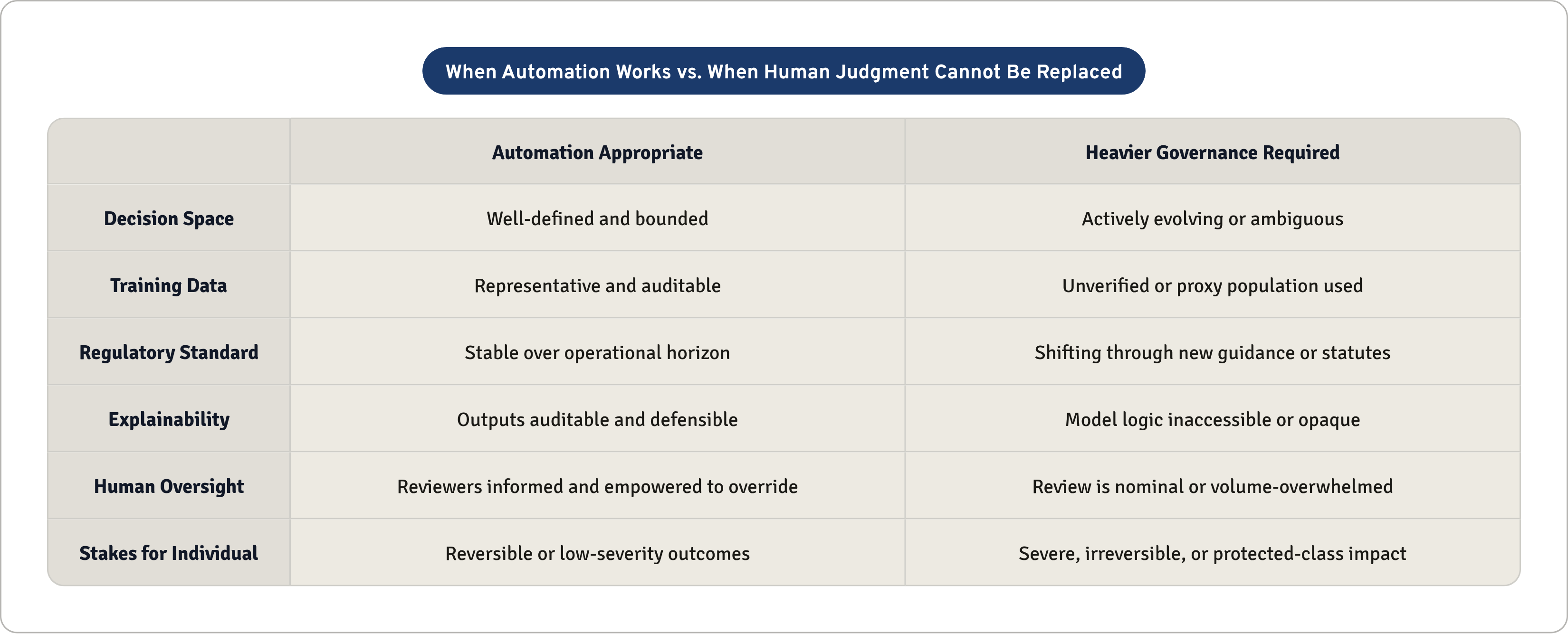
It would be dishonest to spend this much time on failure modes without acknowledging what the actual case for automation is. Organizations that rely entirely on manual compliance processes face their own elevated risks. Reactive, understaffed, inconsistently applied compliance postures have historically correlated with higher rates of breach and enforcement exposure. The manual alternative is not safe. It is differently risky.
Automation works well under a specific set of conditions: the decision space is well-defined; the training data is representative of the population the model will affect, and that representativeness is auditable; the regulatory standard is stable enough that the model's embedded assumptions remain valid over the operational horizon; and outputs are reviewed by informed humans who have genuine authority to override. When those conditions hold, automation is a legitimate risk management tool.
But when one of those conditions does not hold, the governance burden multiplies. And in compliance contexts, the condition most frequently absent is the last one. The human reviewer with genuine knowledge and genuine authority exists on paper. It rarely exists in practice.
Automation is poorly suited, or requires substantially heavier governance, in specific circumstances: where the decision directly affects members of a protected class; where the regulatory standard is actively evolving; where the model cannot produce an auditable explanation of its outputs; or where the volume of decisions has outpaced the organization's actual capacity for meaningful review.
The practical test is blunt. Can the organization reconstruct how its AI system contributed to a specific compliance outcome, including the model version that was running, the validation history, and the specific data it processed? If not, it cannot satisfy emerging regulatory expectations in the EU, California, or New York, and it cannot defend the outcome in litigation.
Human judgment remains non-negotiable at decision points where the stakes for the individual are severe and potentially irreversible; where the applicable regulatory framework explicitly requires explainable rationale; or where the model's performance has been validated against the actual population it is affecting. These are the criteria that regulators and courts are applying now.
What Governance Structures Actually Need to Exist Before Automated Compliance Decisions Go Live
The gap that enforcement actions keep exposing is the same one repeatedly: organizations have frameworks and lack controls. The documentation exists. The operational mechanisms do not. That gap is where liability accumulates.
Before deployment, document data provenance completely and validate the training data for representational bias against the specific population the model will affect, not a convenient proxy population. Establish the explainability standard the organization can defend to regulators before selecting a model architecture. The explainability requirement should drive the architecture decision, not the reverse.
For ongoing monitoring, treat model performance as a continuous obligation. Define drift thresholds, both statistical and compliance-oriented, that trigger mandatory review and retraining. Review triggers should be automatic, not dependent on someone remembering to look.
On record-keeping: maintain logs sufficient to reconstruct how AI tools contributed to specific decisions, including model versions, validation records, and logs of material changes. California's four-year retention requirement is a useful operational floor, though specific requirements vary by jurisdiction and context.
Human oversight infrastructure requires specificity. Define who reviews AI outputs. Define what information they receive when they review them. Define what authority they actually hold, and document evidence that reviews are substantive. Auditing whether the oversight process is real matters as much as having one.
Cross-functional ownership is not optional. When no single function owns the intersection of model behavior, regulatory change, and organizational exposure, accountability diffuses across everyone, which is operationally equivalent to belonging to no one.
On vendor accountability: the organization bears regulatory liability for discriminatory or unlawful outputs. Contracts and due diligence processes should reflect that reality explicitly, including audit rights over model behavior, access to validation documentation, and provisions governing what happens when the model is updated in ways that affect compliance-relevant outputs. Vendors are not going to volunteer this language. You have to ask for it.
The governance gap is a prioritization failure. The institutional tendency to move quickly on deployment and defer governance work until it becomes urgent is understandable and consistently costly. The failure modes described here have the characteristic of becoming urgent at the worst possible time: during an enforcement action, a lawsuit, a parliamentary inquiry. The governance structures need to exist before deployment not because regulators want documentation, but because the alternative is discovering, after harm has occurred, that you cannot explain what happened or to whom.
Notes
- https://law-ai.org/automated-compliance-and-the-regulation-of-ai/
Provided context on explainability tools such as SHAP and LIME and their limitations in producing decision-level rationale for regulators.
- https://www.themodernworkplace.com/lawsuits-alleging-systemic-bias-in-ai-algorithmic-screening-tools-should-serve-as-cautionary-tale/
Provided details on the SafeRent housing discrimination case involving an undisclosed algorithmic scoring product that resulted in a multimillion-dollar settlement.
- https://angelareddock-wright.com/ai-driven-hiring-bias-the-next-frontier-of-eeoc-enforcement/
Provided information on the EEOC's Strategic Enforcement Plan targeting algorithmic fairness in hiring tools through 2028.