Robotic Process Automation in Compliance Operations

Compliance has always been expensive. But the real issue isn't the cost of compliance itself; it's the cost of doing compliance manually at the scale modern regulation demands. Banks alone were spending around $270 billion annually on compliance management operations as of 2020. That number reframes the entire conversation around robotic process automation. RPA in compliance isn't an efficiency experiment. It's a structural response to a math problem that headcount alone cannot solve — like trying to empty the ocean with a teaspoon.
The structure of compliance work makes it uniquely susceptible to automation and uniquely costly when left manual. The tasks are high-volume and low-variance, meaning the same steps repeat thousands of times with negligible deviation. The error tolerance is effectively zero, because a missed field or a late filing doesn't just create rework; it creates regulatory exposure. And the documentation requirements are non-negotiable. Audit trails, exception logs, and timestamps aren't byproducts of the process. They are the process. Every layer of regulation added, whether AML rules, KYC obligations, GDPR, SOX, or IFRS, adds more process surface area. Human teams can't scale to meet it linearly without costs compounding just as fast as the risk.
That's why compliance pressure consistently ranks among the top catalysts for enterprise RPA adoption. Not a secondary benefit discovered after deployment. The reason organizations start.
What RPA Actually Does Inside a Compliance Workflow
The simplest way to understand RPA is operationally: software robots that mimic how a human interacts with digital systems. They click, copy, extract, validate, and submit. They don't touch underlying code. They don't require system integration in the traditional IT sense. They work at the interface layer, the same screens a human would use, which is what makes them deployable in compliance environments without waiting years for infrastructure overhauls.
This is the distinction that matters most for compliance teams. Most compliance operations run across mixed-system environments: legacy platforms, PDFs, web portals, spreadsheets, external databases. RPA operates across all of them because it works on the UI layer. It doesn't need those systems to talk to each other. It bridges them the same way a human does, except faster, without fatigue, and with a timestamped log of every action it takes.
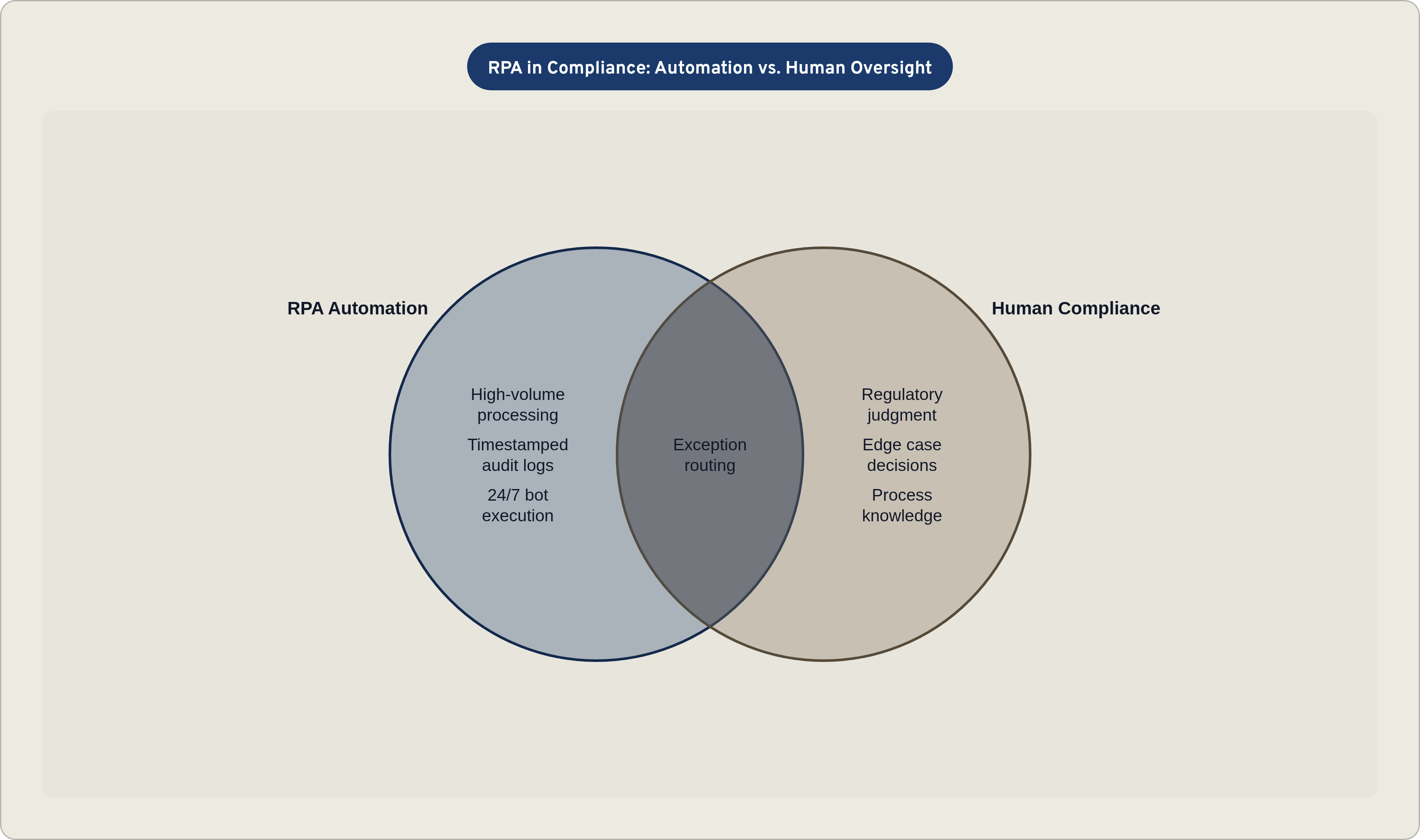
Three capabilities make RPA directly useful in compliance contexts. First, data extraction and validation: bots pull records from multiple sources and cross-check them against defined rules. Second, process execution with a logged record: every action the bot performs is traceable by design. Third, rule-based decision routing: clean cases move forward automatically; exceptions get flagged and routed to human reviewers.
That last part is worth dwelling on. RPA doesn't replace judgment. It handles the repeatable so that human judgment can focus where it's actually needed: ambiguous situations, novel regulatory language, edge cases that don't fit the rule set. The automation contains the volume; the humans contain the risk. Compliance automation is like a good sous chef — it handles all the prep work so the head chef can focus on the dish that actually matters.
The audit trail deserves specific mention because it's often misunderstood as a feature. It's not something you configure. It's structural. Bots log inputs, outputs, exceptions, and decision points as a function of how they operate. That's a significant part of why regulators are willing to accept automated compliance processes. The evidence of process execution is built in.
The Compliance Workflows Where RPA Has the Deepest Operational Impact
KYC and AML Verification
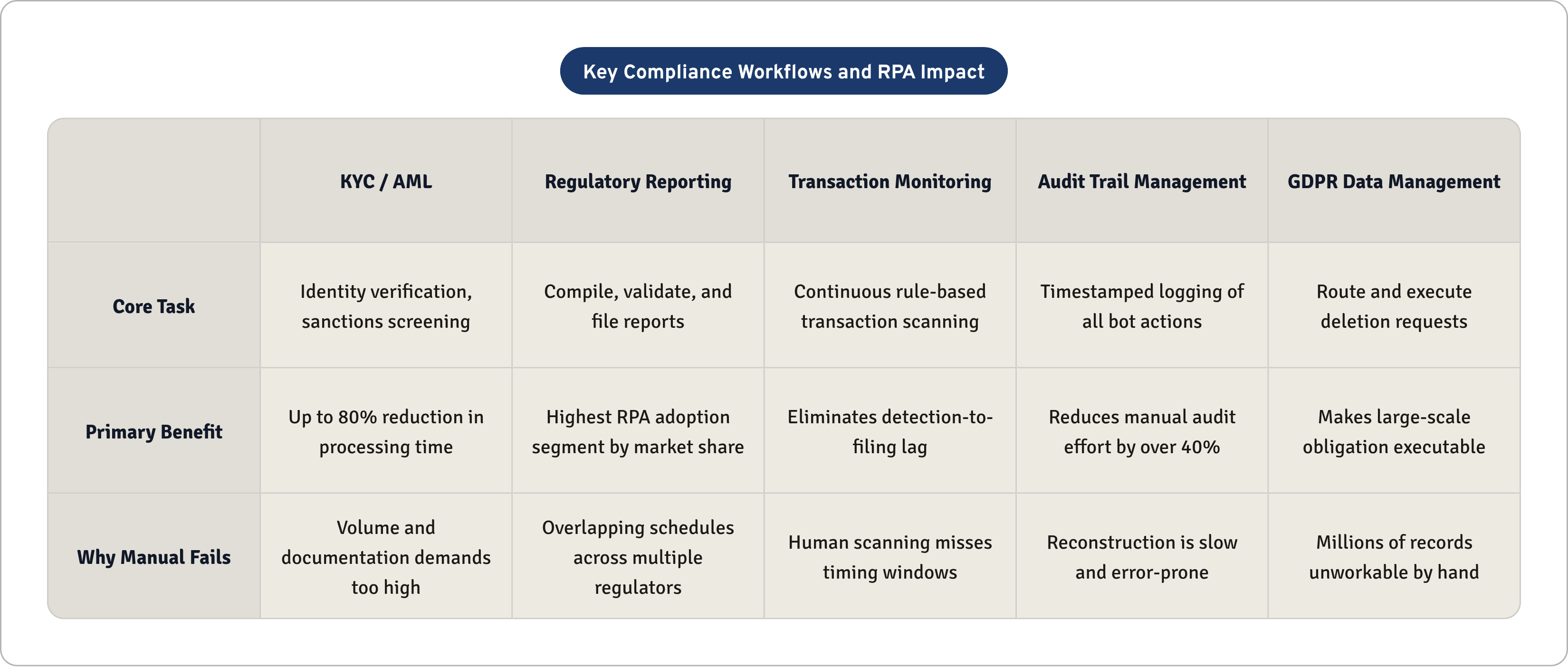
Know Your Customer and Anti-Money Laundering workflows are among the highest-volume, highest-stakes processes in financial services. They involve customer data collection, identity verification, sanctions screening, and due diligence documentation, all of which follow defined rules and require complete records. RPA is well-suited to every step.
Reported implementations have reduced KYC compliance time by as much as 80%. Combined with reconciliation automation, banks have eliminated up to 60% of processing time across KYC, compliance, and reconciliation workflows. The speed improvement isn't just operational. Delayed KYC is a customer onboarding failure with a regulatory exposure attached. Faster processing serves both sides of the ledger simultaneously.
Regulatory Reporting
Financial statements, tax filings, sector-specific reports: all time-sensitive, precision-dependent, and filed across multiple regulators on overlapping schedules. RPA bots compile data from source systems, validate fields, populate report templates, and submit, with a complete log of every action. Regulatory reporting automation has reached 53% adoption across surveyed enterprises, and finance and accounting represents the largest RPA application segment by market share, at 22.80% in 2025. Reporting is the core of why.
Transaction Monitoring and Suspicious Activity Reporting
RPA enables continuous, real-time monitoring of transaction streams against defined rule sets. When a transaction meets the criteria for a suspicious activity report, the bot generates and submits the SAR automatically, removing the lag between detection and filing. That lag is where regulatory exposure lives. Human reviewers focus on adjudicating flagged cases rather than scanning through clean ones.
Audit Trail Management
Every bot action creates a record. Timestamps, inputs, outputs, exceptions, and decision points are captured as a byproduct of process execution rather than a separate documentation effort. Auditors receive a structured, searchable log rather than reconstructed paperwork. In highly regulated industries, RPA-led compliance automation reduces manual audit effort by more than 40%.
Tax Reporting and SOX/IFRS Compliance
Bots collect, validate, and format tax data before submission and generate the documentation package required for audit support. SOX controls benefit particularly from RPA's inherent logging. The evidence of control operation is built into the process itself rather than assembled retroactively when an auditor asks for it.
GDPR Data Management
Right-to-be-forgotten requests require routing, execution, and documentation of deletions across multiple systems. Consent verification requires checking personal data against current consent records before any processing occurs. At scale, meaning millions of customer records, manual handling is practically unworkable. RPA makes the obligation executable.
Where RPA Adoption Is Actually Concentrated and Why BFSI Leads
Banking, financial services, and insurance generated 36.52% of global RPA market revenue in 2025, the largest single sector share. That concentration exists because compliance density, transaction volume, and regulatory scrutiny converge in BFSI at an intensity that exists nowhere else.
The deployment numbers are substantial. More than 61% of global banks use RPA for account reconciliation, KYC verification, and regulatory reporting. Financial institutions automate an average of 43 processes per organization and execute over 2.6 million bot actions per month. Over 56% of financial institutions have implemented RPA to streamline operations and reduce costs.
What this concentration implies for other industries is worth stating directly. Healthcare, energy, telecom, and manufacturing all face analogous structural pressure: high-volume data obligations, multi-regulator environments, and mandatory audit requirements. They are following the BFSI path at an accelerating pace, not because RPA is a financial services technology, but because the compliance problem BFSI solved first is the same problem every regulated industry has.
The deployment architecture decisions in BFSI also signal something important. As of 2025, 73% of banking and financial enterprises prefer on-premises deployment for RPA, driven by data security compliance and infrastructure control requirements. The choice of where to run the bots isn't primarily a cost decision. It's a regulatory data sensitivity decision. That distinction matters for any compliance leader evaluating deployment models.
At the enterprise level, over 74% of large enterprises globally have deployed at least one RPA bot, and more than half operate over 50 bots across functions. Compliance is consistently among the first functions automated at scale, not a late-stage addition after automation matures elsewhere in the organization.
The Measurable Return on Compliance Automation Investment
Most RPA projects return between 100% and 200% ROI within the first 12 months, with payback periods in the range of 6 to 9 months. That's faster than most enterprise technology investments, and particularly significant given compliance's cost structure, where the baseline spending is high, the labor is specialized, and the consequences of underperformance are financial and regulatory simultaneously.
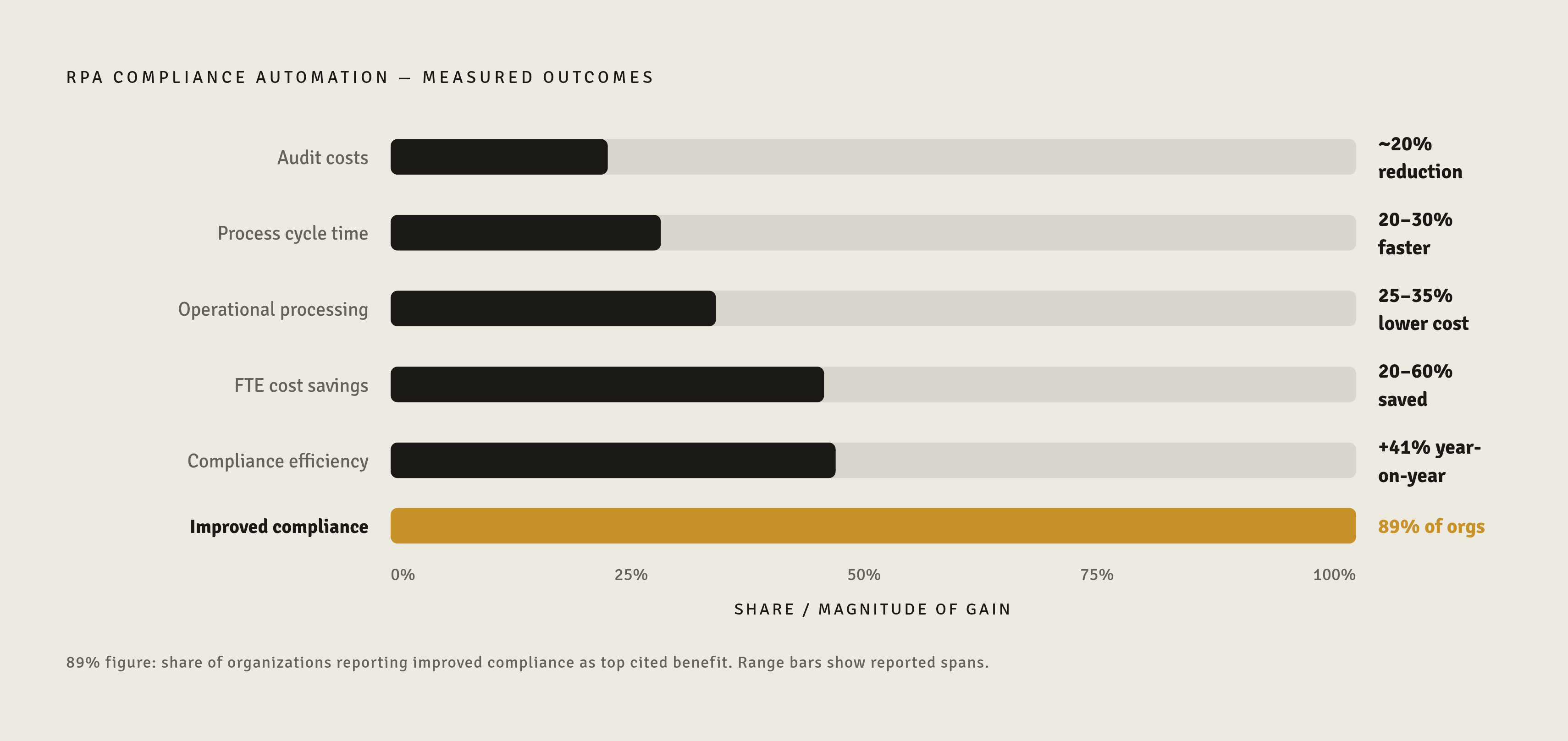
The cost reduction data across specific dimensions: operational processing costs drop 25 to 35%. FTE cost savings in financial services range from 20 to 60%. Audit costs decline by roughly 20%. Average process cycle time falls 20 to 30% in automation-mature organizations. Compliance efficiency rose 41% year-on-year across industries including energy, telecom, and retail. And 89% of organizations implementing RPA report improved compliance as a primary benefit, making it the most consistently cited outcome in adoption surveys.
The error reduction figure is where the ROI argument becomes most compelling specifically for compliance contexts. KPMG has reported a dramatic drop in error rates following RPA implementation. In an environment where a single error can trigger a regulatory fine, initiate an audit, or require public disclosure, near-zero error rates carry financial protection value that's genuinely difficult to overstate.
One caveat the numbers don't capture: the avoided cost of non-compliance. Fines, remediation work, reputational damage, and the executive attention consumed by regulatory investigations are harder to quantify than processing costs. But in BFSI and healthcare, those avoided costs often dwarf the operational savings. A complete ROI case for compliance automation has to include both sides of the ledger, or it's understating the value.
The Risks That Compliance Leaders Have to Plan For Before Deployment
A peer-reviewed article in Accounting Horizons, published by the American Accounting Association in June 2024, identifies five challenges that most vendor-sponsored materials don't address directly. They're worth engaging with because compliance leaders will encounter pushback from auditors and internal skeptics who have read this work.
The first challenge is what the article calls band-aid risk. RPA is frequently deployed over broken or suboptimal processes rather than fixed ones. Automating a flawed workflow at scale doesn't eliminate the flaw; it amplifies it at machine speed. The second is control and security vulnerabilities. A bot with access to sensitive systems is an attack surface. If compromised, it executes at machine speed with broad data access, creating a breach scenario that a human error wouldn't replicate at the same scale or velocity.
Third: true cost underestimation. Licensing, maintenance, exception handling, and ongoing bot management are recurring obligations. The build cost is rarely the full cost, and organizations that plan budgets around initial deployment often encounter friction when the operational cost profile becomes clear. Fourth is governance complexity. Who owns the bot? Who is accountable when it produces a compliance error? These questions don't have obvious answers in most organizational structures, and leaving them unresolved before deployment is a control failure waiting to happen.
Fifth, and perhaps the most underappreciated: process knowledge loss. When humans stop performing a task, institutional understanding of that task atrophies. If a bot breaks, if a regulation changes, or if an edge case emerges that the bot wasn't designed to handle, the organization will lack the expertise needed to respond. That's a fragility that doesn't show up in efficiency metrics until it matters. As one compliance officer put it: "We automated ourselves right out of knowing what we were doing" — a cautionary tale that's less funny when it's your audit on the line.
Beyond the Accounting Horizons framework, data quality dependency is a practical deployment constraint. RPA produces compliant outputs only when inputs are accurate. In multi-system environments where data quality varies significantly across sources, input validation is often the first real bottleneck encountered in deployment. The governance and security concerns are especially acute in BFSI, which is a significant contributing reason why 73% of banking enterprises prefer on-premises deployment: direct control over the systems bots access is a risk management decision, not just an IT preference.
None of these risks are disqualifying. They are all manageable. But they require deliberate design before deployment, not remediation after a control failure surfaces.
What Governance and Change Management Actually Look Like in Practice
The single most important operating principle: fix the process before automating it. The band-aid risk is real, and it demands process mapping as a non-negotiable prerequisite. Document the current workflow in full. Identify where errors and delays actually originate. Resolve root causes before bot design begins. Automation should compress a good process, not scale a broken one.
Bot ownership needs to be structurally explicit. Each bot should have a named process owner in the compliance function, not solely an IT owner. When a compliance error occurs through automation, the compliance function needs to be accountable for investigating and resolving it. Escalation paths for exceptions must be defined before go-live. The bot's job is to route an exception to the right human; the human's job is to adjudicate it. That division of responsibility has to be written down and understood before the bot is live.
Security controls for compliance bots follow the same principles as security controls for human users, applied with the same rigor. Least-privilege access means bots have credentials only for the systems required by that specific process. Credential management, including vaulting and rotation, applies to bot accounts the same way it applies to human accounts. Activity monitoring on bot accounts should trigger alerts for anomalous behavior, exactly as it would for a human user with the same system access.
Preserving process knowledge requires active effort. Document the logic the bot executes in language that humans can read, understand, and maintain. Retain human proficiency through periodic manual walkthroughs or rotation, particularly for low-frequency but high-stakes processes where the institutional knowledge risk is highest.
Deployment model decisions are governance decisions. The preference for on-premises deployment in regulated industries, reflected in 58.40% of market share in 2025, follows directly from data residency requirements and audit access obligations. Where the bots run is determined by regulatory constraints, not IT aesthetics.
One directional signal worth tracking: enterprises integrating RPA with AI and analytics are achieving two to three times faster ROI realization compared to rule-based automation alone. Intelligent automation is the trajectory the industry is moving toward. Governance frameworks need to evolve alongside expanding capability rather than lag behind it, because a governance structure designed for simple rule-based bots will not be adequate for bots making probabilistic decisions.
The practical conclusion, drawn from organizations that consistently extract more value and face fewer control failures: compliance leaders who approach RPA as a process discipline get better outcomes than those who treat it as a technology purchase. The difference isn't the tool. It's whether the compliance function owns the deployment or merely benefits from it.