
Essay Compliance Automation
Automating Policy Management Workflows
Compliance failures cost 2.7 times more than prevention, making automation a strategic investment.
The policy management software market crossed roughly $1.5 billion to $1.9 billion in 2024 and 2025, depending on which analyst you consult, and multiple forecasters project it reaching multibillion-dollar scale by the early 2030s. North America holds the largest regional share, over 42 percent as of 2024, driven by the regulatory density of financial services, healthcare, and government. The broader workflow automation market reached $23.77 billion in 2025. These are not speculative figures. They reflect a decision that enterprises have already made: automation is core infrastructure, not a departmental experiment.
What's driving that investment is as reactive as it is strategic. Regulatory enforcement is intensifying globally, and the cost of inaction has become visible in ways it simply wasn't five years ago. The question worth answering now isn't whether to automate policy management. It's where, exactly, automation delivers value across the lifecycle, and in what sequence organizations should think about it.
What Manual Policy Management Actually Costs Organizations
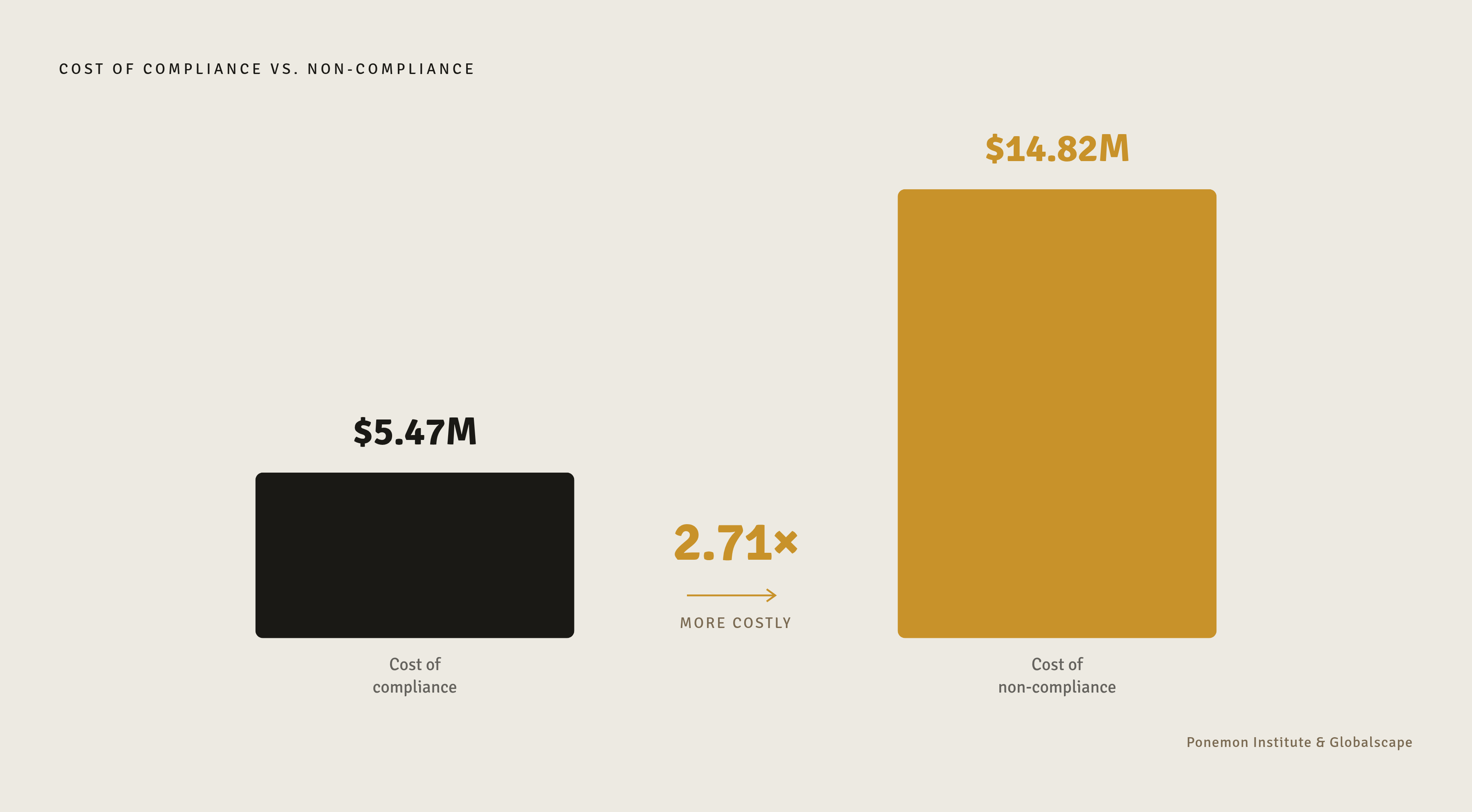
Global fines for non-compliance hit $14 billion in 2024, per Thomson Reuters Regulatory Intelligence. That figure sets the stakes. But the more instructive number comes from Ponemon Institute and Globalscape: non-compliance costs organizations an average of $14.82 million, more than 2.71 times the average cost of achieving compliance at $5.47 million. The build-versus-buy debate becomes almost irrelevant once you see that asymmetry clearly. The real comparison is compliance investment versus enforcement exposure.
What generates that exposure isn't exotic. It's mundane. Email chains and spreadsheets make version control unreliable, so outdated policies circulate alongside current ones without anyone noticing. No audit trail means teams scramble to reconstruct who approved what and when, precisely when regulators are asking for that reconstruction. Sixty-five percent of organizations are operating reactive or basic policy programs, according to a multi-industry benchmark survey reported by Compliance Week via Quantivate. And Atlassian's State of Teams 2025 found that employees waste 25 percent of their time searching for information, a friction cost that compliance and HR teams absorb acutely.
The coordination problem is social as much as it is technical. Getting legal, HR, operations, and subject matter experts to respond to a policy review on a shared deadline, without formal routing or accountability mechanisms, is a structural problem that goodwill and calendar reminders cannot solve. These failures aren't random. They're predictable at each stage of the policy lifecycle, which is exactly why point solutions only shift the bottleneck rather than eliminate it.
How the Policy Lifecycle Creates Compounding Risk When Any Stage Is Left Manual
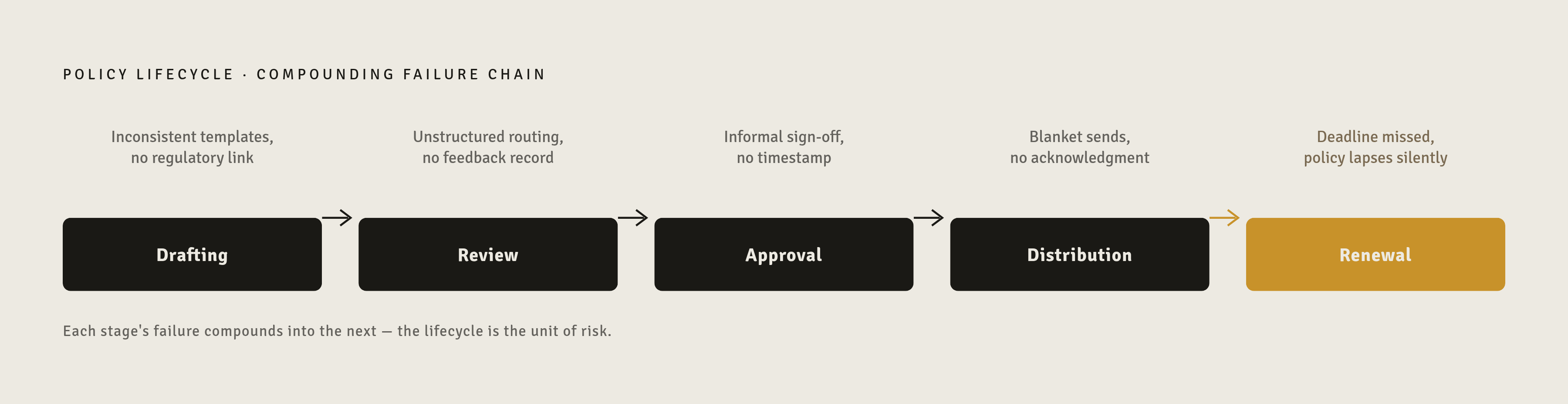
A complete policy lifecycle has five stages: drafting, review, approval, distribution, and renewal. Each one has a distinct failure mode when left manual, and those failure modes don't stay contained within their stage.
At drafting, inconsistent templates produce policies that arrive in incompatible formats with no connection to existing regulatory requirements. At review, there's no structured routing, delays accumulate based on stakeholder availability, and no record captures what feedback was incorporated or ignored. At approval, sign-off collected informally via email or verbal confirmation leaves no timestamped record and no clarity about which signatories were actually required. At distribution, blanket email sends go out with no confirmation of receipt, no role-based targeting, and acknowledgment tracked in spreadsheets if tracked at all. At renewal, deadline tracking is entirely manual; policies lapse without notice, disconnected from any external trigger like a regulatory change.
The compounding dynamic is the part most organizations underestimate. A gap in distribution means acknowledgment data is unreliable. Unreliable acknowledgment data means renewal decisions are made without knowing who has actually read the current version. Outdated policies still in circulation create drafting confusion in the next cycle. The errors are self-reinforcing.
Regulators don't audit one stage. They examine the full chain: when was this policy reviewed, who approved it, was it communicated to relevant staff, who acknowledged it, and when was it last renewed. The argument here isn't for any specific tool. It's for thinking about automation as a lifecycle problem, not a loudest-bottleneck problem.
What Automation Does at the Drafting Stage
Drafting is where most organizations apply the least automation, even though it sets the quality ceiling for everything downstream. What arrives at the review stage is a direct function of what was built at the drafting stage.
Template standardization is the most immediate gain: enforcing consistent structure, required fields, and approved language so drafts don't arrive in incompatible formats that reviewers must normalize before they can actually evaluate content. Beyond templates, version initialization addresses a common but costly gap. Automated systems can create a versioned document from the first save, so a complete version history exists from day one rather than being reconstructed retroactively. Drafting from existing policy libraries is equally practical: surfacing related or superseded policies so writers don't inadvertently contradict or duplicate what already governs a given area.
The more sophisticated capability, and the one accelerating fastest, is regulatory mapping. AI-native platforms increasingly link draft clauses to specific regulatory requirements, flagging gaps before the review stage begins. As of 2026, leading platforms use AI agents to automate initial drafting and map content to applicable regulations, per Sprinto's analysis of the policy management software market. That's a meaningful shift in where the heavy lifting happens.
What automation cannot do at drafting: supply organizational judgment, interpret ambiguous regulatory intent, or decide what a policy should actually say. Human authorship remains essential. The payoff of getting drafting right is downstream: fewer revision cycles in review, cleaner audit trails from the first version, and policies that arrive at approval in a form approvers can genuinely assess rather than one they have to rehabilitate.
What Automation Does at the Review Stage
Review is the stage most commonly described as herding cats, and that description is accurate. The coordination problem is real. The manual tools most organizations rely on, email, calendar reminders, status spreadsheets updated by a single coordinator, are structurally inadequate for it.
Structured routing is the foundational fix: workflows that automatically send a draft to the correct reviewers in the correct sequence, whether sequential or parallel depending on policy type, without a coordinator manually forwarding documents and hoping nothing falls through. Deadline enforcement closes the accountability loop. Automated reminders that escalate as deadlines approach make delay visible to the coordinator and, if configured, to the reviewer's manager. That visibility alone compresses cycle times without any change in the underlying policy content.
Consolidated feedback replaces email threads with in-platform commenting, creating a single record of what was flagged, by whom, and what was resolved before the policy advanced. Dashboard status visibility gives coordinators a real-time view of every policy in review: who has responded, who is overdue, what is blocking progression.
The accountability shift that follows is significant. When reviewers know their response time is tracked and visible, behavior changes. And what this stage produces downstream is equally important: a complete, timestamped record of the review process that can be surfaced for auditors without manual reconstruction.
Global fines for non-compliance hit $14 billion in 2024, per Thomson Reuters Regulatory Intelligence.
What Automation Does at the Approval Stage
Approval is where audit exposure concentrates. Regulators want to know who authorized a policy, when, and under what version. That's not a philosophical question. It's an evidentiary one.
eSignature workflows produce the unambiguous record: who approved, when, which version was active at the precise moment of approval. Role-based routing ensures approvals reach the correct authority, whether a department head, legal counsel, or board-level signatory, based on policy type and risk tier rather than someone's manual judgment about who to CC on an email. Conditional logic can require additional approval steps when a policy crosses a defined threshold, such as a materiality limit, scope expansion, or specific regulatory category.
Rejection and revision routing matter more than they initially appear. If an approver rejects, the workflow automatically returns the document to the appropriate revision state. Without that, status becomes ambiguous and the paper trail breaks.
eSignature integration is specifically noted as essential for demonstrating compliance during audits because it provides an efficient collection method while maintaining the full action trail, per ConvergePoint's workflow automation documentation. The capability that becomes possible here, historical point-in-time reporting, is practically impossible to reconstruct from email records. The ability to show an auditor exactly what version was active and who had approved it on a specific past date requires this kind of structured record from the beginning.
Approval closes the internal process. What follows, getting the right policy to the right people and confirming they've received it, is where many organizations inadvertently lose the compliance evidence they just worked to create.
What Automation Does at the Distribution and Acknowledgment Stage
Organizations routinely treat "sent" as equivalent to "acknowledged." The gap between those two states is exactly what regulators probe.
Role-based targeting is the operational correction: policies delivered to the employees, teams, geographies, or functions for whom they are actually relevant, rather than blanket sends that overwhelm inboxes and get ignored. Automated acknowledgment collection prompts employees to confirm receipt and understanding, with completion tracked at the individual level without manual follow-up from HR or compliance. Escalation for non-responders closes the gap: automated reminders that, if configured, escalate to a manager's view when an employee hasn't acknowledged within a defined window.
The acknowledgment audit trail is what makes this stage durable from a compliance standpoint. Completion data stored alongside the distributed version creates a self-contained record: who received which version, when, and whether they acknowledged it. That record is exportable and doesn't require manual reconstruction.
Fifty-eight percent of organizations in public and private sectors report time savings exceeding 30 percent after switching from manual policy procedures to dedicated platforms, per Market Growth Reports, and distribution and acknowledgment tracking is a significant contributor to that efficiency gain. Access permissions and distribution controls also serve a security function, keeping sensitive policy content visible only to authorized roles.
What this stage produces is the evidentiary chain regulators expect to see: the closed loop between approval and employee awareness.
What Automation Does at the Renewal and Ongoing Monitoring Stage
Renewal is where manual systems fail silently. Policies lapse. Deadlines pass unnoticed. The organization discovers the gap when an auditor asks when a policy was last reviewed, and no one has a clean answer.
Scheduled review triggers address the foundational problem: administrators set review frequencies per policy type, and the system surfaces the policy automatically and routes it back into the review and approval workflow without manual initiation. Renewal dashboards give real-time visibility into which policies are approaching review dates, which are overdue, and which are currently moving through renewal.
Gap analysis dashboards extend that visibility further, showing which policies are missing required controls for a specific audit framework. That's proactive rather than reactive identification of exposure. Regulatory change integration goes a step further: AI-native platforms increasingly monitor regulatory feeds and flag when a change affects an existing policy, connecting the renewal trigger directly to the external event that necessitates it. Platforms with regulatory intelligence capabilities access large volumes of real-time regulatory data, keeping organizations audit-ready as standards evolve, per Grid Dynamics' analysis of automated policy management in insurance.
The renewal stage also generates the data that feeds the next drafting cycle: what changed, why, and who authorized the change. That completes the evidentiary loop. In the insurance sector, automated renewal processes have reduced issuance and renewal times by up to 70 percent in underwriting contexts, per Grid Dynamics, a dramatic efficiency gain in a domain where renewal volume and regulatory precision both run high.
What the Full-Lifecycle Gains Look Like in Practice
Automation of policy lifecycles integrated with eSignature platforms has improved organizational compliance rates by 52 percent, per Market Growth Reports. That figure reflects the full-cycle approach rather than single-stage fixes. It's an outcome metric, not a process metric. Organizations that automate the full lifecycle are measurably more compliant, not just more efficient.
Administrative cost reductions of up to 35 percent are achievable through systematic digital management of policies and procedures, per FlowForma. The word "systematic" is doing real work in that sentence. Point solutions don't produce those numbers. Processing times compress from weeks to days. AI agent benchmarks across rules-driven processes indicate 20 to 40 percent efficiency gains and 30 to 60 percent error reduction.
Time to ROI is faster than organizations typically anticipate. Targeted deployments reach payback in six to eighteen months; scaled enterprise programs achieve full ROI within one to three years, per Blue Prism's AI agent ROI analysis.
What these numbers don't fully capture: the audit preparation time that disappears when evidence is automatically compiled rather than manually reconstructed, and the organizational confidence that comes from real-time visibility into policy status across an entire portfolio. Those aren't soft benefits. They're the difference between an audit that takes days to prepare for and one that takes weeks.
How AI Is Changing What Policy Management Automation Can Do
The baseline capabilities of workflow automation, routing, reminders, version control, are now effectively commoditized. The differentiation has moved to AI-native capabilities layered on top of that foundation.
At the drafting stage, generative assistance, regulatory clause mapping, and gap detection before human review begins are already features in leading platforms. At the monitoring stage, real-time risk assessment against live regulatory feeds replaces periodic manual review. For employees navigating policy, natural-language search allows them to find relevant guidance without submitting a ticket to compliance. At the governance level, organizations that have deployed AI governance platforms are 3.4 times more likely to achieve high effectiveness in AI governance, per Gartner data cited in Optro.ai's analysis.
Seventy-two percent of organizations expect GRC technology budgets to increase, with AI governance solutions ranking as the top investment priority, per the same Gartner data. Budget is following the capability shift.
The risk worth naming directly: AI can accelerate a flawed process as easily as a sound one. Organizations that haven't structured their review, approval, and distribution stages will find AI-assisted drafting creates more volume without more compliance. The automation creates throughput; the structure determines whether that throughput is compliant.
The more durable point is this: AI makes the lifecycle framework more valuable, not less. AI tools need structured workflows to route their outputs into. Without the lifecycle architecture underneath, the intelligence has nowhere to go. Organizations that build the framework first and layer AI capabilities on top will compound their advantage. Organizations that chase AI features without the underlying structure will find themselves with a faster version of the same manual problem.
Notes
- https://www.griddynamics.com/blog/automated-policy-management
Provided the figure that automated renewal processes have reduced issuance and renewal times by up to 70 percent in insurance underwriting contexts, and informed the discussion of regulatory intelligence capabilities.
- https://www.flowforma.com/demo-library/how-to-automate-policy-administration
Provided the figure that administrative cost reductions of up to 35 percent are achievable through systematic digital management of policies and procedures.
- https://www.thisandthat.chat/blog/automation-roi-statistics-business-teams/
Provided the Atlassian State of Teams 2025 finding that employees waste 25 percent of their time searching for information.
- https://sprinto.com/blog/policy-management-software/
Provided the observation that leading platforms use AI agents to automate initial drafting and map content to applicable regulations as of 2026.
- https://www.convergepoint.com/policy-management-software/automating-policy-workflows-convergepoint
Provided the documentation on eSignature integration as essential for demonstrating compliance during audits and maintaining a full action trail.
- https://optro.ai/blog/ai-governance-stats
Provided the Gartner-cited statistics that organizations deploying AI governance platforms are 3.4 times more likely to achieve high effectiveness, and that 72 percent of organizations expect GRC technology budgets to increase.