
Long read Compliance Technology
Build vs. Buy Decisions for Compliance Technology
Non-compliance costs $14.82 million; smart tooling decisions save millions more.
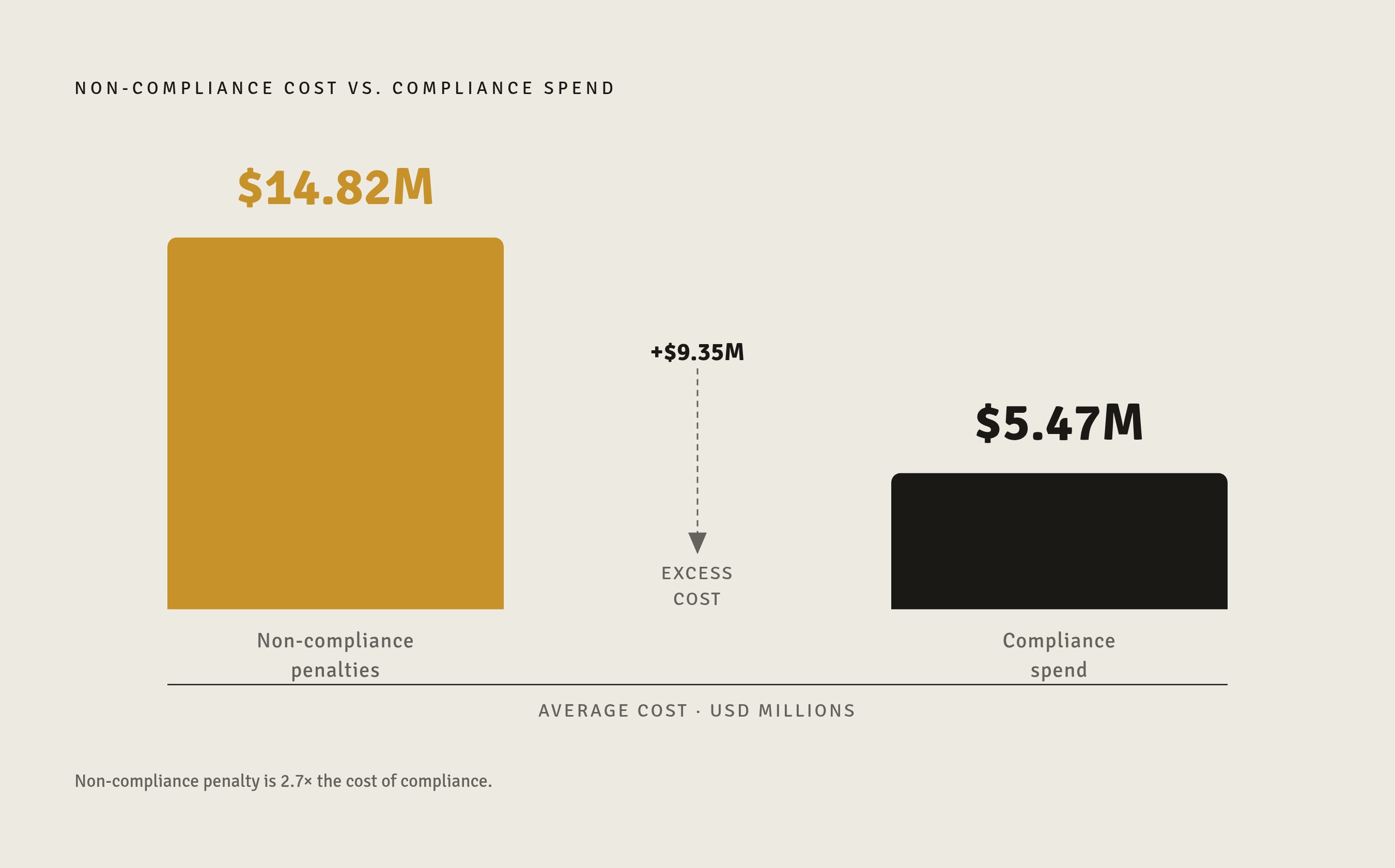
This is about a decision that gets made by gut feeling far too often, and the numbers say that gut feeling is expensive. Companies that fail to keep up with regulation pay an average of $14.82 million for the privilege, versus $5.47 million for those who spend properly on compliance. Global non-compliance fines hit roughly $14 billion in 2024, and AML penalties alone jumped about 417% in the first half of 2025 compared to the same period a year earlier, landing near $1.23 billion. GDPR fines in the EU reached €2.1 billion in 2024, up 34% from 2023, with the cumulative total now sitting at €7.1 billion since the law took effect.
None of that is a budget conversation. It's a story about what happens when a company's tools can't keep pace with the rules it's supposed to follow, and enforcement lands before anyone fixes the gap. Financial institutions already spend an average of $30.9 million a year just staying compliant, which means there's not much room left to get the tooling decision wrong. So the question of whether to build compliance technology in-house or buy it from a vendor deserves more than the usual reflex answer of "we've always bought" or "we've always built." It deserves a process, one you can actually repeat every time the ground shifts under you, which in this industry is often.
How the compliance technology market has changed the conditions for this decision
The vendor side of this market has gotten big and specialized enough that "buy" is no longer a euphemism for "settle." Compliance management software was a $60.02 billion market in 2025, and it's projected to hit $106.76 billion by 2030, growing at an 11.8% annual rate. RegTech, the more specialized slice of that market built around automated regulatory tracking and AI-assisted monitoring, is expected to go from $14.69 billion in 2025 to $115.5 billion by 2035. That's a 20.62% compound annual growth rate, which tells you this isn't a niche corner of enterprise software anymore, but a real industry with real depth.
At the same time, the regulatory environment isn't holding still long enough for anyone to get comfortable. Thomson Reuters' Cost of Compliance surveys have tracked upwards of 200 regulatory changes a day, globally, across sectors, and any internal system a company builds has to keep pace with that indefinitely, which is a maintenance burden that doesn't show up in the initial project plan. Bank IT budgets tell the same story from a different angle: compliance's share of IT spend rose from 9.6% in 2016 to 13.4% in 2023, and employee hours devoted to compliance work rose 61% over the same stretch. The work is getting heavier no matter which path a company picks.
Then there's AI, which has genuinely changed part of this calculus and inflated the rest. A 2026 survey of 817 enterprise builders by Retool found that 35% had already replaced at least one SaaS tool with something built in-house, and 78% expected to build more custom tools in 2026. That's a real shift in what "build" costs to attempt. But a 2025 study from METR found that AI's productivity gains shrink to under 10% on complex, unfamiliar tasks, the kind that make up most compliance work. AI writes code fast, but it does not sit in for a compliance officer's sign-off, and it does not attend the audit.
So here's where that leaves things: more vendor capability than ever, more regulatory complexity than ever, and a build case that looks more attractive on paper than it usually is in practice. That combination doesn't call for a default. It calls for a framework, which is what the rest of this is.
The first factor: total cost of ownership beyond the initial price comparison
The mistake almost everyone makes here is comparing a vendor's license fee to an engineer's salary, treating those two numbers as if they represented the full cost of either path. They don't, not even close.
Building a compliance system in-house typically takes six to eighteen months just to get to a usable first version, and that's before the maintenance clock starts running. Every regulatory update after launch means another development cycle, and those don't stop just because the initial build is done. There's also the opportunity cost of the engineers doing this work instead of something else. Shopify's CEO made that trade-off explicit in early 2025, mandating that AI be evaluated before any new hire or software purchase gets approved; whatever you think of that policy, it names a real cost that most build decisions quietly ignore. Add infrastructure, security hardening, and audit-readiness work on top, and the "we'll just build it" estimate usually needs a second look.
Buying isn't free of hidden costs either. The license fee is the headline number, but implementation and customization work often isn't in the base quote, and integration with legacy systems is frequently the biggest line item nobody budgeted for. Vendor pricing at renewal time can also move in directions the buyer didn't expect, especially once a company is dependent on the system and switching costs have piled up.
One case worth sitting with: a Fortune 500 financial services company ran a structured evaluation and chose to build custom, ending up with substantial cost savings over three years compared to the vendor alternatives it considered, with returns that beat its own forecasts. That was a clean win for building, but it took eight months of implementation and, critically, the company already had a compliance engineering team in place before it started. That's not a starting condition every company has.
What this actually requires is a three-year model, not a year-one comparison, with maintenance, regulatory update cycles, and internal team bandwidth written in as explicit costs rather than assumed to be free. Research from BCG and McKinsey has put digital initiative failure rates around the majority for years running, and Bain's 2024 analysis found the vast majority of business transformations fall short of what they set out to do. Internal builds routinely underestimate their own total cost at the planning stage; that's not cynicism, it's a pattern. Build the three-year model before you compare anything to a vendor quote, not after.
The second factor: how regulatory specificity tilts the decision
Here's the structural argument for buying that doesn't get made often enough: when a vendor serves hundreds of clients across dozens of jurisdictions, every regulatory change one of those clients triggers gets absorbed into the product for everyone else. You're not just buying software. You're buying the accumulated pattern recognition of a company that has watched hundreds of other companies go through the same regulatory changes you're about to face.
Adherent's regulatory dataset is a useful illustration of the scale involved: hundreds of thousands of regulations tracked across 195 countries, built up over nearly 25 years. No internal team assembles that on a project timeline, full stop, though an internal team might do a genuinely good job tracking one or two jurisdictions closely. The moment a company needs real-time obligation mapping across many jurisdictions, it's no longer running a technology team. It's running a regulatory research operation that happens to also write software.
DORA, which took effect in January 2025, makes this concrete. It applies to banks, insurers, investment firms, payment institutions, crypto-asset service providers, and the critical ICT vendors that serve them, and it demands resilience, auditability, and regulator access into the ICT systems themselves, not just data protection controls. A vendor that's already built DORA compliance into its product has taken that burden off your plate before you've even signed the contract.
Data sovereignty complicates the picture in a way that cuts against easy answers. The US CLOUD Act creates legal exposure based on where a company is incorporated, not where its servers physically sit; a US-incorporated vendor storing data in Frankfurt doesn't necessarily resolve the legal conflict a European regulator might raise. That's an argument for scrutinizing a vendor's corporate structure carefully, not, by itself, an argument for building instead.
Building tends to make more sense when a company operates in one genuinely unusual regulatory environment, when its risk model or product mix doesn't resemble anyone else's closely enough for a vendor's pattern library to help, or when regulators specifically require that the logic inside the system be proprietary and auditable in a way off-the-shelf software can't offer. The BFSI sector shows both sides of this at once: it's the largest buyer of compliance software, at 23.89% of category revenue in 2025, largely because financial crime compliance rewards vendor depth. But certain model-risk and stress-testing functions stay in-house because regulators expect them to.
The question worth asking directly: does the company need to track regulatory change across many jurisdictions, or does it need to encode one stable, specific regulatory logic deep into how it operates? Those are different problems, and they point in different directions.
That's a 20.62% compound annual growth rate, which tells you this isn't a niche corner of enterprise software anymore, but a real industry with real depth.
The third factor: internal capability and what it actually takes to build well
Here's the honest question underneath all of this: does the organization have compliance expertise, engineering capability, and ongoing bandwidth, all three, at the same time? Not one after another, but simultaneously. Most companies that get burned on a build decision had one or two of these and assumed the third would show up.
AI-assisted development has genuinely sped things up for well-scoped internal tools; work that took months can take weeks now. What it hasn't touched is the review process. Compliance sign-off, legal review, and user acceptance testing run on regulatory and organizational timelines, not coding speed, and no amount of AI assistance shortens a legal team's schedule. The depth that real GRC platforms have, multi-framework control mapping, continuous evidence validation, audit-ready reporting, workflows that span departments, represents years of specialized engineering that takes far longer to replicate than most teams expect. Forrester's 2024 Software Development Trends Report attributed 67% of failed software implementations to bad build-versus-buy calls, and the failure usually shows up in execution, not in the original decision logic. The plan looked fine; the follow-through didn't.
Shadow IT is worth flagging as its own warning sign. Retool's 2026 survey found 60% of enterprise builders had built software outside their IT department's oversight in the past year, and a quarter did it regularly. Compliance tooling built outside proper governance creates audit exposure even when the tool itself works exactly as intended; a system that functions perfectly but was never reviewed by the right people is still a liability waiting to be discovered.
Before committing to build, a team should be honest about a short set of questions. Do we have engineers who've actually worked on compliance systems before, or just strong general engineers who'll be learning on the job? Do we have compliance subject matter experts in-house who can own the requirements and check the output, not just approve it after the fact? Can we staff a maintenance team through regulatory cycles without pulling people off product work every time a new rule lands? And what's our actual track record on internal projects of similar size and complexity?
A 2025 Gartner survey of 3,186 CIOs and technology executives found that fewer than half of digital initiatives meet or beat their own targets. Teams that overestimate their internal capability are the biggest contributor to that gap, and there's no reason to assume a compliance build is exempt from the pattern.
There's a middle path worth naming here too. Organizations with partial capability sometimes do best building a thin layer of orchestration and configuration on top of a vendor's core system, keeping control over their own logic and auditability without taking on the burden of maintaining the underlying regulatory data infrastructure themselves.
Working through the three factors in sequence as a repeatable decision process
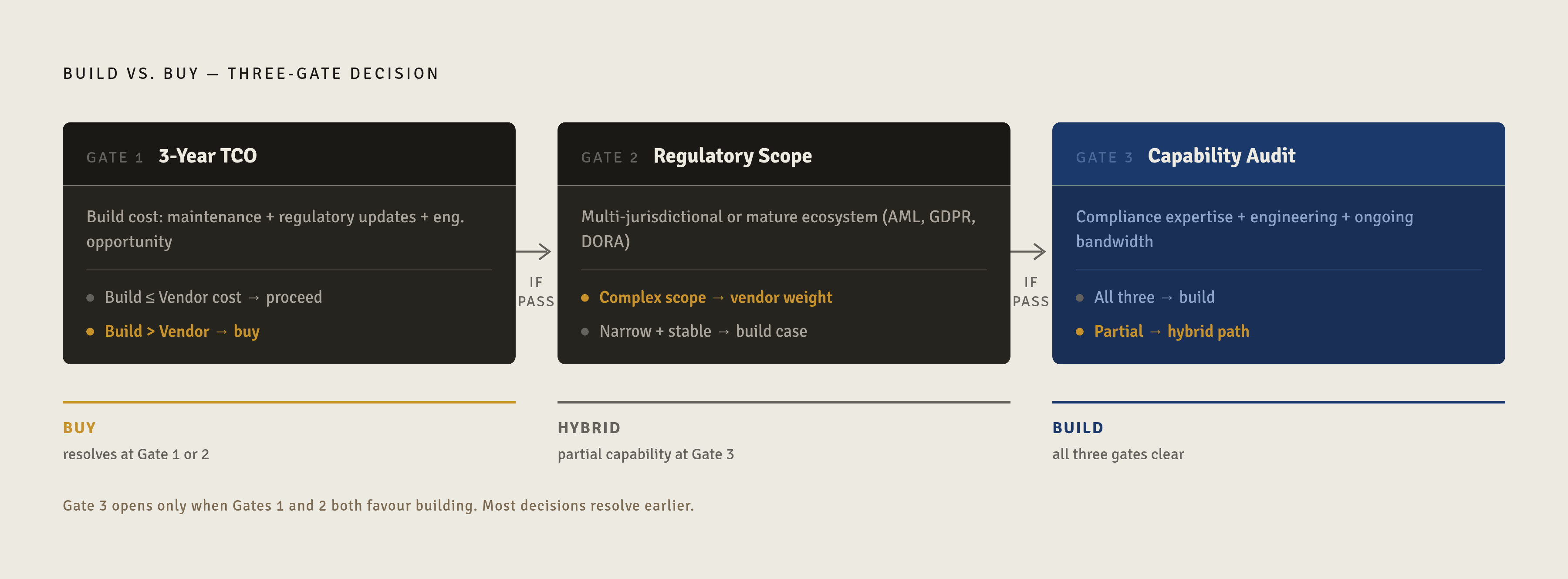
The order isn't arbitrary. Total cost of ownership comes first because it kills off options that don't survive contact with basic economics, before anyone commits to a build plan that was never going to pencil out. Regulatory specificity comes second because it can override a purely economic preference; the cheapest path on paper doesn't matter if regulators expect something the cheap path can't deliver. Capability comes third because it's the reality check on whether the path you'd prefer is one you can actually execute.
Think of it as three gates. At Gate 1, if a full three-year model shows the build cost, including maintenance, regulatory updates, and the opportunity cost of engineering time, is close to or below the vendor's total cost, move to Gate 2. If it's not, the case for buying just got a lot stronger, and there's no shame in stopping there. At Gate 2, if the company needs multi-jurisdictional tracking, or if it's subject to a regulation with a mature vendor ecosystem already built around it (AML, GDPR, DORA all qualify), the vendor side picks up structural weight it's hard to argue against. If the regulatory need is genuinely narrow and stable, the build case gets stronger instead. Gate 3 only matters if the first two gates pointed toward building: that's where the capability audit becomes the real test. A good TCO case and a solid regulatory rationale still fail if the organization can't actually execute the build, which happens more often than anyone likes to admit.
The hybrid path deserves its own explicit checkpoint in this process, not just a footnote. When capability is partial but the regulatory logic is clear and specific, a vendor core paired with an internal configuration layer is often the option with the best return, splitting the difference between owning your logic and not owning the regulatory data burden.
This isn't a decision one department should make alone. The compliance officer owns the regulatory specificity read, the CTO or engineering lead owns the capability assessment, and the CFO owns the cost model; leave any one of them out of the room and the decision tilts, predictably, toward whatever that missing perspective would have flagged. And because regulatory change moves at up to 200 changes a day industry-wide, this isn't a decision you make once and file away, but one you revisit on a set cycle.
A few failure patterns worth watching for along the way: comparing a vendor's year-one cost against a build's full multi-year cost, as if those are the same kind of number; assuming AI's coding speed translates directly into compliance system speed, when the review bottleneck sits somewhere AI can't touch; letting an engineering team's enthusiasm for building override a vendor's genuine regulatory depth; and letting a vendor's sales timeline set the pace of your evaluation instead of running it on your own clock.
What strong compliance technology execution looks like regardless of which path is chosen
Getting the decision right is necessary, but it's not the finish line. A well-chosen vendor can still be badly implemented, and a well-funded internal build can drift away from what regulators actually want the moment nobody's watching closely enough.
If you're buying, a few things matter more in compliance than in most other software categories. How often does the vendor update for regulatory change, and how transparent are they about validating those updates before they ship? How deep is the audit trail, and can a regulator actually get into the system logic if they need to? How is data handled, especially given the CLOUD Act and DORA exposures discussed earlier? And what happens if the vendor gets acquired or shuts down: can you actually get your data and your logic out?
If you're building, the governance work matters as much as the code. Someone needs to own every update cycle by name, not just sign off at launch and disappear. There needs to be a documented process connecting regulatory monitoring to actual engineering sprints, so a new rule doesn't sit unaddressed for months before it becomes a ticket. And shadow IT needs to be off the table from day one; recall that 60% of enterprise teams in that Retool survey built outside IT oversight, and in a compliance context, that habit creates exactly the audit exposure the build was supposed to avoid in the first place.
Whichever path a company takes, the tooling only works if it's anchored to a clear compliance workflow with a named owner. Sophisticated technology bolted onto a vague process underperforms, reliably, no matter how good the underlying software is.
The metric that actually matters after implementation isn't uptime or feature count, but how fast the organization detects a regulatory change and responds to it; that gap, between a rule changing and the organization catching up to it, is the entire reason compliance technology exists. And given that the compliance software market is projected to nearly double by 2030, the vendor landscape two years from now will look different enough that a decision made well today is worth revisiting before it quietly becomes the wrong one.
Notes
- https://www.adherent.com/webinars/build-vs-buy-making-the-right-call-for-ai-powered-product-compliance/
Provided the example of Adherent's regulatory dataset covering hundreds of thousands of regulations across 195 countries over nearly 25 years, used to illustrate the scale of vendor regulatory coverage.