
Long read Compliance Automation
Automated KYC and AML Screening Systems
Automated systems slash compliance costs and false positives in financial crime detection.
Financial crime moves trillions of dollars through the global banking system every year, and by the World Economic Forum's own accounting, less than a small fraction of those illicit proceeds ever get seized or frozen. That gap between money laundered and money caught is the whole story here: how much crime is out there, and how badly the tools built to catch it have lagged behind. Automated KYC and AML screening systems exist to close that gap, combining data matching, risk scoring, and rule sets to flag bad actors faster than a human reading through case files ever could. The systems only work as well as the wiring underneath them, and that wiring is where most of this article lives.
Crypto has made the problem move faster than most compliance shops can track. Chinese money laundering networks now push billions through stablecoin rails, a scale and speed that didn't exist a decade ago and that manual review was never built to handle. Meanwhile, financial institutions in the US and Canada spend tens of billions annually just trying to keep up, and nearly every institution surveyed says those costs keep climbing. Volume is part of the problem. Velocity compounds it: layered crypto transfers, underground banking networks, and cross-border shell structures were engineered specifically to outrun a human reviewer's attention span.
What manual KYC and AML review actually costs — in time, money, and lost business
Start with the price tag, because it's bigger than most people outside compliance realize. Fenergo's 2025 Financial Crime Industry Trends report puts the global average KYC/AML spend at tens of millions of dollars per institution annually, with UK banks sitting at the top of that range. That's not a rounding error in anyone's budget.
Break it down per client and the picture gets more granular. Fenergo's 2022 research found that more than half of corporate and institutional banks spend thousands of dollars on a single KYC review, and one in five spend more than that. Multiply by thousands of corporate clients and you start to see why compliance departments balloon.
Then there's the clock. A large share of banks take 31 to 60 days to complete a single corporate KYC review, and some stretch to 150 or even 210 days. Put yourself in the shoes of a mid-sized manufacturing company trying to open a new banking relationship: you're now waiting the better part of a year for someone to confirm you are who your paperwork says you are. A global survey of 600 senior decision-makers found most firms lost clients over the past year specifically because onboarding was too slow, and that number has climbed sharply over the past two years. Slow compliance carries a cost beyond the compliance department, bleeding directly into sales pipelines and client retention.
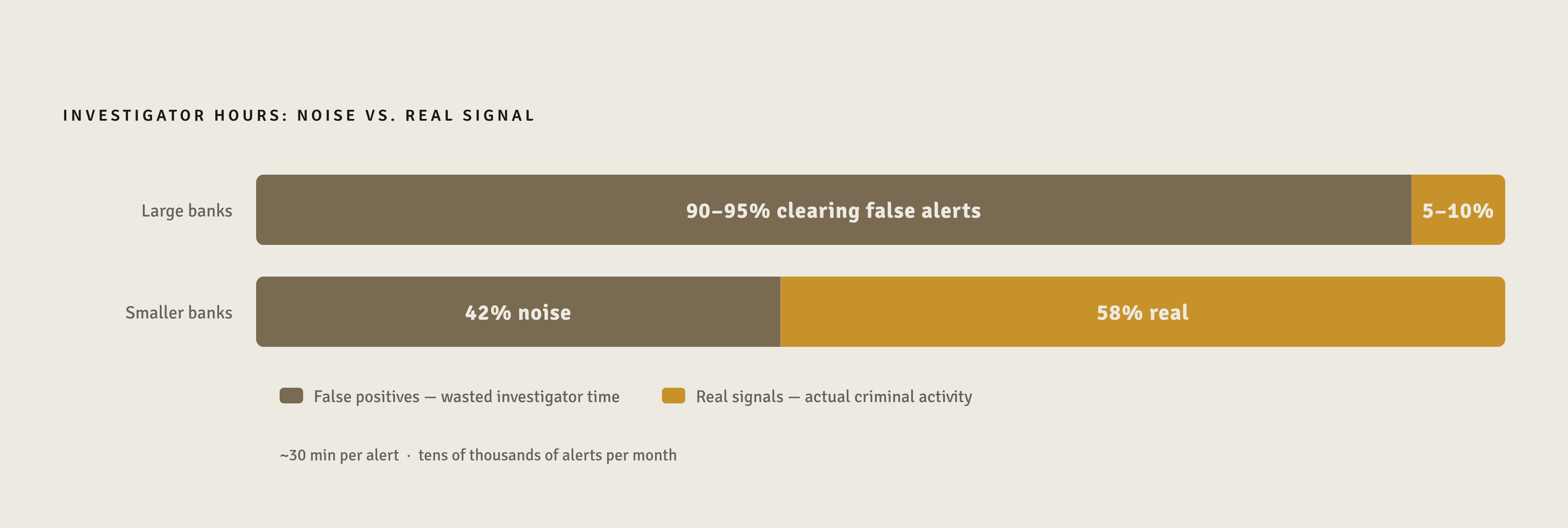
The false positive numbers are where the whole manual model falls apart under its own weight. AML alert systems generate false positive rates between 90% and 95%, with large institutions clustering near the top of that range and smaller banks closer to 42%, according to research from sanctions.io and businessscreen.com. Each false alert eats about 30 minutes of an investigator's time. Do the math on a bank generating tens of thousands of alerts a month and you'll see compliance teams spending most of their working hours clearing noise, not catching criminals. Nobody in compliance finds this particularly funny: the system is technically working exactly as designed, and the design is mostly a very expensive way to confirm that grandma's wire transfer to her grandson was, in fact, just a birthday gift.
Get it wrong and the fines make the operating costs look like pocket change. AML and sanctions penalties have totaled in the billions globally since 2000. TD Bank's settlement, the largest in Bank Secrecy Act history, is the industry's go-to cautionary tale for what happens when monitoring fails at scale rather than in some isolated corner case.
The core architecture of an automated KYC/AML system
Automated KYC/AML isn't one product you buy off a shelf. It's a stack, built in layers, and each layer does a distinct job.
The identity verification layer sits at the front door. It captures documents and runs OCR to pull identity data off government-issued IDs, checks biometrics (facial recognition, fingerprints) against the photo on file, and cross-references government registries, credit bureaus, and watchlists to confirm the person exists and is who they claim to be.
Behind that sits sanctions and watchlist screening, matching customer names in real time against lists from OFAC, the UN, the EU, and national regulators. This is where fuzzy-matching algorithms earn their keep, catching name variations, transliterations, and aliases; it's also, not coincidentally, the layer where false positive rates are shaped most directly by how well the matching logic is tuned. PEP screening and adverse media feeds live here too, flagging politically connected individuals and anyone showing up in unflattering headlines.
Transaction monitoring comes next, built on rule-based triggers first: velocity thresholds, round-number transactions, geography flags. Behavioral analytics get layered on top to catch the patterns that static rules miss entirely. All of this feeds into a risk scoring engine, which pulls signals from every layer into a single customer risk profile and decides whether a case needs enhanced due diligence, escalation, or a Suspicious Activity Report filing.
Case management and reporting closes the loop: workflow routing sends flagged cases to human reviewers, and the system generates audit trails plus SAR and STR filings for regulators. None of this architecture exists in a vacuum. It's shaped directly by the US Bank Secrecy Act, the EU's 6AMLD and AMLR, and FATF guidance, meaning the system's design is a regulatory obligation before it's ever an operational choice.
How AI and machine learning change what these systems can detect
Rule-based systems are transparent, auditable, and brittle in roughly equal measure. They flag a transaction because it hit a predefined condition, full stop. Criminals adapt around static rules constantly, and rules, being rules, don't update themselves. That's the fundamental limitation machine learning was brought in to solve.
ML models learn from patterns across large transaction populations rather than checking boxes, which shifts the underlying question from "did this match a rule" to "does this look like laundering behavior." Adoption has moved fast: Fenergo's 2025 data shows advanced AI tools in KYC/AML went from a minority of firms using them in 2024 to a majority in 2025, with Singaporean firms leading the pack.
Where does ML actually move the needle on false positives? Name-matching gets a probabilistic score instead of a binary match or no-match, cutting a meaningful chunk of irrelevant alerts. Behavioral segmentation scores a customer against their own peer group instead of a single universal threshold, so a construction company moving large sums doesn't get treated like a shell company just because both trip the same dollar amount. Network analysis goes further still, spotting shell company structures and layering patterns across entities rather than staring at one transaction in isolation.
The newest wrinkle is agentic AI: specialist AI agents that handle narrow, repeatable sub-tasks (gathering case evidence, drafting SAR narratives, checking a file for completeness) before a human makes the final call. Fenergo's report frames this as the next step past standard ML deployment, and it's a reasonable one; humans are still terrible at reading the same 40-page corporate structure diagram for the third time that week.
One honest caveat worth sitting with: ML models need training data that reflects actual financial crime patterns, and a poorly trained model can quietly create new blind spots even as it reduces false positives on the typologies it already knows. Napier AI's 2025 report estimates US institutions stand to gain the most from AI-powered compliance in absolute dollar terms, with large European markets close behind, though results depend heavily on how well the thing gets built and tuned, not just whether it gets bought.
Perpetual KYC — why point-in-time verification is no longer sufficient
Here's a number worth sitting with: most fraud happens after initial KYC is completed, not during onboarding. Traditional KYC checks a customer at the start of the relationship and then again on some annual or periodic schedule, leaving a wide-open window where risk can evolve without anyone noticing. The point-in-time model ends up catching crime at exactly the wrong moment, like checking your smoke detector's battery once a year and hoping the fire waits politely for the appointment.
Perpetual KYC, or pKYC, swaps the calendar for triggers. A sudden spike in cross-border transactions, a change in beneficial ownership, a fresh hit in adverse media: any of these fires a re-screening workflow automatically, no scheduled review required. Regulation is pushing this shift along rather than resisting it. FinCEN's 2024 Beneficial Ownership Rule requires updates within 30 days of any ownership change, a cadence no annual refresh cycle can realistically meet.
There's an efficiency case here too, alongside the risk case. PwC's Financial Crime Report 2024 found organizations adopting pKYC models cut KYC maintenance costs substantially while improving detection accuracy at the same time, largely by eliminating the resource-heavy backlog that builds up between scheduled reviews.
Technically, pKYC needs continuous feeds from corporate registries, adverse media, and sanctions lists, a risk scoring engine that re-evaluates profiles as new data lands rather than only on demand, and workflow automation that can launch a triggered review without waiting for a human to notice something's off. The honest limitation, and it's worth saying plainly: pKYC is only as current as the data feeding it. Gaps in the underlying data sources become gaps in coverage, not just gaps in internal process, no matter how well the automation around them is built.
Start with the price tag, because it's bigger than most people outside compliance realize.
The regulatory environment these systems must be built to satisfy
The floor everything sits on is still the US Bank Secrecy Act, the EU's AML directives, and FATF recommendations. Which one takes precedence in a given system depends entirely on geography, and getting that wrong is a fast way to fail an audit.
Europe is in the middle of its biggest AML overhaul in twenty years. Three instruments are doing the heavy lifting: AMLA became operational in July 2025, while the AMLR and AMLD6 apply in full from July 2027, together replacing five separate directives with a single EU-wide rulebook. AMLA has real teeth, with the power to fine institutions up to tens of millions of euros or a significant percentage of annual group turnover for serious violations. Anonymous crypto transactions are banned outright under the new rules; crypto asset service providers, banks, and other financial institutions must verify identity before letting anyone open an account or move funds. Direct supervision of the highest-risk cross-border institutions is expected to start in early 2028.
On the US side, OFAC issued several high-value penalties in 2025, and regulators have made it clear they're done accepting "tick-box" compliance programs. They want evidence of genuine, risk-based design rather than a checklist someone filled out to keep the auditors happy. Billions in AML and sanctions fines have been levied globally since 2000, and the first half of 2025 already shows a sharp year-on-year jump in penalty volume. The cost of a weak system isn't a hypothetical anymore; it's a line item.
What does this mean for the people actually building these systems? Regulatory frameworks don't sit still. New list versions, rule changes, jurisdiction-specific requirements: all of it needs to propagate through an automated system without someone manually rebuilding the thing every time a regulator issues an update.
Where automated systems fail and why configuration is the deciding factor
Automation doesn't make failure go away. It just moves the failure somewhere else. A missed annual review turns into misconfigured logic and data pipelines that don't talk to each other properly.
The false positive epidemic is, in large part, a configuration problem wearing a technology costume. Set name-matching thresholds too wide and investigators drown in noise; set them too narrow and real hits slip through unflagged. Sanctions lists get updated by regulators constantly, and if those updates don't propagate to the screening engine in near real time, you've got a compliance gap even while the system shows a green light on the dashboard.
Data quality upstream decides alert quality downstream, full stop. Incomplete beneficial ownership data means entity resolution falls apart the moment a corporate structure gets more than two layers deep. Inconsistent customer data across business lines creates duplicate profiles, and duplicate profiles create monitoring gaps that nobody notices until an examiner does.
Then there's model drift. ML models trained on historical typologies can miss laundering methods that didn't exist when the training data was collected, and the stablecoin-driven Chinese money laundering networks mentioned earlier are a textbook case of a typology outrunning legacy detection before anyone had time to retrain the model. Integration gaps compound the problem: a strong identity verification layer that never talks to the transaction monitoring layer means the onboarding risk score sits there, unused, while ongoing behavioral alerts fire without that context. The components have to be connected, not just installed next to each other and called a system.
Worth repeating because it cuts against the common assumption: that 90-95% false positive rate isn't some inherent tax that comes bundled with automation. It reflects rule sets built for an older era of financial crime that never got recalibrated as transaction patterns shifted underneath them. Regulatory auditors have caught on to this, too. They're increasingly scrutinizing configuration decisions themselves, not just checking whether an automated system exists. Having the software is necessary, and rarely sufficient on its own.
What the market for KYC and AML software currently looks like
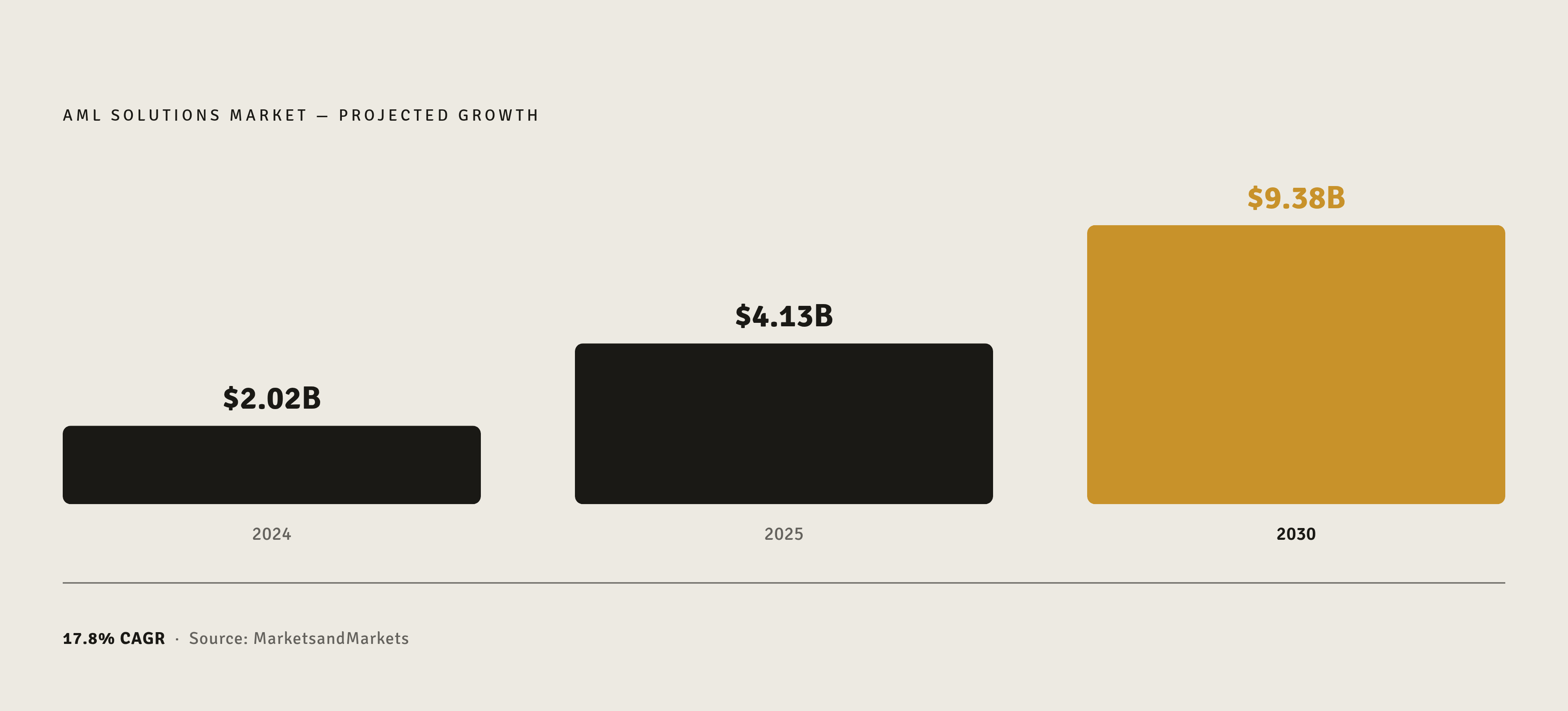
The numbers here move fast enough that any figure risks going stale before this sentence finishes loading. MarketsandMarkets put the AML solutions market at $2.02 billion in 2024, projecting $4.13 billion in 2025 and $9.38 billion by 2030, a compound annual growth rate of 17.8%. Global Market Insights runs a broader estimate: $4.4 billion in 2025, climbing to $23.8 billion by 2035 at 18.7% CAGR. Different methodologies, same direction: up, and fast.
KYC software specifically generated $4.8 billion in 2024, with the e-KYC segment alone reaching $948.8 million in 2025 and, per IMARC Group, projected to hit $3,853.8 million by 2034 at a 16.35% CAGR. A more conservative slice, AML and KYC data and services in banking, reached $2,269.5 million in 2025 and is expected to grow to $4,129.46 million by 2034 at 6.88% CAGR, a figure that reflects managed services and data rather than full platforms.
Five vendors, FIS, NICE Actimize, Fiserv, Experian, and ACI Worldwide, hold roughly 40% combined market share in 2025. That leaves the majority wide open, which is exactly the space where specialized and regional vendors compete on depth rather than scale. Biometric authentication has become the largest segment in onboarding specifically, pushed along by facial recognition and fingerprint checks spreading across every digital channel a bank operates.
Three forces are pulling this growth simultaneously: rising regulatory obligation (Europe most visibly), expanding crypto compliance requirements, and plain old efficiency demand from institutions tired of watching compliance costs climb every year. The RegTech category surrounding all of this has become a multibillion-dollar market growing faster than traditional financial software generally, turning into default infrastructure rather than a niche response to a compliance headache.
How institutions should think about building or buying an automated screening capability
For onboarding and sanctions screening specifically, the build-versus-buy question is mostly decided already. Maintaining global watchlists in real time and keeping pace with regulatory change across a dozen jurisdictions is a full-time discipline, and building it in-house rarely pencils out against buying from a vendor who does nothing else.
The real decisions sit one level down. Which layers get integrated versus run as standalone point solutions? Transaction monitoring, identity verification, and sanctions screening each have their own specialist vendors, and stitching them together carries real integration cost that doesn't show up on the initial price quote. Is the risk scoring logic something compliance can adjust directly, or does every threshold change require an engineering ticket and a two-week sprint? That question alone determines whether a system can adapt to a new typology in days or gets stuck waiting on a dev backlog while criminals, who don't file tickets, move on to the next thing.
None of this resolves cleanly into a single recommendation, and that's sort of the point. The institutions getting real value out of automated KYC/AML aren't necessarily the ones who bought the most expensive platform. They're the ones who understood that a screening system is only as sharp as its worst-configured layer, and treated the wiring between components as seriously as the components themselves.
Notes
- https://www.marketsandmarkets.com/Market-Reports/anti-money-laundering-solutions-market-95490454.html
Provided the AML market size figures of $2.02 billion in 2024, $4.13 billion in 2025, and $9.38 billion by 2030 at a 17.8% CAGR.
- https://www.marketgrowthreports.com/market-reports/anti-money-laundering-and-kyc-in-banking-market-116897
Provided the AML and KYC in banking market figures of $2,269.5 million in 2025 growing to $4,129.46 million by 2034 at 6.88% CAGR.
- https://www.imarcgroup.com/e-kyc-market
Provided the e-KYC segment market size of $948.8 million in 2025, projected to reach $3,853.8 million by 2034 at a 16.35% CAGR.
- https://www.gminsights.com/industry-analysis/anti-money-laundering-aml-market
Provided Global Market Insights' broader AML market estimate of $4.4 billion in 2025 climbing to $23.8 billion by 2035 at 18.7% CAGR.
- https://www.sanctions.io/blog/the-problem-of-false-positives-in-aml-screening
Provided the false positive rate figures of 90–95% at large institutions and approximately 42% at smaller banks, cited directly in the article.
- https://www.businessscreen.com/resources/ai-in-aml-compliance-reducing-false-positives-with-smart-detection
Cited alongside sanctions.io as a source for AML false positive rate data and supports the section on AI reducing false positives.