Long read Compliance Automation
Compliance Automation for HIPAA Privacy Rule Requirements
Automation cuts through fragmented systems to catch compliance gaps before regulators do.
PHI is anything that ties a person's name to their health, their care, or how they paid for it. HIPAA's Privacy Rule sets the rules for handling that information and gives patients real say over their own records. The framework hasn't changed shape much since it was written, but the world around it has gotten meaner: more breaches, more enforcement, more overlapping duties landing on different desks at the same company on the same afternoon. That overlap is the actual case for automating this work, and it's the thread running through everything below.
HIPAA lists 18 identifiers that trigger PHI status: names, dates, device serial numbers, geographic data, and so on. Three clusters of obligations generate most of the real labor. The Minimum Necessary Standard says you can only touch PHI to the extent your specific purpose requires it, which means checking access practices on an ongoing basis instead of writing one policy and filing it in a drawer. The Patient Right of Access requires records within 30 days of a request, with one 30-day extension allowed if written notice goes out. And the Notice of Privacy Practices, the disclosure document every patient is supposed to see, has to reflect 2024 changes by February 16, 2026; that's one of the nearest deadlines on the books right now. Each obligation lives in its own system: EHRs, access controls, patient portals, policy binders. Run compliance by hand and each one gets handled alone, with no shared record tying any of it together.
Where enforcement is actually landing, and what violations look like in practice
The numbers say enforcement stopped being occasional a while back. OCR has settled or fined 152 cases totaling $144,878,972, and closed more than 31,191 cases through corrective action or technical help. That's a steady grind, with headline cases showing up regularly rather than rarely.
The five most-cited violation types, in order, are impermissible uses and disclosures of PHI, missing safeguards, blocked patient access to records, missing administrative safeguards for ePHI, and disclosing more than the minimum necessary. Three of those five map straight onto the obligation clusters above, and the pattern holds year after year.
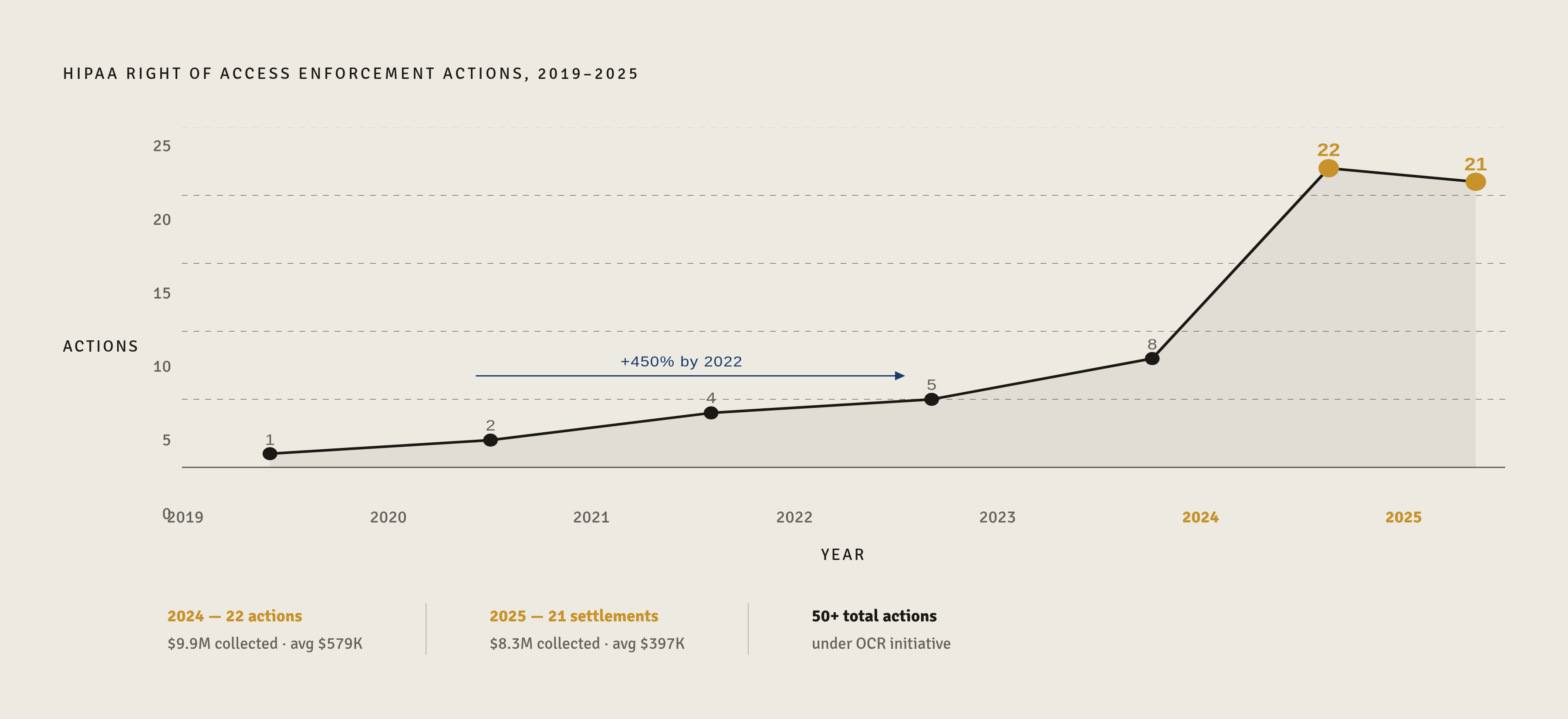
Right of Access is the busiest enforcement lane right now. Enforcement jumped 450% between 2019 and 2022 after OCR launched its Right of Access Initiative, and the agency has now passed 50 actions under it. Case number 53, from March 2025, hit an academic medical center with a $200,000 penalty because records didn't go out until more than two years after the request came in. A system with no clock running on it produced that outcome, and nobody caught it until OCR did.
2024 was one of the most active enforcement years on record: 22 actions, $9.9 million collected, average penalty $579,003. 2025 shifted, with 21 settlements totaling $8,330,066, an average of $396,670, and a median of $182,000. Smaller checks per case, sure, but OCR is clearing its backlog faster, so more organizations are getting touched even as the per-case dollar amount shrinks.
State attorneys general run a second enforcement track a lot of compliance teams underweight. Nine actions in 2024 brought in $19,560,000. The Comstar case is worth sitting with: a single breach drew a $515,000 state fine from Massachusetts and Connecticut, plus a separate $75,000 OCR settlement. One incident, two regulators, two checks written. Phase 3 audits are also underway; OCR confirmed in March 2025 that it's auditing 50 covered entities and business associates. Staying under the radar was never really a plan, and now it isn't even an option.
Website tracking is the newest front, and it blindsides most organizations because it doesn't register as a HIPAA issue until it becomes one. Pixels, session replay tools, analytics scripts, all quietly sending health-related data out the door without a business associate agreement or any real safeguards. Industry reporting ties hundreds of millions of dollars in penalties and settlements to pixel-tracking violations between 2023 and 2025.
The breach environment that makes these requirements harder to meet manually
Healthcare is, by a wide margin, the most breached sector in U.S. history. There are 7,419 healthcare data breaches on record through January 31, 2026, affecting more than 935 million individuals. That's more than the entire U.S. population, so plenty of people are getting hit more than once.
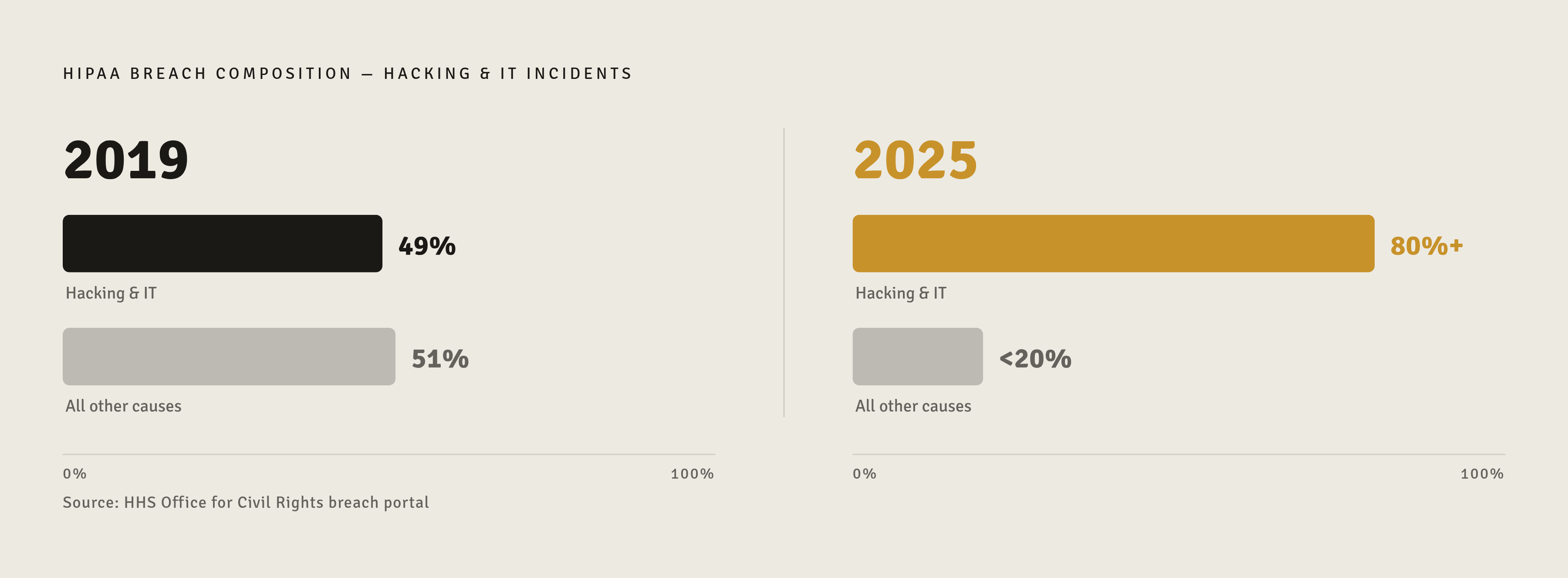
2025 was the worst year on record for large healthcare breaches specifically: 772 incidents, roughly 138.5 million people affected, most tied to hacking and IT vulnerabilities. The shift toward hacking is stark. In 2019, hacking and IT incidents made up 49% of reported HIPAA breaches; by 2025, that share passed 80%. The hacking and IT category grew 239% between 2018 and 2023, and ransomware inside that category grew 278% over the same stretch.
Breach costs show the strain too. Healthcare's average breach cost was $7.42 million in 2025, down from $9.77 million globally the year before, but the U.S.-specific number tells a different story: $10.22 million, up 9.2% year over year, with regulatory fines and slow detection doing most of that work.
On detection: the average time to identify and contain a healthcare breach runs 279 days, or roughly nine months during which PHI sits exposed while breach notification clocks, patient notification clocks, and OCR reporting clocks all tick quietly in the background, waiting for someone to actually look.
Business associates are a persistent soft spot. Roughly 40% of all HIPAA breaches involving 500 or more records trace back to a business associate, and plenty of BAs still skip independent risk assessments entirely, a gap that's drawn direct enforcement action. Meanwhile, healthcare organizations spend, on average, only 4 to 7% of their IT budget on cybersecurity, against roughly 15% in financial services. Fewer resources plus a bigger attack surface adds up to a longer detection window, every time. Manual PHI governance, the hand-built access spreadsheet, the request timeline tracked in a shared doc, the policy review that happens once a year if someone remembers, carries real strain in a threat environment that has outgrown it.
The numbers say enforcement stopped being occasional a while back.
How automation maps to each Privacy Rule obligation
Compliance runs as a stack of workflow automations stitched together by a shared audit trail, and each major Privacy Rule obligation has its own automation answer. Line them up side by side and an abstract regulatory burden starts looking like a checklist with actual technical fixes attached.
PHI identification starts the chain. Automated data discovery tools scan structured databases and unstructured files alike (PDFs, free-text clinical notes, email threads) to find PHI wherever it's hiding. Tagging links each field to the relevant HIPAA standard so downstream handling rules apply on their own, and classification happens the moment data comes in, not months later during a retrospective audit scramble. That matters because it takes the job away from every employee having to spot all 18 identifier types by sight, which nobody manages consistently no matter how good the training slides look.
For the Minimum Necessary Standard, role-based access control puts the Principle of Least Privilege into practice: people get access at the minimum level their job actually needs, nothing more. Access rights adjust automatically when someone changes roles, no manual deprovisioning ticket required. One newer wrinkle worth watching: generative AI tools used in clinical settings can return more PHI than the original prompt asked for, so the automation layer has to filter outputs too, not just gate inputs on the way in. Automated alerts should also flag access patterns that stray from baseline; a query pulling records outside a clinician's assigned patient panel, say.
Patient Right of Access is where automation earns its keep fastest. A structured digital intake form with identity verification starts the compliance clock the moment a request lands, not whenever someone gets around to opening the email. Workflow routing sends the request to the right records custodian automatically, based on request type and facility. A 30-day countdown runs with escalation alerts firing before the deadline, and if an extension is needed, the system drafts and logs the written notice itself. Fulfillment tracking closes the loop: what got delivered, in what format, and when, which happens to be exactly the evidence OCR asks for during an investigation. Proposed rules would shrink the response window to 15 days, and running that off a shared spreadsheet gets harder with every added request; past a handful a month, it stops working entirely.
Notice of Privacy Practices gets the same treatment. Policy management automation keeps the NPP version-controlled in one place, and when regulations change, like the February 2026 deadline coming up, the updated version pushes out to every distribution channel at once instead of trickling out over weeks. A distribution log tracks who got it, in what format, and when; that's the record you need to show good-faith compliance, and acknowledgment tracking covers the patient-facing side too.
Underneath all of it sits the audit trail, the connective tissue nobody thinks about until they need it badly. Every automated action, an access grant, a request received, an NPP distributed, a disclosure made, gets written to an immutable log. That log is the main evidence in an OCR investigation or a Phase 3 audit, and automation means it exists whether or not staff remembered to write it down by hand that day.
Risk assessment and business associate management as the two most neglected automation opportunities
Risk assessment is consistently the most-cited deficiency in OCR investigations, and it's the focus of the agency's current enforcement push as it works through its backlog. Manual risk assessments tend to be periodic, point-in-time exercises: someone fills one out, files it, and doesn't look at it again until the next audit cycle rolls around.
Automated risk assessment tools watch system configurations, access logs, and vulnerability data continuously against a defined risk register instead. HHS does publish a Security Risk Assessment Tool, and it's genuinely useful as a starting point, though it needs heavy manual input and has limited ability to monitor anything on its own over time. The proposed HIPAA Security Rule NPRM, published December 27, 2024, would raise the bar considerably: annual audits of all safeguards, vulnerability scans at least every six months, annual penetration testing. Running that by hand isn't realistic without putting staff on it full time, and most organizations don't have the headcount for that. The NPRM also proposes scrapping the "addressable" versus "required" distinction for implementation specifications, which raises the compliance floor across the board.
Business associate management sits in a similar blind spot. Given that roughly 40% of large HIPAA breaches trace to business associates, BA oversight is live risk sitting on the balance sheet, and treating it as paperwork to file and forget carries real cost. Yet the manual version of BA management is usually a spreadsheet of vendors, periodic email reminders about BAA renewals, and no real ongoing check on a BA's actual security posture. Automating this means keeping one central BA inventory, triggering renewal workflows automatically as BAA expiration dates approach, and tying vendor risk assessments to how much access each BA actually holds. Go back to Comstar for a second: a single breach exposed the organization to a state fine and an OCR settlement at once, and automated BA oversight is exactly what closes the kind of gap that produces that double liability.
What connects both of these neglected areas is the same failure mode. Nobody's ignorant of the requirement here; the trouble is doing it consistently, month after month, at scale, without something slipping through a crack nobody happened to be watching that week.
What the pending Security Rule NPRM means for organizations building compliance automation now
The Security Rule NPRM is the biggest pending change to HIPAA in years. Proposed December 27, 2024, it pulled in thousands of public comments during its 60-day window, which is a lot of attention from a compliance community that doesn't usually get this worked up about a proposed rule.
The changes with the most direct automation implications: every implementation specification becomes required, killing off the old "addressable" flexibility that let organizations defer or swap in substitute controls. Annual audits would cover administrative, technical, and physical safeguards all at once, and organizations without automated evidence collection are looking at a genuinely brutal manual documentation load trying to keep pace. Vulnerability scans at least every six months and annual penetration testing round out the schedule. Automation is really the only practical way most organizations hit that cadence without hiring a small army of analysts they don't currently have budget for.
Pushback has been loud. CHIME, along with a coalition of more than 100 hospital and provider groups, has formally asked HHS to withdraw or scale back the rule, arguing the cost estimates are unrealistic, especially for under-resourced providers. The final rule may well get softened in response, but the direction it's pointing, toward stricter, more frequently verified controls, isn't likely to reverse even if the specifics shift in the final draft. Organizations that build automation aligned with the NPRM's requirements now stay compliant under the current rule and end up positioned for whatever the final version turns out to be. Organizations that wait are signing up for a retrofit under deadline pressure instead, which is its own kind of expensive.
HHS is pushing in this direction beyond the Security Rule too. The December 2024 Administrative Simplification final rule, which modified pharmacy transaction standards, points the same way: less manual data entry, more workflow automation built into the compliance system by default.
How to evaluate compliance automation tools against the actual regulatory requirements
So how do you actually shop for one of these platforms without getting talked into buying a feature list? Judge any compliance automation tool against the specific obligation map covered above, weighing it on substance over how many features it claims on the sales deck. The real question for each candidate: does it close every regulatory loop, PHI classification, access control, patient rights workflow, NPP distribution, audit trail, risk assessment, BA management?
Does PHI discovery actually cover unstructured data (PDFs, free-text notes, email) or only structured database fields? Does access control support automated provisioning and deprovisioning, since manual off-boarding is a documented and repeated breach vector? For Right of Access specifically, does the tool timestamp intake, route requests on its own, track deadlines, and produce a closed-loop fulfillment record, or does someone still have to chase it down by hand at the end? Can NPP updates push from one version-controlled source to every channel at once, and is the audit log immutable, exportable in a format OCR would accept, kept automatically for the six-year minimum? Does the risk assessment function support continuous monitoring, or is it just a fancier-looking version of the same annual checklist? And for BA management: is there a central inventory, automatic BAA expiration tracking, vendor risk scoring built in?
On whether any of this automation actually pays off, the data backs it up. Per IBM's 2025 findings, organizations using AI-driven security tools extensively cut their breach lifecycle by 80 days and saved close to $1.9 million on average. That's the benchmark worth holding a tool to: how much it actually shortens the breach lifecycle and how audit-ready it leaves you when OCR comes knocking, weighed against what it costs.
There's real value, too, in platforms that pair automated process execution with human editorial oversight on the content side: drafting NPPs, patient rights response templates, policy update language. That hand-off between legal, compliance, and operations teams is exactly where things tend to fall through the cracks. Before signing anything, ask the vendor directly whether the platform produces audit-ready documentation on its own, or whether staff still have to assemble the evidence by hand once an investigation actually starts. A vendor that hedges on that question is telling you something worth hearing about the product, whether they mean to or not.
Notes
- https://www.hipaajournal.com/new-hipaa-regulations/
Provided the 2024 and 2025 enforcement figures including total settlements collected, average penalty amounts, and median penalty for those years.
- https://www.metricstream.com/blog/hipaa-updates-key-changes.html
Provided statistics on healthcare cybersecurity spending relative to financial services and the number of people affected by 2025 healthcare breaches.
- https://www.hhs.gov/hipaa/for-professionals/regulatory-initiatives/index.html
Served as the authoritative source for the Patient Right of Access requirements and timelines described in the article.
- https://www.hhs.gov/hipaa/for-professionals/security/hipaa-security-rule-nprm/factsheet/index.html
Provided details on the proposed Security Rule NPRM requirements including annual audits, vulnerability scan frequency, penetration testing, and the elimination of the addressable versus required distinction.
- https://www.federalregister.gov/documents/2025/01/06/2024-30983/hipaa-security-rule-to-strengthen-the-cybersecurity-of-electronic-protected-health-information
Served as the primary source for the Security Rule NPRM published December 27, 2024, including its specific proposed requirements discussed throughout the article.
- https://healthit.gov/privacy-security/security-risk-assessment-tool/
Identified as the HHS Security Risk Assessment Tool discussed in the risk assessment section, noted as useful but limited in continuous monitoring capability.