Long read Compliance Automation
Vendor Risk Assessment Automation
Automation replaces slow manual reviews with continuous assessment across hundreds of vendors.
Vendor risk assessment used to be a manual process because the vendor ecosystems it managed were small enough for one person to review one company at a time. Enterprises now run relationships with hundreds, sometimes well over a thousand, third parties, and a big chunk of those vendors touch sensitive data somewhere along the way. This piece walks through why the old method is breaking down, what automation actually replaces, and what a program looks like once it's built around software instead of a spreadsheet.
The structural problem is easy to state and a pain to fix. Manual review is sequential: one team, one vendor, one file at a time. The vendor list keeps growing no matter how fast that team works. EY's research into third-party risk management maturity turns up a genuinely odd pattern: newer programs, the ones without years of process behind them, often manage far more vendors than mature programs do. Manual review hits a hard ceiling on capacity, and once you hit it, you've got two choices: hire more reviewers or let coverage get thinner. Most organizations quietly pick the second one. Venminder's 2025 research found a meaningful share of companies still run vendor risk programs mostly out of spreadsheets, which tells you the tooling gap isn't a rounding error.
Manual processes weren't badly designed, to be fair to whoever built them back in the day. They were built for a scale that doesn't exist anymore.
The concrete costs of manual assessment: time, inconsistency, and coverage gaps
Start with time. A single vendor assessment done by hand can eat dozens of hours of skilled staff time. The work itself isn't hard so much as repetitive: chase down documents, follow up on incomplete answers, wait for a compliance officer to get back from vacation, repeat. Most organizations say this delay slows vendor onboarding directly, and the risk team ends up cast as the department that tells procurement no. Nobody enjoys being that department, for what it's worth.
Then there's inconsistency, which might be the sneakier problem. Hand the same vendor file to two different reviewers and their risk scores can land in wildly different places, depending on that reviewer's experience, workload, or how many other assessments are stacked on their desk that week. A risk rating often says more about who reviewed the file than what the vendor actually does, and that gap undercuts the entire point of having a rating system in the first place.
Staleness compounds it. By the time a manual review wraps up, weeks after it started, the vendor's actual risk posture has probably already moved: a new subprocessor got added, a certificate lapsed, a breach happened somewhere upstream. Manual assessment hands you a snapshot of a risk profile that's already out of date by the time you're holding it.
Coverage is its own separate mess. Realistically, manual programs can only go deep on a fraction of their vendor population; the rest get a light touch or nothing at all. It gets worse the further out you look. Supply chain research consistently shows organizations have decent visibility into their direct, Tier 1 vendors, and dramatically less into what those vendors' own suppliers are doing. Manual processes can't reach fourth-party depth at any cost that makes sense. Ask a risk team what their vendor's vendor is doing, and you'll usually get a shrug.
The questionnaire itself deserves a hard look too. Traditional vendor questionnaires generate mountains of raw data and comparatively little signal anyone can act on. Security teams spend hours parked in static spreadsheets, cross-referencing answers against policy, and still can't say with confidence which vendor represents the biggest threat. That's a lot of paperwork for not much clarity, and everyone in this field has lived it at least once.
What's at stake when vendor risk goes undetected
Third-party breaches haven't crept up gradually; they've jumped. Verizon's 2025 Data Breach Investigations Report documents roughly a doubling in the share of breaches involving a third party compared to the year before. A swing that size in a single year points to something structural, not noise. SecurityScorecard's 2025 Global Third Party Breach Report backs this up independently, finding that a significant share of all breaches trace back to third-party access. Two separate reports, same conclusion: third-party access now sits next to the main breach vectors, ahead of where it used to rank as a footnote.
The cost angle makes this worse. Ponemon research shows breaches that start through a third-party vendor cost meaningfully more than breaches that don't; the third-party path adds a real premium on top of the average breach cost. Healthcare and financial services carry the sharpest exposure. Healthcare alone saw hundreds of millions of patient records breached in 2024, and most of those incidents ran through a third-party vendor somewhere in the chain. Cybersecurity Ventures projects software supply chain attacks are on track for enormous economic damage by the end of the decade, which turns the whole conversation into systemic risk instead of an occasional bad headline.
Manual review being slow is annoying but survivable on its own. Pair that with breach exposure climbing at this rate, though, and slow, inconsistent, partial coverage stops being an operational headache. It turns into a liability sitting on the balance sheet, waiting for someone to notice it.
What automation actually does differently in a vendor risk workflow
Automated vendor risk programs swap periodic, sequential human review for continuous, ongoing evaluation. The program runs at machine speed and covers the full vendor population at once, something manual review structurally can't do no matter how many analysts you hire.
"Automation" is doing a lot of work as a word here, honestly. It covers several distinct mechanics that get lumped together in vendor pitches.
Automated questionnaires pre-fill vendor responses from trusted existing sources, flag whatever's incomplete, and score risk in real time. That cuts out most of the back-and-forth email chains eating up the manual timeline. Self-scoping questionnaires go a step further: the system adjusts the question set based on vendor type and inherent risk, so a payroll processor and a low-risk office supplier don't get handed the same forty-question form. Vendors answer fewer, more relevant questions, and the answers tend to be better, since nobody's rushing through a survey section that doesn't apply to them.
Continuous risk scoring replaces the point-in-time snapshot with something closer to a live feed. Vulnerability scans, dark web mentions, expiring compliance documents all get pulled in, and the vendor's score updates on an ongoing basis instead of once a year at renewal. Intelligent workflow routing means that once a vendor's inherent risk score crosses a defined threshold, the system kicks off additional due diligence on its own; no analyst has to notice and escalate it by hand. A fair amount of the administrative grind, profile updates, report generation, remediation routing, audit documentation, gets handled without anyone's judgment involved at all.
Well-built platforms also sharpen their risk models over time as they accumulate more incidents and assessment outcomes, refining accuracy with each cycle instead of staying frozen at whatever settings shipped on day one.
Fourth-party visibility might be the biggest practical unlock here. Automation makes monitoring your vendors' vendors tractable, something manual programs basically can't touch at scale. EY's 2025 research found a substantial majority of organizations now do fourth-party monitoring, a capability that barely existed under manual programs a few years back. The consistency gain matters as much as the speed gain, too: every vendor runs through the same scoring logic, weighted the same way every time. Reviewer variance gets designed out of the process, since scoring no longer depends on which analyst happened to catch that file on a Friday afternoon.
The performance gap between manual and automated programs in practice
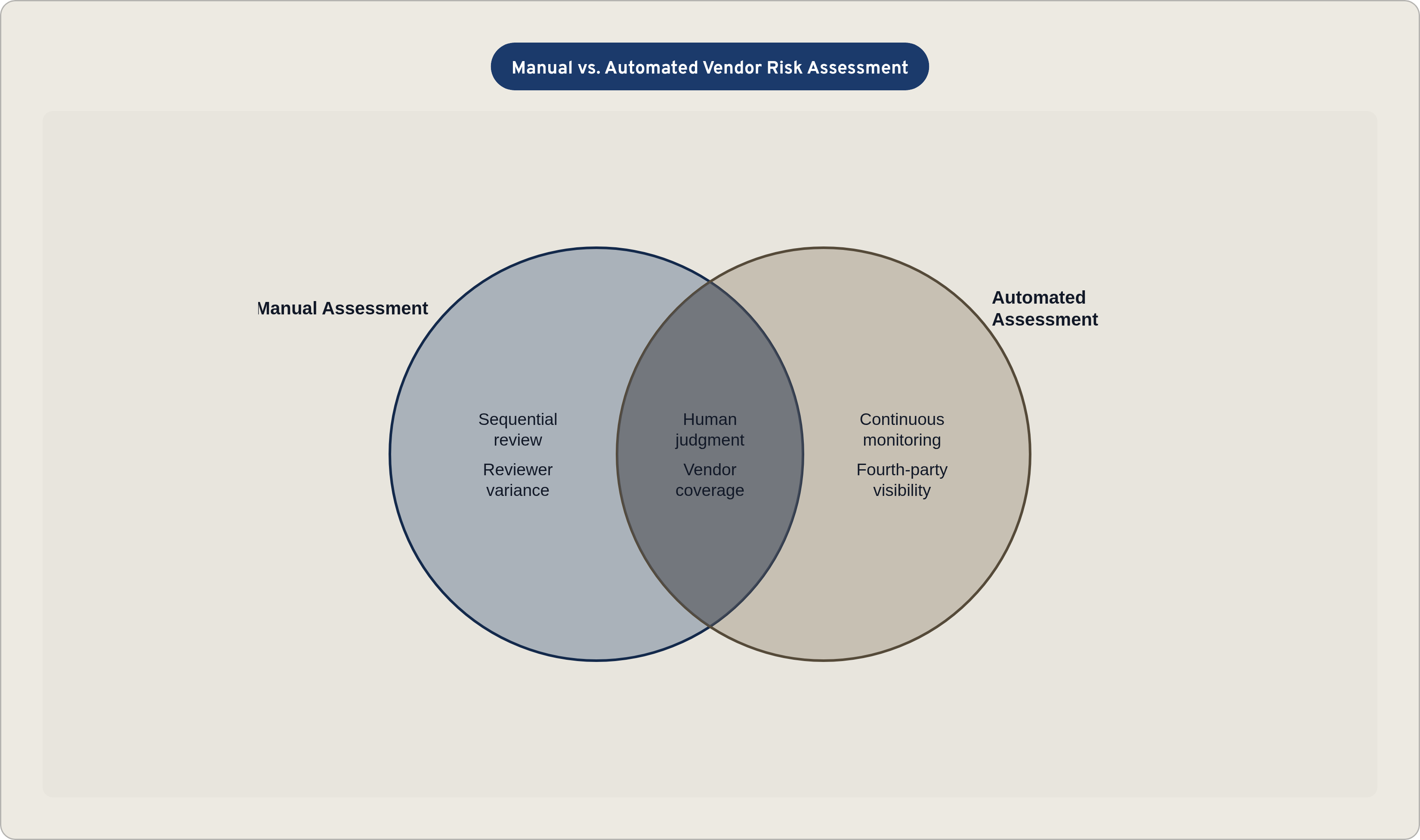
So what does this look like with numbers attached? Pulling vendor benchmarks from platforms like DSALTA and Atlas Systems/ComplyScore, the pattern holds across both: automated assessments finish in a fraction of the time manual review takes, days instead of weeks, sometimes hours instead of days. Coverage moves the same direction. Automated platforms can realistically monitor close to the entire vendor population, where manual programs only cover a slice of it with any real depth. That gap between the two numbers isn't abstract; it's the unmonitored part of your risk surface, sitting there, unattended, quietly hoping nobody asks about it.
Consistency improves sharply too. The wide reviewer-to-reviewer variation that plagues manual scoring narrows to something close to zero once the same logic applies to every vendor. Onboarding speed, usually the friction point procurement complains about loudest, compresses from cycles that used to take many weeks down to under two. Organizations report that automation soaks up most of the repetitive task volume, freeing analysts to spend time on escalations, remediation strategy, and actually running the program instead of feeding it data by hand.
Here's the honest caveat, and it matters: these benchmarks come mostly from the platform vendors selling the automation. Take them as directional, not gospel. Actual gains depend on how the program's designed, how cooperative your vendors are about filling out a digital questionnaire, and whether the data going in is clean to begin with. Feed the system a messy process and you'll get a faster, more consistent version of that same mess. Software doesn't fix bad inputs on its own; it just processes them quicker.
Manual processes weren't badly designed, to be fair to whoever built them back in the day.
How regulation is making automation a compliance requirement, not just an efficiency choice
DORA, the EU's Digital Operational Resilience Act, has been fully in force since January 2025, and it's the most prescriptive third-party ICT risk regulation the EU financial sector has seen. It requires a maintained inventory of every ICT third-party provider with defined criticality ratings, formal pre-contractual risk assessments, and mandatory contract clauses covering data location, audit rights, exit strategy, sub-contracting conditions, and incident notification timelines. It also requires concentration risk assessment: figuring out whether too many critical functions depend on the same underlying provider.
The Register of Information requirement turned out to be the toughest part of DORA operationally, and by a wide margin. The 2025 pilot submission round found that a lot of in-scope financial entities simply didn't have a centralized view of their own ICT contracts; the arrangements were scattered across business units and subsidiaries that hadn't been talking to each other. In November 2025, EU supervisory authorities used DORA's powers to formally designate a group of the largest cloud providers as critical ICT third-party providers. That's about as clear a signal as regulators can send that concentration risk monitoring is now an active supervisory priority.
NIS2, applicable since October 2024, mandates supply chain security as part of cybersecurity risk management across eighteen sectors. ENISA's June 2025 technical guidance requires organizations to keep a live supplier register, updated through ongoing risk management rather than refreshed once a year during an audit cycle. That live-register requirement is, for practical purposes, hard to meet through annual manual review. It assumes continuous monitoring already exists everywhere, whether or not that's actually true on the ground.
Beyond the EU, the compliance stack keeps growing: ISO 27001, SOC 2, PCI DSS 4.0, SEC cybersecurity rules, NYDFS requirements. Each one stacks its own third-party oversight obligation on top of the last, forming a layered set of requirements that accumulates rather than one you satisfy once and move on from. Data from the National Association of Manufacturers in 2025 shows regulatory penalties for supply chain compliance failures have grown substantially year over year, and most of the incidents behind those penalties trace back to something mundane: a lapsed certification, a missed deadline, the kind of thing a manual tracker was supposed to catch and didn't.
What a well-structured automated vendor risk program looks like end to end
Everything starts with vendor inventory and tiering. Automation only works if the vendor population is already catalogued and segmented by criticality, and that's a governance decision your team makes; no software license solves it for you, no matter what the sales deck implies.
From there, inherent risk rating comes first, before any detailed assessment happens. Score each vendor on what it accesses, what it does for the business, and what breaks if it fails. That score determines which assessment path the vendor follows. High-criticality vendors get the full treatment: complete questionnaire, evidence review, continuous monitoring, periodic reassessment triggered whenever something material changes. Mid-tier vendors get a scoped questionnaire matched to their risk profile, automated scoring, and review on a set cycle. Low-risk vendors get a lightweight intake and automated scoring, and only resurface if ongoing monitoring flags a change worth a second look.
Continuous monitoring sits above all three tiers, scanning the whole vendor population for real-time signals: security incidents, dark web exposure, compliance documents about to lapse, regardless of which tier a given vendor sits in. Remediation tracking closes the loop: a mature program routes the finding to whoever owns it, tracks the fix, and escalates on its own if the deadline slips.
Audit readiness ends up as a byproduct of all this rather than a separate project you bolt on later. When the assessment workflow, the scoring logic, and the remediation records are all generated by the system as it runs, the audit trail builds itself in the background. That's a real advantage under DORA's Register of Information requirement, where the pilot round showed exactly how painful it is to reconstruct this stuff after the fact.
The human role shifts rather than disappears. Analysts move away from data collection and spreadsheet upkeep toward interpreting the cases the system flags, managing vendor relationships through remediation, and making the calls that automation surfaces but can't close out on its own.
How to evaluate vendor risk automation platforms
The market's grown fast enough that a large number of TPRM tools rolled out AI-driven risk scoring between 2023 and 2025, based on research tracking product development in the space. Picking one takes real criteria, weighed carefully, not a features checklist lifted off a sales deck.
Ask whether the platform does continuous monitoring or just produces point-in-time assessments dressed up in a nicer interface. Ask how it handles questionnaire pre-filling and self-scoping, and specifically what data it's pulling from to do that. Ask whether its risk scoring model can explain its own output, or whether it just hands you a number with no traceable logic underneath. An unexplained score isn't worth much more than an unsupported guess dressed in a dashboard. Ask whether it supports fourth-party monitoring at real scale, not just as a bullet point on a slide. And ask directly how it handles DORA's Register of Information and NIS2's live supplier register, since those aren't optional line items for a lot of buyers anymore.
Integration matters as much as any of the scoring mechanics. A platform that doesn't connect into your existing procurement, contract management, and GRC systems becomes a new silo sitting next to the old ones, which defeats a good chunk of the point of buying it. Deployment model matters too: cloud-based deployment now dominates TPRM adoption, largely because continuous monitoring needs continuous data feeds, and on-premise setups tend to struggle to keep pace with that.
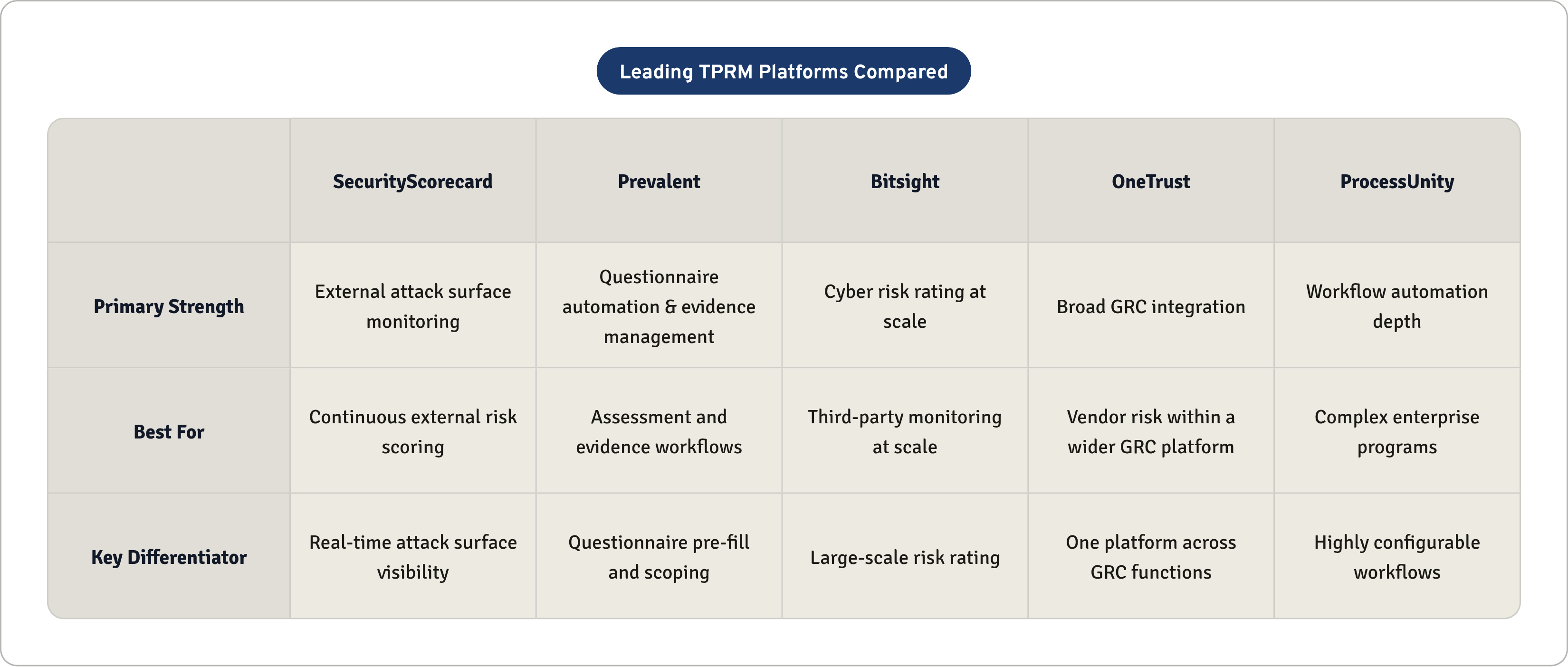
A few names come up regularly, each with a different strength, worth weighing against each other rather than treating as interchangeable. SecurityScorecard is known for continuous external attack surface monitoring and risk scoring. Prevalent is strong on questionnaire automation and evidence management. Bitsight does cyber risk rating and third-party monitoring at scale. OneTrust offers broad GRC integration with vendor risk as one piece of a bigger platform. ProcessUnity brings workflow automation depth for complex enterprise programs with a lot of moving parts. Which one fits depends on whether you need deep external scanning, questionnaire depth, or GRC breadth more than the others; nobody needs all three equally, and pretending otherwise just delays the decision.
One thing buyers sometimes overlook: the platform itself is a critical third-party provider with access to your sensitive vendor data. It deserves the same scrutiny you're asking it to help you apply to everyone else on your list. Slightly ironic, but there it is.
Where automated vendor risk programs still require human judgment
Automation solves the scale problem, the consistency problem, and the speed problem. Whether a program is actually any good still comes down to judgment calls automation can't make on its own, and that's a fact about what technology is for, not a knock on the technology.
Risk model design is a human decision, full stop. The weights, thresholds, and triggers driving automated scoring embed assumptions about what counts as acceptable risk, and those assumptions need to be set on purpose and revisited as the threat landscape shifts. A system tuned for 2023's threats quietly drifts out of date if nobody checks in on it, the same way a GPS app keeps routing you down a road that closed six months ago.
Some things a system just can't read. A vendor's explanation for an odd finding, how much a particular contractual relationship actually matters to a critical business function, the nuance in a remediation commitment that reads fine on paper but feels shaky in the actual phone call: these need a person listening and weighing context. Emerging risk categories work the same way. Vendor AI usage has become a top concern across TPRM programs, with a growing share of organizations actively monitoring how their vendors deploy AI internally, and the frameworks for judging that are still being written as we go. Someone has to set policy before a system can enforce it.
Regulatory interpretation lands here too. DORA's concentration risk requirement asks organizations to reason about systemic dependencies across an entire portfolio; a system can hand you the data to make that call, but it can't make the call for you.
Automation's real value is that it absorbs the volume. That frees up the risk professionals on staff to spend their limited hours where their judgment actually changes the outcome, rather than on the twelfth follow-up email asking a vendor for a SOC 2 report they were supposed to send in March. The organizations getting the most out of automated TPRM tend to share one trait: they figured out which decisions still need a human in the loop, and built the program to put people there on purpose.
Notes
- https://securityscorecard.com/blog/automating-vendor-risk-management-and-assessments/
Provided data on the share of breaches tracing back to third-party access, cited in the section on breach exposure.
- https://www.trustcloud.ai/tpra/best-practices-for-automating-third-party-vendor-assessments-a-leadership-perspective/
Supplied the concept and mechanics of self-scoping questionnaires that adjust question sets based on vendor type and inherent risk.
- https://www.flowforma.com/blog/automated-vendor-risk-assessment-tools
Contributed detail on specific administrative tasks handled by automation, including remediation routing and audit documentation.
- https://panorays.com/blog/automated-vendor-risk-assessments-for-tpcrm/
Provided information on fourth-party visibility as a key capability unlocked by automated vendor risk programs.
- https://www.dsalta.com/resources/tprm/how-to-automate-vendor-risk-assessments-in-2025
Provided benchmark data on automated vs. manual assessment timelines and coverage rates referenced in the performance comparison section.