Essay Compliance Technology
Privacy Management Software for GDPR and CCPA Compliance
The $4.2 billion privacy software market is racing toward $32.7 billion as regulations multiply.
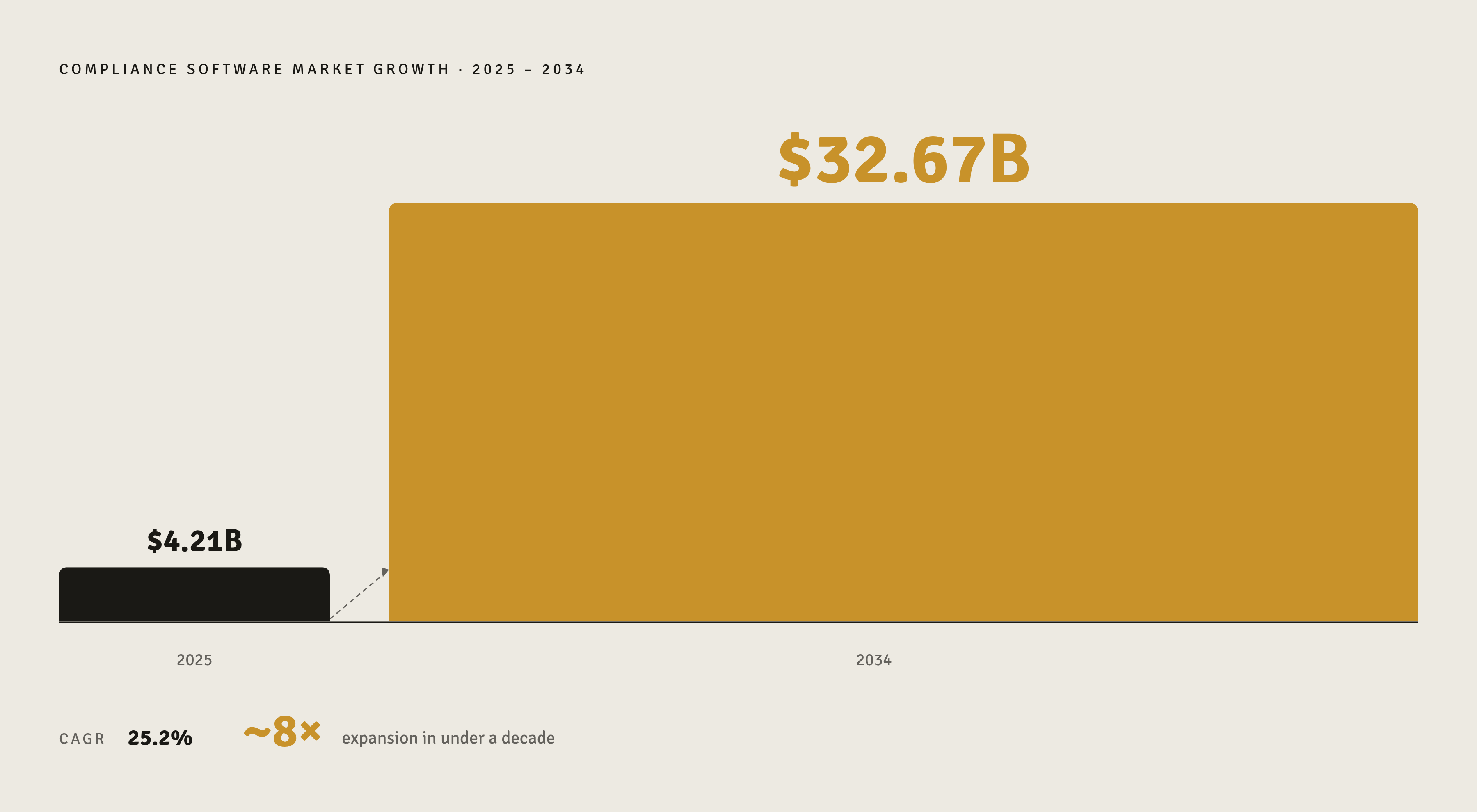
Privacy management software used to be the thing legal asked for once a year, right around audit season. Now it's core infrastructure, sitting next to your CRM and your identity provider on the list of tools you'd panic without. Intel Market Research put the GDPR/CCPA compliance software market at $4.21 billion in 2025, heading toward $32.67 billion by 2034. That's a 25.2% compound annual growth rate, which is not the kind of number a slow-moving, check-the-box category produces.
Here's what should get your attention if you're still treating privacy compliance like a fire drill: more than 130 countries have some form of privacy law on the books now, and in the U.S., 24 states had comprehensive privacy laws in effect by mid-2026, up from 20 just six months earlier. Four new state laws in half a year, with no federal law forcing any of it. SNS Insider found regulatory compliance applications made up almost 29% of the privacy software market in 2025, the largest single use case they track, and North America held over 35% of global market share. Read that last stat plainly: CCPA is driving a lot of the purchasing on this side of the Atlantic. Nobody's buying this software for the badge. They're buying it because the rules are multiplying faster than a spreadsheet can keep up, and somebody finally ran the numbers on what a missed deadline costs.
What GDPR and CCPA actually require — and where the enforcement pain is concentrated
Skip the legal treatise; that's a duller article for a duller day. What matters is what these regulations actually force software to do.
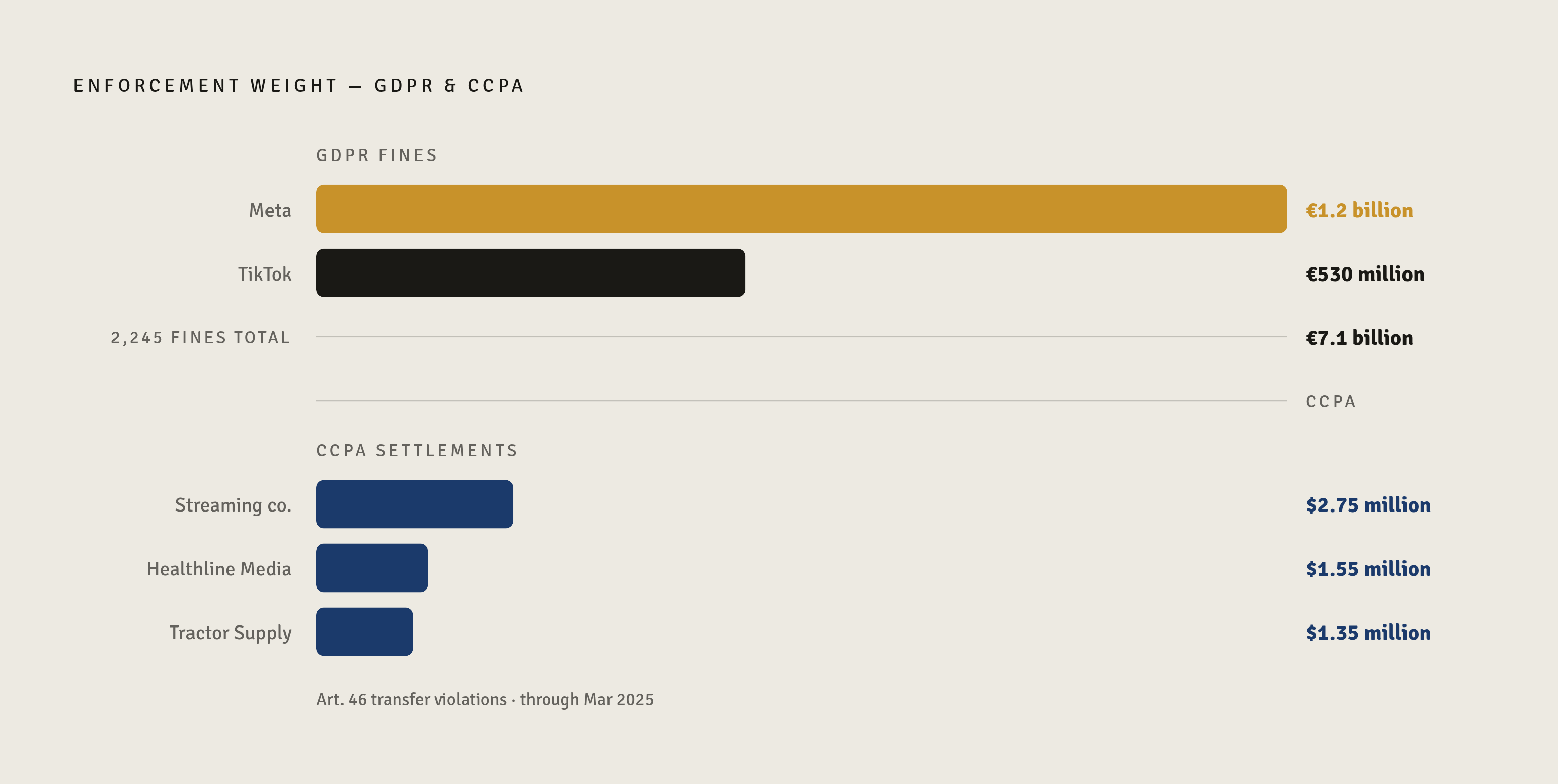
GDPR wants a lawful basis before you touch anyone's data, and a consent system that can prove it. It requires handling Data Subject Access Requests (people asking to see, fix, delete, or export their data) on a clock. It also requires Data Protection Impact Assessments before certain high-risk processing, breach notification within 72 hours, a running Record of Processing Activities under Article 30, and controls on cross-border transfers. That last piece is where the real money sits. Article 46 transfer violations produced the largest individual fines in GDPR history, including the €1.2 billion penalty against Meta and the €530 million penalty against TikTok, per Kiteworks. Numbers like that get board meetings rescheduled on short notice.
CCPA and its successor, CPRA, work differently but rhyme. Consumers can know what's collected, delete it, correct it, opt out of sale or sharing. Sensitive personal information gets extra handling. Global Privacy Control, the browser-level "don't sell my data" signal, became mandatory to honor in 12 states as of January 1, 2026. Businesses get 45 days to respond to a request, and regulators check the math: Todd Snyder was fined $345,178, in part because it took 40 days to process opt-out requests that should have moved faster. Annual reviews of data minimization round things out.
None of this lives in theory. As of March 2025, the CMS GDPR Enforcement Tracker had logged 2,245 fines totaling €5.65 billion, with cumulative penalties past €7.1 billion. Five of the ten largest fines ever issued involved plain old non-compliance with basic processing principles, which tells you regulators aren't hunting exotic violations. They're catching the basics, over and over. On the CCPA side, a streaming company settled for $2.75 million in February 2026 over opt-out failures, Healthline Media paid $1,550,000, and Tractor Supply settled for $1.35 million. GDPR's ceiling sits at €20 million or 4% of global annual turnover, whichever stings the CFO more. CCPA's statutory damages run $100 to $750 per consumer per incident, and the California AG can tack on civil penalties ranging from $2,500 to $7,500 per violation. Multiply any of that by a real customer list, and "we'll just track it in a spreadsheet" stops sounding like a plan.
One shift worth catching before it's obvious in hindsight: regulators have signaled increasing focus on AI systems and automated decision-making as the next enforcement frontier. Enforcement is walking past the cookie banner and into the algorithm itself. Anyone shopping for software today needs to think about where enforcement is going, not just where it's been, because the cost of getting caught flat stays on an upward climb. Industry research consistently places the average cost of a data breach in the millions, a figure that reflects the compounding effect of regulatory penalties on total breach costs.
The three categories of privacy management software and what each one actually does
Something vendors won't put on their homepage: the market never settled on one kind of product. Three distinct tool types exist, and each one solved a different problem first, bolting privacy compliance on at a different stage of its life.
Privacy-first platforms build around consent management, DSAR automation, and data subject rights from the start. Core modules include a Consent Management Platform, DSAR intake and response tooling, ROPA tracking, DPIA templates, and privacy notice management. If you're consumer-facing, media, or e-commerce, where consent banners and deletion requests show up daily, this is your category. It's also the fastest-growing slice of the market: the CMP sub-segment alone is projected to grow from $802.85 million in 2025 to $3,592.63 billion by 2033.
Security and compliance automation platforms grew from a different root system entirely. Built first for SOC 2 and ISO 27001 certification, they added CCPA and GDPR modules once regulators made it unavoidable. Their strengths are control frameworks, evidence collection, vendor risk management, and audit-ready reporting. If privacy compliance needs to run alongside a bigger security certification push, especially for engineering-heavy SaaS companies selling into the enterprise, this tool is often already sitting in your stack for other reasons. The catch: consent and DSAR workflows tend to run shallower here than in a dedicated privacy platform. You trade depth for breadth.
Data discovery and classification tools chase a third, more foundational problem: finding personal data across your systems before you can do anything else with it, and mapping how it moves. Core capabilities are automated scanning, data lineage mapping, sensitive data tagging, and risk scoring. This matters most for large, data-heavy organizations, healthcare systems, financial institutions, anywhere data lives in forty different places and nobody's quite sure which forty. You can't manage what you can't find, and "where is our data" turns out to be a much harder question than most companies expect walking in. Usually this gets bought alongside a privacy-first platform, not instead of one.
Plenty of enterprise vendors now blend across all three. Fine, but that means picking a category is less about choosing a vendor and more about knowing which problem you're actually solving, before someone sells you a suite that does everything a little and nothing particularly well.
What matters is what these regulations actually force software to do.
Core capabilities every privacy management platform should cover
Whatever category you land in, some capabilities aren't optional. They're the floor, not the ceiling.
Consent management needs to collect consent by purpose and legal basis, granularly, not as one all-or-nothing toggle. It needs to auto-respect Global Privacy Control signals (mandatory in 12 states as of 2026), store consent records with timestamps for the audit trail, and show different consent experiences depending on where the visitor actually sits. A banner that treats someone in Frankfurt the same as someone in Fresno isn't doing its job.
DSAR automation is where volume has quietly become the whole story. DSAR volume has been rising sharply across the industry, and at that pace, handling requests by hand isn't inefficient so much as it's a bet you'll lose eventually. A platform needs to manage intake, verify identity, pull data automatically from connected systems, track the deadline, and generate the response. Here's the honest part: the dashboard isn't the differentiator. Whether the tool can actually reach into your CRM, your data warehouse, and your cloud storage to retrieve the data is. A tool that can't touch the data can't fulfill the request, no matter how clean the intake form looks on the sales call.
Data mapping and ROPA maintenance need to run continuously, not as an annual scramble. That means automated discovery of where personal data actually lives, a living inventory of processing activities under GDPR Article 30, and flags for third-party data flows and cross-border transfers before they turn into an Article 46 problem.
Privacy impact assessments work better with template libraries pre-mapped to GDPR Article 35, workflow routing so approvals don't die in someone's inbox, and a direct link between assessment outcomes and the ROPA entries they touch.
Vendor and third-party risk management rounds things out with data processing agreement tracking, vendor privacy posture scoring, and sub-processor registers, which matter a great deal under GDPR Article 28 the day you have to explain to a regulator why your vendor's vendor mishandled something.
Compliance reporting needs pre-built reports mapped to GDPR, CCPA/CPRA, and the growing pile of state laws, plus immutable audit logs and a breach notification workflow that tracks the 72-hour GDPR clock in real time, not in someone's calendar reminder.
Then there's the newest line item, one that didn't exist as a checkbox two years ago: shadow AI and AI governance controls. Shadow AI, meaning unauthorized or unmonitored AI tool use, has emerged as a distinct breach risk category, one that tends to go undetected longer than standard breaches and compounds regulatory exposure as a result. Given where the EDPB is pointing its enforcement, platforms that can scan for unauthorized AI use or classify AI-processed personal data are moving fast from nice-to-have to why-doesn't-this-exist-yet.
How the leading privacy management platforms compare
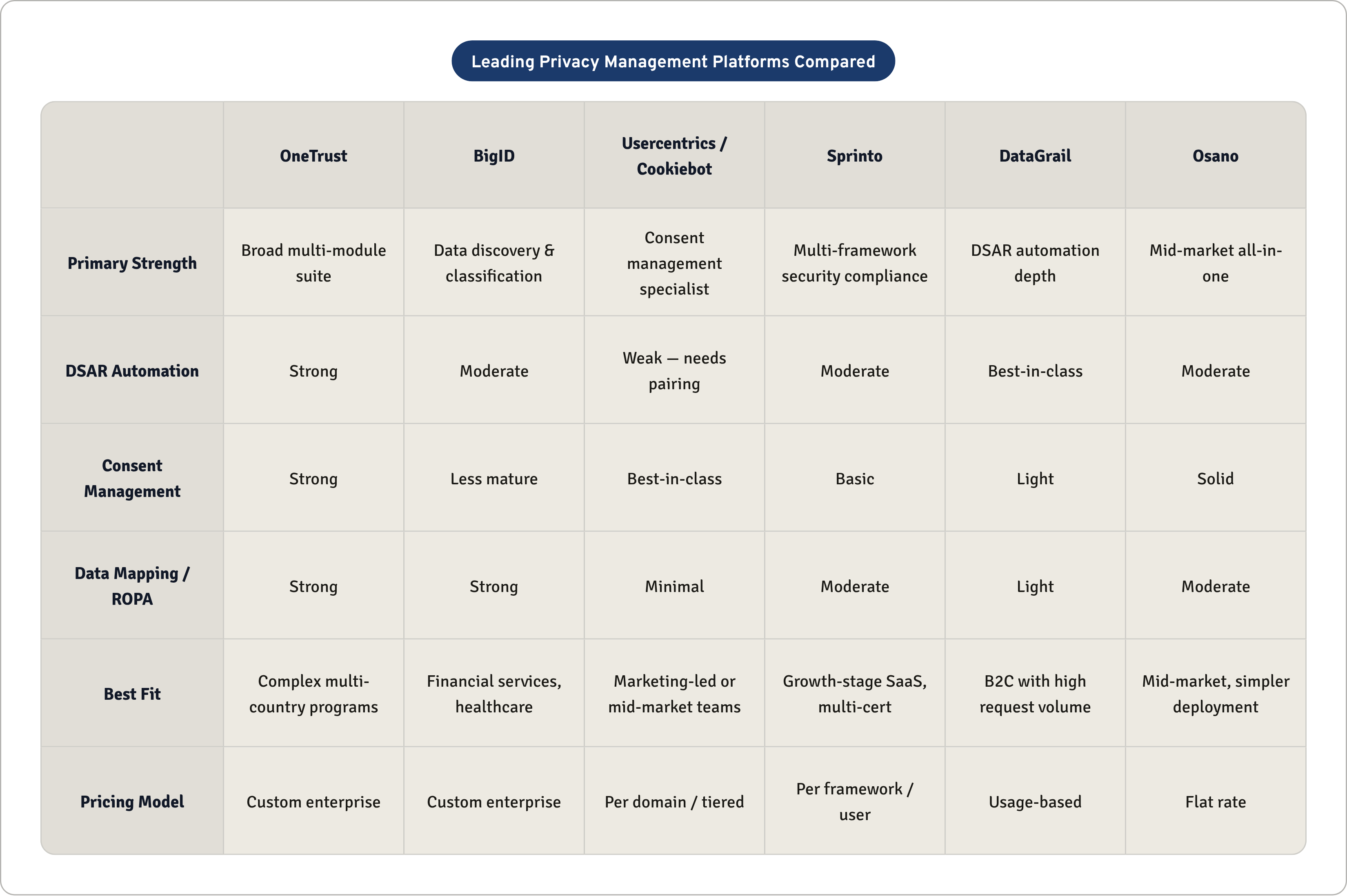
Judge these against the capability list above, not against whatever feature grid shows up first in the sales deck.
OneTrust sits at the broad end: consent, DSARs, ROPA, DPIAs, vendor risk, and ethics modules in one suite, with strong multi-jurisdictional coverage and a large partner ecosystem. Buyers consistently flag pricing and implementation complexity as real friction, and for a smaller company, it can be more machine than the job calls for. It fits best where a dedicated privacy operations team is running a genuinely complex, multi-country program.
BigID leads with data discovery and classification, then builds privacy compliance on top of that intelligence layer. It answers "where is our data" well across messy, heterogeneous environments, which makes it a strong fit for financial services and healthcare, where that question is the hard one. Its consent management and DSAR workflows are less mature than what a dedicated privacy-first platform offers, so weigh that trade-off going in.
Usercentrics and Cookiebot live in the consent management specialist lane: fast to deploy, a straightforward consent UI builder, solid geo-targeting, strong GPC signal support. What you don't get is a full compliance program; DSAR automation and vendor risk management need pairing with other tools. Good fit for marketing-led organizations or mid-market teams who want the best possible consent layer and plan to handle the rest separately.
Sprinto comes at this from the security automation side, covering CCPA alongside SOC 2, ISO 27001, HIPAA, and other frameworks, with tight integration into engineering workflows and automated evidence collection. Strong pick for growth-stage SaaS companies chasing multiple certifications at once with engineering as the main stakeholder. Less strong if privacy, specifically consent and DSAR handling, is your central concern rather than one line among several.
DataGrail specializes in DSAR automation with deep integrations into CRM, data warehouse, and SaaS tool stacks, which matters given the volume increases its own research documented. It isn't trying to be a full-suite privacy platform, and its consent management and ROPA capabilities run lighter than OneTrust's. Best fit: B2C companies fielding heavy consumer request volume across a wide, connected system landscape.
Osano targets the mid-market with a simpler deployment than OneTrust, covering consent, DSARs, vendor assessments, and monitoring in one platform with flat-rate pricing transparency. What it trades away is the enterprise-grade workflow customization and multi-jurisdictional depth OneTrust offers, a reasonable trade if you're not running a compliance program the size of a small country.
Line these up and the comparison points that actually matter are primary strength (consent, DSAR, data discovery, or multi-framework compliance), depth of GDPR and CCPA/CPRA coverage, GPC signal support, how mature the DSAR automation really is, data mapping capability, how wide the integration ecosystem runs, and the pricing model, whether per-domain, per-user, usage-based, or flat, plus how complex deployment turns out in practice versus in the pitch.
What to evaluate before you select a platform
Start with your compliance surface, not the feature list. Most buying committees skip this step because a demo with a slick consent banner is more fun than an afternoon spent figuring out which laws actually apply to you. Do you have EU customers or employees? GDPR applies. California consumers? CCPA/CPRA applies, and depending on revenue and data volume, so might a handful of the other 23 state laws now on the books. Map that surface first, in writing, before the first vendor call.
From there, figure out which of the three categories matches your actual bottleneck. If you're drowning in DSAR volume, a data discovery tool with a mediocre DSAR workflow won't save you, no matter how good its data lineage mapping looks on screen. If your problem is genuinely not knowing where personal data lives across forty systems, a slick consent platform won't fix that either; it'll just make you feel compliant while the real risk sits untouched in some old database nobody remembers building.
Check integration depth before anything else, because a platform's value is bounded entirely by what it can actually reach. Ask vendors directly: which of our specific systems can you connect to, and what does that connection actually retrieve, versus what still needs a manual export? Push for specific answers, not a logo wall.
Weigh the pricing model against your actual usage. Per-domain pricing punishes companies running lots of microsites; usage-based pricing can spike unpredictably if your DSAR volume follows the trend DataGrail documented; flat pricing is easier to predict but sometimes pays for capacity you'll never touch.
And ask about the AI governance roadmap, even if it feels early. Given where the EDPB pointed its 2025 enforcement framework, and where IBM's breach cost data is heading, a platform with no answer here today is one you'll be re-evaluating in eighteen months. Better to ask the awkward question now than explain to your board later why the compliance software didn't see the compliance problem coming.
Notes
- https://www.intelmarketresearch.com/bfsi/44618/gdprccpa-privacy-compliance-software-market
Provided the market size figure of $4.21 billion in 2025 and the 25.2% compound annual growth rate projection toward $32.67 billion by 2034.
- https://www.snsinsider.com/reports/privacy-management-software-market-3344
Provided the statistics on regulatory compliance applications making up 29% of the privacy software market, North America's 35% global market share, and GDPR's 4% of global annual turnover penalty ceiling.
- https://www.enzuzo.com/alternatives/onetrust-vs-bigid
Provided the characterization of BigID's primary strength in data discovery and classification as the foundation of its privacy compliance approach.
- https://sprinto.com/blog/best-ccpa-compliance-tools/
Informed the description of Sprinto's capabilities covering CCPA alongside SOC 2, ISO 27001, HIPAA, and its fit for growth-stage SaaS companies.
- https://usercentrics.com/knowledge-hub/data-privacy-management-tools/
Informed the description of Usercentrics/Cookiebot's consent management capabilities including geo-targeting and GPC signal support.