Essay Compliance Technology
Compliance Technology Integration with ERP Systems
Direct ERP integration turns compliance from quarterly audits into real-time control.
Compliance software is only as good as its plumbing. If it plugs directly into the ERP system where payroll, procurement, financial postings, access controls, and inventory data already live, compliance becomes something the business does every day without thinking about it. That connection determines everything else: a reporting tool without it stays a step behind reality, checking last week's exports while today's transactions post unwatched. This piece walks through why that connection matters, what breaks when it's missing, and what it actually takes to build it right.
The financial pressure making integration a board-level conversation
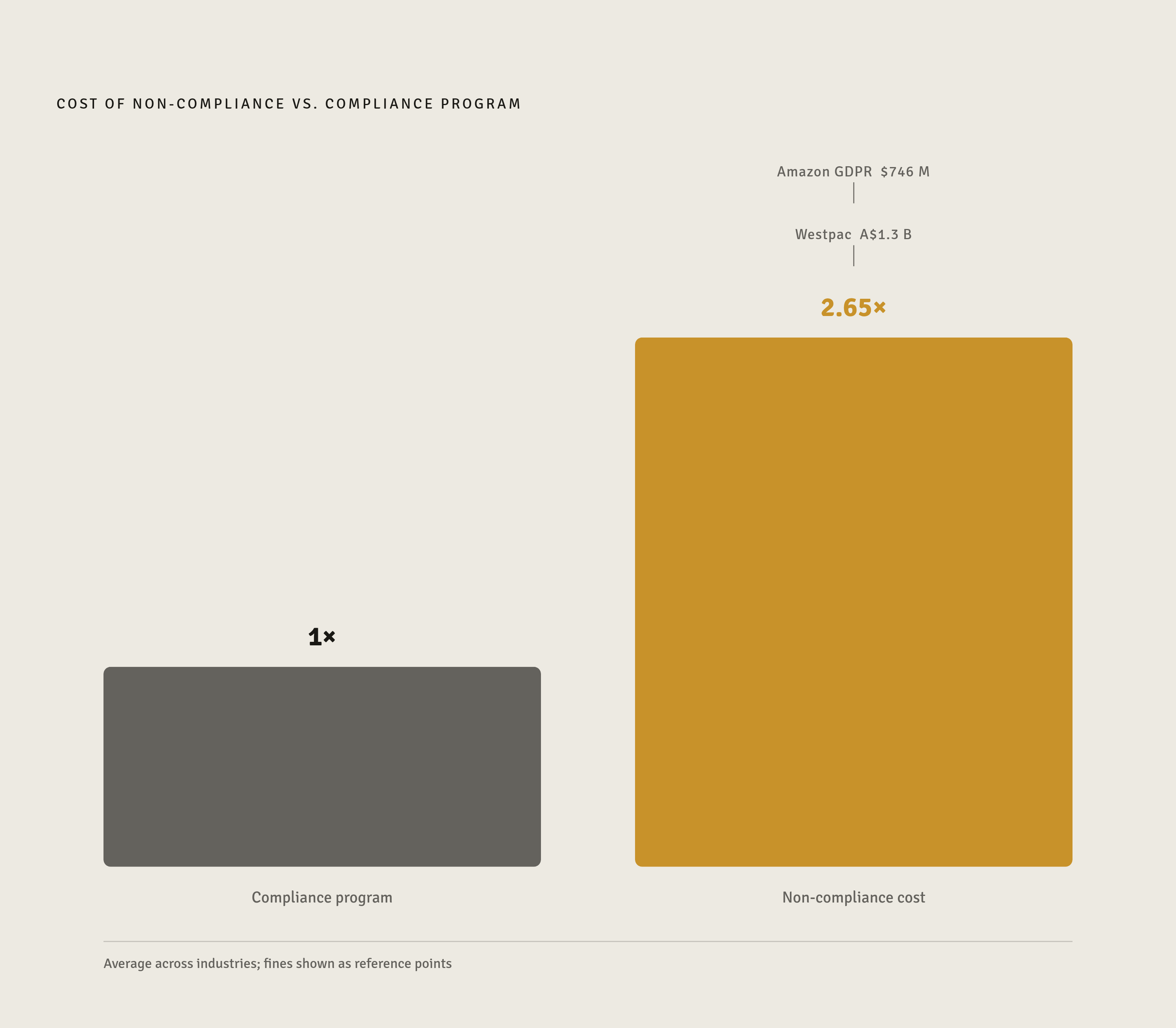
The Ponemon Institute has a number worth sitting with: non-compliance costs organizations 2.65 times more than running a compliance program does, averaging tens of millions of dollars per incident. That's the kind of ratio that makes a CFO reread the line item labeled "compliance software" and wonder if it's secretly an insurance policy.
Zoom out and the picture gets worse. Global fines for non-compliance hit $14 billion in 2024, and North American financial institutions averaged $2.5 million per incident that same year, according to Statista. Numbers like that stay abstract until you put a name on them. Amazon's GDPR fine ran to $746 million, and Westpac paid A$1.3 billion over money-laundering failures. In both cases, the data in question was already sitting inside enterprise systems, with nobody watching it in real time. The systems had the receipts, but nobody read them fast enough.
Most organizations still book compliance tooling as a cost center, something you spend on to stay out of trouble. Few treat it as an investment that pays for itself the first time it catches something before it becomes a headline. That framing decides a lot downstream, including which architecture gets funded this year and which one waits until after the next audit finding forces the question.
How the market is responding — and what the growth curve signals
Money is voting, and right now it's voting for integration over any single compliance feature. Grand View Research puts the enterprise governance, risk, and compliance market at $72.4 billion in 2025, heading toward $203.7 billion by 2033, a 13.7% compound annual growth rate. Within that market, the fastest-growing piece is integration itself: stitching together legacy on-premises systems, multi-cloud platforms, ERP suites, and HR systems that today spit out risk data in silos nobody can see across.
RegTech, the layer of tooling closest to actual compliance-ERP connectivity, is set to grow from $16 billion in 2025 to nearly $62 billion by 2032, a 21.3% CAGR. Read that curve carefully and it tells you something specific: buyers want the ability to connect compliance logic to wherever their data actually lives. That's a much harder thing to sell than a standalone compliance package, and a much harder thing to buy, too.
Banking got here first, which makes it worth watching closely. Bain & Company found that banks raised compliance-related IT spending from 9.6% of budgets in 2016 to 13.4% in 2023, with 15 to 20% of operating expenses now going to GRC. Their regulators showed up earlier and asked harder questions earlier. Everyone else is catching up, whether they picked this fight or not.
What the integration actually connects — the technical anatomy
There are three layers doing the actual work here, once you get past the sales decks.
The first is API-driven connectivity. RegTech platforms use APIs to link into ERP cores, CRM systems, legacy databases, and outside feeds like sanctions lists, ESG data, and regulatory aggregators, so data moves continuously instead of in scheduled batches. The second is AI and anomaly detection: engines read ERP transactions as they post, checking posting times, location patterns, and peer-group behavior for the kind of deviation a static rule set would walk right past. The third, and the one that still catches people off guard, is blockchain used as a trust layer. In pharmaceuticals, financial instruments, and supply chains where multiple parties need to trust the same record, SAP and Oracle increasingly bolt on permissioned ledgers as a sidecar system. The ERP stays the system of record; the ledger just makes the audit trail hard to tamper with and lets smart contracts handle what used to require someone manually chasing down paperwork.
Cloud has basically won the deployment argument. Cloud platforms held a substantial majority of ERP security and compliance revenue in 2025 across major market reports, and the ongoing move to Oracle Fusion Cloud, SAP S/4HANA Cloud, and Microsoft Dynamics 365 is pushing more organizations toward setups that assume integration from day one instead of bolting it on after the fact.
Worth saying plainly: a large portion of enterprise compliance deployments run on SAP or Oracle as of 2025. That fact alone shapes strategy, because your integration options are partly bounded by whatever those two companies decide to expose through their APIs and partner programs. And the compliance perimeter keeps stretching outward past the ERP's own walls. The share of enterprises folding vendor and supply chain compliance into one unified system grew a lot between 2021 and 2025, which tells you compliance officers stopped pretending the four walls of the ERP were the whole problem a while ago.
Segregation of duties — the use case that shows why real-time access to ERP data changes everything
Segregation of duties, SoD if you like acronyms, is a plain idea hiding under a dull name: no single person should be able to both start and approve the same transaction.
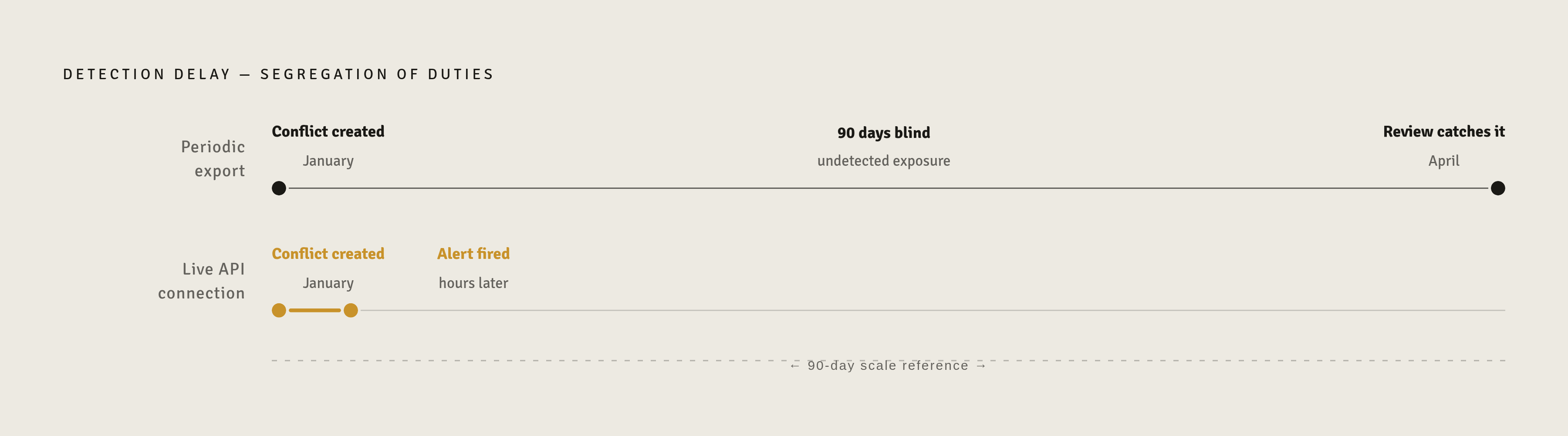
The ACFE's 2024 Report to the Nations found weak internal controls behind a large share of occupational fraud cases, and poor segregation of duties shows up again and again as the common thread. The old way of catching SoD violations is a quarterly role-conflict report run against ERP user tables, which means a conflict created in January might not surface until the April review. That's three months of exposure nobody could see, because nobody was looking yet.
Real-time integration changes the timeline: the alert fires the moment a conflicting permission gets granted or a conflicting transaction posts. Detection time drops from months to hours. Grant Thornton has noted that North American auditors increasingly reject manual SoD attestations in favor of continuous digital proof; the ask has shifted from "show us your annual review" to "show us your controls, live, right now." That shift only works if the compliance tool has steady, low-delay access to ERP role assignments and transaction logs. An export from last Tuesday doesn't cut it anymore.
Numbers like that stay abstract until you put a name on them.
Regulatory reporting obligations that require ERP data to be compliance-ready at all times
PCI DSS v4.0 became mandatory in March 2024, and 64 more requirements, including quarterly penetration testing inside ERP-linked cardholder environments, kicked in as of March 2025. Rules like that assume continuous monitoring is already running; they're written for organizations that have already moved past point-in-time checks.
Europe's Corporate Sustainability Reporting Directive might be the clearest example of compliance and ERP architecture turning into the same problem. CSRD now requires finance teams to reconcile ESG metrics against general ledger entries, which means sustainability reporting and financial reporting have to pull from connected data instead of two separate spreadsheets reconciled by hand at quarter-end. Basel III's operational resilience rules do something similar for banks, requiring them to map critical business services to specific ERP modules and produce automated evidence that controls actually work. Nobody's doing that by hand at scale, not really.
The pattern across all three is the same: regulators have stopped accepting the periodic attestation, the "we checked this in March" letter, and started asking for evidence pulled straight from live systems. That forces the integration question whether an organization is ready for it or not. The reporting calendar is quietly turning continuous instead of event-driven, and the ERP has to double as a compliance data source, right alongside its day job of getting invoices paid.
AI's role in turning ERP transaction data into proactive compliance signals
Here's where it gets genuinely interesting. AI anomaly engines can read enormous volumes of ERP transactions, correlating posting times, geographic oddities, and peer-group deviations across patterns a fixed rule set has no shot at catching, because rules only know what someone thought to write down ahead of time.
Predictive compliance pushes this further: AI models trained on historical ERP data can flag a risk before it fully shows up. Picture a supplier relationship drifting toward a sanctions violation. The pattern shows up in the transaction history well before any single transaction crosses a legal line, and a well-integrated system can catch it before that line gets crossed instead of after. Some platforms now track regulatory updates directly and map new rules automatically to the ERP controls they touch, shrinking the gap between "the law changed" and "our system reflects that."
PwC's 2025 survey found organizations that invested in this kind of connected compliance technology saw 64% better risk visibility, 53% faster issue response, and 43% gains in productivity. Those numbers are just what happens when the compliance tool finally reads the same data the business is actually running on. Organizations doing this well have also shrunk the size of the compliance team needed to hold the same level of oversight, freeing people up for judgment calls instead of data entry.
One caution, though: AI anomaly detection is only as sharp as the data it's fed. Feed it stale exports and you get confident-sounding conclusions about a world that no longer exists, because the model doesn't know it's wrong; it only knows what it was shown. The integration has to come first; the AI sharpens good plumbing, and good plumbing is what lets the AI do anything useful at all.
Where integration breaks down — the architectural mistakes that limit what compliance tools can do
The most common failure is almost dumb in its simplicity: the compliance tool only ever sees a snapshot. If it's fed by periodic exports instead of a live API connection, every transaction between exports is invisible until the next batch lands. That's a window of total blindness, and fraud doesn't wait politely for the export schedule to catch up.
Vendor concentration adds its own drag. With a large portion of deployments sitting on SAP or Oracle, how deep your integration can go depends a lot on what those two platforms choose to expose. Organizations that don't deliberately build for API flexibility find themselves boxed in the moment a new regulation moves faster than the vendor's roadmap.
Legacy environments make it worse. On-premises ERP versions built before modern API layers existed force organizations into middleware, ETL pipelines, and flat-file transfers, and each hop adds delay and a fresh chance for something to break quietly. Add a governance gap on top, nobody clearly owning whether the ERP data feed is accurate and current, and you get a compliance tool faithfully reporting on data that already went stale weeks ago.
Most enterprises today run a mix of on-premises ERP, multi-cloud infrastructure, and assorted SaaS tools, with compliance data scattered across all of it. An integration built for one layer routinely misses the rest. Grant Thornton's 2025 analysis makes a point worth remembering here: ERP environments where users hold multiple conflicting roles because SoD controls were never configured at deployment are far harder and more expensive to fix later. Building the controls in from the start beats remediating them after the fact, every time.
What a well-integrated compliance architecture looks like in practice
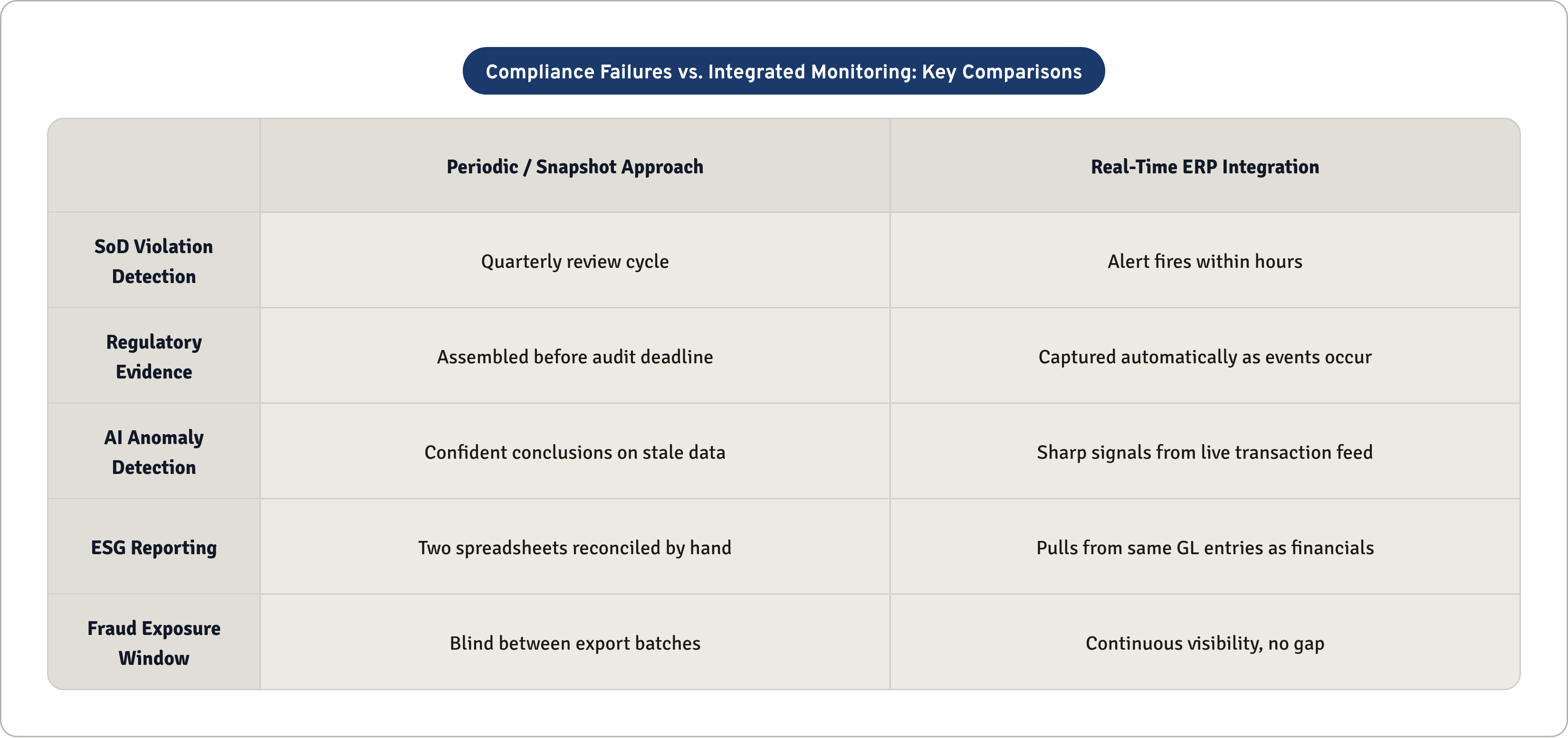
Picture the opposite of the last section. ERP, HR, CRM, and third-party risk data all flow into one compliance platform through APIs, no manual consolidation step, no batch delay sitting in the middle. Dashboards update continuously, so a compliance team sees the actual current state of its controls instead of a snapshot frozen at the last audit date.
Evidence generation happens automatically too: the system captures and formats documentation straight from ERP transaction logs as events occur, so when an auditor asks for proof, it's already there instead of being assembled overnight before a deadline. Manufacturing and logistics firms that connect their ERP to supplier management and product lifecycle tools get visibility across the whole supply chain, not just what happens inside their own walls. On the ESG side, connecting sustainability metrics directly to general ledger entries means the CSRD report and the financial report pull from the same underlying numbers, which sounds obvious until you remember how many organizations still reconcile the two by hand in a spreadsheet somebody dreads opening every quarter.
Purpose-built platforms like MetricStream, Pathlock, and TrustCloud exist specifically to sit on top of this kind of ERP data layer through APIs, applying the same idea that keeps showing up throughout this piece: build the connection first, generate the reports second. People underrate how much that order matters.
How to approach the integration decision — questions that shape architecture before vendor selection
Start with the data, not the vendor demo. Map which ERP modules hold the regulated information before you even look at compliance software; the integration requirements follow from where the data lives, not from whichever tool has the nicest dashboard.
From there, a handful of questions actually shape the architecture. Is the ERP cloud-native or on-premises, and does it expose the API layer a compliance tool needs to work? Which regulatory frameworks apply, and do they demand continuous monitoring, or will periodic reporting still pass, because that answer alone decides whether near-real-time integration is worth paying for. How far does the compliance perimeter actually reach: just internal ERP data, or suppliers, subsidiaries, and third parties too? And who owns data quality for that compliance feed, IT, finance, or compliance operations, settled before deployment rather than fought over after something breaks?
Sequencing matters more than most project plans give it credit for. Organizations that configure ERP access controls and SoD policies during initial implementation dodge the expensive remediation work of retrofitting controls onto a system where bad access patterns already took root. That's the build-versus-integrate question in miniature: native ERP compliance modules like SAP GRC or Oracle Risk Management Cloud give tighter access to the underlying data but less flexibility, while best-of-breed platforms cover more regulatory ground across multiple ERP systems but demand real integration work up front. Your regulatory profile and your existing IT setup make that call for you, whether you like the answer or not.
Get the architecture right, and compliance stops being a periodic fire drill and starts working like a capability the business simply has, the same way it has payroll or inventory tracking. Regulators, auditors, and boards are already pushing in that direction. The only real question left is whether the integration gets built on purpose, or gets discovered the hard way, after the fine shows up in the mail.
Notes
- https://www.grantthornton.com/insights/articles/technology/2025/time-for-tech-to-rethink-erp-compliance
Provided Grant Thornton's 2025 findings on auditors requiring continuous digital SoD proof and the cost of retrofitting controls onto ERP systems with pre-existing bad access patterns.
- https://cleareye.ai/regulatory-technology-compliance-automation-trends-banks/
Supplied the RegTech market growth figures, including the 21.3% CAGR projection from $16 billion in 2025 to nearly $62 billion by 2032.