
Essay Compliance Technology
GRC Platform Comparison for Mid-Market Companies
Mid-market GRC spend is booming, but most platforms weren't built for them.
GRC software spend hit $21.04 billion in 2025 and is on track for $39.01 billion by 2031, growing at a 10.84% compound annual rate. That growth is not evenly spread: mid-market companies, roughly 200 to 2,000 employees, are adopting GRC platforms faster than anyone else, and most of the software they're choosing between was never built with them in mind.
What a mid-market GRC buyer actually looks like in 2025–2026
Picture a 300-person SaaS company. It carries SOC 2 as a baseline and has bolted on ISO 27001 or HIPAA as customers demand it, maybe both. It works with somewhere between 30 and 60 vendors if it's around 100 employees, a number that only climbs as headcount grows. Every quarter, a fresh stack of customer security questionnaires lands in someone's inbox, and somewhere between 10 and 50 people across engineering, HR, and finance get pulled in to produce evidence for an audit they didn't ask to be part of.
Nobody hired for this. That's the part that gets missed in most vendor pitches: there is rarely a dedicated GRC team on the other end of the sale. Cybersecurity staffing data backs this up starkly. A majority of cyber teams report being understaffed, and a large share carry open positions they can't fill. Fewer than half of organizations expect their security budgets to grow at all in the next year. Layer on a shortage of certified GRC professionals running above 25% in some regions, and the picture comes into focus: the person managing this program is probably wearing three other hats and did not go to school for compliance frameworks.
So what does that person actually need? Role-based access so an engineer can upload evidence without needing a training session first. Automated evidence collection that keeps pace with a tech stack that changes every quarter. Vendor risk tools that don't collapse under their own weight as the vendor list grows from 30 to 90. Dashboards a CISO can hand to a board without a week of prep. What they do not need is a platform built for a Fortune 500 risk department: no six-to-twelve month rollout, no seven-figure invoice, no module they'll never touch. Buying that anyway is a little like renting a cargo ship to move a studio apartment. Technically it'll fit. Good luck parking it.
The three-tier market structure and where mid-market companies land
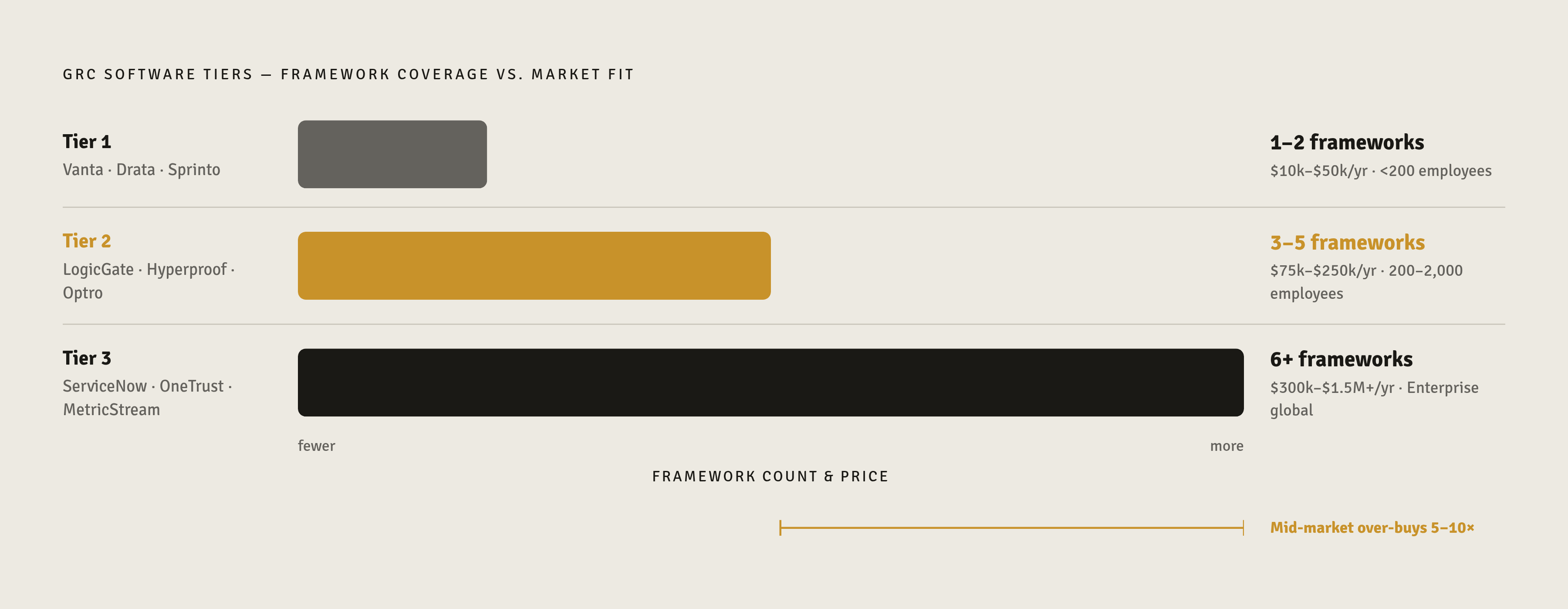
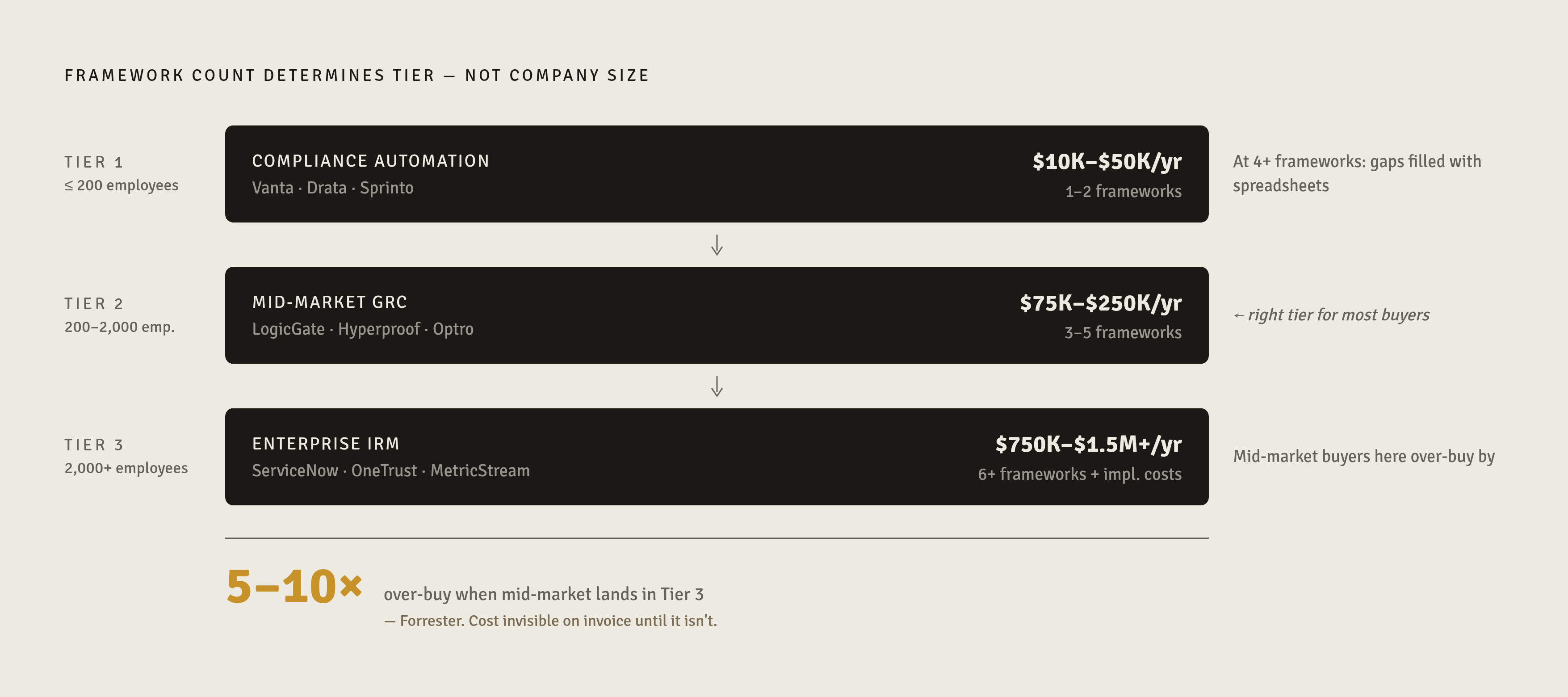
Underneath the noise of vendor marketing, the GRC market sorts itself into three fairly clean tiers, and the number that predicts which tier a buyer needs isn't headcount or revenue. It's framework count.
Tier 1 is compliance automation: tools like Vanta, Drata, and Sprinto, priced around $10,000 to $50,000 a year, built for companies managing one or two frameworks, typically from early-stage through roughly 200 employees. These tools are excellent at what they do. They also run out of road fast once a third or fourth framework enters the picture.
Tier 2 is the mid-market band proper: LogicGate, Hyperproof, and Optro (formerly AuditBoard) sit here, covering three to five frameworks for companies between 200 and 2,000 employees. Pricing runs $75,000 to $250,000 for a typical deployment, climbing to $400,000 to $600,000 for larger public companies layering in SOX, internal audit, and enterprise risk modules. This is the tier built, at least in theory, for the buyer described above.
Tier 3 is integrated enterprise IRM: ServiceNow GRC, OneTrust, MetricStream, handling six or more frameworks across large, often global enterprises. License costs rarely dip below $300,000 a year and routinely land between $750,000 and $1.5 million-plus, with implementation costs that often match or exceed the first year's license fee alone. These deployments take six to twelve months and usually need a systems integrator just to get off the ground.
Here's the trap. A company running three frameworks that buys into Tier 3 is paying enterprise money to use maybe a fifth of the platform; Forrester's own analysis of the space suggests mid-market buyers who land in enterprise GRC typically over-buy by five to ten times relative to what they configure and use. Flip it around, and a company at four frameworks trying to squeeze by on a Tier 1 tool is under-platformed, patching gaps with spreadsheets nobody trusts. Both mistakes are expensive. Only one of them looks expensive on the invoice.
What the 2025 Gartner Magic Quadrant signals about where the market is heading
Gartner published its first-ever Magic Quadrant for GRC Tools, Assurance Leaders on October 27, 2025, evaluating 15 vendors. Archer, Optro, Diligent, IBM OpenPages, and LogicGate landed in the Leaders quadrant. The detail worth sitting with is the one that didn't happen: the Visionaries quadrant came back completely empty.
That's unusual for a market this size, and it's worth asking why. An empty Visionaries quadrant in a maturing category usually means nobody's betting on a single platform reinventing the category from scratch; the action has moved toward composability instead, buyers assembling several best-fit tools rather than parking their whole program inside one system. Gartner's own client data backs this reading up directly: 85% of surveyed organizations already run multiple GRC tools at the same time. That number alone should recalibrate how a mid-market team frames its search. The question isn't which platform replaces everything else in the stack. It's which platform anchors the program well enough that the other tools around it don't have to compensate for its blind spots.
There's a second signal buried in Gartner's naming choice that's easy to skim past. Framing the category around assurance leaders, rather than enterprise risk executives or board-level governance audiences, points to the center of gravity shifting toward the practitioners actually running these programs day to day, not just the C-suite signing the check. Worth noting, though: a Leader ranking built around what serves an assurance function at a multinational bank does not automatically translate to what serves a 400-person healthcare startup. Quadrant position is a signal. It is not a substitute for evaluating fit against your own framework count, team size, and budget.
A majority of cyber teams report being understaffed, and a large share carry open positions they can't fill.
The evaluation criteria that actually matter for mid-market buyers
Strip away the marketing copy and the evaluation comes down to seven questions, most of which have concrete, checkable answers if you push vendors past the sales deck.
Start with framework coverage and cross-framework mapping. How many frameworks does the platform natively support, and does it map a single control across multiple frameworks or force you to maintain parallel evidence sets for each one? A team running SOC 2, ISO 27001, and HIPAA at once should map an access control policy once, not three separate times. Hyperproof's support for 140-plus frameworks with unified mapping is a reasonable benchmark for what "good" looks like here.
Then there's implementation timeline. Enterprise platforms lean on external integrators and six-to-twelve month rollouts; most mid-market teams have neither the budget nor the patience for that. The real test: can a compliance manager configure the workflow themselves, without pulling an engineer off a product sprint? LogicGate's no-code configuration model is built around exactly that constraint.
Integration depth matters just as much, because automated evidence collection is only as good as what it actually connects to. Vanta runs over 1,400 automated tests hourly across more than 400 integrations, which is a useful reference point when asking any vendor which of their integrations are native versus which require a custom connector or third-party middleware to bridge the gap.
Vendor risk management deserves its own line item, since a 100-person company managing 30 to 60 vendors today will be managing more next year. Ask whether the platform runs live questionnaires, tiers vendors by risk, and monitors continuously, or whether it's really just a spreadsheet with a nicer interface.
Total cost of ownership needs a three-year lens, not a first-year quote. License fees are only part of the number; implementation, ongoing configuration, and the staff hours the platform quietly absorbs all belong in the math. Pricing opacity shows up constantly in mid-market platform reviews, so insist on an all-in number rather than a pile of module-by-module estimates that somehow never add up the way the sales call implied.
Role-based access and usability across departments round out the practical list: with up to 50 non-GRC employees touching evidence at any given company, the test isn't whether a CISO can read a dashboard. It's whether an engineer can submit evidence without a training session first.
Last, and increasingly unavoidable: AI. Worth drawing a real distinction here between AI that automates a task and AI that's woven into governance itself. Vanta's AI Agent handles policy drafting, evidence evaluation, and questionnaire responses on its own, which is a task-automation model. Diligent, recognized by Forrester in its Q2 2026 Wave for AI integration across risk and audit workflows, represents something closer to AI embedded at the governance layer. For a thinly staffed mid-market team right now, task-level automation is where the immediate relief lives. Governance-layer AI becomes more relevant as the program matures and the questions get harder than "did this evidence get collected."
How the leading mid-market platforms compare across these criteria
None of these platforms is wrong, exactly; they're built for different shapes of the same underlying problem, and the honest version of this comparison says so plainly rather than crowning one winner and moving on.
LogicGate Risk Cloud earned the highest-right position among Leaders in the 2025 Magic Quadrant, largely on the strength of its completeness of vision. Its no-code configuration lets compliance teams build and adjust workflows without engineering support or a professional services invoice, which fits a mid-market team that expects its program to keep changing shape. Pricing sits squarely in the Tier 2 range, $75,000 to $250,000.
Optro, rebranded from AuditBoard in March 2026, has grown well past its original SOX and internal audit roots into third-party risk, information security compliance, and ESG. More than half the Fortune 500 use it, and roughly 140,000 GRC professionals rely on it daily. Third-party contract data puts the median annual contract around $21,180, which is modest by enterprise GRC standards, though pricing complexity shows up often enough in reviews to be worth flagging. It fits best from around 2,000 employees upward, particularly in finance, healthcare, technology, and manufacturing.
Hyperproof's whole value proposition is the control-mapping engine: over 140 supported frameworks, map a control once and satisfy SOC 2, ISO 27001, NIST, and PCI DSS requirements simultaneously instead of four times over. It gets recommended often for mid-market teams whose framework count is actively climbing past three, since the mapping does the heavy lifting that would otherwise require adding headcount.
Vanta covers more than 35 frameworks, connects to over 400 integrations, and runs its 1,400-plus automated tests continuously; its AI Agent takes on policy management, evidence evaluation, and questionnaire responses without much hand-holding. IDC named it a Leader in its 2025 Worldwide GRC Software MarketScape. It runs lighter on enterprise-grade governance depth, which makes it a strong starting point for companies between 200 and 2,000 employees prioritizing SOC 2 Type II or ISO 27001 over deep risk modeling.
Diligent One Platform is the rare vendor named a Leader by all five major analyst firms, Chartis, Forrester, Gartner, IDC, and Verdantix, and Forrester's Q2 2026 Wave singled it out as the only vendor fully integrating boards of directors into the GRC workflow. That makes it a strong fit for mid-market companies with real board-level governance obligations, or ones expecting to move upmarket faster than their current tooling can follow.
OneTrust started in privacy and expanded into GRC and third-party risk from there, and it remains the category leader for privacy-specific workflows, consent management, data subject requests, ROPA, that most GRC platforms simply punt to a separate tool. For a mid-market company where GDPR or state privacy law is as much a driver of the compliance program as SOC 2, that's not a small advantage. Pricing does scale into enterprise territory, though, so it's worth measuring carefully against what you'll actually use.
ServiceNow GRC rounds out the list mostly because it comes up constantly in searches, and it deserves a clear caveat: it makes sense almost exclusively for organizations already running ServiceNow ITSM. Outside that context, the value proposition thins out fast. Licensing rarely comes in under $300,000 a year, and total cost climbs quickly with additional modules and implementation work. For most mid-market buyers, this is a Tier 3 platform wearing a mid-market invitation it didn't really send.
The pattern across all seven, if there is one, is that none of them are trying to be everything. That's the whole point of the empty Visionaries quadrant discussed earlier: the market stopped pretending one platform could do it all, and started competing on how well each one does its actual job.
Notes
- https://checkthat.ai/answers/what-are-the-best-unified-grc-platform-solutions
Provided the median annual contract figure cited for Optro's pricing.