
Essay Compliance Technology
Compliance AI Tools for Regulatory Change Management
Enforcement fines jumped 417% as companies struggle to track regulatory changes in real time.
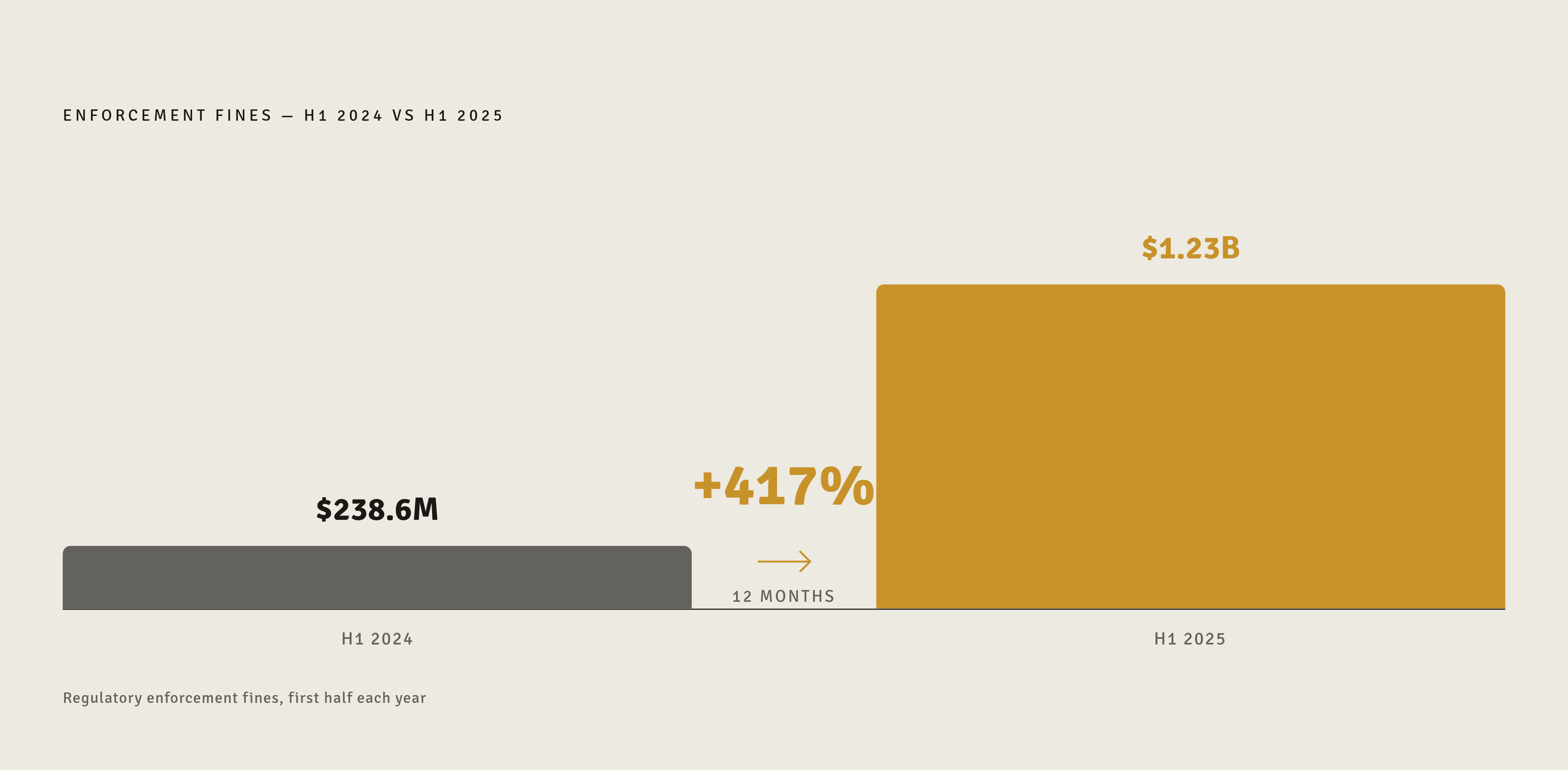
Regulatory complexity has climbed roughly 85% over the past three years, according to PwC research cited by Glean, and enforcement has caught up fast. Fines in the first half of 2025 totaled $1.23 billion, a 417% jump from the $238.6 million recorded over the same stretch in 2024. Here we examine the way AI-powered compliance platforms let companies keep up with rule updates, and why moving from hand-built, late-stage checks to always-on watching has become the market's core issue. Teams using a spreadsheet for this work have not fallen behind. The real risk starts with a spreadsheet: structurally, it guarantees they learn about each rule change only after they have paid for it.
This enforcement trend is no blip. In 2024, the SEC brought in $8.2 billion from fines, a record for the agency. The OCC levied $1.5 billion in fines. People got $3.2 billion from the CFPB. This isn’t some correction blip. It reads like regulators speeding up, done waiting for organizations that hear about a rule change too late. Rules for AI, data protection, along with cybersecurity plus industry-specific requirements change all the time, not through predictable government meetings. Breaking rules costs businesses more than twice what maintaining compliance does, per industry data, and this gap brings blown deadlines, unexpected liabilities, plus reputational harm. These are actual costs, not mere abstractions of risk.
How manual processes create the compliance blind spot
Some 42% of institutions handle regulatory compliance with manual processes, and among compliance teams nearly 80% call the spreadsheet their tracking tool. The main system for monitoring duties that pose billion-dollar regulatory risk is a communal document a person edits manually.
This failure mode has nothing to do with trying hard. Teams go through pages one by one, extract data from platforms that won't connect, and must juggle multiple tracking tools simultaneously, all of which miss any regulatory change that hasn't been noticed yet. According to research from Thomson Reuters, with ioni.ai cited, risk and compliance teams mainly handle assessing risk (56%) plus compliance monitoring (52%). So there's barely any time left to do anything with those results.
It's predictable, this pattern. A change gets published by a regulator. Days pass before our team discovers it, then everyone scrambles trying to see if it applies so they can update relevant policies, but another change arrives before that task wraps up. Distributed workforces and digital infrastructure have widened what compliance teams must monitor. Manual processes got built for checking the past, not spotting what comes next. Adding more workers fixes nothing, since the real trouble is architecture rather than poor staffing choices.
What AI-powered regulatory monitoring actually does differently
Tools built with AI plus machine learning check law databases everywhere, continuously, instead of through quarterly or once-a-year cycles. Closing the gap between a rule shifting and a compliance team learning about it is why continuous monitoring matters.
The real value sits a layer down, yet buyers mostly underrate it. Rather than just alert a group when something changed, Regulatory mapping tools map each new requirement straight onto the organization's current internal policies, showing exactly which document requires updating so nobody has to figure it out manually. Predictive analytics and Machine learning bring in a further layer for spotting anomalies while flagging new issues before they become findings. According to ioni.ai, AI could automate as much as 70% of that time-consuming groundwork needed for compliance, freeing teams to focus on figuring things out and acting rather than searching plus tracking. AI-enabled compliance tools are reported to reduce regulatory processing time by 42% across banking and insurance workflows.
Compliance shifts from episodic checks to ongoing controls monitoring. The team responds while the software monitors. Such tools never hand anyone a flood of regulatory data; each screens by sector, geography and risk appetite, plus strategic goals, so every compliance staffer receives only what's already been narrowed down to whatever matters. Stronger tools go beyond that, linking enforcement action trends with internal obligations plus controls inside the company, letting teams set remediation priorities where regulators focus now instead of wherever a rule merely saw a change.
The two-layer architecture most mature compliance programs use
Mature compliance programs often use a two-layer model: regulatory change is detected by an awareness layer, and the organization's handling of it is managed by a risk, governance, and compliance (GRC) platform.
The awareness layer spots, sorts, and links updates to the company's obligations. From there, the GRC layer handles updates, assigning work, remediation tracking, plus documenting records a later auditor will request. AI delivers its fastest, largest payoff at the handoff linking those stages, which is where manual work once stacked up.
Archer IRM offers a system designed to help companies address regulatory shifts, with AI capabilities supporting compliance workflows. What actually matters for purchasing: judging one tool alone, ignoring the two-layer setup, leaves you with half-done automation nearly always. Detection becomes automatic. Reply isn't. A team member still has to move findings by hand out of the awareness tool and into the GRC platform, defeating a large piece of the purpose. If your organization already has a GRC platform in place, you can usually add an AI awareness layer over it. Different buyers do well picking one combined platform which handles both layers natively right away, and that route wins: the manual handoff goes away rather than merely automating beyond it.
Some 42% of institutions handle regulatory compliance with manual processes, and among compliance teams nearly 80% call the spreadsheet their tracking tool.
Named compliance AI tools and what each is best suited for
This group of products, designed primarily to spot and sort new rules, falls into several different camps. Archer’s Compliance.ai covers regulatory change monitoring in financial services, filtering regulator updates and enforcement items so each firm sees what actually applies. If your business has multi-country footprints, Regology matters because it keeps a law collection continuously changed to follow regulators in over 135 nations, covering a wider geographic range. FiscalNote, according to Changeflow, also sits within this awareness-layer category focused on regulatory change detection. CoCounsel, from Thomson Reuters, suits teams that live in Practical Law or Westlaw: it adds document analysis and AI research to the material they already rely on every day. Some tools focus on mapping regulatory changes to internal policies and controls, identifying gaps in compliance coverage.
Made for a single market, US regulatory compliance groups, Kluwer's Compliance Intelligence came out in October 2025. It combines accumulated subject-matter expertise with proprietary machine learning, bringing financial regulatory data for an institution, including alert monitoring and enterprise-wide obligations for compliance, together. According to Ross, one of the firm's VPs, the tool drastically shrinks the hours compliance teams spend figuring out when a rule applies plus what obligations it carries. Because audit-readiness matters, human oversight stays built into each workflow even when automation runs.
Among integrated-platform and GRC vendors stands NAVEX One, a mature platform used by over 13,000 organizations around the world, embedding AI within workflows that tie rule management, learning, reporting, plus third-party risk together; the AI handles case summarization, categorization, and translation of documents. Archer Evolv was built to track regulatory changes in many jurisdictions together, while monitoring over 2,000 regulatory sites with ratings based on quantitative risk. Harvey serves in-house counsel, giving built-to-order workflow tools and mass document analysis, done safely, for organizations that are security-conscious. GRC platforms like Diligent and MetricStream are used by organizations to manage compliance responses.
What counts isn't any one entry here, but the slot a given tool occupies, built for awareness or to react, plus the industry it targets. Focus on the type, not the brand, and find which area you still lack. No matter what tools are picked, several frameworks set rules for the industry: EU AI Act rules, NIST's AI Risk Management Framework rules, plus ISO/IEC 42001 standards. So these tools need to manage how a company applies AI, rather than only tracking rules from a distance.
Why the compliance AI market is expanding so fast, and what that signals for buyers
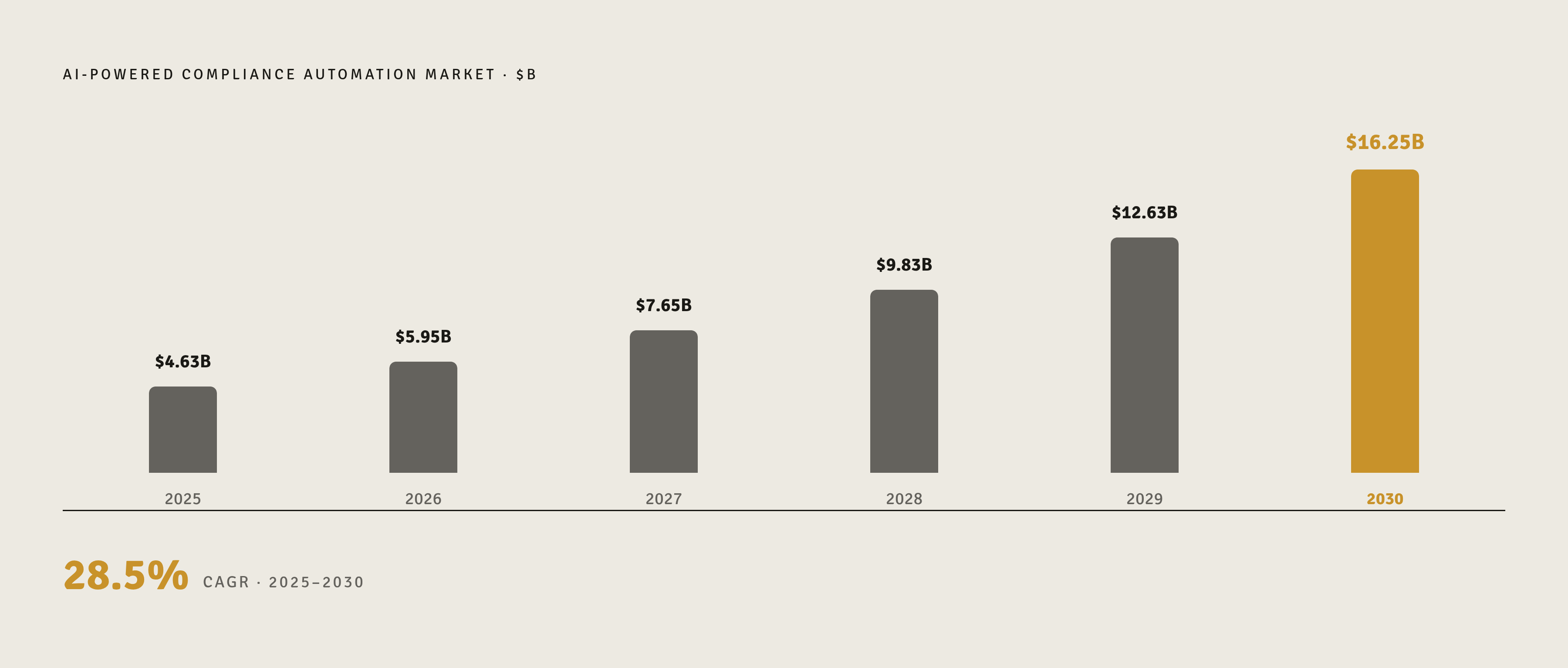
The AI-powered compliance task automation market is projected to reach $16.25 billion by 2030, growing at a 28.5% CAGR from its 2025 value of $4.63 billion. It traces to one shift, episodic audits giving way to continuous controls monitoring, not discretionary buying. It’s being pushed by instant event-report rules, growing digital security charges, plus ESG updates joining regular money statements, and every affected company must deal with it.
Quick expansion like that draws in vendors whose overlapping promises are often indistinguishable. This is exactly where the covered earlier two-layer framework matters during the buying stage, gives each buyer room to ask whether any given tool actually handles response and detection, or both, rather than taking that vendor's claims on trust. Since the market constantly ships new stuff, picking based on how well a given tool plugs in and its data works longer than choosing something for one flashy trick any competitor matches in months.
What to verify before selecting a compliance AI tool
Start with what the tool covers. Can the tool genuinely cover the regulators and jurisdictions relevant for the sector at hand? Regology's main advantage is its breadth, covering over 135 nations. Compliance.ai specializes in regulatory change monitoring for financial services. Both have their place; the choice comes down entirely to an organization's footprint.
Most buyers quit their questions early here, but Mapping matters just as much. Does the tool just fire an alert when something changes, or can it map the change onto internal controls and existing policies and flag the gap? That later function is where you save entirely on work, not with an alert, and the vendor presentation with only an alert list hasn't covered what actually matters. Skip any demo where an alert is all you see.
Ask if the existing GRC platform links via API to the awareness tool, or if the team still has copying findings to do. Scrutinize the Human oversight architecture too. Wolters Kluwer's Compliance Intelligence combines AI with human subject-matter expertise for regulatory compliance, not some layer that's black-box. When regulations are high-stakes, showing how you got an answer is usually what makes it audit-ready.
Enforcement linkage also matters: can the tool draw on enforcement action data the relevant regulators publish, letting a team prioritize which controls get scrutinized, not just ones with recent updates? Industry-specific precision carries more weight than people assume. Find out what data trained the NLP system, since one built for banking mandates behaves unlike another fed general law documents. For any company with multiple teams in jurisdictions, centralized management plus multi-entity workflow isn’t optional. Without them, your tool won't scale and just turns into a fresh silo.
How organizations make the reactive-to-proactive shift in practice
The reactive-to-proactive shift unfolds in many moves, not a single one. This change shifts how details flow across the company. Incoming change is filtered into an alert flagged relevant, mapped to its duty, triggers an update to the rules, and generates the records an auditor will need. AI handles those center tasks, which once took up the bulk of any compliance analyst's time.
Wolters Kluwer describes its Compliance Intelligence product as enabling forward-looking compliance, allowing leaders to focus on strategic initiatives, and that view stands up. AI-powered tools can help identify compliance gaps and policy conflicts, supporting remediation efforts, letting them begin ahead rather than facing new material cold. Archer and IRM frame the role of AI's in like terms: highlighting the controls that matter, plus confirming checks happen on schedule or through outside review, so a company can fix issues before breaking rules.
Firms that put continuous monitoring infrastructure in place today gain an advantage no one can retrofit down the road. Compliance ends behaving like an expense that changes at the same pace as regulatory demands and becomes something the company uses every day. That difference matters too for the firms advising businesses on such platforms: a live read on where a compliance posture actually sits, and how well it runs, is an offering of its own, not simply a software suggestion. Tools designed to measure AI-driven results across compliance domains demonstrate how accountability improves when AI supports traditionally manual processes.
The groups most ready for coming rule shifts handle compliance as an ongoing, AI-supported job, not a one-off task. This shift depends on tools like these for its infrastructure, and organizations still relying on spreadsheets may face increasing challenges.
Notes
- AI-Powered Compliance: Turning Regulatory Challenges into Opportunities
Provided details on Archer Evolv's multi-jurisdiction regulatory tracking and its AI-supported compliance workflow framing.
- Introducing Compliance Intelligence: trusted AI for when you have to be right | Wolters Kluwer
Sourced the description of Wolters Kluwer's Compliance Intelligence as enabling forward-looking compliance with human subject-matter oversight.
- Implementing Generative AI in Compliance: Challenges & Best Compliance AI Solutions - Springs
Provided the figure that AI could automate up to 70% of compliance groundwork, and context on how compliance teams spend their time.
- Wolters Kluwer launches Compliance Intelligence | Wolters Kluwer
Confirmed the October 2025 launch date of Wolters Kluwer's Compliance Intelligence product.
- Using AI for effective regulatory change monitoring
Supplied the core enforcement statistics including the 85% complexity increase, $1.23 billion in H1 2025 fines, the 417% jump, and the 80% spreadsheet-use figure.