Essay Compliance Software
HR Compliance Checklist for Multi-State Employers
Forty-seven compliance updates in 2026 make multi-state payroll rules unprecedentedly complex.
Hiring across states makes compliance costs multiply, not add up. A worker signing on from a different state may set off tax sign-ups, wage-law coverage, sick time earned, and notice duties the same moment they begin, with most such duties binding right away, not after any waiting period. At its worst, this means California's PAGA plus New York's Human Rights Law: liability may attach even before someone finishes one day.
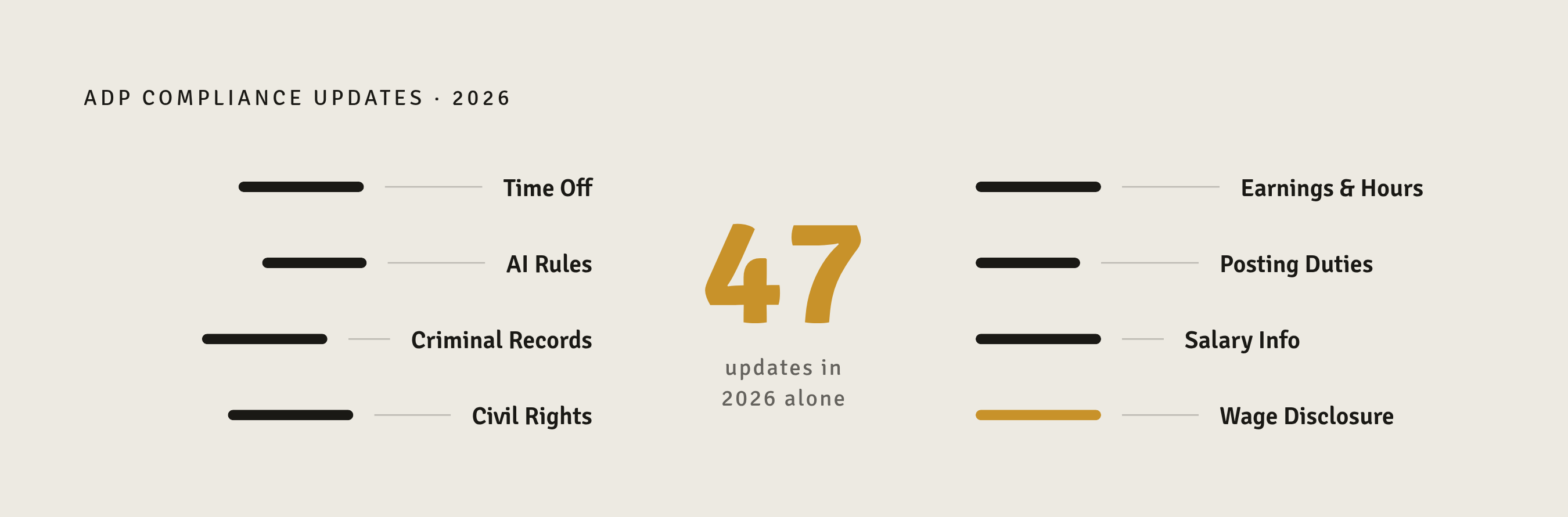
Do the calculations on multiple states. It means 10 wage levels, 10 paid sick leave plans, 10 workplace posting requirements, and 10 separate directions for what each termination notice must include and when it must come. SixFifty's 2026 guide notes that after a business crosses a few states, tracking everything by hand often becomes costly. And none of it stays put. SixFifty's 2026 findings reveal that in the most quickly shifting fields (mandated paid leave, reporting on pay equity, AI recruiting rules), updates occur frequently in the largest labor markets, with many new law revisions enacted annually. According to ADP, 47 fresh compliance updates are already live or scheduled for 2026 alone, covering time off, AI, criminal record reviews, earnings and hours, civil rights, posting duties, salary info, and wage disclosure laws.
Many employers see gaps after an outside audit, worker report, or note from a regulator's office. A smarter response won't help; a checklist drafted ahead of time and grouped by compliance topic will, since an error in one spot stays hidden elsewhere. Seven of these areas are laid out below, each tracked separately and each liable to surprise a business.
Establishing legal and tax presence before the first paycheck: nexus and registration
Being within a state takes very little. A desk counts, but so does a remote employee doing their job at home, or one person covering routes that enter another state. Beyond that, many states now follow nexus standards triggered by employee presence or other factors.
Registration must be completed ahead of, rather than following, the first paycheck. Look up every state that has an employee on the payroll, then file paperwork with that state's revenue office. Under 2026 guidance, Late registration after hiring remote employees remains a common payroll compliance challenge.
State-by-state registration is required next, with each state needing its own forms and pricing schedule. Workers' comp works the same way: what each jurisdiction demands and pays out changes, and going without enough coverage brings big fines. Sorting who's an employee also calls for state-by-state checking, because classification controls if withholding, workers' comp, plus other obligations even kick in, not merely their price tag. State-level WARN Act equivalents also matter, since they set advance-notice requirements for large layoffs. ADP Spark notes that California broadened its take as of January 1, 2026.
This isn’t one-time work. Each fresh hire in a different state starts the whole process over.
Wage and hour compliance: tracking minimum wage, overtime, and local ordinances across jurisdictions
INFINITI HR's Employer Compliance Guide reports twenty-two states will introduce new wage requirements during 2026. California illustrates how tangled pay rules can get: $16.90 covers most workers, quick-service restaurant staff hit $20.00, 38 local jurisdictions pile on their own pay floors, and 88 workplace notices must stay up to date.
New York has its own take on the same issue. In New York City and nearby areas, pay is $17.00 hourly, but it's $16.00 elsewhere across the state, where 56 posters are required statewide along with another 31 for the city.
The checklist kicks off by going through every wage number across each city, county, and state where staff are based, because local rates routinely go past the state floor. Overtime laws vary by place: California requires extra pay each day, but the FLSA counts time once a week. Exempt classification, along with salary thresholds, need careful review as well. Misclassification remains one of the costliest triggers of wage disputes.
Local ordinances bring more to manage: lunch periods, pause breaks, and other workplace standards. SixFifty reports California requires attestations for lunch periods, a practice Texas doesn't mandate. Pay timing changes state by state too, pay timing requirements vary by state. Under ADP Spark's reporting, California clarified starting January 1 that employers must repay workers driving their own car for work, while Illinois now demands pumping-room time be compensated at the worker's standard pay beginning that same day.
MyHR Professionals flags one way payroll breaks: applying a single standard withholding setup to all employees, no matter their state. Each jurisdiction needs a separate payroll configuration. Seeing it otherwise lets gaps show up.
Pay transparency and pay equity reporting obligations by state
SixFifty's 2026 breakdown frames pay transparency not as a single law but as three distinct obligations bundled together: disclosing salary bands within job postings and reporting pay equity data for state authorities, plus letting workers access their pay scale upon request.
The states now with broad pay transparency rules are California, Colorado, Connecticut, Maryland, Nevada, New York, Washington, plus Rhode Island. Some states require salary disclosure only upon request rather than upfront in postings. Pay equity reporting now applies to California and to Illinois.
On January 1, 2026, California revised its own definitions. "Pay scale" now means a good-faith estimate of the salary or hourly range the employer reasonably expects to pay for the role at hire, and the state also clarified what counts as "wages" and "wage rates," per ADP Spark. Another California requirement took effect that same date: demographic data gathered under pay data reporting must be kept outside employee records, not combined with them.
Those requirements shape the checklist. Check job listings in every state for salary compliance, even ones where a remote applicant might work. That difference throws everyone off, so find out if a transparency law covers promotions and moves inside the company or just outside job postings. Set up a way for staff to ask for their pay scale in places where the law requires it, hold California's pay data walled away from general HR documents, and calendar all deadlines on state by state pay equity reports. SixFifty recommends a tool to spot pay disparities ahead of any regulator finding them.
Many employers see gaps after an outside audit, worker report, or note from a regulator's office.
Paid leave compliance: federal baseline, state programs, and the new 2026 rollouts
Start by checking what federal law requires before stacking state requirements on top. FMLA applies to employers having 50 or more workers at a worksite inside 75 miles. The Pregnant Workers Fairness Act applies to many employers, and requires accommodations like adjusted hours, lighter tasks, or added breaks tied to pregnancy-related conditions. The PUMP Act requires accommodations for lactating employees.
The hard part is state law. SixFifty reports seventeen states alongside many towns and local governments now require paid sick leave, with every one setting different accrual patterns, carryover terms, allowed reasons, and posting rules. Over twelve U.S. states offer paid parental and health leave plans, with each choosing contribution rates plus eligibility terms.
2026 ushered in a fresh set of initiatives. Starting January 1, Delaware employers with 10 or more staff must provide paid leave for new parents, while larger employers must also provide leave for health and family care needs. Maryland and Maine are still rolling theirs out, while Minnesota's began that same January 2026. Colorado updated its FAMLI program effective January 1, expanding leave options and adjusting contribution rates. Connecticut also changed the paid sick leave law then, setting coverage at employers with at least 11 and widening qualifying uses, eligible workers, plus the way accrual is figured. California made a narrower move: workers may now spend accrued sick leave on court dates if they or a relative were hurt by particular offenses.
First, note each state with staff, compare it to today’s paid-time-off and PFML rules, and identify the worker counts that matter. Sign up for every state's PFML system and start contribution withholding ahead of each effective deadline, not after. Review coordination for state paid leave plus FMLA and company leave plans, because states vary on if these happen concurrently or layer. See if any workers meet Colorado's NICU add-on rules. Check accrual tracking for each employee’s work state, because payroll using one accrual rule for every state leaves a compliance hole. Because the law requires it, plenty of states mandate handing out state-specific leave notices upon hire and once a year.
Mandatory harassment prevention training: state-by-state cadence and content requirements
Coggno's 2026 guide notes that 8 U.S. jurisdictions now mandate private-sector harassment prevention training on a regular basis. No one-size-fits-all training module meets any state's requirements.
Under SB 1343 plus AB 1825, California's employers hiring 5 or more staff must give supervisors 2 hours of training plus 1 hour for all others every couple of years. After hire or being moved up, new supervisors have half a year to finish it, but short-term staff and seasonal workers have only 30 calendar days. New York State requires training every year for all employees at all employers, regardless of headcount, and the material has to match or go beyond the state's rules. New York City also requires it: companies with at least 15 workers must give bystander training every year. Across Illinois, Connecticut, Maine, Delaware, along with Washington plus Oregon, each state has its own approach, with separate cadences, training details, as well as headcount thresholds; Coggno's 2026 guidance says each must be individually tracked, not lumped with others.
Set up a training calendar by state, breaking out timing, attendees, and specs. Check that the material follows every state's rule, because California requires training based on California law instead of a national model. Log each worker and each state separately, since some states want records showing both that the training took place and what it included. Each state (California's 6-month plus 30-day windows aren't a basic yearly renewal) needs its own due dates when new hires start, and employers having 15 or more NYC staff must include bystander training from New York City as one entry, while Oregon stays on since Coggno calls it the eighth required jurisdiction.
AI in hiring: the fastest-moving compliance frontier across multiple state regimes
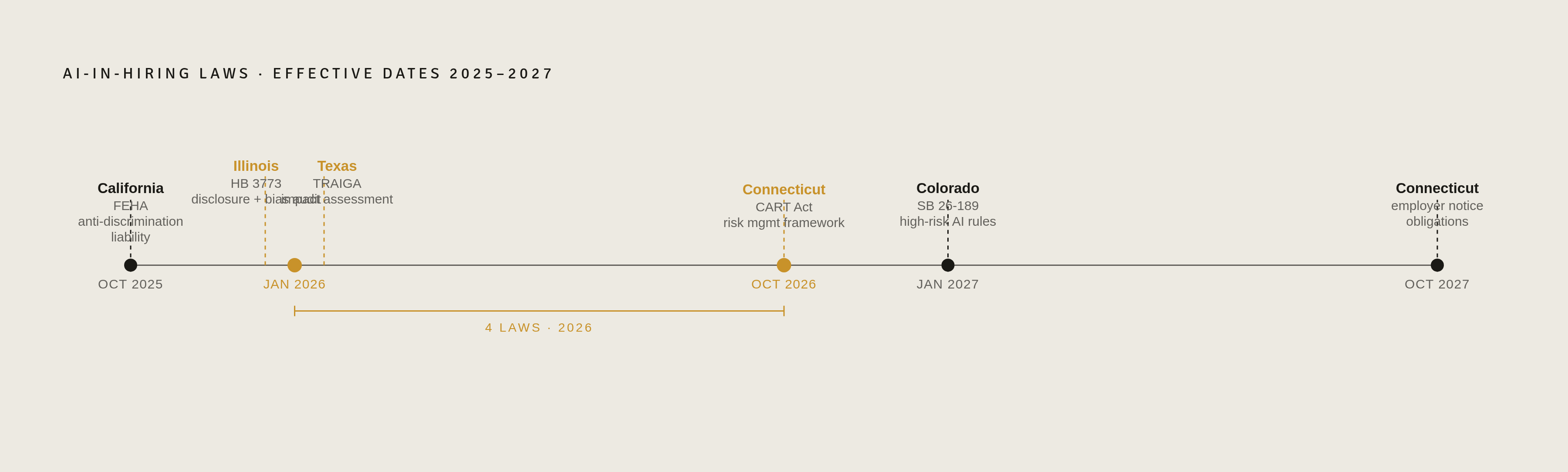
SixFifty's 2026 tracking finds 7 places currently limit AI-powered candidate screening through disclosure requirements, and the situation grew much more complex during 2026 alone.
Effective January 1, 2026, Illinois passed HB 3773, mandating that applicants and workers receive disclosure if AI factors into any employment decision, while imposing anti-discrimination liability on systems causing adverse outcomes. Illinois Department of Human Rights rules call for 4-year recordkeeping covering disclosures and AI-related notices. TRAIGA in Texas starts January 1 and stops only purposeful AI-based bias, leaving out unequal results claims completely, requiring no reviews or warnings, and letting companies fix problems within 60 days before fines hit, much easier on businesses than California, Colorado, or Illinois.
On June 2, 2026, Connecticut passed its CART Act, joining five other states that oversee AI use in hiring. It covers what the law calls "automated employment-related decision technology" used as a substantial factor in hiring, promotion, discipline, or discharge decisions. On October 1, 2026 the statutory framework kicks in, and employer notice obligations begin twelve months after that date: October 1, 2027. Colorado swapped its prior AI law for SB 26-189, taking effect January 1, 2027, creating a notice-and-human-check setup: employers must reveal AI involvement and give workers a human look at adverse outcomes, with all enforcement handled by the Attorney General alone. California changed how FEHA treats Automated Decision Systems starting October 2025, barring them in ways that lead to unfair job results, calling for records for 4 years about information these systems created or handled, and making companies answer even when an outside company owns the tool.
Nothing Washington did altered the situation. The White House's December 2025 order 14365 and the March 2026 National AI Legislative Framework created no actual law, so all those state rules keep applying no matter what Washington does.
The checklist starts by cataloging each AI and algorithmic program handling sourcing, filtering, rating, sorting, plus any decision regarding an applicant or employee mapped across the states where it runs. Next, hiring should include disclosure workflows, rather than having them bolted on later like an afterthought, because Colorado, Illinois, and California each set disclosure rules in separate ways, and one workflow will not fully satisfy the others.
Notes
- 47 State-Specific HR Compliance Changes for 2026
Provided the figure of 47 compliance updates live or scheduled for 2026, specific California and New York wage rates, and details on California's mileage reimbursement and Illinois pumping-room pay changes.
- 2026 Employer HR Compliance Guide | Free Download
Supplied the figure that twenty-two states will introduce new wage requirements during 2026.
- HR Compliance Software for Multi-State Employers (2026 Guide)
Provided tracking data on AI hiring laws across 7 jurisdictions, the framing of pay transparency as three distinct obligations, and figures on states with paid sick leave and paid leave programs.
- Compliance Training Requirements by State: A 2026 Reference for Multi-State Employers - Coggno
Supplied the figure that 8 U.S. jurisdictions mandate private-sector harassment prevention training and details on California, New York, and other states' specific training requirements.
- Multi State Payroll Compliance: Complete Guide for 2026
Flagged the common payroll error of applying a single withholding setup to all employees regardless of state.
- https://www.ebglaw.com/insights/publications/2026-family-and-medical-leave-law-updates-what-employers-in-seven-states-need-to-know
Provided details on the 2026 paid leave rollouts in Delaware, Maryland, Maine, Minnesota, Colorado, and Connecticut.
- https://www.consultils.com/post/us-ai-hiring-laws-compliance-guide-2026
Provided details on Illinois HB 3773, Texas TRAIGA, Connecticut's CART Act, and Colorado's SB 26-189 AI hiring laws and their effective dates.
- From East Coast to West Coast: What Multi-State Employers Need to Know About 2026 Employment Law Compliance
Covered the range of state-level posting requirements and wage compliance obligations referenced in the wage and hour section.