Essay Compliance Software
Compliance Management Software Integration With HRIS Platforms
Syncing employee data between systems prevents compliance gaps that audits and lawsuits expose.
Compliance usually breaks down less because teams misunderstand the law than because employee records fail to move cleanly into the tools that manage regulatory obligations. The discussion below unpacks the practical shape of that handoff, the requirements for connecting an HRIS with a compliance tool in a meaningful way, and the platforms that bridge the divide.
The Handoff Between HR Data and Compliance Tools
When an employee moves to a different state and the HRIS location field changes to match, the engine responsible for pay transparency rules never registers the shift, since it runs on a subscription to legal content plus a quarterly review. The mismatch can sit there for six months before anyone notices, leaving the company in violation of a state statute its own systems could have flagged. This is the core issue: the organization understood its legal obligations, but it could not link an individual's personnel file with the mechanism that determines which regulations govern them.
When a worker's classification shifts away from contractor status toward employment, a downstream compliance tool that fails to register the change will continue enforcing incorrect obligations for whether someone qualifies for benefits and how taxes get withheld. AirMason's 2026 compliance guide calls this what happens when a system built around one state's rules and a more relaxed pace of change meets a world that has outpaced it, a world where annual policy reviews and yearly handbook reprints no longer carry meaningful risk. That environment has vanished. When obligations come through subscription-based legal updates and scheduled manual reviews rather than continuous monitoring, policies grow outdated, employees receive stale direction, and the company builds up legal exposure that stays invisible until an audit, complaint, or lawsuit reveals it.
In 2026, five areas absorb the brunt of this lag: DEI and anti-discrimination policy alignment after recent Supreme Court decisions, pay transparency mandates that bring fines in the states that passed them, AI-in-hiring policies that open up algorithmic bias exposure, political expression policies enforced inconsistently across locations, and independent contractor misclassification under state tests that have grown considerably stricter. Each issue deepens the moment workforce details meant to prompt action, such as location, classification, and contract type, sit inside software disconnected from whatever monitors compliance. The law is not the hard part. What proves difficult is maintaining information fresh enough for proper legal application.
What HRIS-compliance integration does, layer by layer
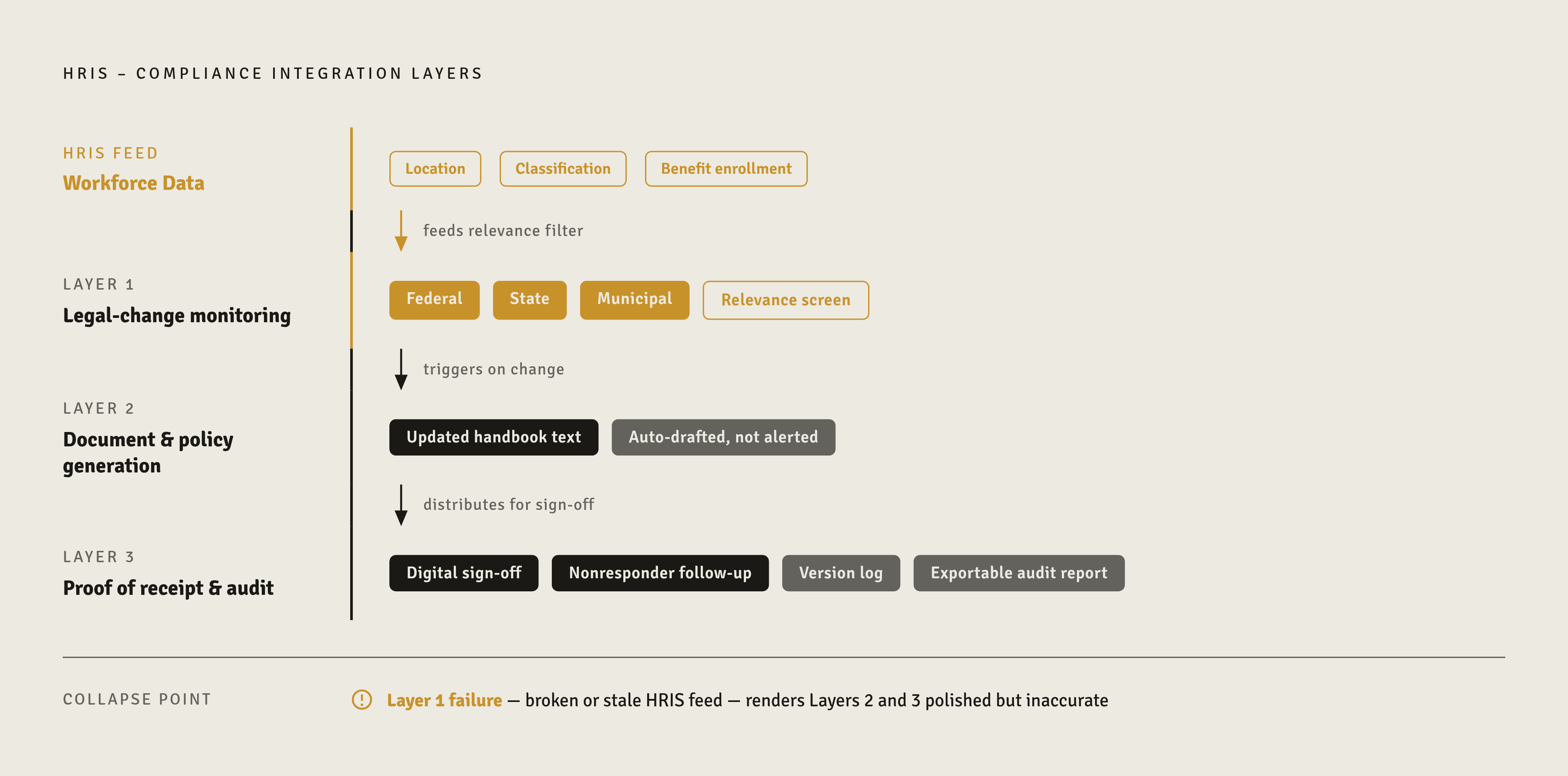
Real integration links an HRIS with a compliance tool across three layers, and any platform that only covers one or another is handing the missing pieces to HR, quietly, once the sales process is done.
The opening layer combines legal-change monitoring with a relevance screen. The engine must watch federal sources alongside state and municipal legal updates and compare them with the company’s real workforce before sending anything on for action. If monitoring is not tied to actual workforce data, the system buries teams in alerts they must triage by hand, undercutting the automation it was meant to provide.
Generating documents and policies forms the second layer. Whenever local authorities modify a regulation, the platform should automatically produce updated text for every affected guideline or manual chapter rather than merely alerting staff to handle the edits manually. Lacking that capability, oversight merely shifts the pile of pending revisions into someone's queue, recreating the exact obstruction it aimed to resolve.
The third layer focuses on proof of receipt and records for review. Digital sign-off records, follow-ups to nonresponders, policy-version logs, and downloadable audit reports together verify that employees received the updated policy and acknowledged it. Without evidence that employees read it, even the latest handbook offers weak protection during challenges, audits, or discovery. AirMason’s compliance guide warns that if monitoring and document management are split across tools, HR must manually connect the missing pieces, bringing back the same bottleneck the tool was meant to remove.
The first layer gains operational reality through the HRIS connection. For relevance filtering to function, the compliance engine must understand every worker's location, classification, and benefit enrollment. The HRIS, rather than the compliance platform itself, holds those details. Thus, any compliance platform relying on an outdated staff list bases its filtering choices on potentially inaccurate data, regardless of superb monitoring or expertly drafted policy templates.
Why data silos make the three-layer model collapse
The compliance data gap stems from data architecture, not policy, so a fragmented HR stack prevents you from maintaining the accurate, up-to-date employee records that the three-layer framework requires. When separate systems handle scheduling, compensation, hiring, and regulatory functions, they generate redundant entries, conflicting position names, incomplete information, and status details that go stale as soon as employees switch positions or sites. Each error can compromise the regulatory reporting that relies on precise employee records.
Bad data produces a real compliance problem, not a theoretical one. When a faulty record drives decisions about where a worker falls, how they are classified, or whether they qualify for ACA coverage, the resulting compliance output is faulty too, even with highly sophisticated monitoring above it. No amount of advanced oversight can rescue compliance work built on flawed underlying data.
Distributed teams introduce yet another dimension of risk here. Remote work triggers data localization mandates plus limits on moving data across borders under regimes like GDPR, alongside related contractual duties under CPRA, meaning you need precise employee data while also keeping it housed and moved in the correct jurisdiction under the proper conditions. Even with integrations in place, mismatched schemas persist: what one platform calls "employee_id" appears elsewhere as "worker_number" or "employee_reference_id," forcing ever more mapping effort with each new tool to maintain alignment across these fields. Connecting systems does not guarantee that clean, consistent information moves between them.
For compliance, if unified employee data flowing is missing from the HRIS, the compliance layer relies on assumptions, perhaps accurate when the system went live, that drift after each hire, termination, promotion, or relocation.
What proves difficult is maintaining information fresh enough for proper legal application.
The all-in-one versus best-of-breed decision
Choosing all-in-one HR or assembling a best-of-breed compliance stack changes the data-quality load an organization is owning, and what works depends on what it can realistically maintain.
By housing payroll, HR, and regulatory information within a single record structure, unified suites lower integration overhead and remove the bulk of schema-mapping headaches. Without any independent synchronization step to lag, the compliance layer always reflects the current employee state. The downside is speed: such platforms struggle to match rapidly shifting regulations, and deployments taking as long as 18 months risk launching software that lags current mandates where jurisdictions revise requirements often.
Choosing top-tier tools for each specific task may seem ideal, yet upkeep expenses grow significantly as time passes. Integration maintenance alone consumes between 60 and 70 percent of lifetime integration expenses, and each custom connection requires continuous engineering effort to endure platform updates on both ends. A provider updating twice yearly might disrupt field mappings unexpectedly, leaving compliance software relying on information that had diverged from the HRIS long before.
AI changes the stakes here. When automated oversight tools ingest mismatched data across siloed platforms, they generate polished but inaccurate conclusions that directly influence personnel choices. Treating integration merely as an IT budget entry quantified by engineering hours saved is no longer viable. It now serves as a regulatory obligation carrying potential legal liability.
Once they outgrow the startup stage, most organizations use a hybrid setup: a broad HRIS for compensation runs, benefit administration, and employee files, alongside one or two focused compliance tools where the main platform falls short. What really sets the boundary for adding separate point tools is not the appeal of any single option, but the team’s realistic capacity to maintain the necessary integrations. That limit should shape how any specific platform gets evaluated, too. The checklist below starts there.
What to evaluate in a compliance-HRIS integration
Buyers who size up compliance-HRIS integration only by feature lists usually discover the gap once the system is live, when the link they counted on turns out to be thin. A few operational factors decide whether an integration holds up or breaks down.
Start with where the tool covers: how many regions it monitors, where its updates come from, and whether it tracks requirements down to the municipal tier, where minimum wage amounts, sick leave mandates, and pay transparency rules commonly differ from state law.
The next consideration is how the connection is built. A compliance engine built on the HRIS data layer is fundamentally different from one linked by an API that needs attention whenever either platform changes. A native link also avoids synchronization delays, so live compliance monitoring can be trusted in day-to-day use.
Relevance filtering decides whether the monitoring layer compares incoming law changes to the organization's actual employee location, classification, benefit enrollment, and contract type, or broadcasts each regulatory change across the whole organization so HR handles the filtering.
Audit-trail defensibility covers whether a platform produces timestamped acknowledgments, with version-specific tracking and exportable records that survive agency scrutiny, acquisition diligence, or litigation, not a tidy dashboard made only for internal use.
Acknowledgment workflow completeness covers getting electronic signatures, automated reminders for employees still needing to respond, and acknowledgment status by employee and specific document.
Maintenance and Update cadence cover when compliance content gets refreshed, whether attorneys join the process, and how a platform handles a mid-cycle law change.
Scalability covers whether the platform absorbs the complexity of global hiring, cross-border operations, and data localization requirements, or if it was designed for domestic US compliance and will require a tool bolted on as the company expands.
If an organization buys by counting integrations on a sales site or checking how many regions a tool handles, they usually learn in implementation that the connection fails at the first edge scenario: an employee who splits hours between borders, a contractor reclassified halfway through the year, or changes from a benefit enrollment that shift the ACA calculation.
How Phantom Farm and leading alternatives handle HRIS-compliance integration
The platforms below cover integration architectures buyers can choose, from one native data layer through modular add-ons bolted to payroll systems, and each suits company needs, jurisdiction footprint, and integration maintenance capacity.
Phantom Farm embeds HRIS-compliance links directly into its core, so regulatory oversight, staff files, and policy confirmations share a single data layer rather than traveling through a cobbled-together API connection. Because regulatory tracking cross-references each worker's current profile, site, classification, and contract type, new legislation targets only the staff it affects instead of flooding the entire company for HR teams to triage by hand. All three components outlined previously, regulatory oversight, handbook and policy drafting, plus receipt logging that exports cleanly for audits, operate within a single unified system requiring no manual bridge. When managing multi-state requirements, the entire chain linking oversight through executed confirmations functions seamlessly in Phantom Farm, sparing you from assembling a bespoke integration stack.
Gusto bundles complete payroll processing alongside HR compliance tracking in all 50 states, plus tools to build handbooks and receive alerts whenever minimum wage or labor statutes change. It also handles electronic paperwork, enabling digital signatures on W-4 and I-9 forms, while offering secure file storage with audit logs plus a legal template library in its HR Resource Center. PTO and benefits administration live inside the same setup. Smaller and midsize companies wanting unified payroll, benefits, and compliance will find it appealing, thanks to clear costs and quick onboarding.
ADP SmartCompliance works in a modular way, plugging into the HCM and payroll platforms you already run. It unifies wage garnishments, ACA monitoring, tax credits for hiring, and employment checks within one dashboard. If your goal is applying uniform rules throughout several payroll platforms while retaining your existing vendor, this solution serves large HR departments well.
By pairing automated features and real-time HR guidance, Paychex Flex serves smaller and midsize firms seeking self-service options alongside direct access to compliance experts. Extra modules drive up overall pricing. Users additionally complain that the platform's design feels outdated compared to more modern rivals.
Rippling brings HR, IT, and finance together on one system, taking over compliance-heavy tasks such as onboarding, payroll, benefits administration, ACA work, COBRA submissions, document handling, plus labor-law tracking for national, state, and city requirements through a shared HRIS that includes alerts. It also connects with many ready-made apps, and in 2026 Rippling introduced an Automated Compliance module for SOC 2 help plus audit-proof gathering across workforce records, hardware, and application permissions.
Workday serves HR alongside finance and planning through one platform, pairing live analytics with configurable dashboards while supporting compliance across domestic and international rules. But its size makes integrations demanding: Workday relies on layered data models, and each twice-yearly release may impose required updates to existing setups and mappings, so engineering resources are needed to keep everything running smoothly. As a result, it suits large multinational companies that already have technical teams better than smaller organizations lacking that support.
For HR groups focused on policy documents and handbooks, AirMason combines automated updates that are attorney-reviewed, real-time tracking, and an AI-powered compliance engine.
Notes
- Benefits of HRIS Integration with Your Compliance Platform
Informed the article's explanation of how HRIS integration enables compliance platforms to access accurate employee data for relevance filtering and regulatory monitoring.
- Top 10 Features to Look for in Compliance Software
Informed the evaluation checklist section covering features such as audit-trail defensibility, acknowledgment workflows, and maintenance cadence.