Long read Compliance Software
What Is Compliance Software for HR and Legal Teams
Automated auditing and documentation turns regulatory chaos into something enforceable.
Compliance software for HR and legal teams takes regulatory chaos and turns it into workflows someone can actually audit later. That's the whole premise, and it explains why a category that used to mean "policy documents on a shared drive" now means something closer to what enterprise finance software does for a company's books.
At its core, this software automates the monitoring, documentation, and enforcement of compliance tasks across HR and legal functions. It doesn't belong to one department: HR uses it, compliance officers live in it, legal teams pull records from it, and executives read its dashboards when a board member asks an uncomfortable question. Corporate offices, hospitals, factories, and government agencies all lean on some version of it, because all of them face the same basic problem: rules pile up faster than any human can track by memory.
Worth separating out early: this sits next to, but isn't the same as, an HRIS (which manages employee data generally) or a corporate LMS (which handles training broadly) or GRC software, which stands for Governance, Risk, and Compliance and treats those three as one connected discipline instead of three separate headaches. HR compliance software is often the door people walk through on the way to a fuller GRC setup. And "compliance" itself covers two different things that get lumped together: external mandates like labor law and data privacy, and a company's own internal policies, which need enforcing just as much even though no regulator wrote them.
The regulatory environment that made this software necessary
Oversight used to sit mostly with legal departments, but now HR is the frontline, mostly because HR is where the paperwork actually lives.
The United States is the main reason this got complicated. Federal, state, and local labor law overlap significantly, especially in states like California, Texas, and New York, where an employer can trip three different wire alarms with one bad scheduling decision. The U.S. accounts for roughly 35% of global HR compliance software revenue, according to Verified Market Research's 2025 figures, and that share tracks pretty closely with how much regulatory noise American employers have to filter compared to the rest of the world.
The list of frameworks a mid-size U.S. employer has to track is extensive: FLSA, FMLA, ADEA, Title VII, ADA, ACA, I-9 eligibility rules, worker classification, PTO accrual, benefits administration. Layer in the international side and it gets heavier still: GDPR, CCPA, SOX, HIPAA, and now the EU AI Act, which is being phased in with enforcement provisions rolling out over a multi-year timeline. Each of these has its own definitions, deadlines, and paperwork, and none of them talk to each other.
None of this is static, either. HR.com's State of Legal Compliance and Employment Law 2025 report found that 46% of HR professionals name the expanding scope of federal and state mandates as their top challenge, with 38% citing shifting legal interpretations right behind it. Both have held the top two spots for three years running, which says something: this isn't a spike teams can wait out. And even when HR knows exactly what's required, GoCo's research found 64% of HR managers say they lack the time and resources to actually meet the demands. Knowing the rule and having the bandwidth to follow it turn out to be two very different problems.
So the old approach, spreadsheets, shared drives, someone's memory of what changed last quarter, stops working. Not because anyone got lazy, but because the volume and speed of regulatory change outran what a manual system was ever built to handle.
What happens when organizations get compliance wrong
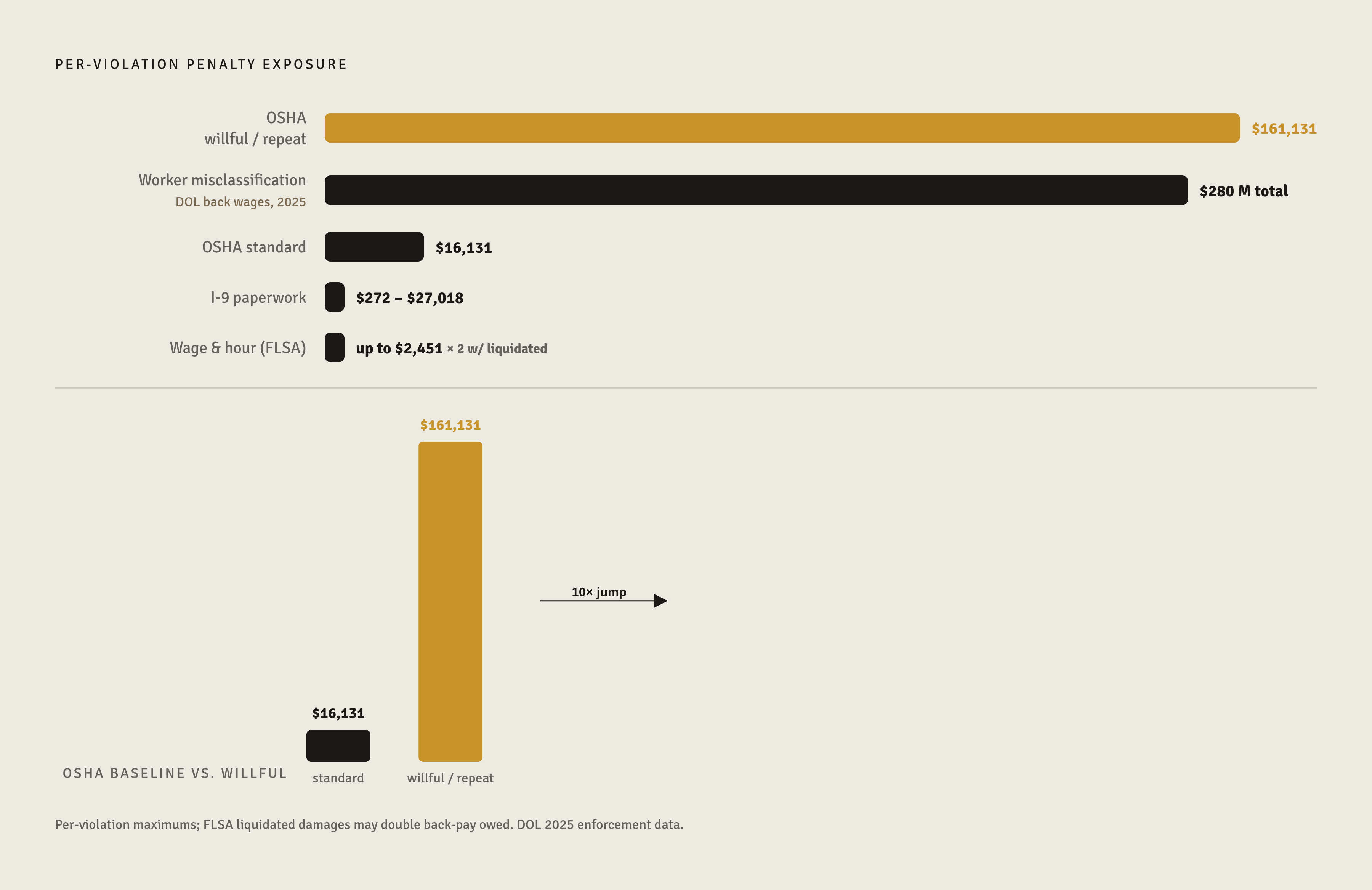

Start with the costliest one: wage and hour violations, meaning unpaid overtime, minimum wage miscalculations, and work done off the clock that nobody logged. This is consistently the largest source of employer fines, and it rarely comes from malice; it comes from a timesheet that didn't sync with a scheduling tool that didn't sync with payroll.
Under the FLSA, violators owe back wages plus liquidated damages that can double the total bill, and willful violations carry civil penalties up to $2,451 per violation as of 2024, a figure that rises annually. OSHA standard violations reach $16,131 per violation in the same year, and willful or repeat offenses jump to $161,131 each. Then there's I-9 paperwork: $272 to $2,701 per form for a first offense, scaling to $2,701 to $27,018 per form for repeat or substantive errors. Multiply that by a workforce of a few thousand and a filing cabinet full of sloppy I-9s turns into a seven-figure problem almost by accident.
Worker misclassification is its own category of pain. The Department of Labor recovered over $280 million in back wages from misclassification cases in 2025, according to Workisy's 2026 reporting, which means somewhere out there, a lot of "independent contractors" were, legally speaking, employees the whole time. And discrimination complaints show the exposure even before anything reaches a courtroom: the EEOC logged over 522,000 calls related to inquiries and complaints in 2023, per Paradigm IE. That's not 522,000 lawsuits, but rather 522,000 moments where someone picked up a phone because something felt wrong, which is its own kind of signal.
Zoom out and the mood among the people whose job it is to worry about this stuff has gotten noticeably tenser. The Diligent Institute and Corporate Board Member's GC Risk Index had legal and compliance leaders rating business risk at 7.9 out of 10 in the fourth quarter of 2025, up 16% from the start of the year, with 60% citing technology risk as a top concern, ahead of economic and tariff worries.
Here's the pattern worth sitting with: almost none of this comes from someone deliberately breaking the law. It comes from a gap in documentation, a tracking system that missed an update, a process that relied on someone remembering something instead of a system recording it. Which is, conveniently, exactly the gap this software is built to close.
The core functions compliance software performs
Regulatory monitoring is the base layer. The software tracks labor law, employment law, and tax regulation changes across local, state, and federal jurisdictions, and flags what's relevant to a given employer before a violation happens rather than after. For international employers, this extends to country-specific frameworks, ACA rules in the U.S., GDPR obligations in the EU, and so on, each running on its own clock.
Document management comes next, and it's less glamorous but arguably more load-bearing. Handbooks, policies, employment contracts, essential HR files: all centralized, version-controlled, ready to hand over the moment an auditor or regulator asks. When a regulation changes, the platform pushes an updated policy while keeping the old version on file, so an organization can show exactly what rule was in effect on any given date. That last part matters more than it sounds; regulators don't care what your policy says today if the violation happened under last year's rules.
Policy management and enforcement is the layer that gets policies out to actual humans and proves they read them, distributing updates and capturing acknowledgment. Good platforms map internal controls to the specific regulatory requirement each one satisfies, a practice sometimes called compliance mapping, so a company can point to a control and say exactly which rule it answers to.
Training and certification tracking automates the assignment and completion tracking for the training that regulators actually care about: workplace safety, harassment prevention, ethics, DEI programs. The content itself is usually built by legal experts and kept current, and certification records sit ready for an audit instead of buried in someone's inbox.
Case and incident management handles workplace investigations: anonymous reporting channels, case logging, escalation paths for when something needs to go up the chain. This is also where risk registers live, sitting at the GRC layer proper, and every incident record feeds straight into the audit trail and reporting dashboard rather than living in a separate system nobody checks.
Dashboards and reporting give real-time visibility into outstanding tasks and policy performance across teams or office locations, and they translate all of this into something a board member can read in five minutes without a compliance degree. Automated regulatory reports also cut down the manual prep work before an audit or filing deadline, which is a meaningful time savings ahead of any deadline.
HRIS and payroll integration syncs employee records across systems, cutting down duplicate data entry and the errors that come with it, and makes sure the classification data feeding compliance reports actually matches current HR records. Finally, data security and access controls, role-based permissions and encryption, protect sensitive employee data and support the obligations GDPR and CCPA place on how personal records get handled and stored.
HR compliance software is often the door people walk through on the way to a fuller GRC setup.
How AI is changing what compliance software can do
AI use among legal professionals rose 315% between 2023 and 2024, according to NetDocuments. That's not an experiment anymore, but a shift in how the daily work gets done.
What AI actually adds: automated document review that summarizes contracts and flags risky clauses without someone reading every page, contract analysis and compliance mapping done at a scale no legal team could match by hand, predictive flagging of likely compliance gaps before they turn into violations, and regulatory monitoring that parses updates in something close to real time instead of waiting for a human to notice a new rule got published.
Adoption is moving faster than a lot of people expected. The American Bar Association's 2025 Legal Industry Report found 30% of legal professionals use generative AI personally, and roughly one in five firms report firm-wide adoption. But there's a gap worth noticing: Research has found that a large share of organizations expect AI to support legal compliance monitoring, yet far fewer plan to actually adopt AI tools within the near term. That's a lot of people nodding along in the meeting and then quietly not signing the purchase order, since watching from the sidelines is apparently still a strategy.
There's a wrinkle worth sitting with, too: AI compliance is becoming its own compliance requirement. The EU AI Act takes a risk-based approach, with enforcement provisions being phased in over time, which means organizations using AI tools now have to track their own AI governance obligations on top of everything else. So compliance platforms are starting to build AI governance modules just to manage the AI features they already added.
Put together, this changes what the software actually does. It has moved from passive record-keeping toward acting like a live intelligence layer, one that notices things instead of just storing them after the fact.
How the market has grown and who is driving adoption
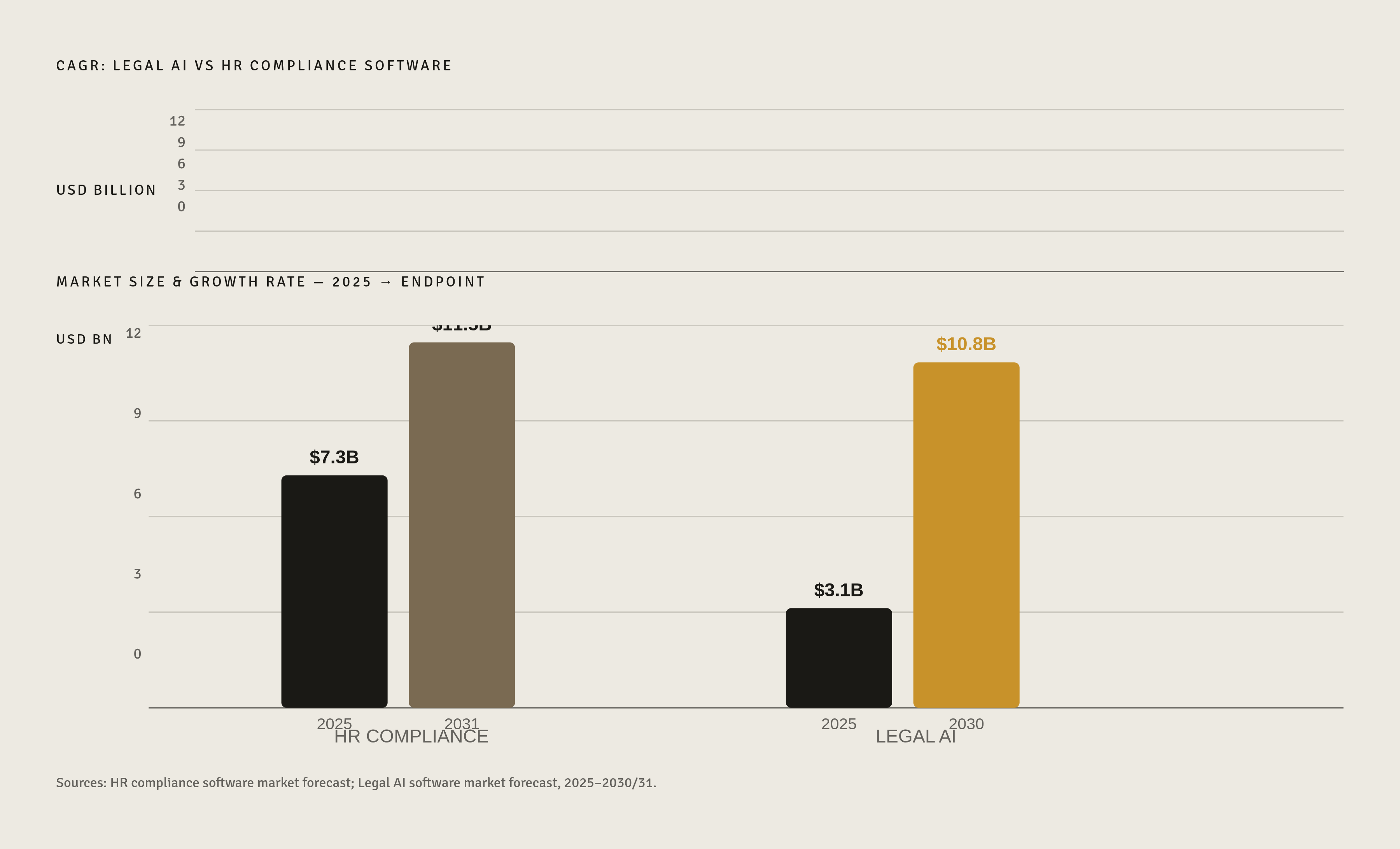

The HR compliance software market sits at USD 7.29 billion in 2025, and Research and Markets and Mordor Intelligence project it reaching USD 11.46 billion by 2031, growing at an 8.03% compound annual rate. The adjacent legal AI software market, tools built specifically for AI-powered legal workflows, is smaller in absolute terms right now at an estimated USD 3.11 billion in 2025, but MarketsandMarkets projects it hitting USD 10.82 billion by 2030 at a 28.3% CAGR. That's roughly three and a half times faster growth than the broader compliance category, which tells its own story about where the money's placing bets.
Cloud deployment holds a 68.4% share in 2025 and keeps growing at a 10.8% CAGR through 2031, while on-premise setups keep shrinking as a share of new purchases, per Mordor Intelligence's 2026 figures. Large enterprises still hold the bigger revenue base overall, but small and mid-size employers are the fastest-growing buyer segment, projected at a 10.4% CAGR through 2031. Compliance software has expanded well beyond its original enterprise-only buyer base.
By application, payroll processing remains the biggest single use case, but HR compliance and regulatory management specifically is growing faster, at an 11.6% CAGR, which suggests the dedicated compliance layer is catching up to the payroll tools it used to just sit beside. Geographically, North America leads with that same 35% of global revenue mentioned earlier, and the region's market alone is projected to grow from USD 2.49 billion in 2025 to USD 4.35 billion by 2031 at a 9.71% CAGR. Asia-Pacific is the fastest-growing region worldwide, projected at 12.7% CAGR through 2031, driven by labor markets formalizing and small businesses digitizing across India, Southeast Asia, and Australia.
The main platforms HR and legal teams are using
No single platform owns every function here, so teams tend to shop by their sharpest pain point rather than by brand reputation alone.
For organizations managing employees across borders, Deel HR is one platform designed with cross-country regulatory differences in mind. Mitratech is another platform that addresses compliance training and investigation-related workflows. Homebase is an option smaller employers consider for basic labor law compliance needs.
HR Acuity is oriented toward case management and investigation workflows. SixFifty focuses on HR document generation with an emphasis on multi-state U.S. compliance. Some platforms specialize in background-screening compliance as a dedicated niche. Paylocity gets singled out for dashboard efficiency inside a broader HRIS package. And at the large-enterprise end, SAP, Workday, and Oracle anchor compliance as one module inside a much bigger HR and ERP system.
There's also a content layer to this that doesn't always get grouped with compliance software but probably should. Moving from "the regulation changed" to "the policy document is updated" to "every employee actually read and acknowledged it" is as much a content production problem as a software one. Compliance software orchestrates these functions into a unified system. The integration is the point: isolated tools leave gaps between steps, while a system that chains strategy through execution to audit creates something an organization can actually stand behind later.
Which platform is right depends entirely on where the gap actually is: documentation, training completion, case management, or multi-jurisdictional monitoring. And whether the answer is a standalone tool or something that has to plug into an HRIS already in place.
What to look for when evaluating compliance software
Start with the gap, not the feature list. Is the risk in documentation, training completion, regulatory monitoring, or incident tracking? The honest answer shapes everything that follows, and skipping this step is how organizations end up buying a platform that's great at the wrong thing.
Check jurisdiction coverage carefully. A multi-state U.S. employer and an international employer need almost entirely different monitoring setups, and a platform that's excellent at California labor law might have nothing useful to say about GDPR.
Confirm integration with the existing HRIS and payroll system. A compliance tool that can't sync with core HR data just recreates the manual reconciliation problem it was supposed to fix.
Look hard at audit trail quality. Records need to hold up to a regulator's scrutiny, not just look tidy on an internal dashboard nobody outside the department ever sees. Ask about update cadence too: regulatory change never really stops, so find out exactly how the vendor pushes legal updates into the platform and how fast users get notified.
As AI features become standard rather than a selling point, ask whether the platform's AI decisions are explainable, not just accurate. That matters even more now given the AI governance obligations building under frameworks like the EU AI Act. And think about scalability: SMEs are the fastest-growing buyer segment, per the market data above, but a lot of them start with a basic tool and outgrow it fast. Worth asking whether the platform can grow into fuller GRC functionality without forcing a full migration down the line.
Last, security. Role-based access and encryption should be the floor, not a premium feature. For any organization handling GDPR or CCPA obligations, get the vendor's data processing agreements checked before signing anything, not after.
Notes
- https://www.rippling.com/blog/hr-compliance
Provided the 2024 per-violation penalty figures for FLSA willful violations and OSHA standard violations cited in the penalties section.
- https://www.paradigmie.com/post/hr-compliance-software-comparison
Supplied the EEOC call volume figure of over 522,000 inquiries and complaints in 2023 and the $161,131 repeat OSHA violation penalty cited in the article.