Essay Compliance Software
Compliance Software Audit Trail Requirements for SEC and FINRA Examinations
Broker-dealers must now prove their audit trails capture every change with precise detail.
Broker-dealers spent 25 years with a single electronic recordkeeping option: WORM storage (write once read many), where changing data was physically unfeasible. The SEC broke that monopoly on October 12, 2022 by adopting amendments introducing a second path: the audit trail alternative [1]. Though seemingly administrative, this shift fundamentally alters the criteria examiners apply. Previously, examiners simply asked whether records met the WORM standard. Today, the inquiry resists easy answers or deception: when a platform allows edits, does it preserve an unbroken, verifiable log of each change meeting every criterion this new option defines?
For everyday operations, the two paths impose different demands on a firm. WORM answers the problem by taking away the ability to make a change. Under the audit-trail route, later edits are permitted only when the system records every one with the detail the rule demands. That difference is still lost on many firms after their shift to modern recordkeeping systems designed for flexible, editable records. When users can revise trade blotters or change a client record, the platform permits conduct WORM storage exists to block, leaving compliance to depend entirely on whether the audit trail is strong enough.
The amendments also introduced a significant administrative adjustment in addition to the substantive change. Prior to 2022, broker-dealers were required to inform their designated examining authority before implementing any fresh digital recordkeeping platform. The SEC removed that requirement. Adoption became faster for firms upfront, though this came at a cost: reduced initial friction brings heightened examination pressure when regulators later require systems to demonstrate compliance with the specific mandates of the alternative audit-trail approach. By moving oversight from advance approval to after-the-fact proof, the technical standards discussed ahead become the real battleground where examinations are decided.
What the audit-trail alternative requires a compliant system to capture
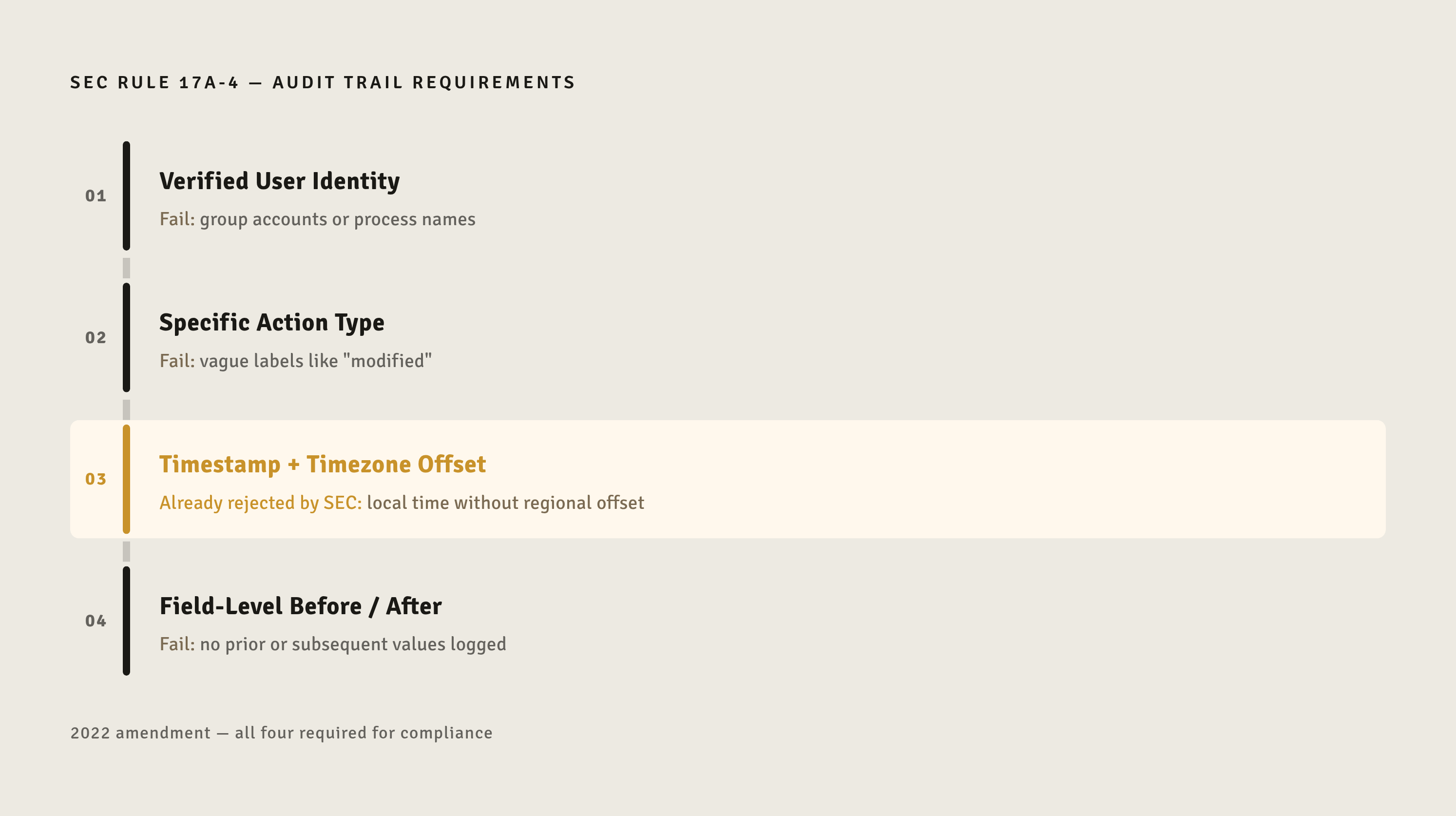
This alternative for auditing does not leave room to interpret the standard. A compliant system has to keep a complete audit log, marked with timestamps, recording every change made to a record and any removal of its parts. It must log when every operator input or step that generates, alters, or removes the record occurs, name who performed it, and retain any additional details required to maintain a distinct audit trail per record. Those criteria yield four actionable demands that serve as the working checklist for any examiner.
The first requirement centers on confirming the user’s identity. Each logged event must identify the verified individual behind it. Group accounts and catchall process names fall short, since compliance depends on knowing the verified person who acted, not simply recording that something happened.
The second requirement is specifying the precise action type. Each entry must capture the specific operation performed, be it viewing, editing, approving, or deleting. A field merely noting "modified" gives an examiner no indication of what value was altered, its previous state, or its new one, and such imprecision often fails under scrutiny.
Third, each timestamp must include its timezone. Every recorded time needs both a synchronized source and explicit regional offset information. Because SEC reviews have already rejected records showing merely local time lacking any offset, this requirement stands out as especially verifiable.
Fourth, capture field-level states both before and after the change. Pinpoint the particular record or transaction in question, together with its prior and subsequent states. This granularity distinguishes compliant logs from those that only pretend to record data.
A tamper-evident design serves a different purpose than immutability. With immutability, the record is kept fixed. It shows when a record has been changed after the fact. Reviewers look for tamper-evidence and immutability together when software follows the audit logging alternative instead of WORM, since that option permits changes only if they remain visible. Most compliance-review findings about audit trails concern adequacy rather than presence; the log typically exists. Problems instead arise when the log lacks enough detail and proof value, omitting per-field edits or recording timestamps with no timezone context, so its existence does not make it adequate.
Retention, accessibility, and storage architecture requirements that shape examination readiness
Getting the correct information into the log is only part of the duty. Even when a log covers all required technical points, it may not pass review unless the firm can produce it promptly on request and reach the place where it is kept without delay. How long records are kept and how quickly they can be accessed are judged apart from how well the data was captured.
Under SEC Rule 17a-4, firms must retain required records for at least six years, keeping the initial two in hot or warm storage rather than cold archive so they can be produced right away. When multiple compliance frameworks apply, the longest mandated retention period governs. Public company issuers face distinct record-keeping duties under SOX Section 404, which independently mandates preserving access events and financial data change logs. Under MiFID II, EU investment firms must preserve records for at least five years while tagging order lifecycle data with microsecond precision, exceeding any domestic SEC requirement.
The early architectural decisions a company makes, such as choosing between append-only logs and mutable databases or between on-premises and cloud storage, determine its capacity to satisfy these retention mandates while withstanding scrutiny. Choosing storage based on price or ease, while ignoring retention and accessibility mandates, creates built-in examination exposure that no policy document can later remedy. Whether a system enables prompt production is locked in at the moment of construction or acquisition, not bolted on once an examiner starts asking questions.
The amendments also introduced a significant administrative adjustment in addition to the substantive change.
What FINRA examiners are finding in books and records reviews
FINRA’s 2026 Annual Regulatory Oversight Report does not treat recordkeeping failures as single control gaps. It calls them broad weaknesses that hurt supervision, weaken accountability structures, and leave a firm unable to mount a defense should litigation proceed.
In the 2026 Report, books and records violations make up the main cluster of findings. When ledger and trial-balance entries are wrong, the mistakes flow into capital and reserve calculations, skew FOCUS Reports, and breach SEA Rules 17a-3, 17a-4, 17a-5, plus FINRA Rule 4511.
The 2026 Report labels electronic message retention a persistent, systemic gap, citing firms that miss capture, screening, or archive steps for staff electronic communications, focusing on Chief Compliance Officers working part-time and Financial plus Operations Principals, positions where nobody has verified coverage.
Specific CAT reporting problems are singled out. Some firms are late in providing the Central Repository with required CAT event records, such as those for new orders, routing, and executions. They also miss T+3 as the cutoff for fixing errors after they are found. CAT reporting oversight is also deficient: review samples often omit a sufficient range of orders and events, and firms fail to scale them appropriately by desk, aggregation unit, business line, and order flow.
The Report also surfaces a third recurring theme: firms outsourcing record capture and archiving to outside vendors without checking whether the work is being performed as contracted. In the 2026 Report, firms typically uncover the gap only once a review or enforcement proceeding has begun, and by then the missing verification falls on the firm itself, not the vendor.
Enforcement Actions and the Cost of Audit Trail Failure and Document Falsification
Enforcement actions give a price tag to audit trail failure and show what comes next when a compliance weakness turns into an effort to mislead a regulator.
The SEC disclosed a collaborative crackdown on January 13, 2025, settling claims that three broker-dealers and nine investment advisers failed to keep electronic correspondence. Fines proved severe, extending beyond lower-level employees who disregarded rules to encompass leadership and oversight personnel as well.
The more instructive case came over a year later. On March 6, 2026, FinCEN entered a consent order against a global broker-dealer, imposing a large civil money penalty, at the time the largest Bank Secrecy Act enforcement action ever brought against a broker-dealer (a record later surpassed by FinCEN's penalty against UBS Financial Services on August 3, 2026). The order arose from an alleged willful failure to implement an effective anti-money-laundering program running from roughly March 2018 through June 2024. What made the case an aggravated one rather than an ordinary compliance failure was the audit trail itself: the firm allegedly backdated hundreds of documents in response to regulator inquiries. A years-long compliance weakness, on its own, might have drawn a penalty that was significant but ordinary. But backdating documents to cover that weakness when regulators came asking made it categorically worse, and the size of the resulting penalty shows that difference.
How AI-assisted workflows extend existing audit trail obligations
The SEC has stated that existing audit trail duties also cover AI agents used within financial services workflows. An AI system handling a task remains subject to the same recordkeeping, client-data access, supervisory, and investor-disclosure rules that govern an adviser or employee handling it. These duties were not newly created to address AI. The change is that firms using AI often learn only after an exam that they were already bound by these duties and had not satisfied them.
The SEC's framework imposes two separate AI-related audit trail duties that firms must not treat as interchangeable. Rule 613's Consolidated Audit Trail reaches broker-dealers, national securities exchanges, and associations like FINRA to track NMS security orders. SOX, together with PCAOB rules, imposes a distinct obligation on public company issuers deploying AI within their financial reporting processes. Meeting one of these obligations does not automatically mean a firm has met the other.
In compliance platforms, logging now has to capture AI-content use: which files the tool opened, the session in which it acted, and the credentials it used. The same rule already governs staff-driven processes; AI is simply another participant that must be covered. The SEC’s examination agenda says reviewers will assess firms’ AI oversight controls and verify the accuracy of registrants’ claims about the capabilities of their AI tools. When a firm offers compliance functions powered by AI, it must be ready in an examination to substantiate the claim, not merely assert it.
Examiners are looking out for the SEC's term black box AI, meaning tools where you cannot see or audit how decisions get made. Deploying such technology against regulated data while lacking governance infrastructure aligned with current recordkeeping obligations produces the exact exposure these reviews now target. The 2026 Report from FINRA introduces an entire GenAI segment, requiring firms to evaluate compliance duties prior to launching such tools, establish oversight structures governing their application, and maintain continuous human review of outputs. When it comes to autonomous AI agents, FINRA points out that oversight may take new forms, like tracking agent actions and controlling which systems are available to them.
What compliance software must demonstrate in an examination
Examiners do not treat the mere presence of an audit trail as enough. A firm instead must be able, immediately and from existing records, to show that its trail meets every required component under Rule 17a-4 for the audit-trail option, together with FINRA Rule 4511’s accessibility requirement. From the capture mechanics and storage design to FINRA’s observed breakdowns and AI-assisted workflows’ added risks, this discussion distills practical checkpoints for a firm to apply as it selects or reviews compliance software.
Instead of merely noting that an operation occurred, the platform must track modifications down to individual fields while preserving what each value was before and after. Each event must connect to an authenticated individual user, so shared logins are out and automated process identifiers cannot stand in for a real person. Every recorded time must include its timezone and originate from a synchronized source. The storage layer must guarantee integrity cryptographically, whether through chained hashes or a comparable technique, and rely on a structure that only permits additions rather than a mutable database protected merely by permission rules. FINRA Rule 4511 requires records to be indexed and searchable for quick retrieval upon request, with SEC Rule 17a-4 mandating that the first two years remain readily accessible under its tiered retention schedule. Any software used in an AI-assisted workflow must record session details, tracking which tool was employed, during which interaction, and with what authorization, matching the granularity of manual operations. A firm must also confirm, not just trust, that outside vendors managing capture or archive genuinely preserve records per their contracts, preventing the discovery of gaps when regulators or enforcement proceedings reveal them.
Some firms may cite a 2025 midyear lull in enforcement activity to justify delaying investment in purpose-built compliance software. The record does not support that view. Regulatory intensity may rise or fall, but the duty to keep proper records stays in place, as FinCEN’s March 2026 order shows: exposure can span administrations rather than a single enforcement cycle, while falsified documents discovered in any examination during that period can trigger consequences far beyond those tied to the original compliance gap.
Notes
- 20 26 December 2025 FINRA ANNUAL REGULATORY OVERSIGHT REPORT
Primary source for FINRA's 2026 examination findings on books and records violations, electronic message retention gaps, CAT reporting deficiencies, vendor oversight failures, and the new GenAI oversight segment.
- Consolidated Audit Trail
Provided detail on CAT reporting deficiencies identified by FINRA examiners, including late submissions, T+3 error-correction deadlines, and inadequate review sampling.
- Federal Register :: Electronic Recordkeeping Requirements for Broker-Dealers, Security-Based Swap Dealers, and Major Security-Based Swap Participants
Provided the regulatory text and detail of the SEC's 2022 amendments to electronic recordkeeping requirements, including the audit-trail alternative and removal of the advance-notification requirement.
- SEC.gov
Cited as the SEC's official page for the October 12, 2022 amendments introducing the audit-trail alternative to WORM storage.
- Summary of SEC Amendments to Rule 17a-4 - 17a-4 LLC
Provided a summary of the specific technical criteria the audit-trail alternative imposes, including field-level capture, timestamping, and tamper-evidence requirements.
- Exchange Act Rule 17a-4 Amendments—Chart of Significant Changes Page 1
Provided the detailed chart of significant changes introduced by the 2022 Rule 17a-4 amendments, informing the article's description of what the audit-trail alternative requires.
- Books and Records
Provided the specific books and records findings from FINRA's 2026 report, including ledger errors, FOCUS Report breaches, and Rule 4511 violations.
- 2025 Wealth Management Enforcement Actions Roundup
Provided details on the January 13, 2025 SEC enforcement action settling claims against broker-dealers and investment advisers for failures to retain electronic correspondence.