Essay Compliance Technology
Contract Lifecycle Management for Regulatory Compliance
Automated approval workflows and clause libraries turn CLM platforms into compliance gatekeepers.
Compliance complexity doesn't sit still, and the people managing it feel it in their bones. Navex Global's 2025 State of Risk & Compliance Report found 72% of executives said rising compliance requirements over the prior three years had hurt profitability. Sit with that number for a second: it describes organizations trying to keep half a dozen overlapping frameworks straight simultaneously, each with its own clause requirements, its own audit expectations, its own way of fining you.
Look at what's actually stacked on the table. GDPR alone requires data processing agreements, defined DPA terms, and vendor access controls; by March 2025, regulators had logged more than 2,200 fines under the law, averaging above €2 million each, with total fines since 2018 topping €5.88 billion. HIPAA runs on Business Associate Agreements, and big health systems manage these by the thousands, each one needing exact data-handling and breach-notification language; HHS's Office for Civil Rights handed out more than $8 million in fines across 19 settlements in 2025 alone. Sarbanes-Oxley demands contracts hit specific auditing and financial-reporting benchmarks, and CLM generates the audit trail SOX asks for.
Then there's DORA, the EU's Digital Operational Resilience Act, live since January 2025, which requires sovereign audit rights and specific ICT third-party risk terms for financial institutions. EU banks have started pulling cloud workloads back onto home soil largely because of it, which tells you something about how seriously they're taking this. CMMC bakes cybersecurity language into every Defense Department contract, with an enforcement deadline landing in late 2026. The EU AI Act banned certain practices outright starting in February 2025, added obligations for general-purpose AI models in August, and, in a bit of recursion that made me laugh out loud the first time I read it, now governs how the AI features inside CLM platforms themselves get used. CSDDD alone touches roughly 6,000 EU companies and 900 non-EU ones, and together with CSRD it turns supplier contract clauses into the main tool for tracking Scope 3 emissions and supply-chain due diligence.
What ties all of it together is third-party risk. Privacy and cybersecurity breaches, third-party failures, and regulatory actions are among the most common compliance issues organizations face, and every one of those starts life inside a contract. A CLM platform has to bend to accommodate this: different clause sets, different approval chains, different monitoring rules depending on jurisdiction, counterparty type, and contract category. One template rarely fits every case, and it often struggles to fit even one.
How compliance exposure begins at contract authoring
Where do most compliance failures actually start? Earlier than people assume, in the language drafted before anyone's even negotiating yet, sitting quietly in a template someone downloaded three years ago and never updated.
Part of this is structural. WorldCC's 2025 research found contract-related data scattered across an average of 24 different systems, which means a lot of authoring happens somewhere legal never sees until it's too late to matter. Decentralized authoring, left alone, produces a predictable mess: inconsistent clause language across contracts that should look nearly identical, regulatory clauses that are outdated or just missing because whoever drafted the deal didn't have legal in the room, and version control chaos where the wrong template quietly becomes everyone's default.
CLM's answer here is unglamorous but it works: standardized template libraries and pre-approved clause libraries, built once, inherited automatically. Legal-approved language for GDPR data processing, HIPAA BAA obligations, DORA's ICT provisions, CMMC's cybersecurity clauses, all baked in from the start instead of bolted on during a frantic redline at 11pm. When a regulation changes, the clause library updates centrally, and every new contract created afterward picks up the current version without anyone having to remember to go check. Conditional logic does the rest of the thinking for you: counterparty is an EU entity, GDPR clauses insert themselves; contract touches health data, BAA language triggers on its own, no human required to remember the rule exists.
That closes the gap that opens up when business units draft contracts on their own, using whatever template happened to be sitting in someone's downloads folder. Worth noting the tension, though. WorldCC's 2025 data also found 83% of executives think their contracts are too rigid to adapt to change. Standardized templates fix rigidity at the level regulators actually care about, the structural level, while still leaving room to negotiate wherever the rules genuinely allow it.
Keeping compliance intact through negotiation and redlining
Negotiation is where compliance language goes to die if nobody's watching. Counterparties propose their own version of terms as a matter of course, and without some kind of guardrail, clauses that took legal three weeks to get right can vanish in a single redline pass over a Tuesday afternoon.
Unmanaged negotiation tends to follow a familiar shape. Legal-approved GDPR language gets swapped for a counterparty's weaker data-handling terms, HIPAA breach-notification windows stretch longer than the regulation actually allows, and indemnification or audit-rights clauses get deleted outright because someone wanted the deal closed by Friday. None of this usually happens out of malice. It happens because whoever's redlining doesn't have the regulatory context to know what they're giving away, and honestly, why would they? Nobody hands out a HIPAA refresher before a term sheet call.
CLM handles this with a few layered controls. Certain clauses get marked non-negotiable at the system level, so deleting or weakening them kicks off an escalation workflow instead of just sailing through. Fallback clause sets mean that if a counterparty rejects the preferred language, the system offers the next pre-approved alternative rather than leaving the call to whoever's on the deal that week, under deadline pressure, at 6pm on a Friday. AI-assisted redline review flags deviations from approved language, sorts them by risk level, and routes the risky ones to whoever's supposed to review them, automatically.
The approval workflow itself becomes a compliance gate: nothing with a flagged deviation moves to execution without sign-off from whoever holds that authority. And every redline, every deviation, every approval decision gets logged as it happens, which is exactly the documented trail regulators want when they ask how a contract got reviewed. JPMorgan Chase's use of AI-powered contract review reportedly cut review time by around 80%, while also improving how well the system caught risk and verified compliance. Speed and accuracy pull the same rope here, rather than fighting each other.
Execution as a compliance event, not just a signing ceremony
There's a comfortable myth floating around that once the language is agreed, execution is just paperwork: the part where someone finds a working pen and signs on the dotted line. Treating it that way is exactly how compliance gaps sneak in at the last possible second, because execution carries real requirements of its own.
Signature authority matters, for one. Plenty of regulations, and plenty of internal policies, require contracts above a certain value or covering certain data types to be signed only by authorized signatories, not whoever's sitting closest to the printer. Timing matters too; frameworks like DORA and HIPAA require certain agreements to exist before a vendor relationship starts, not sometime after, when someone remembers. Format matters as well, since electronic signature validity shifts by jurisdiction, and the execution method has to match wherever the deal is actually happening.
CLM enforces all three directly. Delegation-of-authority controls decide who's allowed to sign what, closing off unauthorized execution before it happens. A pre-execution checklist confirms required clauses are present and required approvals are obtained, and execution simply doesn't move forward until that checklist clears. The resulting audit trail is timestamped, tamper-evident, permanent, structured for regulatory review rather than a frantic scramble through old inboxes six months later.
The consequences of getting this wrong aren't hypothetical. Lockheed Martin agreed to pay $29.74 million, on top of $11.3 million paid earlier, to resolve allegations it had provided inaccurate cost or pricing information during contract negotiations, a case brought under the False Claims Act. Documentation failures at execution carry federal enforcement teeth beyond the internal headache. The audit trail is the evidence that decides liability when enforcement actually shows up, and no vendor comparison sheet is going to save you at that point.
EU banks have started pulling cloud workloads back onto home soil largely because of it, which tells you something about how seriously they're taking this.
Post-execution monitoring and the obligation tracking problem
This is where the gap tends to open widest, and it's not close. Once a contract is signed, it usually drifts out of legal's field of view entirely and into the daily grind of business operations, where nobody's specifically watching for a regulatory deadline buried in paragraph 14.
Unmanaged post-execution has a predictable set of symptoms. Deadlines sit in contract text, missed simply because no system ever surfaced them. Vendor obligations, data deletion timelines, audit windows, reporting cadences, go untracked and therefore unenforced. Regulatory changes, a GDPR amendment here, a DORA clarification there, never make their way back into contracts already signed and running. WorldCC's research puts a number on what that costs: the average business loses close to 9% of annual contract value to poor contract management, and the worst performers lose 15% or more, which is not a rounding error by any measure.
CLM's monitoring tools exist to close exactly this gap. Automated obligation tracking pulls every time-bound commitment out of the contract text and puts it on a calendar, with alerts firing ahead of each deadline instead of after it's already blown past. Compliance dashboards give a live view of which contracts are meeting their obligations, which are drifting into risk, and which still have deviations nobody's resolved yet. When a regulatory framework changes, the system flags which active contracts contain the affected clauses, so review happens by design instead of by luck. Supplier compliance certifications, audit results, and risk scores get tied to the contract record itself and tracked against renewal dates.
ESG obligations are becoming their own category to watch. Scope 3 emissions typically make up 70 to 90% of a company's total emissions, and supplier contract clauses are now the main way that data gets captured at all. Companies in CSRD's second wave report on FY2025 data starting in 2026, and CSDDD penalties can run up to 5% of annual turnover, so CLM needs to track whether ESG clauses are actually performing, not just sitting there decoratively on paper. The real shift here is monitoring that catches risk before it becomes a fine, well ahead of any damage-control exercise after the check clears.
Renewal and expiry as a compliance reset point
Ask most legal teams what they're focused on and the answer is new business, new contracts coming in the door. Renewals get treated like an afterthought, a rubber stamp on something that already went through review once, so why bother again? But renewal is exactly the moment when compliance either gets fixed or quietly gets worse.
Auto-renewal is the main culprit. A GDPR data processing agreement drafted on 2021 terms can auto-renew for years without anyone checking whether 2021 terms still meet 2025 requirements. Regulatory changes that happened mid-term don't get folded in unless renewal specifically triggers a review. Vendor certifications like CMMC, SOC 2, or HIPAA BAA status can lapse mid-contract and go completely unnoticed if nobody's cross-checking them against the renewal date, which happens more than anyone wants to admit.
CLM turns renewal into an actual checkpoint instead of a rubber stamp. Automated alerts fire at configurable lead times, 90 days out, 60, 30, giving legal and compliance teams room to actually assess the contract rather than just re-signing it on autopilot. A compliance gap analysis compares the existing contract against the current clause library and current regulatory requirements, flagging exactly what's changed and what needs renegotiating. High-risk categories, health data, defense work, financial services, get routed through a full compliance review before renewal goes through.
Sometimes the right move at renewal is just letting the contract die. Continuing a vendor relationship past its expiry date without a compliant agreement in place creates exposure under GDPR, HIPAA, and DORA alike; there's no regulatory credit given for good intentions. Renewal cycles double as the practical delivery mechanism for whatever's landing on the calendar next, DORA already live, CMMC enforcement approaching in late 2026, the EU AI Act's high-risk obligations arriving in August 2026. Each renewal is a chance to fold those changes in before they turn up during an audit instead.
The compliance ROI case for CLM investment
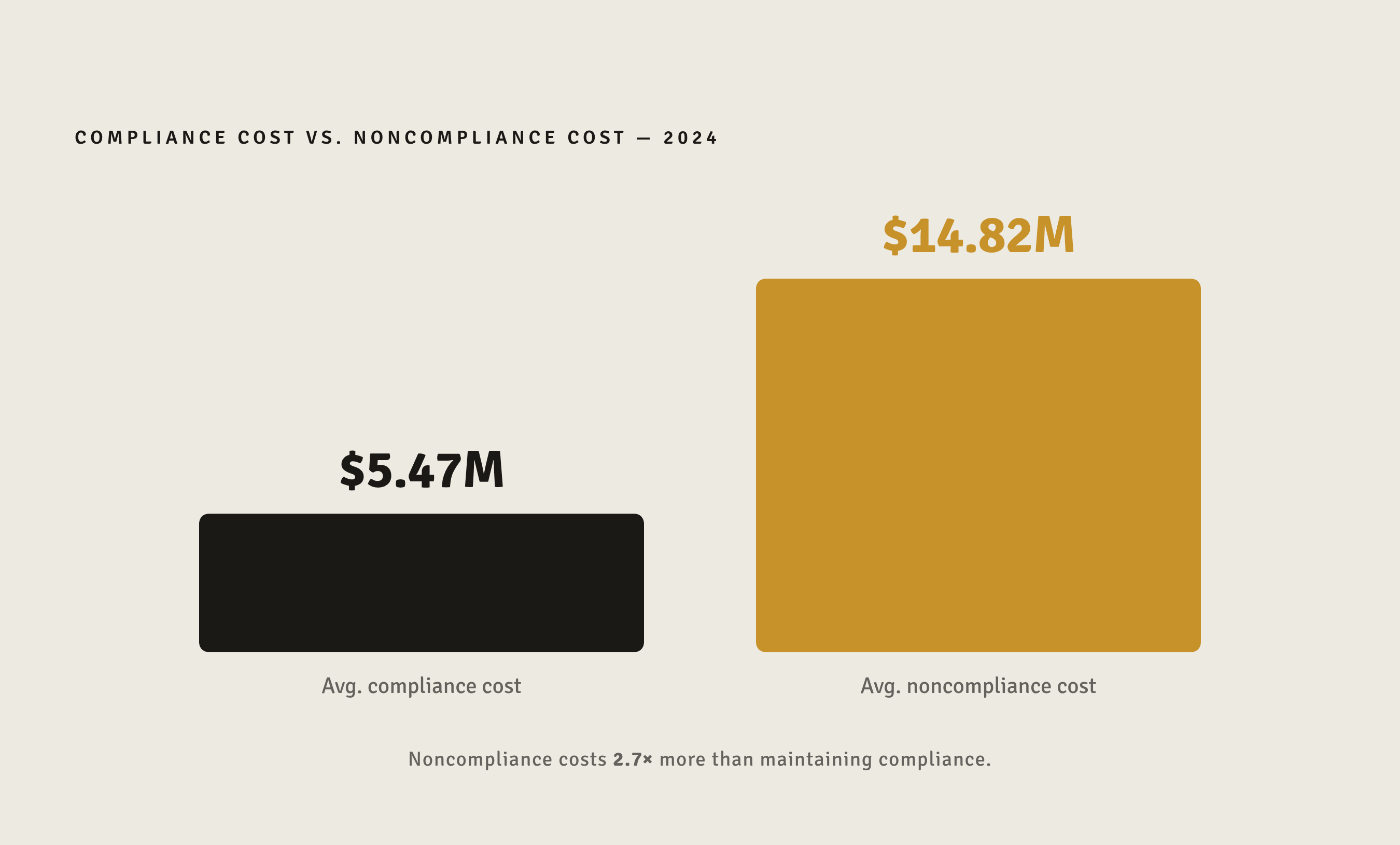
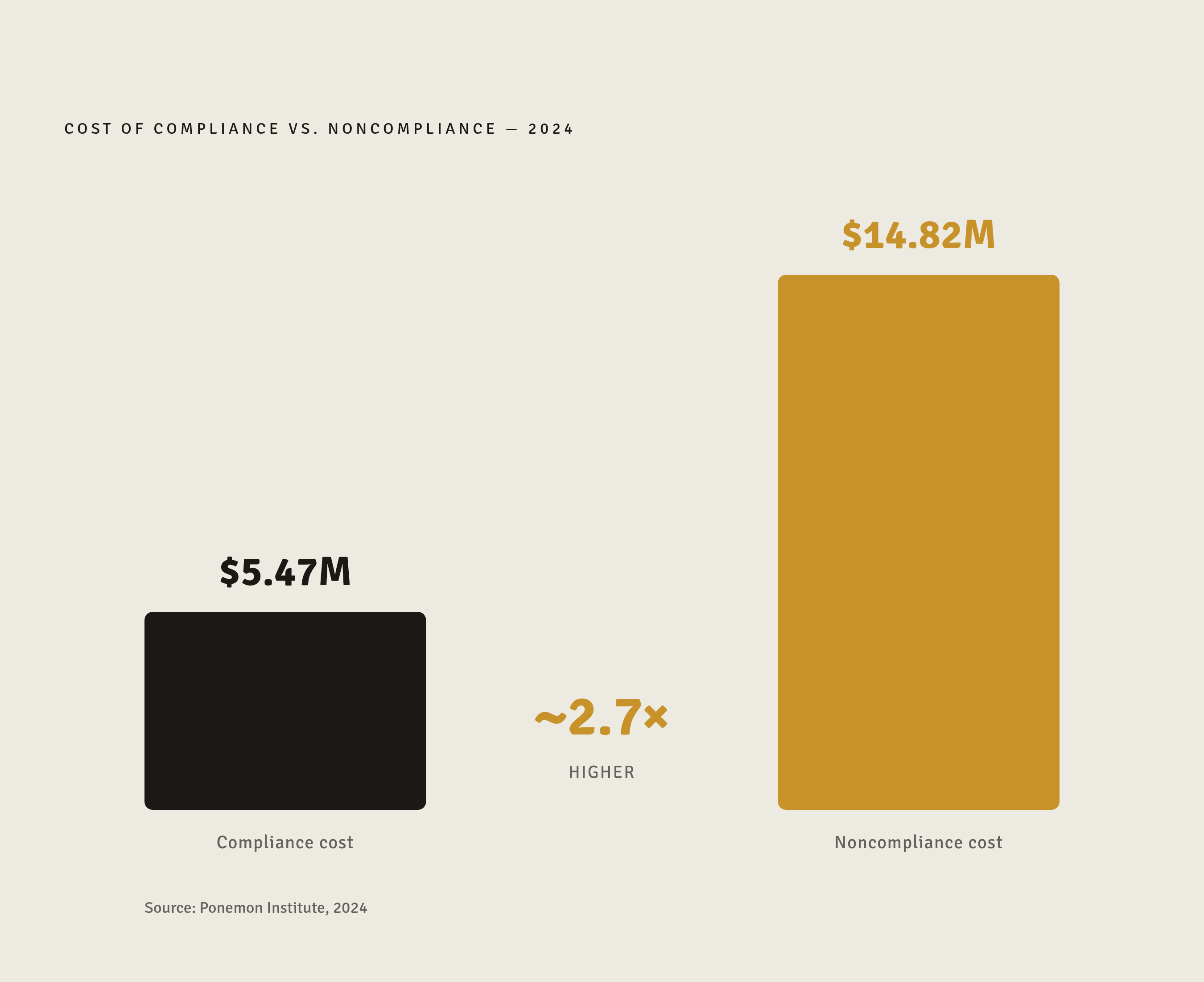
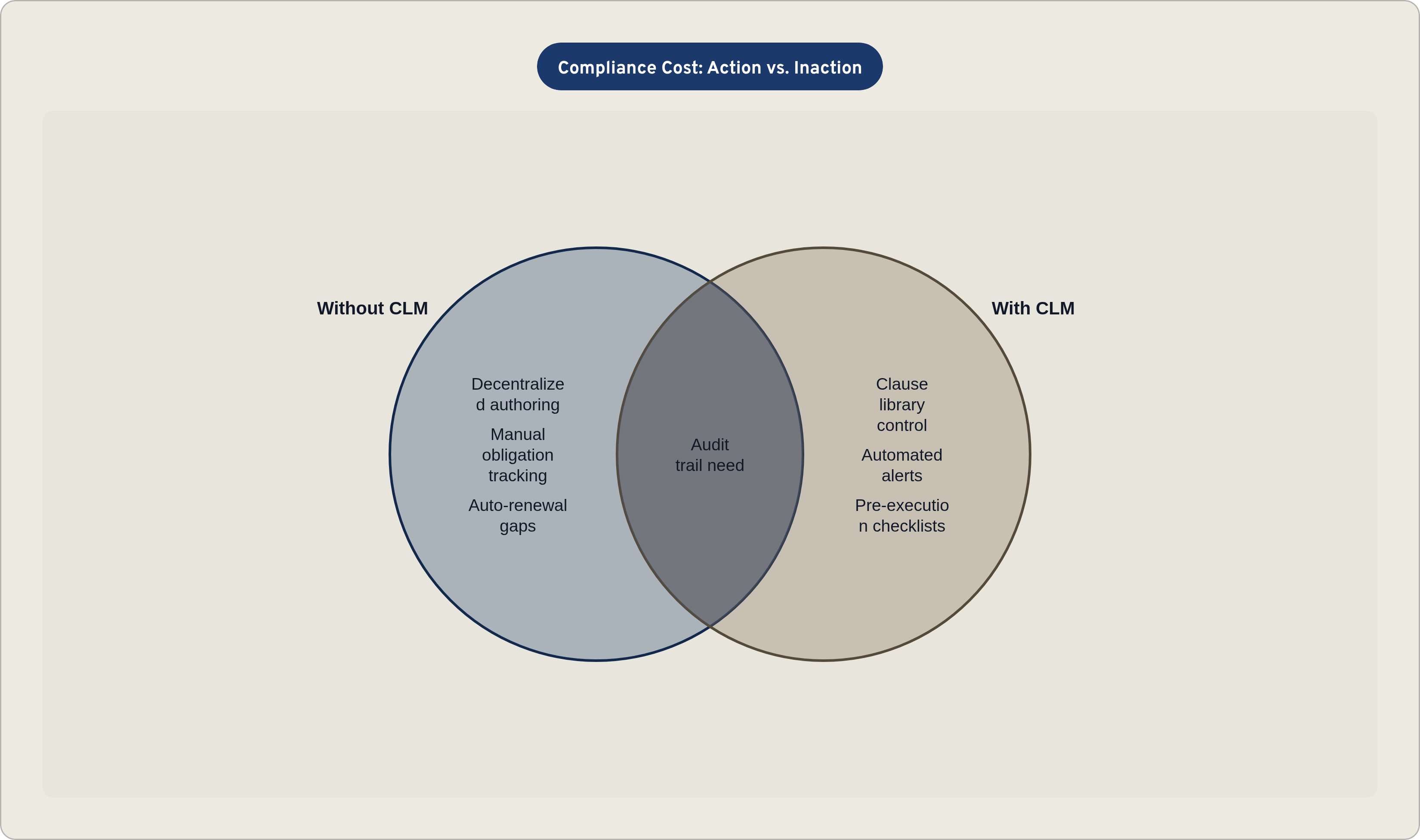
Money focuses the mind, so here's the number that actually matters. Industry analysis found organizations spent an average of $5.47 million maintaining compliance in 2024, while the cost of noncompliance reached $14.82 million, nearly three times as much. That gap isn't subtle, and every system costs money to run; the real question is whether doing this by hand, or not doing it at all, costs quite a bit more, and the math above answers that pretty cleanly.
The value recovery numbers back this up from a few angles. Finextra reported in 2025 that organizations rolling out modern contract management systems saw cost reductions of 30 to 50% in manual processing, along with compliance rate improvements of up to 70%. Icertis has pointed to CLM cutting contract handling times by 50 to 80%, with compliance risk reduction cited as a major driver. ContractSPAN's 2025 figures put it in currency terms: every euro invested in CLM tools recovers between €85 and €170 in value.
And yet, roughly half of in-house legal departments reported actually using a CLM system in 2024. That means a big chunk of the market is still managing contracts without any systematic compliance enforcement at all, absorbing that same 9% average annual value loss, plus a share of exposure to $14 billion in global fines concentrated heavily in GDPR, HIPAA, SOX, and DORA-regulated industries. For anyone weighing the investment, the compliance case and the efficiency case aren't really two separate arguments. A system that enforces compliance at every stage is the same system that clears out the manual review cycles, the approval bottlenecks, and the missed deadlines slowing everything else down.
What to look for in a CLM platform built for compliance
Walking the lifecycle stage by stage surfaces a fairly specific list of what actually matters in a platform, separate from whatever sounds good in a sales deck. Template and clause library management with version control and conditional logic sits at the base of it. Without that, nothing downstream holds up, because authoring is where the exposure starts in the first place.
Beyond that: clause-level permissions and fallback logic that survive contact with an actual negotiation, not just a polished demo. A pre-execution compliance checklist that can actually block a signature, not one that just politely suggests you double-check something. Obligation tracking that puts deadlines on a calendar automatically, instead of relying on someone remembering to open a spreadsheet, and a renewal workflow that treats high-risk contract categories differently from routine ones.
None of this is exotic. It's mostly just the discipline of treating a contract as something still in motion long after the ink's dry, rather than something finished the moment everyone signs and walks away.
Notes
- https://modern-counsel.com/2025/how-to-simplify-global-compliance-with-contract-lifecycle-management-tools/
Provided the figures on Scope 3 emissions as a share of total company emissions and the cost reduction and compliance rate improvement statistics cited from Finextra's 2025 reporting.
- https://swiftwaterco.com/blog/contract-lifecycle-clm/b/contract-lifecycle-management-best-practices-2/
Provided the statistic on JPMorgan Chase cutting contract review time by approximately 80% using AI-powered contract review.
- https://www.icertis.com/learn/what-is-contract-lifecycle-management/
Provided the figures on CLM cutting contract handling times by 50 to 80% with compliance risk reduction as a major driver.