Essay Features
Where Compliance Ends and Legal Liability Begins for SaaS Vendors
Compliance certifications don't shield vendors from negligence claims when breaches occur.
Compliance isn't the same as legal liability, and SaaS vendors still lose fights they figured a SOC 2 report had settled. A vendor can have every certification out there yet still face a negligence claim, since compliance documentation only shows checks were in place. It doesn't show that nothing went wrong, and courts judge damage on its own facts, not by the standards a vendor met beforehand.
That line feels abstract until a breach occurs. Then it takes over the entire case. In 2026, courts increasingly frame large-scale breaches as failures of oversight rather than bad luck with IT, a framing that no audit checklist can capture, since it turns squarely on how the business was led.
The regulatory baseline SaaS vendors must clear before any other liability question arises
GDPR is the starting point here, and meeting it costs more all the time. Fines can reach 4% of company sales worldwide, and regulators in Europe handed down penalties worth €1.6 billion during 2024 alone, a total still rising, not settling. That figure isn't an upper limit being reached. Enforcement keeps intensifying.
Several updates affect SaaS vendors heading into 2026. Regulators have sharpened scrutiny of joint liability under GDPR. A vendor may face liability if its tools contribute to a customer's data mishandling. Regulators have sharpened scrutiny of profiling driven by AI under Articles 21 and 22, demanding real-time tracking of data gathered browser-side alongside backend logs. A vendor whose compliance work only checks backend systems sees just part of the risk.
The US has no national privacy statute yet, and the patchwork keeps expanding state by state. As of the start of 2026, roughly 20 states have consumer privacy statutes in force, and Rhode Island, Kentucky, and Indiana came on board January 1. The CCPA, along with Illinois' BIPA, imposes penalties as fixed amounts, not percentages. These are set per-person amounts, fixed per-person penalties under CCPA, so missing the compliance baseline carries a known cost.
Liability beyond compliance under the updated Product Liability Directive and EU AI Act
The EU AI Act rolled out in stages, and what's currently in force sets which obligations hold at present, apart from the eventual complete framework. Article 5 bans and Article 4's AI literacy duties took effect on 2 February 2025. General Purpose AI models have had Obligations since August 2, 2025, onward. The heavier high-risk obligations under Annex III now start in December 2027 via the Digital Omnibus, while Annex I regulated items wait until August 2028.
In some jurisdictions, a vendor's violations of obligations tied to AI under the Act can trigger liability beyond fines. No compliance certification covers this realm. A SOC 2 report does not address criminal liability.
Then there's the updated Product Liability Directive. From December 2026, AI is explicitly covered, and if a contract says nothing about liability allocation, courts judge the SaaS vendor by PLD maker rules. Any vendor whose MSA omits AI liability allocation may be vulnerable here.
This baseline is closed by the EU Data Act with obligations paperwork cannot satisfy. It mandates customer exit options on two-month notice at most, bans cancellation fees outright once January 12, 2027 passes, and demands data portability delivered in formats readable by machine, as contractual commitments, not audit items. These obligations sit in contracts, not in audit reports. A compliance document can't rewrite a contract's terms. Nothing else works but rewriting the contract.
When judges say SaaS providers are at fault
The Salesforce case points most clearly so far to the direction courts are taking. In the US District Court, Northern District of California, Jacqueline Scott Corley rejected Salesforce's request to dismiss after finding plaintiffs adequately pleaded negligence alongside violations of CCPA, Washington Consumer Protection Act, and Illinois Consumer Fraud Act, arising from the 2025 data breach.
The court allowed multiple state statutory claims to run alongside a common-law negligence theory, all stemming from one breach event. The court let several state statutory theories run beside a common-law negligence theory from a single breach event. One incident can create liability across multiple legal frameworks simultaneously, and satisfying one does not extinguish the rest. A vendor could satisfy every data privacy statute requirement and still lose on a negligence claim tied to the same incident.
Canvas/Instructure proves how quickly this plays out in real life. This case, brought in the Southern District of California's US District Court on 13 May 2026 over leaked identifiable data, is still active. The suit arrived shortly after the disclosure went public, showing how fast plaintiffs are moving now.
SolarWinds is a helpful counterpoint for the securities side. By stipulation, the main SEC case against it ended with prejudice as of November 20, 2025. But there was also an October 2024 enforcement sweep against four vendors, who settled for a total of roughly $7 million. That sweep underscored the focus on public disclosures over internal security measures. This is the red flag regulators are focused on, no matter what the compliance paperwork states.
When SEC cybersecurity disclosure turns vendor breaches into the registrant's own legal problem
Under SEC requirements, a cybersecurity incident must be reported via Form 8-K, Item 1.05, no later than four working days after the registrant concludes it's material. The four-day period begins once the incident is deemed material, not when the breach is first identified, and that difference is significant in real-world cases.
Vendors get caught off guard because this duty applies no matter where the breach originated. When an outside SaaS provider suffers a breach that hits a listed firm's operations, that firm must still evaluate it and possibly report it. A vendor's breach turns into the registrant's own legal problem.
This is no longer just theory. From December 2023 through the start of 2025, companies submitted multiple Form 8-K disclosures linked to cybersecurity breaches. During that period, the SEC settled multiple enforcement cases and collected over $8 million in penalties, then created a new Cyber and Emerging Technologies Unit (CETU) in February 2025 to continue the work.
Under Amended Regulation S-P, most compliance teams have yet to absorb the new vendor-specific notification requirement. Vendors must alert the company promptly after finding a breach, giving that company time to inform its customers. A SOC 2 report won't satisfy that deadline. That wasn't its purpose.
Liability where the shared responsibility model leaves vendor and customer without clear ownership
The shared responsibility model looks good in a presentation. The vendor handles the app and what runs beneath it; the customer looks after its own data and permissions; each side knows its role. In real life, the split between those lanes is not often written clearly enough for a court after a failure.
Yet many people in charge of this line have no idea how it works. During the 12 months before, 75% of teams reported a SaaS security incident, while 53.8% of admins said the Shared Responsibility Model was unfamiliar to them. It's most of those in charge of the customer side who can't say where the boundary sits. A majority of people responsible for handling the customer side can't tell where it ends.
Klue/Salesforce in June 2026 revealed what happens when the risk turns real. A stale credential left in Klue's system let someone take OAuth tokens and copy CRM data from roughly 200 customer accounts. Salesforce put out a single-sentence note disclaiming any vulnerability. Legal responsibility settled with Klue, even though Salesforce was the main platform where the data lived. Compliance certifications failed to stop the incident, and afterward they offered no clarity on liability.
The customer side's sheer size adds to the problem. A Zylo SaaS Management Index report shows companies with 10,000-plus staff hold around 696 apps in their portfolios, with 46% of them rated Poor or Low risk. No customer security group meaningfully exercises its role in the shared responsibility model for 696 applications. The model expects a level of attention the typical enterprise setup can't structurally deliver.
How SaaS contracts lose their liability ceilings in a real breach
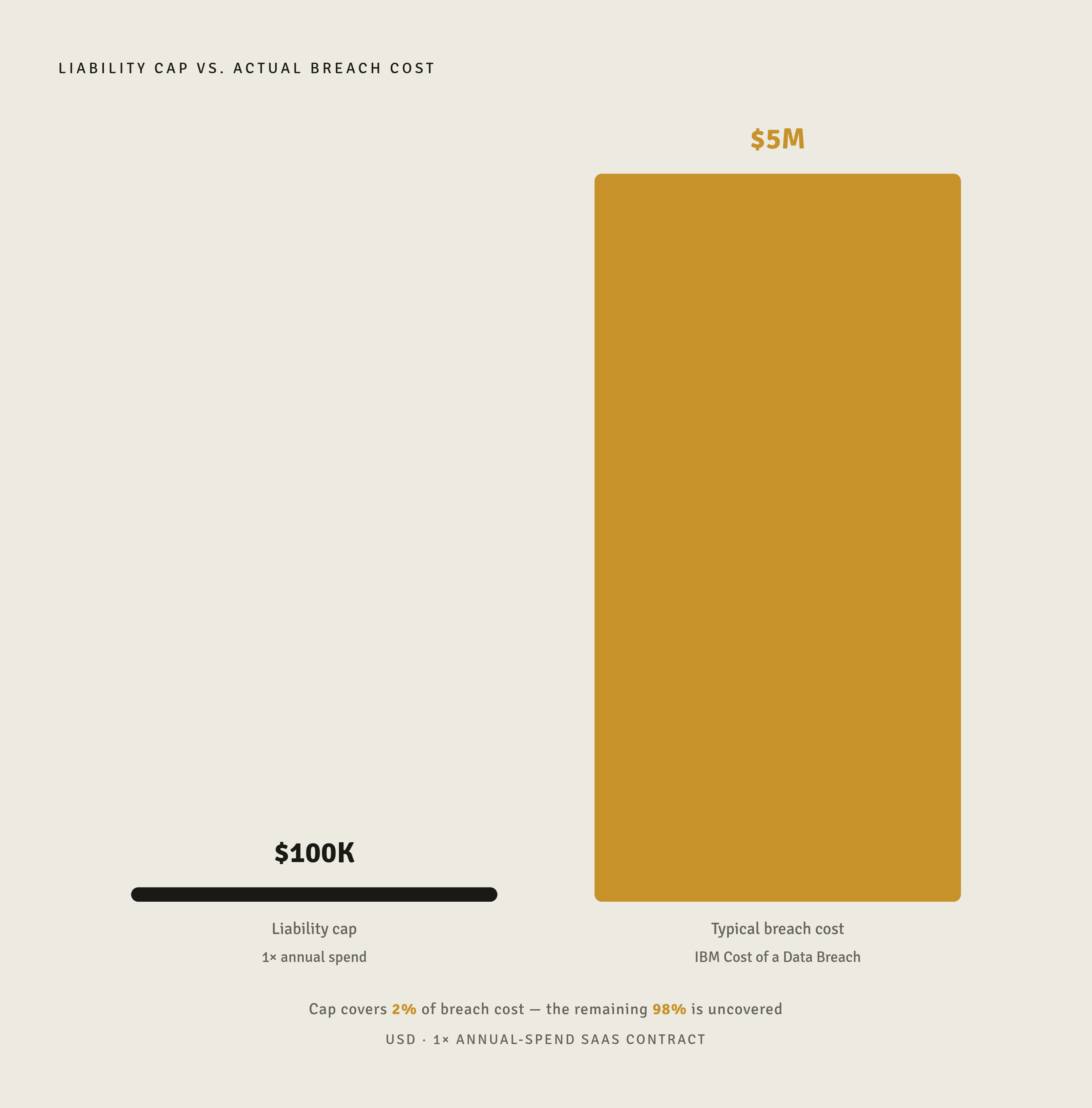
Most SaaS contracts limit liability to 1x the customer's spend in the prior 12 months. This clause gets negotiated so frequently that most contract checks skip right past it.
A cap of 1x fees on a $100,000 SaaS deal falls well short of what a real breach actually costs. IBM's Cost report on Data Breach lists typical worldwide breach cost as many multiples of that $100,000 SaaS deal's value. That $100,000 SaaS contract's 1x cap pays for roughly 2% of it. The remaining, much larger share has to go somewhere, and courts and plaintiffs are more often putting it on the vendor no matter what the contract says about the cap.
Strong contracts already exclude some items from the limit: IP infringement cover, usually with no ceiling, plus secrecy and privacy violations, fraud, serious carelessness, intentional wrongdoing, and amounts owed. Those carve-outs are there because the general cap wasn't supposed to apply to them.
That leaves a drafting problem with no easy fix. Tight carve-outs leave vendors wide open to the data breaches that surface in litigation. Carve-outs that are too loose can wipe out the liability limit, leaving open-ended risk under a figure both parties assumed was settled. Mistakes on either side cost plenty, just in their own ways and at their own pace.
AI-specific contract language enterprise legal teams insist on, and the liability issues they reopen
SaaS contracts have always seen the most back-and-forth over indemnity and Limitation of liability. AI data use and output terms have joined that group, and it’s clear why: AI capabilities are increasingly baked into vendor templates, and the approval and control issues they create aren’t fine details people can gloss over.
In 2026, enterprise legal teams want provisions that most vendor templates still lack. They ask for model disclosure: which model or models run a particular feature. They need defined output rights, settling who controls material an AI tool generates. They want an explicit prohibition on using customer data to train foundational models, not a vague reference to "improving the service." And they want accuracy disclaimers stating what the vendor will and won't warrant about output quality. A template written before most of these capabilities came along covers not one of them, and leaving a contract point blank never signals the exposure has gone away. Nobody's figured out who's on the hook for it.
Even beyond AI, the FTC's Click-to-Cancel push shows how unsettled this field remains. On July 8, 2025, the Eighth Circuit vacated it for procedural reasons, but the FTC isn't finished. It submitted a draft Advance Notice of Proposed Rulemaking to OMB in January 2026 and issued the ANPRM in March 2026, working to revive negative-option regulation through a different procedural path. Regulators are still watching SaaS contracts that renew automatically, no matter what happens with this one mandate.
Texas makes clear how these contract gaps form. The Texas Data Privacy, Security Act covers any company operating in the state that handles data and isn't classified as small under SBA rules, with no income cutoff triggering it. So a startup selling SaaS that hasn't negotiated data terms with any customer might already count as a non-compliant processor in Texas, no matter what its SOC 2 report claims. Compliance and liability drift further with each contract until a breach or regulator makes it impossible to ignore.
Notes
- GDPR Compliance for SaaS: 2026 Action Plan | Feroot Security
Provided the €1.6 billion GDPR penalty figure for 2024.
- Best SaaS Compliance Software for 2026 | Zylo
Provided the statistic that 46% of apps in large enterprise portfolios are rated Poor or Low risk.
- SaaS Compliance in 2026: The No-Nonsense Guide for Founders
Provided the GDPR fine ceiling of 4% of global company sales.
- https://matthewbertram.com/blog/eu-ai-act-what-us-businesses-need-to-know
Provided details on EU AI Act Article 5 prohibitions taking effect February 2, 2025.
- https://toslawyer.com/eu-ai-act-compliance-for-us-saas-companies-what-your-terms-need-by-august-2026/
Provided information on high-risk AI obligations under Annex III and their timeline.
- https://news.bloomberglaw.com/litigation/salesforce-fails-to-dismiss-suit-over-massive-2025-data-breach
Provided details on the court's denial of Salesforce's motion to dismiss following the 2025 data breach.
- https://www.vaquill.ai/blog/sec-cyber-disclosure-enforcement-update
Provided the $7 million total settlement figure from the October 2024 SEC enforcement sweep against four vendors.