
Essay Features
Compliance Monitoring Examples Outside Regulated Industries
Compliance monitoring works in any business that sets rules and checks whether staff follows them.
Compliance monitoring doesn't just apply to medical centers, law offices, or financial institutions. Any company that makes a rule and later checks whether staff followed it has its own compliance program, whether the team gives it that name.
Stripping out auditors and jargon leaves a plain setup: one person sets how a thing ought to be done, and another checks whether it happened that way. A clear rule to follow. A way to detect. The response loop kicks in when those two differ. That same pattern shows up in chain stores, seller deals, HR rules, ad work, and today, as brand answers from AI systems to users seeking suggestions. The framing's weak point is typically piece three, the response loop. The response loop is that third part. Lots of companies spot what's wrong but don't develop the ability to actually fix it.
Brand standard enforcement in retail and franchise businesses
Each franchise group has its own compliance program, whether that’s the name or not. Audits, merchandising checks, checks of planograms: each enforces a brand's guides plus its signage standards against one defined expectation, matching what a regulated manufacturer goes through in a formal compliance visit. The regulator varies. That mechanism doesn't.
Detection happens in several common ways. Shoppers rotate among stores at set times. Site leads snap shelf pictures, then upload each one for review. Area leads move through the store carrying a marked checklist. Certain chains use image-recognition tools that compare an uploaded picture with the approved planogram, flagging any display out of spec with nobody there in person.
All of it falls apart absent that third piece. A site that misses its audit must have corrective steps due by a set date, escalation when it misses again, and, at worst, the franchise contract that's on the line if the behavior doesn't shift. Many brand compliance efforts collect tons of audit data, then do nothing. A completed checklist, a stored image, and no action follows. That's only a detection mechanism without any response loop; it's how these efforts most often quietly fail.
Vendor and supplier conduct monitoring in non-regulated supply chains
Farming out work doesn't farm out fallout. How a seller treats workers, how a partner handles food risks, where a factory gets components: it's outside the company, but the company still takes the hit if it fails.
Clothing and household-product brands check their makers on how workers are treated and how much work gets handed off, since the big chain-store customers at the other side of the deal insist, even where most governments have no official inspector. Drink and consumer goods producers under the legal limit still audit their contract manufacturers to confirm recipes match and packaging is right. Tech equipment companies check outside makers by approved parts records plus counterfeit-parts rules. Service agreements today typically carry deliverable-quality checks along with attestations for data handling that no statute demands.
Finding problems means once-a-year outside inspections, forms the vendors fill out themselves, live info streams from shipping software, and report cards checked every three months. The agreement holds that response loop: strict remediation deadlines with real consequences, plus one escalation clause which triggers a fresh search for other sourcing if it lapses, and maybe a published supplier transparency document applying external heat to everything. Absent a state watchdog, each retailer polices itself, so that's the reason rigor varies that wildly between firms. No one watches the auditor.
Workplace behavior monitoring beyond what employment law requires
Most workplace rules stretch far beyond what the law requires. Laws don't require tracking personal ties, spending limits, or remote-office days, yet companies still watch them all.
The methods involved go beyond what most folks expect. Ethics hotlines aren't only for gathering tips; someone has to keep an eye on them too, tracking whether people actually call in and whether cases get closed within a set time. Certification cycles make supervisors attest annually that their staff completed mandatory coursework and disclosed whatever called for disclosing. Cost checks test reports, at times with software, calling out odd cases against rule limits for staff inspection. Businesses who bristle over the term monitoring are quietly picking up this practice, using schedule analytics and entry data to see who follows the hybrid-work policy.
The way this goes wrong is typical. An ethics hotline which collects complaints but tracks none of them through to the end is no compliance program: it's just data collection wearing a policy-shaped tag. That's what separates monitoring from surveillance: one operates inside of a defined rule with a written response plan, while the other amounts to mere data collection lacking it. What keeps them apart is the system around them, not the device.
Content and creative compliance in marketing and media operations
Marketing work faces constraint unrelated to law: tone standards for a brand, legal review of any comparative statement, channel-specific layout limits, plus briefs meant to specify each deliverable. For a firm handling several customers, that complexity multiplies quickly, since each brand sets its own rules and the team must monitor them all simultaneously.
The first defense is a set review process: specific people must okay every piece before release. After launch, reviews test published material against today’s rules, most useful just after a brand or message change, when lots of public pieces become old without being edited. Software looks for words like "best" or "better than" and routes them to attorneys pre-launch. Versioning and archival systems keep the evidence trail: which version got approved, by whom, and when.
If it breaks the rules, it gets taken down. When that same issue is recurring, its fix often sits in the setup: the instructions get changed, or approval steps are rebuilt since a gap lived in the workflow. The burden falls most heavily on agencies, since monitoring runs in parallel for clients with other standards and other approval chains. Without one platform tying everything in, the monitoring collapses onto a single manager's recall, and recall isn't a process.
That set of rules has another point, and it's a thing many brands barely know to check yet: whether AI platforms show them accurately.
Each franchise group has its own compliance program, whether that’s the name or not.
AI brand representation as an emerging compliance surface
A user prompts Perplexity or ChatGPT for a vendor suggestion. The model puts out an answer, and what comes back might or might not line up with the brand's stated positioning, what sets it apart, or its approved messaging. The brand can't catch that answer being generated through any built-in method. That gap in compliance is something nobody has handled before.
The bar under review is nothing new: the brand's story, its promises, how it's placed within the category, and the approved messaging. This auditor is the unfamiliar part. It's a large language model synthesizing an answer from sources the brand doesn't control and, in most cases, doesn't even know it's being pulled from. It's a large language model producing a reply drawn from material the brand doesn't control and, in most cases, doesn't even know is being pulled into it.
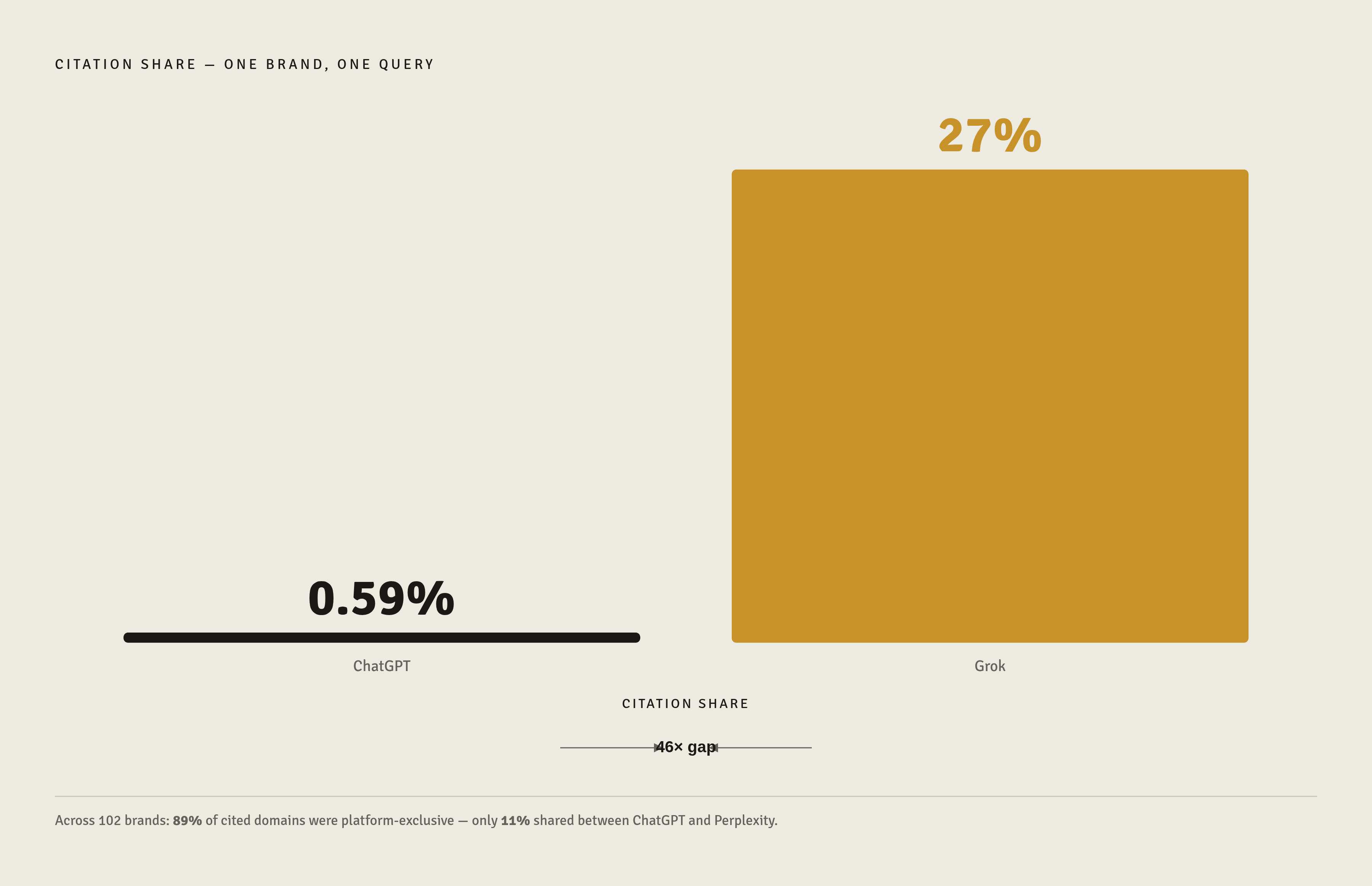
The various AI platforms give different answers. A study of a 102-brand cohort showed that AI platforms varied widely in citations: only 11% of domains were shared by ChatGPT and Perplexity, so 89% were platform-exclusive. Asking nearly identical questions, a single brand gets 0.59% citation share from ChatGPT but 27% from Grok. Elsewhere in compliance, a gap that wide from two audit tools checking one identical query would be flagged right away as a failed control. Here, it's only Tuesday.
AI visibility platforms handle Detection by running regular query checks across several engines, measuring citation rate alongside mention frequency, brand presence share, plus sentiment shift: these are the key metrics behind GEO (generative search optimization). In the response loop, this area departs most: a brand isn't able to take down a weak AI answer like it takes down non-compliant ads from its outlet. Instead, it must act upstream by putting out citation-worthy material, getting mentions from places those models rely on, and keeping structured data fully legible for every engine's retrieval system. Gartner says B2B brands could get over half of their search visits taken by AI before 2028 when not seen in AI-generated results, while G2's Answer Economy 2026 report said 51% among B2B software customers begin checks with an AI tool over Google, after April 2025's 29%. That's a buyer-behavior category shifting in under two years. That's a shift in buyer behavior happening within two years.
How AI brand visibility monitoring tools run
A real AI visibility program starts with prompts: putting queries to engines using the exact things buyers type. On its Growth plan, the company watches more than 600 prompts run across ChatGPT, Google AI Overviews, Google AI Mode, Gemini, and Perplexity along with Microsoft Copilot.
Citation checking follows, and it counts since without knowing which exact source the model pulled from, word that a brand came up tells a reader little. That's the evidence-trail role done by post-publication audit work, only for AI rather than any reviewer. Sentiment matters too. HubSpot's tool for grading AI search gives sentiment a value of 40 from the total 100 points, the biggest piece, since any brand might be described accurately yet still seem awful. Right but a bad look still breaks compliance. Add how the brand's AI compares across rival mentions in the same prompt group to complete the analysis.
A few platforms staked claims in different areas. It now connects with 7 or more LLMs including ChatGPT, Gemini, and Perplexity, adding writing tools and research help using AI; Gauge customers typically see 3x–5x visibility uplift in the first month when implementing. Big companies rely on Profound, which features Conversation Explorer to help with estimating LLM search numbers, and the team prefers AEO over GEO internally. Enterprise AIO checks brand references, tone, and how often brands appear on major AI platforms, while Brand Performance tracks whether sentiment is positive, neutral, or negative. Bluefish offers the strongest tool out there for catching when AI gets a brand mixed up, something the rest will probably need to match soon.
Cadence sets how fast a company can spot and fix what these AI engines claim about it, as the references cited shift every few weeks. Studies of AI behavior show cited material changes within one cycle at 40% to 60%. Every quarterly review misses the bulk of real events. Frequent or ongoing monitoring better reflects how things are actually done. No platform, though, can guarantee a citation. Because models won't expose how source-selection works, a vendor guaranteeing inclusion is misdescribing that mechanism, or quietly redefining goals later to fit outcomes.
When AI errs or omits information, the response loop begins.
Two different fixes address two failure modes. The brand fails to show up in conversations where it belongs, a missing-mention problem. Misrepresentation is when a brand appears but gets cast as false, stale, even unfavorably: a hallucination and sentiment gap. A dashboard shows them as the same. They're different issues.
Fixing any gap requires going upstream, because no tool edits the model's answer on the spot. The opening move is placing well-organized, reliable material where a brand's presence is weak or missing; per Princeton, work using solid numbers and references reaches 30% to 40% higher AI presence versus work without them. Marketers don't realize how much Earned media matters. Muck Rack's Generative Pulse 2025 report looked at over one million references from ChatGPT, plus Gemini alongside Claude, showing that the share hitting 82% for what AI cites comes from news stories, third-party blogs as well as Earned media, with news outlets making up about one fourth of every citation. Schema markup and Structured data count too, as different engines handle them in various ways. Teams need Per-platform monitoring results before picking where to focus. Once a formality, they've gained genuine pull: citations tied to them run as high as 6% in Muck Rack's data, and those references grew fivefold from July to December 2025, which puts them among a handful of levers that act quickly when a correction is time-sensitive.
It isn't finished until that monitoring platform which spotted the gap shows whether this fix changed things, remeasured every few weeks instead of quarterly. For firms applying this across all brands, every account must spell out who triggers new pieces and who confirms each fix went live. Without it, the dashboard turns into a screen people skim without doing anything about it.
The common thread across all these monitoring domains
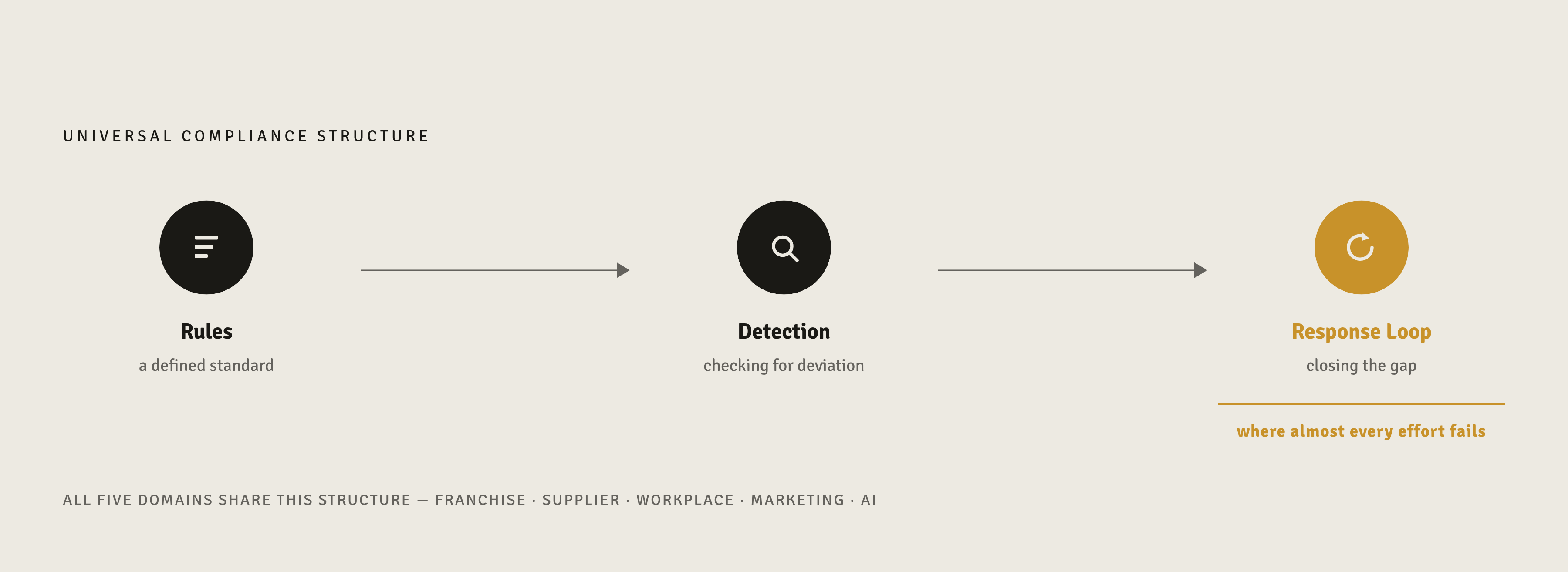
Everything here, whether checking franchise planogram audit results or some hallucinated issue found through Perplexity, follows one three-part setup: rules, checks for deviation, plus the loop meant to closes that gap. Without every piece, the other two are just for show. Without detection, a rule is just a policy nobody's checking. Finding things without a response loop means plain data collection using compliance language, generating files that list issues but never solve one.
That's why AI brand visibility belongs under compliance, not some marketing curiosity. Each brand already sets rules for how its positioning and promises should show up. A detection mechanism had been absent, since until AI visibility platforms existed, nobody could tell what buyers were hearing from Grok or ChatGPT. With detection available, putting a response loop together is the sole remaining piece, and that's the exact piece that's proven difficult across retail audits plus supplier contracts alongside ethics hotlines. The instruments themselves are recent. The rigor they require isn't.
Notes
- Top 10 Generative Engine Optimization (GEO) Platforms for AI Visibility | Gauge
Provided platform-specific details including the 600-prompt monitoring figure, the 3x–5x visibility uplift claim, and the 40%–60% citation turnover statistic.
- Generative Engine Optimization: The Complete 2026 Guide | Similarweb
Supplied the Princeton-sourced statistic that content with solid numbers and references achieves 30%–40% higher AI presence.
- Generative Engine Optimization at Scale: Measuring Brand Visibility Across AI Search Engines
Provided the 102-brand cohort study showing only 11% of domains shared between ChatGPT and Perplexity and the 0.59% vs. 27% citation-share disparity.
- Franchisee Monitoring: How to Track Compliance & Standards
Provided context on image-recognition tools used by chains to compare shelf photos against approved planograms.
- https://www.suppliershield.com/post/the-ultimate-guide-to-supplier-compliance-management-mastering-tprm-in-2025
Informed the description of supplier compliance methods including annual outside inspections and vendor self-assessments.
- https://pdtn.org/employee-monitoring-compliance/
Informed the discussion of ethics hotlines as a monitored compliance mechanism, including tracking call rates and case closure times.
- https://www.sedric.ai/blog/brand-marketing-compliance
Supported the section on content and creative compliance, specifically the practice of requiring specific approvers for every piece before release.