
Essay Features
Why Your Account Managers Can't Sell AI Visibility Without Training
Account managers need to master AI visibility terminology to close client pitches.
Account managers walk into pitch rooms to explain work that most can't define when pressed. The ideas are fresh, the vocabulary changes from one vendor to the next, and objections clients bring up call for a fluency no broad excitement about AI can replace. This is a skills gap, and agencies are losing pitches the moment a client asks one more follow-up.
GEO and AEO explained, with the terminology as a client obstacle
Most pitch conversations lump these disciplines into one, but separating them has to come first. SEO optimizes online listings for clicks and ranked position. AEO, short for Answer Engine Optimization, gets content into snippets plus AI Overviews, mostly with zero click-through. GEO, or Generative Engine Optimization, works another way entirely: it shapes the words Perplexity, ChatGPT, and Claude use about a company when crafting an answer, leaning on ecosystem presence and reputation rather than any ranked position.
A shorthand for a client: SEO brings people in, AEO pulls the answer out, GEO points to the company. Easy to put into words. But the field hasn't agreed on these boundaries yet, and an AM can't hide it. By the start of 2026, research had no agreed line among GEO, AEO, AIO, LLMO, and AI SEO, and companies, experts, and industry sites treated the labels as the same. An AM heading into a pitch walks into a vocabulary debate the category hasn't settled, and acting like it has only speeds up the eventual unraveling.
In 2025, Forrester's Nikhil Lai took a skeptical stance, claiming niche tools popularizing these phrases exaggerate what separates SEO from AEO to carve startup-sized gaps in the tech stacks marketers use. He's right, so a CMO familiar with that argument will raise this objection with an AM. An AM without an answer folds. An AM who has an answer says GEO and AEO overlap around 80 percent, and the other 20 percent comes down to framing, which decides what's counted and which content comes next.
GEO was first cited in 2024 by Princeton, Georgia Tech, IIT Delhi, plus the Allen Institute for AI, then joined marketing vocabulary in 2025. Writer's business breakdown says the job is about 80 percent strategy and just 20 percent mechanics. Most teams pull the wrong 20 percent first, because the technical work feels tangible and billable in a way that "build ecosystem authority" never will on an invoice. An untrained AM leads a client right into this trap.
An AM has no base for sales if they can't hold these definitions while facing the skeptical CMO's pushback. Everything built on top falls apart if this piece gives way, and excitement alone won't hold it up.
The single fact that makes AI visibility genuinely new territory for clients, and hardest to explain
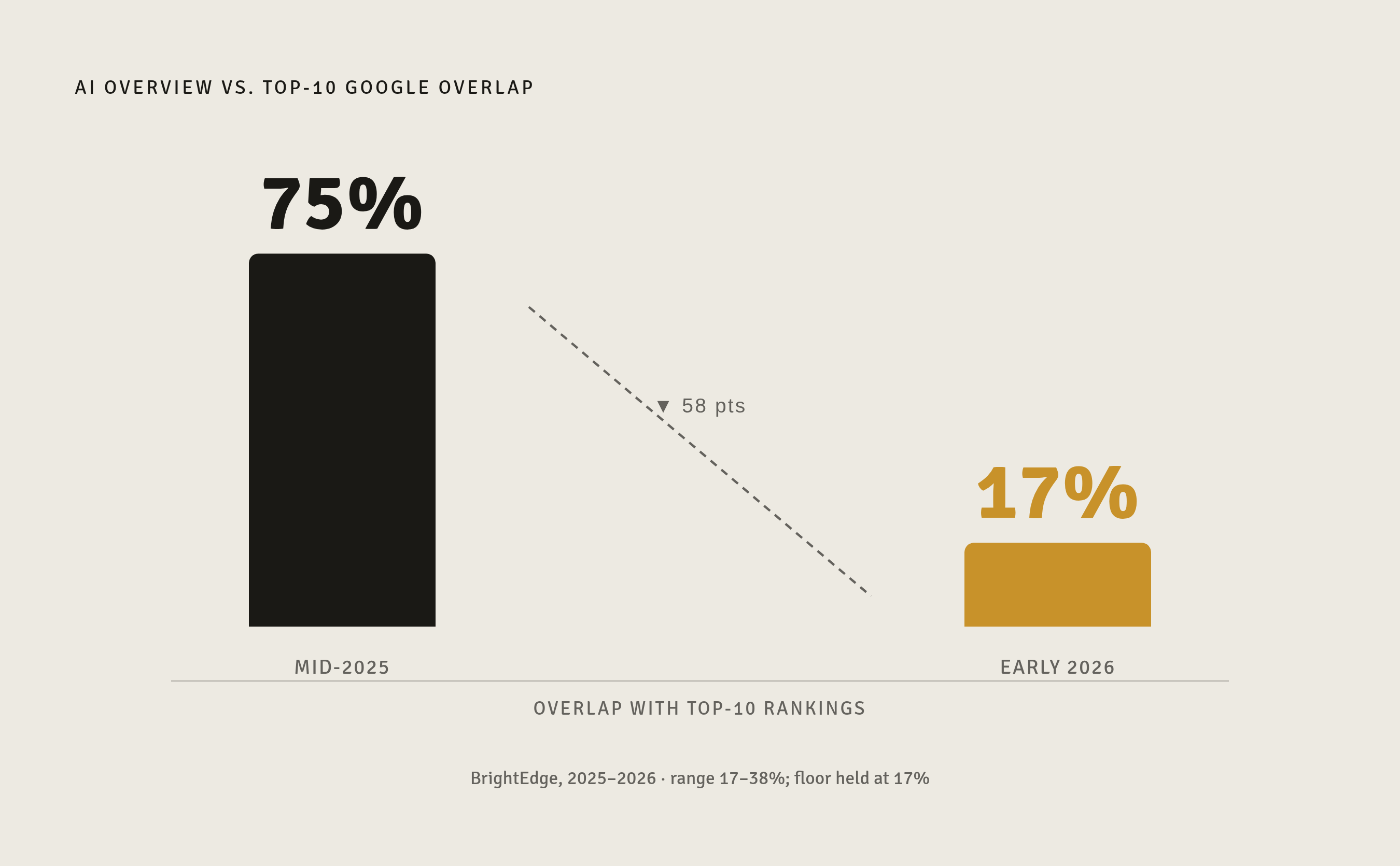
For roughly ten years, sitting atop Google was a dependable stand-in when it came to visibility. That link has fallen away, and how fast it happened is what turns this talk into a struggle with a client whose gut reactions were shaped by what used to work.
In mid-2025, 75 percent of AI Overview citations matched top-10 Google rankings, but by the first part of 2026 the overlap was down to 17 to 38 percent. BrightEdge says AI Overview citations come from pages in the organic 10 just 17 percent of the time, a share that's stayed put for months. A client holding position one or two can still be functionally missing from the tools their own customers rely on, and most rankings-based pitches don't account for that gap.
This goes beyond a technical quirk. Research shows that roughly 85 percent of the times companies show up in AI answers, the source is an outside site rather than the company's own. About 48 percent of citations in big AI tools come from public sites such as Reddit and YouTube. The pivot an AM must explain is this: the client is rewarded for what the wider internet says, not for owning its own category hub. Rank is decided by what other websites publish about it, across listicles, rating platforms, threads, and docs outside the company's reach.
The same objection comes up in the same way each case: "our rankings are fine." Because the rankings do look fine, an untrained AM says yes, or fumbles an answer that falls flat. A trained AM walks through the decoupling figures and explains why AI citations and rankings track separate things.
That argument holds up too. Even in tiny amounts, AI-referred visits behave unlike the rest: people coming from ChatGPT stay 15 minutes instead of 8 from Google, view 12 pageviews rather than 9, and hit 7 percent conversion against 5. Brands cited in an AI Overview get organic clicks up roughly 35 percent and ad clicks up 91 percent versus the result in position one below it. Citation standing flows into areas beyond AI search itself, which makes a skeptical client pay attention.
The size of the AI skills gap in the workforce, and its meaning for account groups
Agencies aren't alone in this, and claiming otherwise would flatter the issue. DataCamp's 2026 State of AI Literacy Report found 82 percent of enterprise bosses offer some kind of AI teaching, yet 59 percent report an AI skills gap that persists. Courses are available. Fluency isn't a given, as EY's survey shows: 88 percent of firms run AI on the job, yet just 28 percent have workers putting it into everyday tasks. According to IDC, over 90 percent of companies worldwide are expected to deal with serious AI skills shortages, and cumulative costs tied to ongoing gaps could reach $5.5 trillion in total.
The gap sharpens when you look harder. A Section report found under 10 percent of employees can even define what an AI agent is, a conceptual gap nearly identical to what AMs encounter when pressed to describe AEO or GEO without warning.
Agencies feel the hit right away. According to Fuel Online, 62 percent of big enterprise brands go unseen by generative AI, even though 86 percent of SEO professionals have folded AI tools into their daily workflow. Those statistics together reveal a harsh reality: agencies use AI to generate more content at greater speed, yet their clients stay uncited where potential customers look for information. A survey of 100+ digital marketing professionals in 20-plus countries caught the same loop running again: people get that search has moved on, but acting on it and tracking results still comes after the awareness.
The failure persists: staff take courses but still can't use what they learned on the job. Basic AI literacy won't show an AM how to walk a CMO through citation share, period. Fewer than one in five agencies know how to pitch AI visibility as a retainer category. The gap comes down to vocabulary, objection handling, and knowing what to measure, and a general AI course wasn't designed to cover any of them.
What an untrained AM does when they pitch AI visibility
These conversations keep hitting the same failure points. The opening pattern: an account manager kicks off with terms like GEO, AEO, or share of model, but can't give a definition when the client follows up. That's where the conversation stalls, and it almost never recovers before everyone leaves the room.
The next failure is quieter and costs more. The AM defaults to what's familiar, framing the pitch around rankings ("we'll improve your position") for a problem rankings no longer solve. The client signs on, since it makes sense, buys the wrong fit, finds no change in AI citation, then churns. No one acted in bad faith here. The AM pushed the service they knew, not the one the client had to have, arguably a bigger mistake than staying quiet.
The next failure shows up in reporting. When an AM can't parse the citation-share report, that document turns into a risk rather than a retention asset, since the firm has no way to show what work it really does.
Clients often raise two objections come; each is winnable if handled well, but most AMs don't get that help. "Our organic rankings are strong, why would we pay for something else?" needs the ranking-citation decoupling argument, delivered with numbers, not a shrug. "AI traffic is less than 1 percent of our referrals, why does this matter?" needs the quality-over-volume argument, delivered with numbers. Wynter's 2026 research found B2B CMOs, at 84 percent, already turn to AI and LLMs to find a vendor, so that objection is winnable: procurement on the client's side mirrors its buyers.
There's real money on the line. AI work can cost from about $3,000 through more than $15,000 monthly, so a delayed or missed sale here means real money. Search interest in "geo agency" has grown sharply year over year, meaning clients are actively hunting for this exact service, and an agency whose AMs can't hold the conversation is simply routing those clients to a competitor who can. McKinsey work cited inside Writer.com's guide found just 16 percent of brands now measure their AI results in an organized way. This opportunity is live, but any AM who can't navigate that conversation will watch it vanish without trying.
What it takes to fix the enablement gap, and where generic AI falls short
Generic AI learning hits the same barrier wherever it's attempted. EY's survey, via USAII, found that Most companies treat AI as a priority, but only about half of employees ever get trained on it, and even the trained half struggles to apply what they learned to real decisions. Add Gartner's projection: AI will be built into 40 percent of enterprise software by 2026, rising from below 5 percent in 2025, and what an AM must grasp is changing too quickly for most upskilling. Generic programs weren't made for something that changes this fast.
AMs require domain-specific skills, and these fall into separate, learnable parts. Fluency means defining GEO, AEO, share, and citation share, plus RAG, without hedging or grabbing a presentation. Objection handling means a prepared, tested response to "rankings look fine," to "AI traffic is tiny," and to "isn't this just SEO with a new name?" Audit literacy means running, or at least interpreting, a basic AI visibility audit and translating the findings into language a client's marketing director will use in a board meeting. Reporting literacy means making sense of citation-share data, tying those numbers to what the client actually wants, instead of rolling out a dashboard like novelty alone matters. Pricing fluency means shaping a retainer conversation around a rationale that holds up to a CFO's scrutiny.
An audit-first approach outperforms any argument, and by a wide margin. Pose the question to a client: what does ChatGPT say about your company? Then pull it up right there. When a competitor appears as part of the answer and the company is missing, it helps win work more than a pitch ever could. The conversation shifts from "why should I care" to "how fast can we start," almost without the AM having to push it there.
It all falls apart unless the third-party piece is made plain. Roughly 85 percent of AI citations hit sites a brand doesn't own, so what's on offer covers press coverage, community engagement, and reputation management. And it can't be one-time onboarding module, however tidy the timing would feel. GEO and AEO shift so rapidly that a refresh cadence has to be part of the instruction.
Executives often have greater availability of AI tooling and more instruction in AI agents than the staff who must work with them daily. Agencies could create that same gap internally: managers fluent in the category while AMs must improvise client conversation without real footing. The problem lies with the system, not the people, and it should be handled accordingly.
How enablement turns into a built-in edge for the firm, not just staff lessons
If AMs can credibly explain AI visibility, their shop stands out as the leader in a category the rest of the industry hasn't figured out yet. That positioning compounds beyond any won deal, because every later pitch falls into place once the opening one lands.
The content is already written for different readers, even if agencies haven't kept up. Research shows that 1 in 4 marketing professionals treat LLM as the main reader for most of their output. Agencies that walk clients through the change keep an edge a generalist content team can't copy, since the edge runs on know-how the generalist has never picked up and probably never will.
Reporting is what holds a client, not what lands one. An initial audit grows into a retainer once the AM reshapes citation-share figures into something a client's bosses can run with, and that reshaping works only when the AM grasps the data closely enough to walk through it without notes. Agencies handling several brands face extra work: every client's citation data needs judging by its category, not shown as a bare figure that means nothing without framing.
Some firms make this enablement a core part of what they sell, not an afterthought bolted onto onboarding. A set routine shows reps and account managers how to handle these conversations with confidence, turning them into a source clients trust rather than a reseller repeating a vendor's script. A firm can use centralized invoicing, or choose per-client billing with granular settings plus per-client data reports, to show worth for each account. This is the proof an AM needs to keep a client account and build on it, not just hope the customer sees the benefit on their own.
Brands that gain AI citation strength today take that edge with them as AI use grows, and the same is true for their agencies. Agencies that get their account managers up to speed now will own the conversation in this category while others are still wrestling with how to pin GEO down in a pitch, and by that point it won't make a difference.
Notes
- Generative engine optimization - Wikipedia
Provided context on GEO's academic origins, cited in the article as first appearing in 2024 from Princeton, Georgia Tech, IIT Delhi, and the Allen Institute for AI.
- Generative Engine Optimization (GEO) in 2026: Playbook
Supplied the figure that GEO and AEO overlap around 80 percent, cited directly in the pitch-objection section.
- https://www.workera.ai/guides-reports/the-5-5-trillion-skills-gap-what-idcs-new-report-reveals-about-ai-workforce-readiness
Provided IDC's projection that over 90 percent of companies will face serious AI skills shortages and that cumulative costs could reach $5.5 trillion.
- https://www.usaii.org/ai-insights/the-2026-ai-skills-gap-turning-training-into-workforce-power
Supplied EY survey figures showing 88 percent of firms run AI on the job but only 28 percent have workers applying it to everyday tasks.
- https://indexly.ai/blog/how-to-ai-search-visibility-for-marketing-agencies-aeo-as-a-service-2026-step-by-step-guide-2026/
Provided the Wynter 2026 research finding that 84 percent of B2B CMOs already turn to AI and LLMs to find a vendor.