
Long read Features
When an AI Vendor's Model Becomes Your Compliance Problem
Organizations absorb all compliance risk from third-party AI systems they deploy.
When an AI Vendor's Model Becomes Your Compliance Problem.
Why deployers, not vendors, own the compliance exposure
Enterprises don't build AI systems anymore so much as assemble them. A language model comes from one vendor, a scoring model that feeds a lending decision comes from another, a computer vision tool that screens job applicants comes from a third, and none of these were built or trained under conditions the deploying organization ever reviewed. That much has been true for years and nobody thought much of it. What's changed is that when one of these models produces a discriminatory outcome, a biased score, or a hallucinated fact that harms a customer, the organization that put it into production owns the resulting exposure, regardless of who built the underlying weights.
This isn't an inference drawn from legal theory. It's written into the rules themselves. The EU AI Act's Article 26 places compliance obligations squarely on the deployer of a high-risk AI system, and it does so without carving out any exception for systems built by an outside provider. The EEOC said much the same in a technical assistance document: employers remain responsible under Title VII, the ADA, and the ADEA for discriminatory outcomes produced by third-party AI tools used in employment decisions, and buying the tool from someone else does not move that liability off the employer's books. The FTC takes the same position with respect to its own unfair-and-deceptive-practices standard: using a vendor's AI is not a safe harbor.
The asymmetry that produces this is structural. The vendor controls the training data, the fine-tuning decisions, the architecture choices, everything that shaped how the model behaves. The deployer controls none of that, yet absorbs every behavioral output once the system is live in production. And when a regulator opens an investigation, it does not subpoena the vendor's training logs first. It knocks on the deployer's door, because the deployer is the one who put the system in front of a customer, an applicant, or a borrower. The rest of what follows maps where that ownership risk appears in practice, and what an organization actually has to do about it.
How fast adoption outran visibility
The scale of adoption alone should give pause. A 2025 survey found 87% of organizations actively using AI in business operations, and most of those deployments draw on third-party sources rather than internally built systems. That's a lot of surface area, assembled quickly, from vendors whose training and validation practices are largely opaque to the buyer.
What compounds the exposure is that most of this activity is happening somewhere the organization can't see. Industry research puts the figure at 89%, the share of enterprise AI usage that was invisible to organizations, so most AI interactions were happening without any central oversight. Shadow AI research from Optro breaks this down further: 35% of organizations describe shadow AI as pervasive or widespread inside their walls, another 45% call it moderate, and 20% say it's rare or nonexistent. A Gartner survey of 302 cybersecurity leaders found roughly seven in ten either suspect or have direct evidence that employees are using generative AI tools nobody sanctioned.
None of this is free. IBM's 2025 Cost of a Data Breach Report found that breaches involving a high level of shadow AI cost organizations $670,000 more, on average, than standard breaches. That's not a rounding error in a security budget; it's the direct financial signature of governance that never happened.
A model running outside IT's visibility is still, in the eyes of a regulator, the organization's compliance obligation. "We didn't know it was running" is not a recognized defense in any of the active regimes discussed below. Once you accept that unseen models still carry obligations, the next question follows naturally: what, specifically, travels with a vendor model the moment it goes live?
The four categories of risk that transfer to the deployer the moment a vendor model goes live
None of what follows is a vendor failure in the sense of a bug or an oversight. These are structural features of how third-party AI systems work, and they appear in every deployment whether the vendor did excellent work or sloppy work.
Performance risk comes first. A vendor's published benchmark numbers were measured against the vendor's data distribution, not the deployer's actual traffic. Accuracy degrades and edge cases multiply once a model meets inputs it was never tested on, and the deployer inherits whatever gap sits between the vendor's evaluation set and its own real-world usage.
Data and privacy risk runs deeper than most procurement teams assume. The Kiteworks 2026 Data Security and Compliance Risk Forecast found that 78% of organizations cannot validate data before it enters an AI training pipeline, 77% cannot trace where their training data actually came from, and 33% have no audit logs at all. If a vendor trained its model on scraped web data that happened to include personal information, the deployer using that model is processing that personal information, quite possibly without a lawful basis under GDPR. The "right to be forgotten" makes this worse: it remains legally contested whether deleting a person's record from a database satisfies the obligation if that same data is still embedded, in some diffuse form, inside the model's trained weights.
Fairness and discrimination risk is the one regulators talk about most, because it's the one with the clearest paper trail of harm. Bias baked into training data or introduced during fine-tuning surfaces in the deployer's outputs, and a hiring tool or a loan-decisioning system built on a biased vendor model produces discriminatory results no matter whose name is on the model card. The EEOC, state civil rights agencies, and financial regulators evaluate outcomes. They do not evaluate intentions, and they do not evaluate contracts.
Opacity risk closes the loop. "The vendor's model did it" answers nothing when an auditor or a regulator asks how a decision was made. Most vendor models offer limited visibility into their own reasoning, and when someone asks for an explanation, the obligation to produce one falls on the deployer, not the company that built the system.
A fourth-party wrinkle appears separately here. Vendor AI features can route data through sub-processors the deployer never vetted, and shadow AI tools frequently rely on their own third-party model providers underneath. That means an enterprise can end up carrying risk from a vendor it never signed a contract with, several layers removed from anyone it actually chose.
Silent model updates and drift: the compliance exposure that starts after the validation is done
Vendors retrain, fine-tune, and reconfigure their models on an ongoing basis. Refusal behaviors shift, output reliability changes, and none of it typically comes with a notification to the organizations running that model in production.
This is a different problem from the ordinary quality concerns that come with any software update, because the regulatory frameworks in question require continuous evidence of risk controls across the system's entire operational life, not just a one-time validation at launch. A system that has drifted away from the behavior it was validated against carries exposure even if the original validation work was thorough and well-documented.
The numbers on drift itself are not encouraging. A McKinsey survey found that 40% of companies deploying AI models experienced noticeable performance degradation within the first year, attributable to drift. Worse, fewer than 40% of organizations running AI in production, per a 2023 survey, had any systematic process for monitoring model performance once deployed; most of the rest relied on user complaints, occasional manual audits, or nothing at all.
Most third-party AI risk accumulates through silent model updates layered on top of contracts written before EU AI Act deployer obligations took effect in 2025, and the vendor has no notification obligation if the contract does not require one. If the contract doesn't require the vendor to say something when the model changes, the vendor has no obligation to say anything. Practical implication: for enterprises that deployed AI agents and have not retrained or recalibrated since, systems are almost certainly performing worse than at launch, and without monitoring, no one has measured by how much.
The vendor controls the training data, the fine-tuning decisions, the architecture choices, everything that shaped how the model behaves.
Deployer requirements under the active regulatory regimes
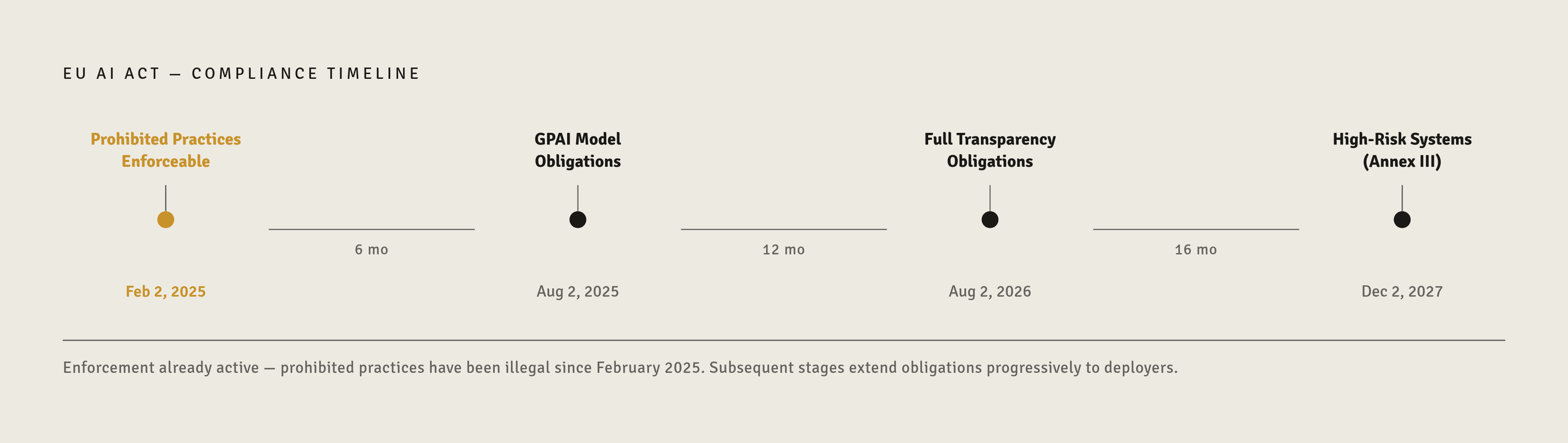
The EU AI Act's timeline is already partly in force. Prohibited-practices violations can reach €35 million or 7% of global annual turnover, and high-risk or governance failures can reach €15 million or 3%, a top tier nearly double GDPR's €20 million ceiling. A GPAI Code of Practice, published July 10, 2025 and declared adequate by the European Commission and AI Board on August 1, 2025, covers transparency, copyright, and safety obligations, with more than 20 providers signed on as of August 2026. Signing is voluntary for providers, but a deployer that knows which of its vendors signed on has a genuinely useful signal about where it stands. One trap deserves particular attention: if a deployer modifies a vendor model significantly enough, the AI Act can reclassify that deployer as a provider outright, handing it the full provider-level compliance burden, a fate every practitioner in this space actively tries to avoid.
The US federal picture is less unified but no less active. The FTC's Operation AI Comply, announced in September 2024, produced five enforcement actions against companies making deceptive AI claims, and DoNotPay settled for $193,000 in consumer redress, with the final order approved in January 2025. A bipartisan coalition of 42 state attorneys general is actively pursuing AI-related enforcement of its own. The SEC has named AI governance, related representations, and AI-related cybersecurity risks as formal examination priorities for FY2026.
State law adds another layer, and the dates matter because they're arriving in a rapid sequence. Colorado's original AI Act was repealed and replaced by SB 26-189, effective January 1, 2027, requiring risk management programs, mandatory impact assessments, and consumer disclosures for high-risk AI used in consequential decisions like housing, employment, and lending, under a "reasonable care" standard. New York City, Illinois, and New York State each layer on bias-audit, notice, recordkeeping, and human-review requirements, and frequently push companies to allocate compliance responsibility explicitly inside their vendor contracts.
Financial services carries its own overlay. And training data exposure is not a hypothetical risk dreamed up by compliance consultants: Italy fined OpenAI €15 million over GDPR violations that included unlawful processing of personal data, failure to notify a data breach, and inadequate age verification. Meanwhile, 63% of breached organizations, per IBM, either have no AI governance policy or are still building one, so most companies are entering this enforcement environment with nothing documented. EU AI Act timeline and deployer obligations. Prohibited practices are enforceable since February 2, 2025; GPAI model obligations have applied since August 2, 2025; full application of transparency obligations begins August 2, 2026; and high-risk system (Annex III) obligations have been extended to December 2, 2027 under the AI Omnibus (GDPR). Texas TRAIGA takes effect January 1, 2026; California SB 53 takes effect January 1, 2026; California AB 2013 takes effect January 1, 2026, requiring generative AI training data summaries disclosing personal information (as defined by the CCPA), copyrighted material, and synthetic data; and Colorado SB 26-189 takes effect January 1, 2027 (GDPR). SR 26-2 (Federal Reserve/OCC/FDIC revised model risk management guidance, superseding SR 11-7 as of April 17, 2026) is now applied to traditional AI/ML systems in financial services, while generative and agentic AI are explicitly excluded from SR 26-2's scope. BaFin's "Guidance on ICT Risks in the Use of AI at Financial Entities," published December 2025, is a 35-page document that pulls AI use into the DORA ICT risk-management regime for CRR institutions and Solvency II insurers (GDPR, AI Safety in 2026: Enterprises Build Compliant AI Systems!).
Vendor contracts and the unclosed liability gap
Standard vendor contracts were not built for this moment, and the gaps appear in predictable places. Indemnification is the first one: AI vendors increasingly carve AI-generated outputs out of their IP indemnity entirely, and liability caps are often pegged to fees paid over the prior twelve months, a figure that bears almost no relationship to an organization's actual regulatory or litigation exposure.
Training data clauses fail in a quieter but equally consequential way. Contracts commonly forbid the vendor from training on customer data, but many AI product features ship with "Product Improvement" data sharing turned on by default. Unless an administrator actively goes in and disables it, data flows to a sub-processor for training purposes regardless of what the data processing agreement says on paper.
Article 26 requires deployers to maintain instructions for use, technical documentation, and logging capability. If a vendor hasn't contractually committed to providing and maintaining those things, the deployer simply cannot comply, no matter how good its internal intentions are. The EU's Model Contractual Clauses for AI Procurement, published by the EU Community of Practice on Public Procurement of AI in 2025 and updated March 5, 2025, offer a useful starting template even for private-sector buyers who have no public procurement obligation. Practitioners now treat a specific set of clauses as non-negotiable: training data restrictions, subprocessor notification and approval, output IP rights, model drift notification timelines, audit rights over fairness data, incident notification requirements, and exit provisions. A cap is only as protective as what it can actually cover, and a twelve-month fee cap attached to a high-sensitivity deployment doesn't meaningfully protect anyone.
Perhaps the most consequential gap is the absence of any drift-notification obligation in most standard agreements. The vendor is under no duty to tell the deployer when the model has changed in a way that affects compliance, so the deployer typically finds out through degraded outputs, or through a regulator's letter, rather than a changelog. The stakes attached to third-party risk generally are not small: a Secureframe report found supply chain attacks accounted for 47% of total affected individuals in the first half of 2025, third-party and supply chain compromise cost an average of $4.91 million per incident, and Verizon's 2025 DBIR found third-party involvement in breaches had doubled to 30%.
A working governance program for vendor AI in practice
Pre-deployment due diligence has to go past the standard vendor questionnaire. It needs model-specific questions about training data provenance, the vendor's bias and fairness testing methodology, the subprocessor chain underneath the product, and output reliability metrics measured on data resembling the deployer's own. The vendor needs to produce technical documentation, model cards, and known failure modes; without those, no conformity assessment is even possible. And the first question to answer, before any of the rest, is classification: is this a high-risk AI system under the EU AI Act, or a consequential-decision system under Colorado or New York's frameworks? That answer determines which controls are actually required.
Contract negotiation deserves to be treated as a governance instrument rather than a procurement formality.
Before a vendor model touches production, it needs to run against the deployer's own data distribution, because vendor benchmark scores tell you almost nothing about performance on your inputs. Bias and fairness testing needs to happen before go-live, with documented pass/fail thresholds, not after a complaint arrives. Logging and audit trail infrastructure needs to exist at launch, not get bolted on retroactively once someone asks for it.
Continuous monitoring catches silent model updates directly. Behavioral monitoring with defined thresholds is the only mechanism that reliably catches drift and silent model changes that a vendor's changelog, if one even exists, won't mention. That monitoring needs to cover performance degradation, shifts in fairness metrics, changes in output patterns, and where data is actually flowing to subprocessors. And there needs to be a defined incident response workflow: what triggers escalation, who owns remediation, and what documentation the response generates for the next audit.
None of this works if shadow AI goes unaddressed. With 35% of organizations describing shadow AI as pervasive, a governance program that doesn't confront unauthorized model use has a hole that undermines every other control built around it. A working program, per the sources examined here, covers inventory and classification, policies and standards, risk management, validation and testing, monitoring and incident response, and documentation and audit trails, and these pieces feed each other continuously across the AI lifecycle rather than functioning as a sequence of one-time checkboxes. Evaluation, observability, and governance platforms, including tools like Openlayer, can run pre-built pre-deployment tests and block non-compliant outputs at the API boundary at runtime; organizations building these programs are better served assessing tooling that folds EU AI Act, GDPR, and NIST AI RMF requirements into one auditable workflow rather than treating each regime as a separate project.
The remaining gaps: insurance, enforcement trajectory, and unresolved contractual limits for deployers
Even a well-built governance program runs into limits that no contract clause currently closes. Insurance markets have not caught up to the actual shape of this risk: cyber policies were written around data breaches and business interruption, not around a vendor's silent model update degrading a lending decision engine for months before anyone notices. Coverage for that scenario is thin, inconsistent across carriers, and often excluded.
Enforcement trajectory is the other open matter. Shadow AI is already widespread, with 35% of organizations describing it as pervasive or widespread and only 20% reporting it as rare or nonexistent.
What remains, for now, is a structural truth no contract can fully absorb: the deployer chose to put the system into production, and that choice is what regulators, courts, and affected individuals will keep pointing back to, no matter how carefully the vendor agreement was drafted.
Notes
- AI Risk & Compliance 2026: Enterprise Governance Overview
Provided the IBM breach cost figures, EU AI Act penalty tiers, and AI governance statistics cited throughout the article.
- Third-Party AI Risk Management and Vendor Governance (July 2026) | Openlayer
Provided the 87% adoption figure and framing around third-party AI risk management for deployers.
- AI Vendor Risk Assessment Questionnaire for Compliance (2026)
Provided the supply chain attack statistics, per-incident cost figures, and AI governance policy gap data cited in the vendor contracts section.
- AI Risk in Third-Party Vendor Tools - Accorian
Provided the 89% figure on enterprise AI usage invisible to organizations without central oversight.
- Vendor Risk Management in the Age of AI: 2026 Guide | Compyl
Provided the Verizon DBIR statistic on third-party involvement in breaches doubling to 30%.
- https://www.kiteworks.com/cybersecurity-risk-management/ai-regulation-2026-business-compliance-guide/
Provided the data validation and audit log statistics on organizations' inability to trace AI training data provenance.
- EU AI Act Compliance: What Enterprise AI Deployers Must Know
Provided detail on EU AI Act Article 26 deployer obligations including documentation, logging, and conformity assessment requirements.
- EU AI Act obligations for providers vs deployers: complete guide for May 2026 | Openlayer
Provided explanation of the provider-vs-deployer distinction under the EU AI Act, including the reclassification risk when deployers significantly modify vendor models.