Essay AI Solutions to Compliance
AI Governance and Compliance Certifications Worth Pursuing
EU AI Act deadlines loom; AIGP and ISO 42001 certifications help teams stay compliant.
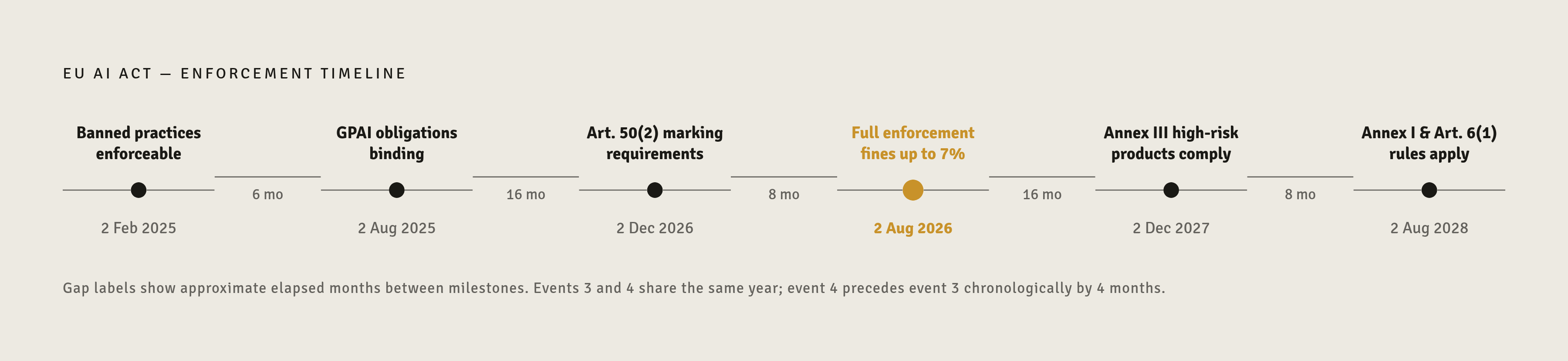
Today, the EU AI Act already applies in the real world, not just in writing. Banned uses could be punished starting on 2 February 2025, while rules for broad AI systems, known as GPAI, took effect on 2 August 2025. GPAI model obligations became binding on August 2, 2025, with full enforcement, including fines up to 7% of worldwide sales, beginning August 2, 2026, and banned practices already covered.
High-risk ones get extra runway, yet that runway hits a limit. Article 6(2) plus Annex III products must comply by December 2 of 2027. On August 2, 2028, the rules kick in for Annex I and Article 6(1). Under the 2026 Digital Omnibus, some due days moved later, such as Article 50(2)'s marking requirements end on December 2, 2026, while the main risk rules remained unchanged. Folks hoping for big breaks got something narrower, and ignoring the details will hurt whoever skipped them.
One point can leave agencies stuck: the Act covers importers, deployers, plus distributors, while a firm using AI tools for clients likely is treated like a deployer carrying disclosure duties in Article 50. Governance credentials are important to ad and advisory firms right now, rather than only within legal departments, because many agencies still don't know where they stand.
The AI Risk Management Framework from NIST plus ISO/IEC 42001 aren't part of the EU Act, but they still guide how people operate between countries. Any credential which teaches one alone is behind already, since what matters is seeing how both fit together when a customer is active in several legal territories at once. America doesn't have anything matching the EU Act yet, meaning professionals who serve only US clients face less compliance pressure. Less, though, does not mean absent.
IAPP AIGP: the credential built for governance, compliance, and privacy professionals
The AI Governance Professional (AIGP) credential was launched in April 2024 by IAPP, the group behind CIPP, CIPM, plus CIPT. These designations now serve as the shared vocabulary privacy jobs use, a track record that hands AIGP an early edge most fresh credentials lack. About 4,000 to 5,000 individuals have earned it globally right now, a small pool next to tens of governance roles sitting unfilled across the field.
Candidates face 100 exam items, 85 of which count, and 30% come from case studies, not pure facts. A 300 on the 100-to-500 scale is required to pass. After the restructure in February 2025, the test covers 4 areas: foundational AI basics, AI rules (including the EU AI Act, NIST's framework, ISO 42001), plus AI lifecycle governance alongside a catch-all section for current issues. The price runs $799, dropping to $649 for those in IAPP at $295 annually, and joining covers the upkeep that maintains the credential.
The numbers prove people want this. Per the Jobs Report from IAPP, AIGP professionals in the US typically earn $141,000 to $170,000 yearly, with $151,800 as the median. Professionals mixing privacy duties with AI governance earn about $169,700 in typical pay, roughly $18,000 higher than AI governance by itself.
Folks keep getting this backwards: AIGP is a governance credential through and through, full stop, not some broad AI credential. Doing that wastes the exam cost and work hours. It's aimed at those already in or heading toward compliance, policy, risk, or governance roles. A developer or researcher who creates models has no business taking the exam. They make the models instead of running them, so AIGP has nothing to do with what they do every day.
ISACA AAIA and AAISM: the audit and security track for IT risk professionals
ISACA, the body that runs the long-running CISA program, brought out its AAIA (Advanced in Artificial Intelligence Audit) in 2025. It’s made for audit professionals already established in the area who aim to document governance and AI-specific audit expertise beyond that foundation. Unlike AAIA's audit angle, the credential called AAIR (Advanced for AI Risk) handles governance, evaluation, plus management of AI risk throughout every stage of the AI lifecycle.
Since its launch, ISACA's AAISM has grown rapidly alongside AIGP, reflecting strong demand. Insiders pay $575 to take the exam, while non-members pay $760.
ISACA built AAIA as a step beyond the entry point, not as one. One prerequisite is needed: CISA, CPA, CIA, or another accepted audit designation. Anyone lacking one of those should begin somewhere else, because the requirement is firm. AAIA brings CISA extra AI risk plus lifecycle governance and assurance tools so the auditor can check AI in practice, not just write about it. ISACA also offers an entry-level AI Auditing Certificate, a training-program credential that sits apart from AAIA, with members paying $459 and others $549.
Going for both through Stacking works better than choosing just one. AIGP covers governance broadly; AAIA gets into audit work. Each one operates at its own altitude, doing its own job next to the other. Who this suits best: audit, risk, or assurance groups within big companies, along with IT auditors who have a CISA and want to take that credential toward AI-specific work.
The AI Risk Management Framework from NIST plus ISO/IEC 42001 aren't part of the EU Act, but they still guide how people operate between countries.
ISO/IEC 42001 Lead Auditor: the credential that travels with the standard itself
No other certifiable AI management framework existed anywhere before ISO/IEC 42001:2023 came out during December 2023. Getting certified costs between $15,000 and $50,000; the certificate is quickly turning into a must-have for businesses selling AI tools in the EU. The certificate is increasingly sought after in procurement processes.
ISO 42001 can be certified as a management system and demands formal audits, full stop. The AI RMF is optional and principle-driven. That’s why many groups put their daily AI risk work under NIST, then get ISO 42001 approved to show it was done to audit and review teams. One runs the day-to-day stuff. The second one shows it.
For candidates, this credential means ISO/IEC 42001 Lead Auditor through groups like PECB, at about $600. It fits those who already hold ISO 27001 as well as ISO 9001 auditing skills, because the exam presumes familiarity with how audits of ISO management-system standards function broadly, not merely the AI material layered onto them. Going in as a beginner usually makes for a tough exam, since AI-specific questions make up roughly a third of what gets asked. Experienced senior practitioners assembling a credential stack see highest-leverage outcomes by adding AIGP alongside one privacy credential and either CISA or an audit credential like this.
EXIN AICP and EC-Council CRAGE: foundational and operational credentials for broader teams
The AICP from EXIN, or AI Compliance Professional, sits at the entry level; it's vendor-neutral by design, made to suit many roles, not just legal or technical ones. The test costs roughly $390, and it goes over AI ethics, regulatory alignment, risk frameworks, plus lifecycle compliance basics. The whole point of that cost: an organization can run a full staff through it, and it still works as a base before a person specializes for AIGP or toward the ISO 42001 path.
For depth, EC-Council's Certified Responsible AI Governance, with Ethics (CRAGE), goes beyond AICP. Rather than abstract ideas, the program runs 11 modules aligned with ISO/IEC 42001 and NIST AI RMF standards, built on scenario-based risk exercises. Cost scales by delivery method: on-demand begins at $999, virtual live runs $1,399, and $1,799 for live in-person. Even though it arrived after what ISACA and the IAPP offerings provide, having Deloitte plus KPMG, PwC, EY send their staff through it buys real credibility. It suits risk staff and compliance officers working between technical and legal departments who must operationalize governance daily.
No credential competes against AIGP, nor with ISO 42001 Lead Auditor; that wasn't the point. These serve as right-sized entry spots, plus team-training tools made to ready staff for senior credentials, not bypass them. People still pitching them as stand-ins for AIGP are misreading why these were built.
Academic programs for executives and legal professionals shaping AI policy
Georgetown's Certificate covering AI Governance plus Compliance runs $2,995, provides 3.2 continuing CEUs, with all course materials included. The program leans on regulatory foundations while it blends legal work with tech using simulations and case studies. Non-technical staff wanting governance depth but no technical prerequisite blocking them, along with legal professionals handling AI setups, are the right fit.
One executive program, Berkeley's AI Business Strategies course, focuses on AI strategy and compliance. It is designed for leaders shaping AI strategy.
Costing $18,928 to $23,296 to cover the full track, with single classes at $4,200 to $5,600 each, Stanford's AI Graduate Certificate runs highest. It provides genuine academic depth, access to Stanford's AI research community, with modules on responsible AI. It best fits technical professionals seeking academically credentialed training in governance, backed by a credential people respect.
Academic courses aren't a stand-in for a real professional certification used as a hiring-filter, and no one should think otherwise. While certification requirements vary by jurisdiction, these programs bring real depth beyond what any multiple-choice exam can measure, and they hold authority during board-level and regulatory discussions.
Mapping credential to role: a decision framework for practitioners
Compliance professionals entering AI governance should pursue AIGP first, then add an IAPP certification to increase earning potential. Auditors with a CPA, CISA, or CIA can pursue ISACA's AAIA or ISACA's AAIA, while a Lead Auditor certificate under ISO/IEC 42001 helps in procurement and supply-chain talks.
Consultants, along with auditors who audit the AI management practices of other organizations, should view ISO/IEC 42001 Lead Auditor certification as their must-have credential. ISO 27001 and 9001 experience is beneficial for this credential. for prerequisites.
Risk and compliance staff seeking foundational grounding, or whole organizations instructing an entire group at once, should first pursue EXIN's AICP, priced near roughly $390 per person, then advance toward EC-Council's CRAGE to gain depth aligned with NIST framework requirements. Attorneys crafting governance structures benefit more from Georgetown's certificate than from any test-focused qualification, because regulatory-law foundations are that course's entire purpose. Executives shaping AI plans may consider programs that focus on business alignment, while others offer academic depth alongside technical credibility.
Senior practitioners get the most value by stacking AIGP with some privacy credential alongside ISO/IEC 42001 Lead Auditor certification or CISA. No other option here hits regulatory interpretation, plus formal audit credentials, and covers governance breadth together. While no universal certification mandate exists as of mid-2026, AIGP and related credentials are increasingly valued for roles involving EU AI Act compliance. For jobs, it’s almost required, so treating this like optional looks wrong.
Credentials in AI governance aimed at agencies handling multiple clients
Agencies using AI tools for clients likely qualify as EU AI Act deployers, with Article 50 disclosure duties. That alone makes credentials less about career-development and more about legal exposure. If a firm fails to record how its own AI tools run or who stays responsible for what, trouble follows once regulators examine the high-risk setup of a client, and then it's past time to become certified.
Staff who struggle to talk through AI governance with clients won't credibly pitch AI-related offerings. It's really a selling issue dressed up as compliance. Paying $649 through $799 for AIGP certification per worker costs more than a whole group can afford, and pushing the issue often leaves most of them skipping that exam.
That is where EXIN's AICP and EC-Council's CRAGE solve the problem. ISO 42001 credentials and AIGP go to the pair of specialists running governance, while each lead gains grounding needed to discuss AI risk properly. This arrangement is what scales. Other options bankrupt the learning spend or keep reps from handling a client's toughest early challenge.
Notes
- Best AI Compliance Courses and Certifications in 2025
Provided cost figures for Stanford's AI Graduate Certificate, including full-track and per-class pricing ranges.
- Certified Responsible AI Governance & Ethics (CRAGE) | EC-Council
Provided details on EC-Council's CRAGE program structure, module count, alignment with ISO/IEC 42001 and NIST AI RMF, and pricing tiers by delivery method.
- AIGP Certification: What It Costs, What It Pays, and Who Should Get It
Provided the figure that 30% of AIGP exam items come from case studies.
- Online Certificate in AI Governance & Compliance
Provided details on Georgetown's AI Governance and Compliance certificate, including its price, CEU credits, and program focus.
- https://pecb.com/en/education-and-certification-for-individuals/iso-iec-42001/iso-iec-42001-lead-auditor
Identified PECB as a provider of the ISO/IEC 42001 Lead Auditor credential and informed the approximately $600 cost figure.
- https://www.exin.com/technologies-software/exin-bcs-artificial-intelligence/exin-artificial-intelligence-compliance-professional/
Provided details on the EXIN AICP certification, including its entry-level, vendor-neutral positioning and content coverage.
- https://www.isaca.org/about-us/newsroom/press-releases/2025/isaca-launches-groundbreaking-advanced-in-ai-audit-aaia-certification
Provided information on ISACA's AAIA certification launch and its design for established audit professionals.