Essay AI Solutions to Compliance
AI for Compliance Professionals in Day-to-Day Regulatory Work
AI handles the grind, but humans must sign off on decisions regulators will scrutinize.
Compliance work now operates on different assumptions than it did just two years prior. Enforcement pushes on several fronts at once, and AI tools can absorb enough manual grind in spotting issues, flagging them, and documenting to free up a compliance officer's schedule. Most groups approach adoption the wrong way: they continue debating AI's role in compliance, while regulators already press a narrower concern, specifically if a human sat within the loop when a decision was made. Here's what it looks like in practice: which tools carry the load, where someone still has to step in, and what regulators will want when they show up requesting proof.
Getting this wrong has real consequences. From February 2, 2025 onward, EU AI Act's prohibited-practices rules have brought enforcement, with costs as high as 7% of turnover or €35 million, whichever is higher. Through Operation AI Comply, the FTC has already forced companies to pay actual money. The SEC has made AI governance, cybersecurity, and supervision, with data protection covered, a core focus of its active-enforcement examinations in 2026. This is active oversight. Real enforcement is happening at the same time in places that schedule their deadlines independently.
How much manual compliance work AI can absorb now
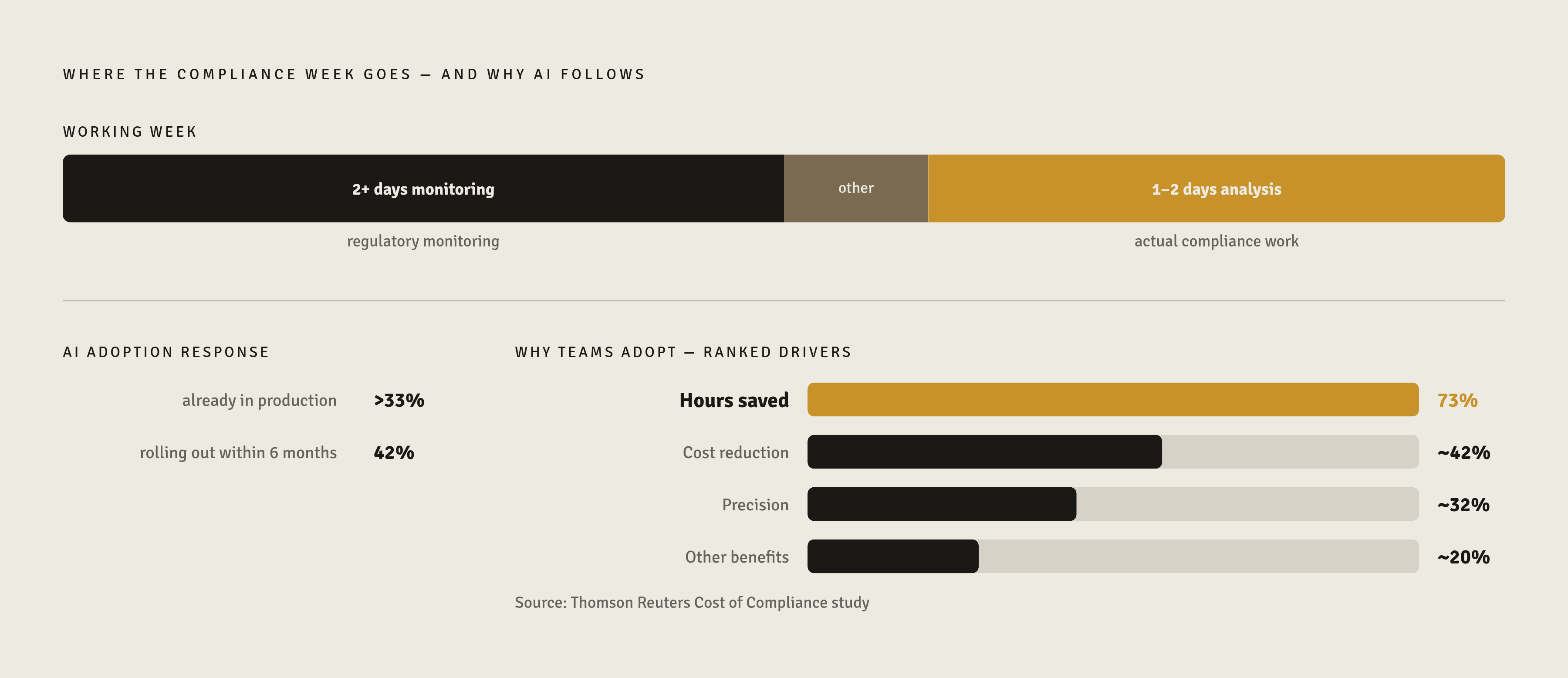
Begin with the math, since it shows why adoption is no longer optional. About 45% of people working in compliance and regulatory jobs say they use up two or more whole days each week just monitoring change across regulations, all before somebody drafts one assessment or even touches an actual decision. It leaves only a day or two for actual analysis.
Spread that across jurisdictions, each speaking its own dialect and pacing its own enforcement, and the math falls apart. Headcount only moves linearly, when it moves. Regulatory demands don't.
Because of that gap, adoption is now beyond trials. 42% of compliance teams aim to roll out AI in the next half year, and over a third have already put it into production. Thomson Reuters' Cost of Compliance study shows what actually pushes adoption: 73% of respondents cite saving hours, above cost, above precision, above all the other benefits vendors usually lead with in a presentation. Compliance teams that still see this as a tech-adoption novelty are overlooking the real story. It's just staffing math that AI takes care of, plain and simple.
The specific tools compliance teams are deploying in 2026
The tools group by job, not by hierarchy, and the difference counts because vendors will blur it in sales talk.
For monitoring regulatory change, Compliance.ai scans regulatory websites around the clock and classifies incoming items by relevance to the company consuming them, instead of dumping every jurisdictional notice into a single undifferentiated stream. Regology takes the same approach but builds AI tools that link researching regulations, managing change, and compliance mapping into connected steps rather than separate lookups.
Checking agreements is a separate challenge, with its own distinct approach. Spellbook automates compliance review, points out clauses with legal exposure, and shows gaps against GDPR, CCPA, and similar frameworks, spotting clause-level drift once found by counsel page by page. GC AI works with over 2,100 in-house counsel groups and focuses on drafting, case analysis, and file checks, reaching a throughput no manual workflow can hit.
Next is GRC and certification, where consolidation starts to show its value. Vanta grew by signing on startups chasing SOC 2 certification, and it has since expanded into broader GRC work as those clients matured. AuditBoard and Centraleyes combine compliance monitoring with regulatory monitoring and certification in one system, eliminating the need to stitch separate dashboards with disconnected data.
The case for "supervised autonomy"
Andy Miller at Case IQ has a sharp way of putting it: AI orchestrates a workflow from beginning to end, but a compliance officer remains in the loop and makes the call where a decision really counts. That is supervised autonomy, and only this setup survives review by a regulator. Unsupervised compliance autonomy is a liability waiting on an exam date. That remains a liability waiting on an examination date.
For compliance, this kind of reasoning works differently than it does almost everywhere else. AI without regulatory rules behaves probabilistically, so the same input on separate occasions, or from two different staff members, can yield two different outputs. For routine fact-finding, the inconsistency feels like an annoyance. For a compliance decision regulators will examine closely, that's disqualifying.
The fix is "Grounded" AI, and it's practical, not aspirational. It stays anchored by the organization's own thresholds, tracks regulatory rules that change by location, gets wired into workflows so every human sign-off happens, pulls from past data instead of starting with an empty slate, and keeps third-party alerts connected so it knows who is involved.
Consider a reported present as the case in point. A grounded AI system matches the gift value to the rules, notes any public-sector affiliation linked with the giver, finds a possible COI, and gives the same assessment whenever the same details appear. Consistency is everything: a compliance system must return the same result no matter who asks, or it's not a compliance system. That's just a chatbot in a costume.
Agentic AI brings end-to-end automation to compliance, yet oversight gaps still exist
Generative AI summarizes, then drafts. Agentic AI is structurally different because it orchestrates. It spots a regulatory change, runs an impact review, drafts a reply, sends the draft for sign-off, and tracks every step, all within limits laid down ahead of time.
Link those actions and a workflow that once ate up whole days collapses into a single governed run. A regulation drops, the system checks where policy falls short, drafts a fresh SOP, and tells the stakeholders who must approve it. It’s one system covering four tasks, not separate tools handing work between them.
The top focus areas today look alike: triaging regulatory changes, finding financial-crime, and watching controls. Each combines heavy transaction flow with a cost that stays containable, never catastrophic, provided a human catches the slip before it compounds. Agentic AI earns its value here, backed by Wolters Kluwer's work showing 44% of money departments plan to run agentic AI during 2026, a big leap from last year.
The oversight gap won't fix itself, though. Each chained step still needs a human-readable audit trail afterward, and each governed boundary needs a person choosing early where that boundary goes. Skipping it leaves compliance un-automated. The automation covers only how it looks, and that works fine until an examiner wants to know who set the boundary.
The professional's role after automation: what shifts to judgment and strategy
When AI handles the high-volume, low-judgment work, the remaining tasks are the ones nobody could ever automate: moral advice, reading regulatory exposure, and accountability at each actual decision. Think of it as the role narrowing to the work that made bringing in a seasoned professional worthwhile, not a demotion.
The change came quickly, and saying it was gradual misreads what really took place. Between 2025 and 2026, compliance adoption of AI accelerated significantly, while the professional's worth followed along instead of falling behind.
The work looks like interpreting the intent behind a rule, and advising on posture when something new comes up that no playbook addresses yet. Overseeing AI tools requires validating their results, auditing real-world conduct, and maintaining the documentation regulators will later request. It calls for governance frameworks that move at the speed of most regulatory cycles, plus handling vendor ties around these tools, because each third-party AI vendor carries its own compliance obligations.
An AI system's output depends entirely on the quality of its training data. Bad or biased training data drives flawed calls in the high-stakes spots compliance covers, so auditing those tools is a main job today instead of an afterthought for IT.
Creating an AI compliance program that regulators will recognize as proof of oversight
Regulators no longer take ethics statements as proof, and using one alone will sink an examination. What they expect is documentation detailed enough to be picked through line by line.
Across jurisdictions, examiners want the training data that fed each AI system tied to compliance decisions, the assessment done before that system launched, bias check outcomes, a playbook for AI system breakdowns, proof a human sat within the loop at actual decision moments, and a complete audit trail for whatever agentic AI systems handled alone.
Putting AI to work in compliance means folding it into enforcement, third-party reviews, whistleblower channels, and the rest as one linked system, not six separate ones that stay out of touch. Bolting on a chatbot to an outdated compliance system is pure decoration, and examiners see right through it. It's just window dressing, and examiners spot it immediately.
Before any of it is launched, governance must address two questions on paper. One: which thresholds and local laws is this AI grounded in, exactly? Next: what does a human decide, and what is the system allowed to execute alone? Get those two questions right, and everything else in the plan has solid ground.
Notes
- Artificial Intelligence and Compliance: Preparing for the Future of AI Governance, Risk, and Compliance
Provided context on the EU AI Act's prohibited-practices enforcement timeline cited in the article.
- AI in Compliance: How to Operationalize AI in 2026
Supplied the key statistics on compliance time spent monitoring regulations, adoption rates, hours-saving as the top benefit, GC AI's user base, and agentic AI deployment figures.