
Essay Compliance Technology
RegTech Solutions for Anti-Financial Crime
Regulators are escalating penalties as financial crime outpaces manual detection.
Ninety percent of financial professionals say they've watched AI-driven attacks climb over the past two years. That's the whole starting point here: financial crime has scaled past what a room full of human analysts can catch by hand, and RegTech has become the baseline cost of staying open for business. This piece walks through what falling short actually costs, how the vendor market is built, and where the tech earns its keep versus where it's still catching up to its own marketing.
An estimated $3.1 trillion in illicit funds moved through the global financial system in 2023, according to Nasdaq's Global Financial Crime Report. That breaks down into drug trafficking ($782.9 billion), human trafficking ($346.7 billion), and terrorist financing ($11.5 billion), among other categories. It lines up with what the UNODC has said for years: 2% to 5% of global GDP, somewhere between $800 billion and $2 trillion laundered annually depending on the year and who's doing the counting. Consumer fraud has its own curve, and it's climbing too. The FBI logged 859,532 complaints in 2024 totaling $16.6 billion in losses, up 33% from the prior year; the FTC separately reported $12.5 billion in fraud losses, up 25%, with investment scams alone eating $5.7 billion of that.
Crypto adds a wrinkle nobody's fully solved yet. Wallets tied to illicit activity moved more than $50 billion in 2024, and layering through cross-chain swaps kept getting faster into 2025, so the money trail goes cold the second it hops a bridge. Only about 40 jurisdictions worldwide rate "largely compliant" with FATF standards, which tells you the containment problem depends enormously on which country's rules you're even trying to satisfy. Put the volume, the variety, and the sophistication side by side, and manual compliance work can't keep pace anymore. Not close.
What regulatory enforcement actually costs institutions that fall short
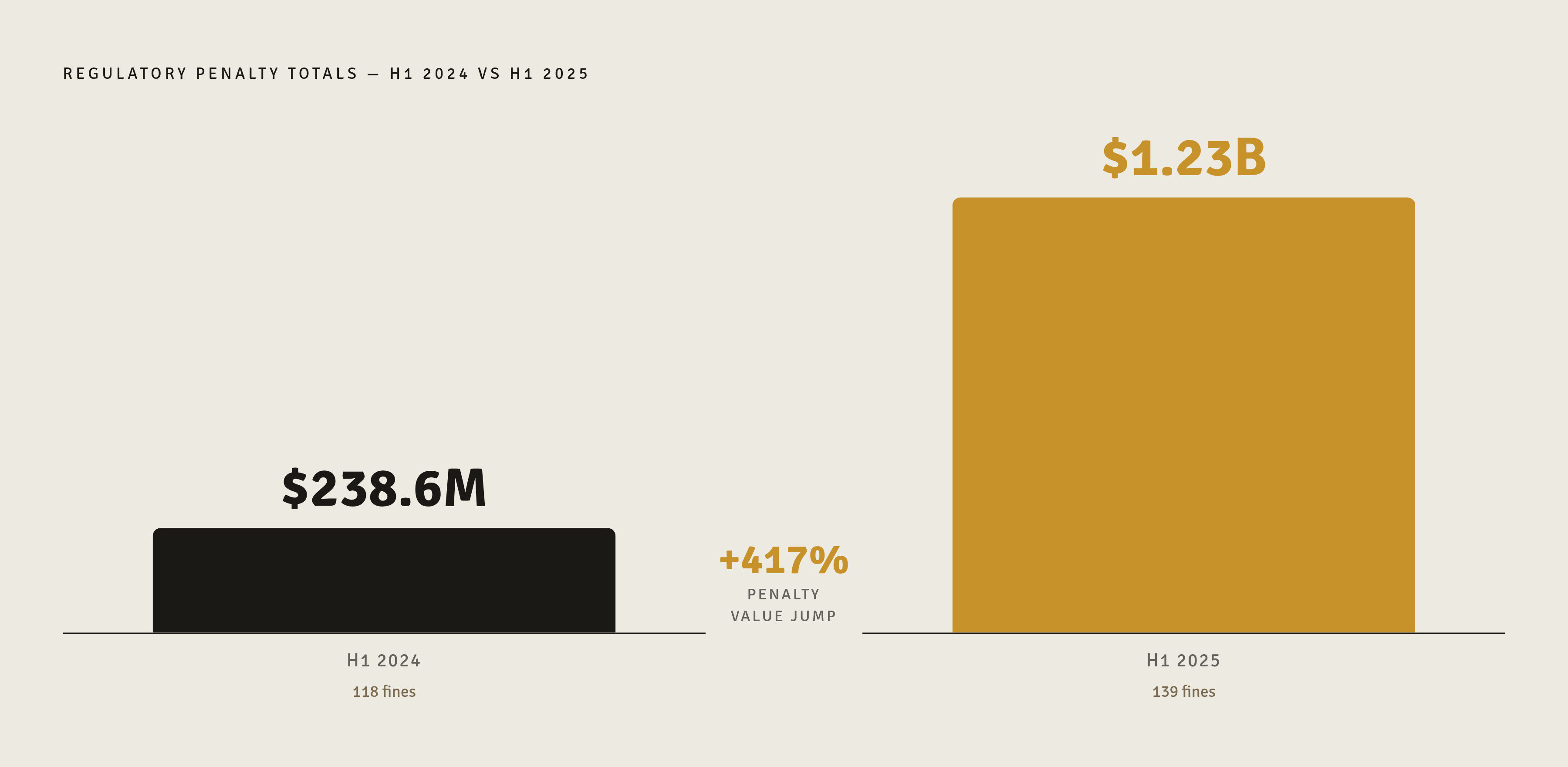
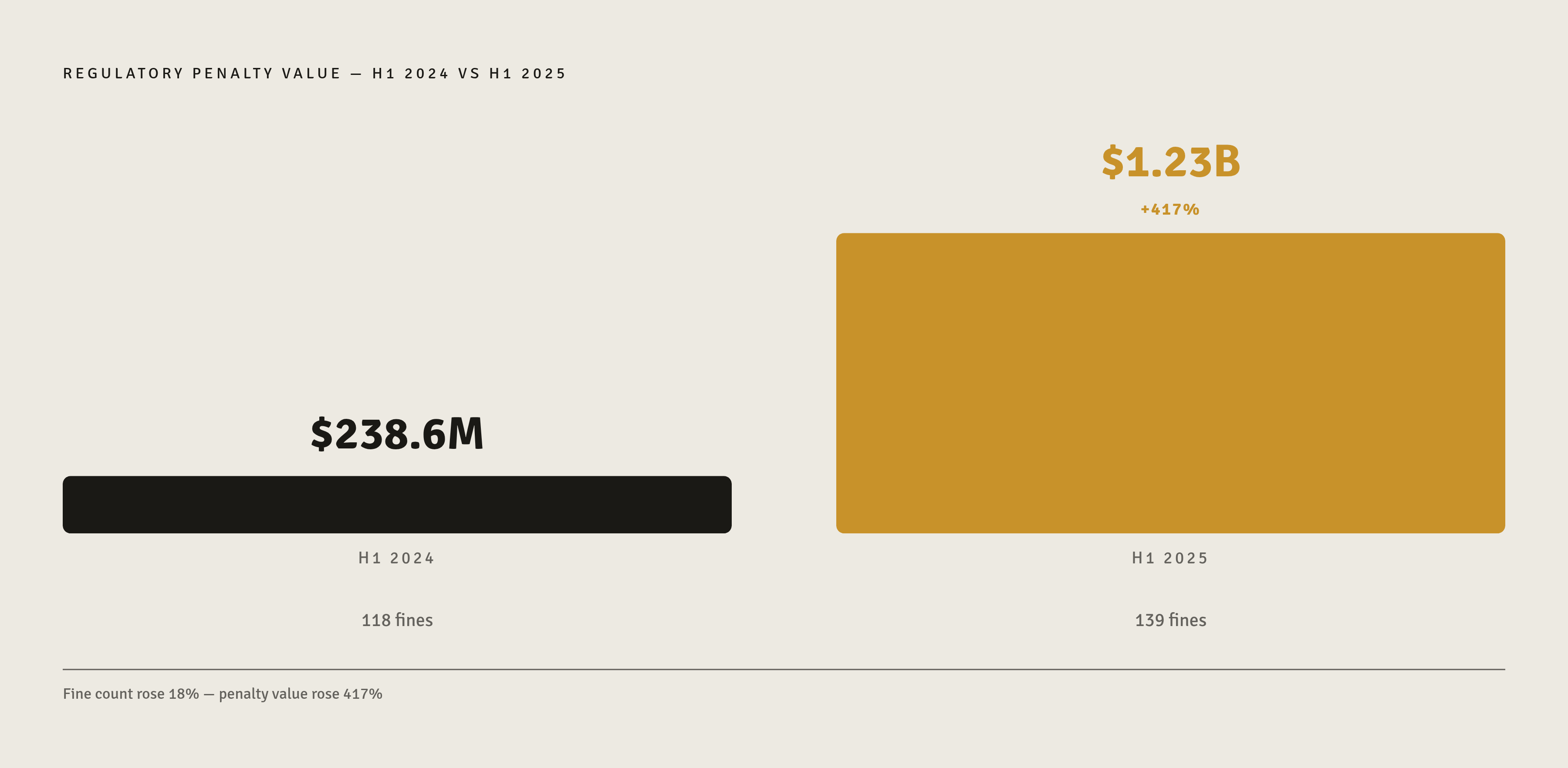
Start with a number that should make anyone sit up straight: regulators handed out roughly 139 financial penalties in the first half of 2025, totaling $1.23 billion, according to Fenergo. Compare that to H1 2024's 118 fines worth $238.6 million, and you get a 417% jump in total penalty value in a single year. Regulators decided the leash was too long. Now they're yanking it back.
TD Bank is the case everyone in this industry name-drops at conferences. In October 2024 the bank ate $3 billion in combined penalties: $1.8 billion under the Bank Secrecy Act (the largest BSA fine ever levied), plus $1.3 billion from FinCEN and $450 million from the OCC. The failure itself was almost embarrassingly simple to describe. The bank didn't detect or report more than $670 million in suspicious transactions moving through its own accounts.
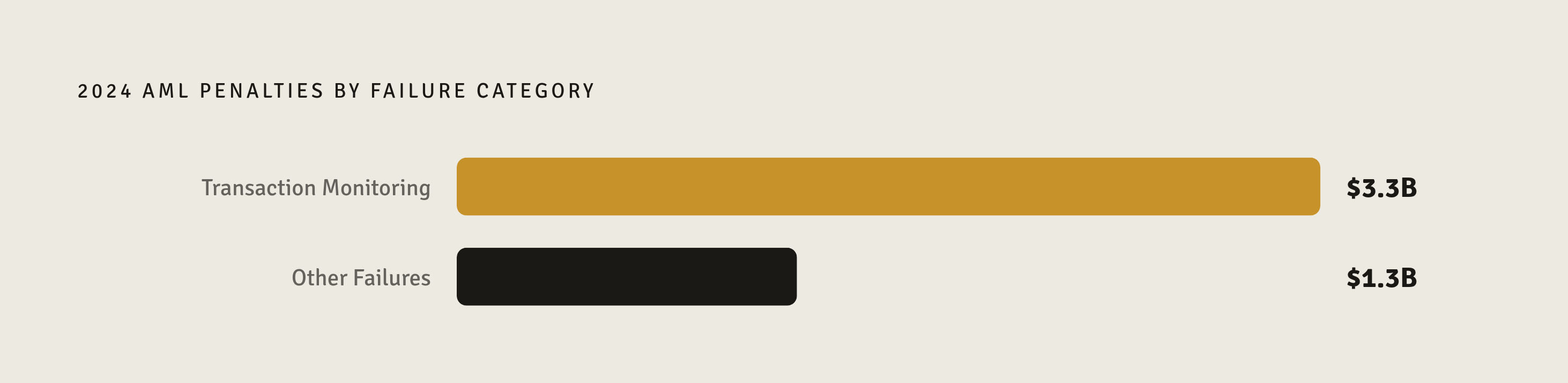
The pattern holds up when you zoom out further. Of the $4.6 billion in total AML penalties assessed in 2024, $3.3 billion traced straight back to inadequate transaction monitoring, a category of failure that roughly doubled year over year from about $1.65 billion in 2023. Crypto enforcement is running on its own track, and it's accelerating faster than the rest: OKX paid $504 million in H1 2025 after pleading guilty to running an AML program that flat-out didn't work, and crypto exchanges accounted for $927.5 million of the more than $1.1 billion in AML and CFT penalties assessed so far in 2025. Sanctions monitoring went from a rounding error to a real line item on someone's budget spreadsheet: fines jumped from $3.7 million in H1 2024 to $228.8 million in H1 2025. Regulators are widening the lens well past the usual AML suspects.
Strip away the framing and this is just arithmetic, the kind a first-year accounting student could do. Getting caught short now costs more, reliably, than buying and running the technology that would have caught the problem first. That gap keeps widening every reporting cycle. At some point the spreadsheet makes the decision for you, whether you wanted it to or not.
How the RegTech market for financial crime compliance is structured
The global RegTech market was worth $19.06 billion in 2025 and is projected to hit $105.23 billion by 2034, per Fortune Business Insights. Financial crime compliance is the sharper slice of that pie, about $4.5 billion in 2025, expected to clear $17 billion by 2032 according to Kings Research, which means it's growing faster than the market surrounding it.
Software holds about 62% of market share today, as opposed to advisory or managed services, though services keep growing too; institutions are figuring out they need more than a tool, they need someone who actually knows how to run it. The ecosystem splits into a handful of core categories: AML and CFT controls, KYC and CDD, transaction monitoring, sanctions and PEP screening, adverse media screening, fraud detection, SAR generation, and regulatory reporting. AI and machine learning are the fastest-growing piece of that stack. Cloud deployment keeps expanding too, as firms look for infrastructure that scales itself without a six-month IT ticket attached to every change.
North America holds the largest regional share at 40.7% in 2025, though Asia Pacific is growing fastest, pushed by expanding regulatory frameworks and the sheer growth of digital financial services across the region. No single vendor covers all eight categories well, and that's worth sitting with for a second. Compliance teams end up assembling a stack piece by piece, choosing each layer on purpose instead of settling for whatever one vendor happens to bundle together.
Put the volume, the variety, and the sophistication side by side, and manual compliance work can't keep pace anymore.
Transaction monitoring: where most fines originate and where AI has the clearest impact
Picture an analyst's Tuesday morning. About 100 alerts land in the queue. Most of them turn out to be nothing, so the analyst spends the bulk of the day clearing noise instead of chasing anything real. That's been the daily grind under static, rules-based monitoring for years, and it's exactly the kind of grind that burns out good people fast.
Machine learning changes the shape of the problem in a few concrete ways. ML models catch behavioral patterns across accounts, geographies, and time horizons that a fixed rule set never will, because rules only know what someone already thought to program into them. Predictive analytics lets teams flag emerging typologies (layering through crypto assets is the current favorite example) before those patterns spread wide enough to become next quarter's headline. AI correlates signals across products and channels at the same time, something a rules engine can't do without drowning in its own logic tree.
The clearest win shows up in false positive reduction. Banks using ML for transaction monitoring consistently report meaningful reductions in false positives, alongside real gains in actually catching suspicious activity. Research into ML-based monitoring has found meaningful drops in false positives alongside improvement in flagging high-risk cases. That is the tradeoff every compliance officer wants and almost never gets to have.
The goal isn't the deepest possible cut in false positives, though. Tune too aggressively and you start missing real threats, which defeats the entire point of building the system. AI is good at generating leads; it's still the experienced analyst who builds a case that survives regulatory scrutiny. Real-time payments raise the stakes further, since ISO 20022 adoption and instant payment rails shrink the intervention window down to milliseconds instead of the old overnight batch cycle. Given that $3.3 billion of 2024's AML penalties traced directly back to monitoring failures, moving off legacy rules-based systems isn't much of a debate anymore.
KYC and CDD automation: removing the bottleneck at customer onboarding
KYC is the part of onboarding everyone complains about, and the complaints are fair, honestly. Manual identity verification and due diligence checks are slow, they vary from one jurisdiction to the next in ways that make consistency almost impossible, and at scale they get expensive fast, especially for a bank operating across a dozen regulatory regimes at once.
RegTech automates specific pieces of that grind. Identity documents and biometrics get verified at onboarding without a human squinting at a passport photo under fluorescent light. Screening against sanctions lists, PEP databases, and adverse media runs in real time instead of a weekly batch job somebody forgot to schedule. Risk scoring and tiering happen automatically, routing higher-risk customers into enhanced due diligence without a person manually deciding who gets the extra scrutiny. KYC also stops being a one-time checkbox this way: continuous monitoring rechecks existing customers as risk profiles shift or new sanctions entries land.
The EU's Anti-Money Laundering Regulation sets a hard deadline on all of this, replacing existing directives with one harmonized standard for CDD and transaction monitoring across the bloc. For the first time, institutions operating across multiple EU member states face a single bar instead of a patchwork of national rules. Firms likely in that pool need audit-ready KYC infrastructure well ahead of the compliance window, not a scramble when deadlines arrive.
That sanctions monitoring spike from the last section, the jump from $3.7 million to $228.8 million, connects directly here. It's a signal that lapses in PEP and sanctions screening, whether at onboarding or later in the relationship, are drawing real regulatory heat. There's a customer experience upside buried in this too: automated KYC shortens onboarding for low-risk customers and frees analysts to spend time on the cases that are genuinely complicated instead of the ones that are just paperwork.
SAR generation and regulatory reporting: closing the loop between detection and disclosure
Every alert that escalates into a confirmed suspicion needs a Suspicious Activity Report: a structured narrative that eats analyst time, requires legal review, and has to get filed by a deadline. Multiply that by volume and you've got a real bottleneck sitting at the end of the pipeline, no matter how sharp the detection upstream turns out to be.
Natural language processing is chipping away at exactly this problem. NLP measurably reduces analyst writing time for SAR narratives, freeing investigators to spend time on analysis instead of wordsmithing a report nobody enjoys writing in the first place. Beyond SARs specifically, RegTech handles automated data aggregation across systems for reporting submissions, pre-built templates matched to jurisdiction-specific formats, and audit trails that show a regulator the compliance process actually happened. That last part matters enormously when a fine hinges on whether a firm can prove it had controls in place at all. Real-time regulatory intelligence feeds keep reporting requirements current as rules shift underneath everyone's feet.
The next frontier, and it's genuinely still a frontier rather than standard practice, is agentic AI running multi-step investigation workflows: gathering data, drafting a narrative, routing it for review, stitching the case together end to end. That's not how most shops operate in 2025. It's the direction the tooling is heading, though, and probably faster than most compliance budgets are ready for.
Go back to TD Bank for a second. Flagging transactions wasn't the failure there; failing to show the bank acted on those flags was. Reporting infrastructure is how a firm proves it did the right thing after detection, and regulators now grade both halves of that equation, whether suspicious activity got spotted, and whether it got reported correctly and on time. A gap in reporting carries the same penalty risk as a gap in detection. Regulators don't hand out partial credit for effort.
How compliance teams are assembling these layers into an integrated stack
Transaction monitoring, KYC, and reporting tools often come from three different vendors, sit on three different data models, and throw alerts into three systems that don't talk to each other. Without integration, a compliance team ends up with a fragmented workflow and, worse, an incomplete picture of actual risk, because none of the pieces know what the others are seeing.
Integration fixes specific, nameable things. A KYC risk score should inform the transaction monitoring threshold for that same customer, but siloed systems can't make that connection on their own. Fraud, sanctions, and AML signals reveal patterns when combined that stay invisible if you only ever look at one function in isolation. Unified audit trails matter a great deal in an exam too, since regulators want one coherent case file running from the first alert to the SAR filing, not three folders a compliance officer has to stitch together by hand under deadline pressure.
A defining theme in 2025 is convergence: across functions, across data sources, and between regulators and the institutions they supervise. Firms treating monitoring, KYC, and reporting as separate workstreams are falling behind the ones that unified them. A 2023 PwC survey cited in that same research found 62% of financial institutions already use AI or ML somewhere in their AML work, with adoption expected to climb further; separately, 75% of institutions say they plan to increase AI use for financial crime detection. The appetite for spending is clearly there.
But buying individual tools doesn't automatically produce an integrated stack. That's the real question hiding under all the enthusiasm: is the spending coordinated, or is it five departments buying five point solutions that happen to share a budget line? Compliance teams generally pick between point solutions stitched together via APIs, end-to-end platforms from one vendor, or some hybrid of the two, and each path trades off differently on customization, vendor dependency, and total cost. Platforms that pair strategy-first workflow design with AI-assisted execution, covering detection, investigation, and reporting in one coordinated system, hold a real edge over point solutions that dump all the integration work back onto the compliance team.
What compliance teams should evaluate when assessing RegTech solutions
If you're the one signing off on a RegTech purchase, a few questions matter more than any vendor demo. What false positive reduction does the vendor actually demonstrate at institutions comparable to yours, and is that number backed by independent validation or just their own internal study? Those two kinds of evidence are not interchangeable, and the gap between them matters a lot when you're explaining the purchase to an examiner two years later.
Check regulatory coverage next. Does the tool actually cover the jurisdictions and reporting formats your institution operates in, including AMLA readiness if you've got EU exposure ahead of that 2027 deadline? Look hard at integration architecture too: does the platform expose clean APIs and support shared data models that plug into your existing case management setup, or does it just become another silo wearing a nicer interface?
Explainability deserves its own line item, not a footnote buried in the RFP. Regulators increasingly expect firms to explain why a transaction got flagged, and just as important, why one didn't, and a black-box model that can't answer that question is an exam risk wearing a technical shortcut as a disguise. Speed to operationalize matters too, since penalty exposure compounds right now rather than sometime down the road; a tool needing a multi-year rollout is solving a problem that will have already cost real money by the time it finally goes live.
Last, and maybe the one that matters most: does the platform actually support human judgment, or does it quietly try to route around it? AI generates leads, but humans still build the cases that hold up in front of a regulator, and getting that workflow wrong makes the algorithm underneath almost beside the point. None of this works without a strategy sitting under the technology, either. A firm that deploys RegTech tools before it defines its risk appetite, its escalation logic, and its investigation workflows just ends up running the same compliance problem it always had, only now at a much higher clock speed.
Notes
- https://www.kingsresearch.com/press-release/regtech-market-for-financial-crime-compliance
Provided the UNODC-cited estimates of 2–5% of global GDP laundered annually and the $800 billion to $2 trillion range, as well as the financial crime compliance market size figures.
- https://www.fortunebusinessinsights.com/regtech-market-108305
Provided the global RegTech market valuation of $19.06 billion in 2025 and the projection of $105.23 billion by 2034.
- https://resources.fenergo.com/newsroom/regulatory-penalties-for-global-financial-institutions-skyrocket-417-in-h1-2025
Provided the H1 2025 and H1 2024 penalty totals and counts, the 417% jump figure, OKX's $504 million fine, and the sanctions monitoring spike from $3.7 million to $228.8 million.