Essay Employee & Workplace Compliance
I-9 Verification Compliance for Remote Hires
Post-August 2023 rules tightened remote I-9 verification into two complex paths.
## Why remote I-9 compliance became structurally harder after August 2023

The COVID-era flexibilities that let employers examine documents remotely, with no video requirement and no E-Verify gate, ended on [July 31, 2023](https://netchex.com/blog/form-i-9-remote-verification-what-employers-need-to-know-in-2026/). Employers had a [30](https://netchex.com/blog/form-i-9-remote-verification-what-employers-need-to-know-in-2026/)-day grace period to complete physical re-inspection of every document examined remotely during the pandemic, with a hard deadline of August 30, 2023. Employers who missed that window are sitting on I-9s that reflect an [incomplete verification process](https://netchex.com/blog/form-i-9-remote-verification-what-employers-need-to-know-in-2026/), and those records are open to ICE audit now.

DHS did not replace the temporary rules with a single successor policy. Effective August 1, 2023, it put two distinct paths in place: the Alternative Procedure, which runs on live video and requires E-Verify enrollment, and the Authorized Representative method, which sends a proxy to examine documents in person and carries no enrollment requirement. A third option has taken shape alongside these two: managed verification services that handle the mechanics of either legal path for employers hiring across many locations. These services run the Alternative Procedure or the Authorized Representative method more consistently than most employers can manage on their own.

The stakes have risen sharply. [ICE audit activity in 2025 ran at roughly ten times its 2024 pace](https://ctrhcm.com/blog/i9-everify-compliance-2026-employer-risk), and the enforcement changes that took effect in March 2026 reclassified a wider set of errors, ones that used to come with a chance to fix them, as substantive violations with no cure window. Remote verification can no longer be treated as a side process to sort out later. The paperwork for a hire can survive an audit two years on, or fail one, based on the path chosen at the moment of hire.

## The DHS Alternative Procedure

The Alternative Procedure is open only to employers enrolled in E-Verify and in good standing at the time each remote verification happens, and it has to be applied consistently across every employee at a given E-Verify hiring site. An employer can limit the procedure to remote hires only and keep physical examination for anyone working onsite or in a hybrid arrangement, but that split can't be drawn along citizenship, immigration status, or national origin lines. Good standing has to be confirmed at every use, not assumed from a past enrollment check. If an employer loses E-Verify eligibility and keeps running remote verifications anyway, every hire processed after that point becomes a substantive violation retroactively under ICE's March 2026 [enforcement guidance](https://www.emptrust.com/remote-form-i-9-verification-checklist-2026-what-every-employer-must-know/). Applying the procedure selectively, using video verification for some employees and not others, invites a DOJ discrimination claim on top of whatever paperwork penalty follows. For federal contractors bound by FAR clause 52.222-54, covering prime contractors and covered subcontractors above a minimum dollar threshold with a period of performance past a minimum number of days, E-Verify is not optional, and the Alternative Procedure becomes the mandatory path rather than a choice.

The procedure runs as a mandatory two-step sequence that cannot be reordered, and the order carries as much weight as the content. The employee has to send legible copies of both sides of their documents to the employer's representative before the live video call happens. Sending the documents after the call, even by minutes, breaks the process DHS requires, and the verification doesn't count. The video call itself has to be live: a recorded submission or a phone call reviewing static photos doesn't meet the standard, because the representative has to examine the transmitted copies against the live feed in real time. Section 2 then has to be completed within three business days of the employee's first day of work for pay, counting only business days and excluding weekends and federal holidays. Somewhere in that same window, the employer has to select [the Alternative Procedure](https://www.emptrust.com/remote-form-i-9-verification-checklist-2026-what-every-employer-must-know/) checkbox in Section 2. Since March 2026, skipping that checkbox is a [substantive violation](https://www.emptrust.com/remote-form-i-9-verification-checklist-2026-what-every-employer-must-know/) carrying an immediate fine with no chance to correct it after the fact. An E-Verify case also has to open within three business days of hire. Missing that deadline is a program violation in its own right, and repeated misses can get an employer's E-Verify account suspended. The state-level E-Verify patchwork further complicates enrollment decisions, layering obligations on top of the federal eligibility rules.

None of this holds up under audit without documentation behind it. Employers need to retain copies of the documents examined on video, some record that the live session actually took place (a system log or a representative's notes), the completed I-9 with the Alternative Procedure box checked, the E-Verify case status through closure, and the audit trail the I-9 software itself generates.

State law adds a layer federal eligibility rules don't address. Roughly two dozen states require E-Verify for some private employers, and Alabama, Arizona, Mississippi, South Carolina, Georgia, North Carolina, Tennessee, and Utah require it for all or most employers, sometimes with size thresholds attached. Several of these states have moved the line further in recent years: Florida, Georgia, and Arizona have tightened E-Verify enforcement specifically for contractors and subcontractors, and Texas, Tennessee, and North Carolina have proposals on the table to expand private-employer coverage further. An employer that checked its obligations once, filed the answer away, and never revisited it may already be out of compliance without knowing it. California runs the opposite direction, generally restricting employers from using E-Verify beyond what federal law strictly requires. For any employer trying to run the Alternative Procedure the same way across a national workforce, California creates a direct conflict with the uniform process the federal rule otherwise calls for.

## The Authorized Representative method: broader access, undivided liability

The Authorized Representative method doesn't ask whether an employer is enrolled in E-Verify at all, and any employer can use it. That openness invites a mistake: designating someone else to examine the documents in person does not move the legal risk onto that person. If the representative makes an error filling out Section 2, the fine lands on the employer, not the representative.

Federal rules on who can serve in that role are permissive almost to a fault. There's no notary requirement, no credential, no training mandate written into federal law, so almost anyone can be designated. The one hard limit is that the employee being verified can't serve as their own representative, since the entire point of Section 2 is to have someone other than the employee examine and attest to the documents.

State law closes some of the gaps federal permissiveness leaves open. California, under Government Code Section 8223(c), bars notaries from serving as authorized representatives on Form I-9 unless they're also qualified and bonded immigration consultants. Licensed attorneys and federally authorized representatives are still permitted. Using a California notary who doesn't meet that bonded-consultant standard is a violation on its own, independent of anything else done correctly. An employer with workers in both a mandatory E-Verify state like Alabama and a restricted state like California is stuck with two contradictory obligations from the same workforce. Neither the Alternative Procedure nor the Authorized Representative method resolves that tension alone. Handling both populations correctly takes state-specific process design.

In practice, a coworker, a family member, or a notary can all serve as the representative, and courts and ICE have been consistent on one point: the employer carries full liability for any mistake that person makes. HR service providers and staffing agencies can step into that role and bring more consistency than an ad hoc arrangement would, but the liability stays with the employer regardless of who does the examining. The quality of the representative's work is effectively impossible to verify after the fact unless the employer builds a documentation protocol into the appointment itself, and most informal arrangements, a coworker asked to help out, a notary found on short notice, skip that step. Timing rules don't bend for this method either: Section 1 still has to be done by day one, Section 2 still within three business days, and [timing violations remain](https://ctrhcm.com/blog/i9-everify-compliance-2026-employer-risk) among the most commonly cited problems because they're easy for an auditor to spot and hard for an employer to fix once the window has closed. Treating a notary or a willing coworker as a low-cost substitute for real process is the surest way for an employer to discover, at audit, that the fine was never anyone's to share but its own. Of the two paths, this is the one employers most often underestimate: the absence of a federal credentialing requirement reads as low risk, when in fact it concentrates all the risk on the employer alone.

## Where Managed Verification Services Fit

Managed verification services exist to fix the exact problems the previous section describes: inconsistent representatives, undocumented examinations, and no audit trail to show an inspector after the fact. These are third-party providers that supply trained representatives, software built for compliance, and the infrastructure to keep an audit trail.

A purpose-built service contributes standardization. Trained representatives apply the same process to every Section 2 completion, removing the variation that builds up when different locations rely on different proxies with no shared protocol. These services also generate tamper-evident audit trails, documenting the live video session, retaining document copies, and recording the Alternative Procedure notation, built to meet the electronic signature and audit trail standards set out in 8 CFR § 274a.2(e)–(i). For employers with no local staff in a given hiring location, these providers can typically offer same-day or next-day availability for new hires.

A manufacturer operating across many locations shows what this looks like at scale. By layering a purpose-built remote verification platform on top of an existing HCM module, and using the managed service to conduct every Section 2 video call and sync the results back into HCM, the employer turns dozens of inconsistent local processes into a single auditable workflow that compliance staff can pull up in minutes rather than chasing down location by location.

Most embedded I-9 modules inside major HCM platforms were built as [form generators](https://ctrhcm.com/blog/i9-everify-compliance-2026-employer-risk) rather than compliance systems. They don't natively meet the tamper-evident audit trail and electronic signature standards required under 8 CFR § [274](https://ctrhcm.com/blog/i9-everify-compliance-2026-employer-risk)a.2(e)–(i), and under the March 2026 enforcement changes, those electronic system deficiencies are now substantive violations carrying immediate fines. An employer running its [I-9](https://ctrhcm.com/blog/i9-everify-compliance-2026-employer-risk) process entirely through a standard HCM module, with no additional layer on top, may be generating violations through the software itself, independent of how well the human side of the process runs. That gap between a form generator and a compliance system is the detail most HR teams discover only after an audit has already started, and by then the fine schedule, not a correction notice, is what applies.

Employers weighing managed services are choosing between two different kinds of provider. One is the authorized E-Verify agent, a provider such as [EMPTrust EVA](https://www.emptrust.com/remote-i-9-verification-what-employers-need-to-know-in-2025-2026/), which supplies a nationwide network of USCIS-trained agents handling compliant notation, document retention, and audit trail work inside an onboarding platform, available to employers enrolled in E-Verify and using the Alternative Procedure. The other is the HR platform with I-9 completion and storage built in to meet DHS access control, indexing, and [audit trail standards](https://netchex.com/blog/form-i-9-remote-verification-what-employers-need-to-know-in-2026/).

## Matching the right path to your organization's situation

Choosing between these paths comes down to three facts about the employer: whether it's enrolled in E-Verify, which states it hires in, and how consistent its existing process already is. Those three questions, answered honestly, point toward a specific path far more often than they leave real ambiguity.

An employer already enrolled in E-Verify, hiring across the country, and needing one consistent process should run the Alternative Procedure, backed by purpose-built I-9 software or a managed E-Verify agent. The step most frequently missed is confirming before every remote hiring cycle that enrollment is still active and in good standing, rather than checking the box once and assuming it holds.

An employer that isn't enrolled in E-Verify, and operates only in states where E-Verify isn't required, is better served by the Authorized Representative method, paired with a documented and standardized appointment protocol. The method only works as a low-cost option if liability awareness is built into how representatives are selected and trained; treated as a no-structure fallback, it is the most expensive path on the list once an audit finds it.

An employer hiring across both a mandatory E-Verify state (Alabama, say) and a restricted state like California does not get a single uniform answer. That combination requires state-segmented process design, built separately for each category of state, and it is exactly where managed services built around state-aware workflows earn their keep. A federal contractor under FAR clause 52.222-54 has less of a choice to make at all: E-Verify is required, the Alternative Procedure is the primary path, and the Authorized Representative method stays available as a supplement for situations where video verification simply can't happen.

One detail applies no matter which path an employer lands on. The Form I-9 edition dated January 20, 2025 is now the only version in effect, and electronic systems were required to update to it by July 31, 2026, a deadline that has already passed. As of August 1, 2026, only that current edition is acceptable. An employer still running an older form edition inside its software is generating violations regardless of which verification method it otherwise follows correctly.

Anti-discrimination obligations bind all three paths [equally](https://www.emptrust.com/form-i-9-compliance-in-2026-the-complete-guide-for-employers/). The DOJ continues to enforce strictly against [unfair documentary practices](https://www.emptrust.com/form-i-9-compliance-in-2026-the-complete-guide-for-employers/), over-verification, and discriminatory I-9 procedures. Applying the Alternative Procedure only to employees of a [particular national origin](https://www.emptrust.com/form-i-9-compliance-in-2026-the-complete-guide-for-employers/), or asking for more documents than the form requires, creates a separate violation no matter which verification path the employer otherwise chose correctly. Selective use of the Alternative Procedure, video verification for some employees but not others, is called out specifically as a discrimination trigger. That is why the procedure has to be applied consistently across every hire it covers, rather than picked and chosen case by case.

## The March 2026 enforcement changes for violations in progress

The March 2026 changes did more than raise the stakes for future hires. They removed the safety net that let employers fix [remote-verification annotation mistakes](https://netchex.com/blog/form-i-9-remote-verification-what-employers-need-to-know-in-2026/) once an audit turned them up. Errors that used to trigger a ten-business-day correction notice now generate an immediate fine, ranging from [$288 to $2,861](https://netchex.com/blog/form-i-9-remote-verification-what-employers-need-to-know-in-2026/) per paperwork error under the 2026 DHS penalty schedule. An employer who previously had room to catch and fix a mistake before it became a fine now has no such room, and that changes the economics of self-auditing: the existing I-9 inventory, not just the next hire, carries financial exposure today.

Several specific errors fall into this newly unforgiving category. Missing signatures, missing date of birth, and missing dates in Section 1 are now substantive violations rather than correctable ones. Failing to check the Alternative Procedure box in Section 2, for any remote verification conducted under the DHS procedure, carries the same immediate-fine treatment, with no window to go back and add the missing notation. The forgiveness that used to come with an audit response has been written out of the rule, so an employer reviewing its own records for the first time since these changes took effect should treat every remote-verification file completed in 2023, 2024, and [2025](https://ctrhcm.com/blog/i9-everify-compliance-2026-employer-risk) as a candidate for a line-by-line check.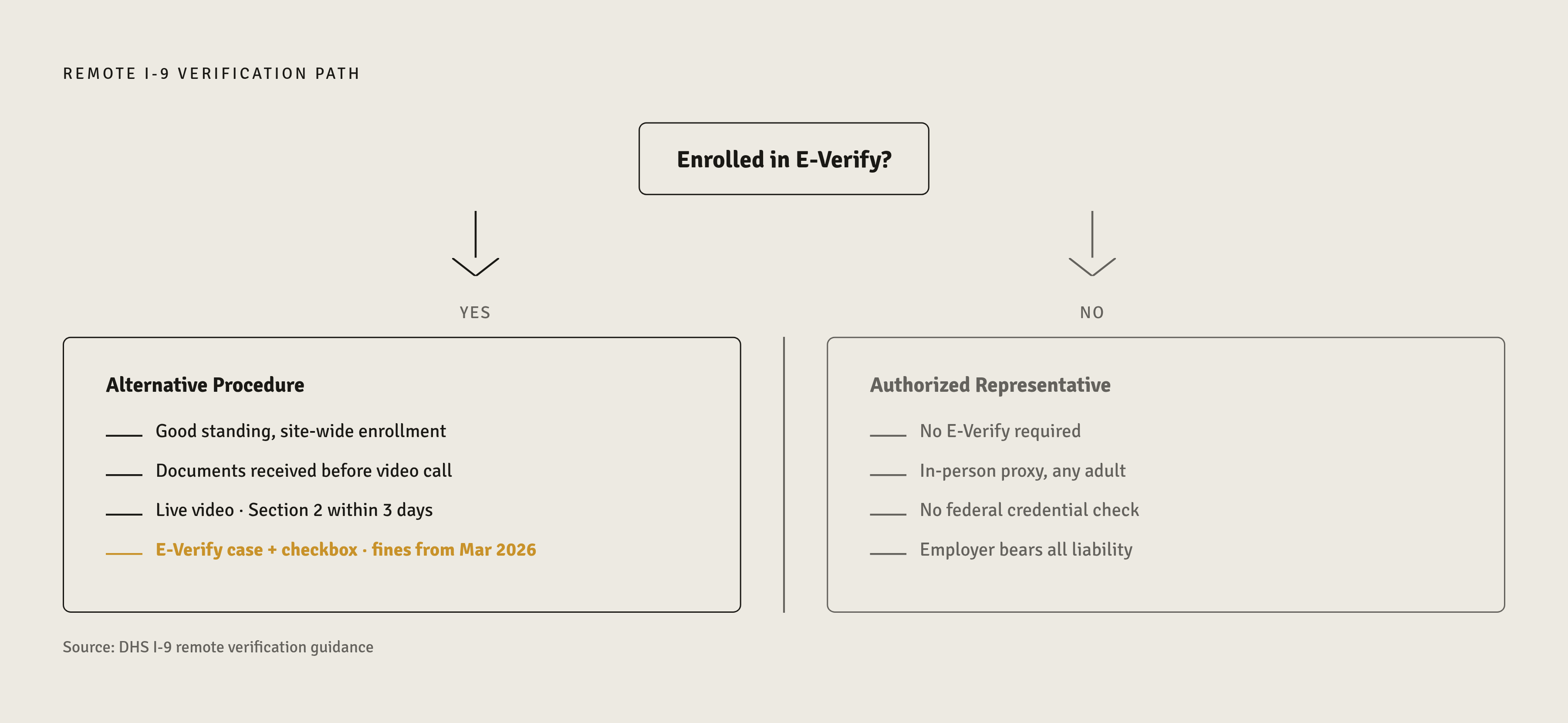
Notes
- Form I-9 Remote Verification: What Employers Need to Know in 2026
Provided details on the end of COVID-era flexibilities, the grace period deadline, penalty ranges under the 2026 DHS schedule, and the impact of March 2026 enforcement changes on annotation mistakes.
- Form I-9 Compliance in 2026: The Complete Guide for Employers - EMPTrust HR
Provided information on anti-discrimination obligations, unfair documentary practices, and the requirement to apply the Alternative Procedure consistently.
- Remote Form I-9 Verification Checklist 2026: What Every Employer Must Know - EMP Trust HR
Provided details on the Alternative Procedure checkbox requirement in Section 2, enforcement consequences of skipping it, and E-Verify good-standing requirements.
- Remote I-9 Verification: What Employers Need to Know in 2025–2026 - EMPTrust HR
Referenced as an example of an authorized E-Verify agent service (EMPTrust EVA) supplying trained agents for compliant remote verification.
- I-9 and E-Verify Compliance in 2026: Where Risk Builds in the Hiring Process
Provided the statistic on ICE audit activity running at roughly ten times its 2024 pace, the characterization of embedded HCM modules as form generators, and details on timing violations.