Essay Third-Party Vendor Risk
Vendor Offboarding Compliance Checklist for Data-Handling Suppliers
Organizations must document data destruction and access revocation when vendors depart.
Once a supplier that handles data reaches the end of its agreement, teams may mark procurement, finance, and the business relationship complete. What remains unchecked are the issues regulators raise after termination: confirmation that data was returned or destroyed, access for that vendor was disabled, and the organization has records proving both. That ordinary wrap-up process does not cover these obligations, leaving legal risk in place well beyond the end of the vendor relationship.
A state privacy regulator made this concrete in a data privacy enforcement action decided in May 2025. The agency determined that relying on an external privacy solution without verifying its boundaries or ensuring it functioned properly constituted a standalone CCPA breach. When a vendor departs, the company's compliance risks remain behind. The hiring company, rather than its supplier, bears the duty to understand and demonstrate how information was handled.
That is the distinction such a supplier's departure forces. A deal may wind up neatly, every invoice may balance exactly, and yet the firm may still hold active API keys, personal data never sent back, and nothing on file proving either issue was resolved. Regulators enforcing CCPA, HIPAA, GDPR, along with DORA want proof, tied to a date and a required format, that records were returned, wiped, and that access was revoked; tidy paperwork earns no credit. Offboarding a supplier that handles data really means building toward that evidence, a process that begins long before the last invoice is settled.
Organizational fragmentation turning an exit into an attack surface
The reason this task frequently goes unnoticed is that offboarding duties are divided across an organization. Procurement finalizes the agreement. Finance reviews the billing records. IT turns off the user profiles within its visibility. Legal examines the contract language governing ownership rights. The security reviews cover whatever destruction certificate is provided. Each group signs off on its slice as complete, yet accountability for the entire handoff is missing, which leaves access lingering in the gaps between teams.
This pattern shows up in nearly the same form wherever it occurs. IT switches off the shared login method, closing the vendor's front-door access, yet months-old or even years-old API keys granted for some integration still function, since nobody in IT realized those credentials existed. Security gathers the vendor's physical badges at departure, yet the VPN credentials that gave the vendor's systems network access remain live, since the team that reclaims badges and the team that shuts off VPN accounts never compared notes.
The 2025 Coupang incident reveals what happens when such a gap goes undetected. After departing, a former worker leveraged an enduring signing credential to extract records belonging to tens of millions of users across roughly five months without detection. This became South Korean history's largest breach, achieved without the intruder ever needing to bypass a firewall or exploit any vulnerability. The key was all they needed, because no one ever revoked it.
Klue shows the same pattern: the named-user SSO login shut down on schedule, while an API key from a 2022 pilot remained active for years because it had never been recorded or revoked. In both cases, the deeper problem was orphaned access with no assigned owner to shut it off. These breakdowns in fragmented offboarding are not usually the result of a single team missing its task. It breaks down when responsibility vanishes in the gaps between steps, leaving any access caught there active without end.
What the compliance frameworks require at contract termination
Every operational-resilience and data-protection framework spells out the specific obligations that apply once the contract ends, and an offboarding checklist has to satisfy each one.
Under GDPR Article 28, the processor must, at the controller's choice, delete or return all personal data once the services end, under Article 28(3)(g), and separately must make available everything needed to demonstrate that it complied, under Article 28(3)(h). The regulation does not explicitly require the processor to confirm which of the two options it carried out. That confirmation, when an organization gets it in writing, becomes the actual artifact regulators want to see. The destruction or return itself is not what gets audited; the paper trail proving it happened is.
Under HIPAA, Business Associate Agreements require the Business Associate, when the relationship ends, to dispose of or hand back every item of protected health information and confirm completion. If that is not possible, the Business Associate must continue safeguarding any retained PHI, restrict later use of that information, with the covered entity recording that these steps occurred.
Since January 17, 2025, DORA has obliged financial firms to record their approach to managing risks from external ICT providers, covering both the ending of contracts and the return of data. Such exit strategies demand scheduled transition blueprints, arrangements to move and port data, backup vendor selection, contractually set handover windows, validated departure processes, plus yearly-reviewed stakeholder communication plans. Once rules impose such exit duties on vendors of that magnitude, handling departure preparations as mere paperwork is no longer justifiable.
For SOC 2 auditors, the file should document revoked access, certified data deletion, and the closing security review tied to the vendor offboarding process. These materials are formal audit evidence for external review, not internal team notes.
All of these frameworks share one subprocessor obligation: the organization must find out whether any subcontractor further down the chain handled the data at some point, and must put those parties through an offboarding process of the same kind. A company can cut off its primary vendor completely, yet a fourth party further down the chain can still hold a live connection no one closed.
Step 1: Confirming termination rights and starting the notice clock
Begin offboarding planning ahead of sending the termination notice, since the agreement controls the steps that follow. Notice periods are often 30 to 90 days; contracts can also impose early-termination fees, renewals that trigger automatically, and required notice channels, including postal registration or certified electronic delivery, so missing those directions can leave the termination open to challenge later.
Before anyone reaches out to the vendor, the termination clause itself has to be read to pin down how much advance warning is required and the way it must be delivered. Simultaneously, teams must verify whether the contract renews automatically, since missing that deadline by just days could bind the organization to an additional complete cycle. The Data Processing Agreement needs its own review here too, since some DPAs specify how data gets handled while that advance warning window remains open, which is separate from what happens once termination takes effect. After that review, the required written notice is sent via the stipulated channel and its arrival is recorded, because that timestamp triggers the offboarding timeline governing all subsequent actions. Finally, teams must locate all schedules, statements of work plus order forms linked to the master agreement since every one needs individual closure. Vendor partnerships almost never rely on just one contract, so any unclosed schedule or SOW may sustain duties well beyond the master agreement's conclusion.
Offboarding a supplier that handles data really means building toward that evidence, a process that begins long before the last invoice is settled.
Step 2: Mapping and revoking every access credential the vendor held
Most revocation failures happen when teams shut off the credentials in their inventory while unknown access stays active. Klue's breach traces back to an API key created for a 2022 pilot that stayed active for four years and was never tied to any offboarding checklist, even though the employee's SSO login had been shut down on time. Coupang's incident traces back to a signing key that remained active after its holder departed. In each instance, the obvious, above-the-surface access was shut off, while the access lurking just beneath it stayed open.
To close the gap, review every vendor-held credential type in turn. Start with named user accounts in single sign-on, Active Directory, plus all vendor-used application logins. API keys and tokens come after that, and they should be found in integration logs, not recalled from memory, because memory is what broke down in the Klue case. Check separately for OAuth tokens and app grants that vendor systems can use on internal platforms, plus VPN credentials and certificates that let vendor staff or systems connect. Tokens for GitHub personal access, service accounts in Kubernetes, plus similar integration-layer credentials need close attention because such environments expose them by nature, and most checklists for offboarding simply miss them. Employers must collect or remotely erase any hardware and entry passes issued by the company. Any shared secrets the vendor used must be fully rotated rather than merely cancelled at their access point, because leaving the underlying key intact renders that cancellation useless. Once those steps are complete, the vendor must provide written confirmation detailing every revoked permission and when it occurred, so the organization holds actual proof instead of relying on guesswork.
These steps should wait until the termination notice has been sent. If access is cut before Step 3 finishes, teams may lose vendor support they still need during the handoff, so timing is critical.
Step 3: Capturing knowledge and transitioning services before access closes
Knowledge handoff should be built into the compliance process rather than treated as a side task, since the opportunity for vendor insight disappears once revocation gets underway, and a messy transition can push teams to delay revocation past its proper deadline. Data vendors may be responsible for workflows, system settings, or practical know-how that in-house teams need, and after access is altered, recovering it can become difficult, or even impossible.
The work starts by documenting each workflow, configuration, and dependency managed by the vendor while the team still has access. Rather than keeping things informal, schedule and record sessions where the vendor's specialists transfer their knowledge, while also drafting or revising standard operating procedures for every task they previously handled. Assign each responsibility to a specific internal owner or incoming supplier, verifying their preparedness prior to the vendor's departure. For critical items, schedule a brief overlap of legacy and incoming workflows to confirm the successor functions properly prior to complete handoff. Communicate the timeline directly to all in-house parties relying on those services so nobody learns of the shift after it happens.
DORA turns this sequencing into a legal requirement, so it stops being just good practice. Its rules on exit strategy lay out firm transition timelines, spell out how data moves between systems, and name backup providers, turning what could be loose planning into binding obligations a firm cannot simply leave on the shelf.
Step 4: Data return, destruction, and the certificate that proves it happened
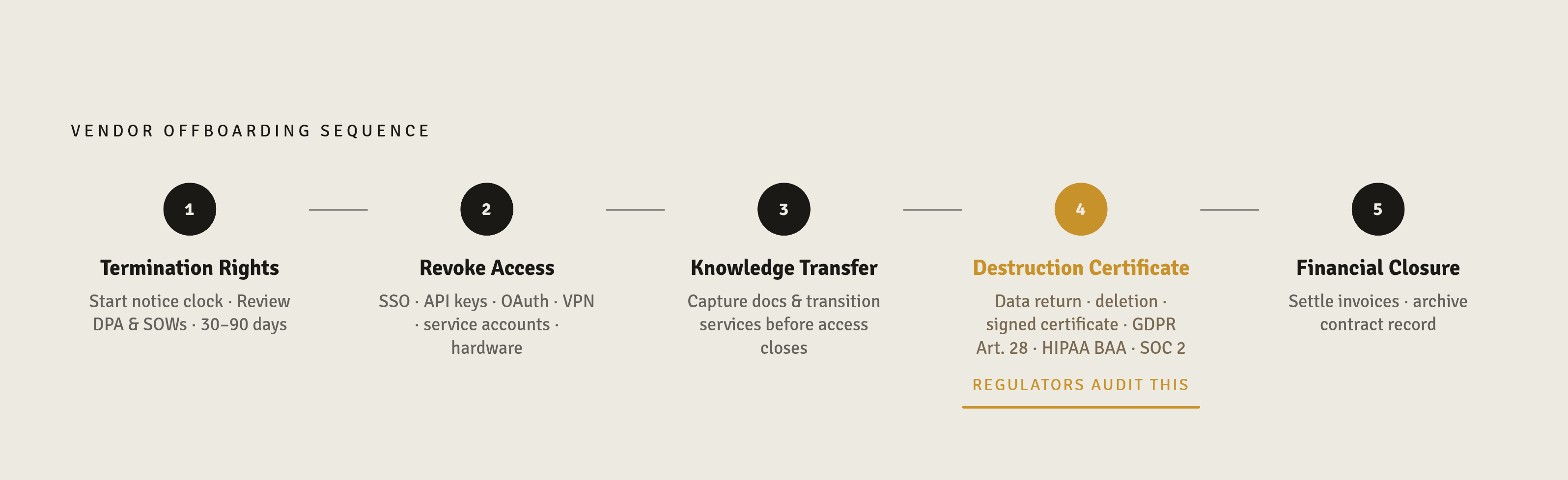
Regulators typically start with data disposition, expecting formal proof in the form of a written certificate that states how destruction was carried out, which data was included, and when it occurred. A simple email confirmation of deletion is not enough.
GDPR Article 28 obliges the processor, once services conclude, to erase or hand back every piece of personal data as the controller directs, a duty found in subparagraph (g) of Article 28(3), while Article 28(3)(h) separately requires supplying the information that demonstrates compliance. Nothing in it says outright that the processor must state which route it chose. With that confirmation secured in writing, the duty turns into proof an organization can present to an auditor.
Before any termination notice is sent, the organization must choose return or destruction, align that choice with its DPA requirements or BAA terms, and avoid leaving it for rushed later negotiation. When return is chosen, the organization should document the file format, delivery process, and schedule, acknowledge successful receipt, and require the vendor to eliminate all residual copies, including backups, supported by a certificate of destruction for the completed work. For direct destruction, the certificate must specify how it was done, which data groups were included, when destruction occurred, and who certifies it, and the contract should require that certificate from day one as a deliverable rather than leaving it to an informal end-of-relationship request.
The subprocessor issue comes back here in a form different from the one it takes during access revocation. The concern now is not that a fourth party keeps an active link; it is that this fourth party may still be holding the data. Unless it spells this out, the lead vendor's certificate of destruction leaves a subprocessor's holdings uncovered, so verifying that the fourth party destroyed its copy needs its own distinct step.
For SOC 2 evidence, keep the destruction certificate with the Step 2 access revocation records because auditors look for both items as one set of proof. Retain the certificate until claims tied to that processing are no longer reasonably possible, as GDPR’s accountability principle requires documentation without setting a specific retention term for it. If the signed agreement did not call for the certificate, the vendor is not later bound to provide it. Build the requirement into the agreement at signing rather than trying to add it when the relationship ends.
Step 5: Financial closure and contract record archiving
Money-related wrap-up is usually the part offboarding teams manage adequately, but it should never replace the remaining checklist items. Teams settle final invoices, address charges for ending the contract early, and close the vendor’s remaining purchase orders. Those tasks still leave data handback, deletion, and access removal unaddressed, and treating a finance approval as completion repeats the error that lets credentials and data copies remain active well after payment to the vendor has ended.
Archive all materials as one unified contract file, including when the termination notice was delivered, any ending-specific provisions alongside the executed BAA or DPA, each Step 2 access revocation entry, Step 3 knowledge-transfer documentation, and the Step 4 destruction or return certificate. Regulators, auditors, and later legal probes demand this dossier, so producing it completely shows the vendor data-handling arrangement concluded as frameworks mandate rather than merely matching how procurement wrapped up its paperwork.
Notes
- How to Build a Secure Vendor Offboarding Workflow
Provided best-practice steps for vendor offboarding workflows, including credential revocation, data return, and documentation requirements that align with the article's checklist structure.
- Managing Record Keeping, Data Erasure & Client Offboarding under GDPR
Informed the discussion of GDPR Article 28 obligations around data deletion, return, and the written confirmation that serves as auditor-facing proof.
- Why the Data Left Behind During Vendor Offboarding Is an Overlooked Risk for SMB Data Security Management
Supported the article's core argument that overlooked vendor offboarding leaves active credentials and data copies behind, creating lingering compliance and security risk.
- GDPR: Retention Obligations & Statutory Deletion Periods
Informed the section on GDPR data retention and deletion obligations, including the accountability principle's documentation requirements without a fixed retention term.
- Updating your vendor agreements to comply with GDPR
Provided detail on GDPR Article 28 processor obligations at contract termination, including the duty to delete or return personal data and supply compliance evidence.
- Vendor Offboarding Checklist
Contributed the structured checklist approach covering credential revocation, data disposition, financial closure, and contract archiving that the article follows.
- Vendor Contract Security Clauses: The Complete TPRM Guide 2026 - LearnTPRM
Informed the guidance on building data return and destruction certificate requirements into vendor contracts at signing rather than negotiating them at relationship end.
- Free vendor offboarding checklist for IT teams
Contributed detail on the types of credentials to revoke during IT-side vendor offboarding, including API keys, OAuth tokens, VPN credentials, and service accounts.